
[et_pb_section][et_pb_row][et_pb_column type=”4_4″][et_pb_text]
 When multiple people inherit or own property together, disagreements about what to do with that property can create serious tension. Perhaps one co-owner wants to sell while others refuse, or maybe family members can’t agree on how to manage an inherited home. A Partition Action Lawsuit: Process, Cost & Timeline Explained becomes essential knowledge when co-owners reach an impasse and need legal intervention to resolve property disputes.
Understanding the partition action lawsuit process empowers property co-owners to make informed decisions about their options. This comprehensive guide breaks down everything from filing procedures to final costs, providing helpful guidance for those navigating this challenging situation.
When multiple people inherit or own property together, disagreements about what to do with that property can create serious tension. Perhaps one co-owner wants to sell while others refuse, or maybe family members can’t agree on how to manage an inherited home. A Partition Action Lawsuit: Process, Cost & Timeline Explained becomes essential knowledge when co-owners reach an impasse and need legal intervention to resolve property disputes.
Understanding the partition action lawsuit process empowers property co-owners to make informed decisions about their options. This comprehensive guide breaks down everything from filing procedures to final costs, providing helpful guidance for those navigating this challenging situation.
Key Takeaways
- A partition action is a legal remedy that allows one co-owner to force the sale or division of jointly owned property when other owners refuse to cooperate
- The typical timeline ranges from 6 months to 2 years, depending on case complexity, court schedules, and whether co-owners contest the action
- Total costs generally range from $10,000 to $30,000+, including attorney fees, court costs, referee fees, and appraisal expenses
- Two primary outcomes exist: partition by sale (property sold and proceeds divided) or partition in kind (property physically divided among owners)
- Most cases settle without trial through negotiation or motion practice, making early legal consultation valuable for exploring alternatives
What Is a Partition Action Lawsuit?
A partition action is a civil lawsuit filed by one co-owner against other co-owners who refuse to sell or divide jointly owned property. This legal mechanism provides a solution when co-ownership becomes unworkable and owners cannot reach voluntary agreement.[1]
Legal Foundation and Rights
The right to partition exists as a fundamental property right in nearly all states. Co-owners hold this right regardless of how they acquired the property—whether through:
- Inheritance from parents or relatives
- Joint purchase with family members or business partners
- Divorce settlements where both parties retain ownership
- Investment partnerships that have dissolved
This legal remedy recognizes that no co-owner should be forced to remain in an unwanted ownership arrangement indefinitely. The courts view partition as an absolute right in most circumstances, making it a powerful tool for resolving property disputes.[3]
When Co-Ownership Becomes Problematic
Co-ownership works smoothly when all parties agree on property management, expenses, and eventual disposition. Problems arise when:
- One owner wants to sell but others refuse
- Disagreements exist about property maintenance or improvements
- Some owners pay expenses while others contribute nothing
- Family relationships deteriorate after inheritance
- Business partnerships end but property ownership continues
These situations create financial strain and emotional stress. The partition action provides a legal pathway forward when helpful solutions through negotiation fail.
When to File a Partition Action
Filing a partition action represents a significant legal step that should follow exhausted attempts at voluntary resolution. Understanding when this action becomes necessary helps co-owners make informed decisions.
Signs You May Need a Partition Action
Consider filing a partition action when: ✅ Negotiations have failed – Multiple attempts to reach agreement produce no results ✅ Financial burden exists – You’re paying property taxes, mortgage, or maintenance alone ✅ Communication has broken down – Co-owners refuse to discuss the property ✅ Relationships are damaged – Family disputes make cooperation impossible ✅ Property is deteriorating – Lack of agreement prevents necessary maintenance ✅ You need to move forward – Your financial planning requires resolving the ownership
Alternatives to Consider First
Before pursuing a partition action, explore these alternatives with expert service from real estate professionals: Buyout Agreements: One co-owner purchases the others’ shares at fair market value. This avoids court costs and preserves relationships when possible. Mediation: A neutral third party facilitates discussion and compromise. Many families find this helpful guidance leads to voluntary solutions. Professional Property Solutions: Companies like Sure Path Property Solutions specialize in helping co-owners navigate complicated situations involving multiple heirs, unclear title, or property disputes. Their trustworthy service coordinates with industry experts to find practical resolutions. Listing and Selling Together: Sometimes simply choosing a real estate agent and agreeing to sell traditionally resolves the impasse.
Who Can File a Partition Action
Any co-owner with a legally recognized ownership interest can file a partition action, including:
- Tenants in common (most common scenario)
- Joint tenants
- Heirs who inherited property together
- Former spouses who jointly own property
- Business partners with shared real estate holdings
The ownership percentage doesn’t matter—even a minority owner can initiate partition proceedings.[3]
Partition Action Process: Step-by-Step Legal Procedure
Understanding the Partition Action Lawsuit: Process, Cost & Timeline Explained requires breaking down each procedural step. This section provides a detailed roadmap of what to expect.
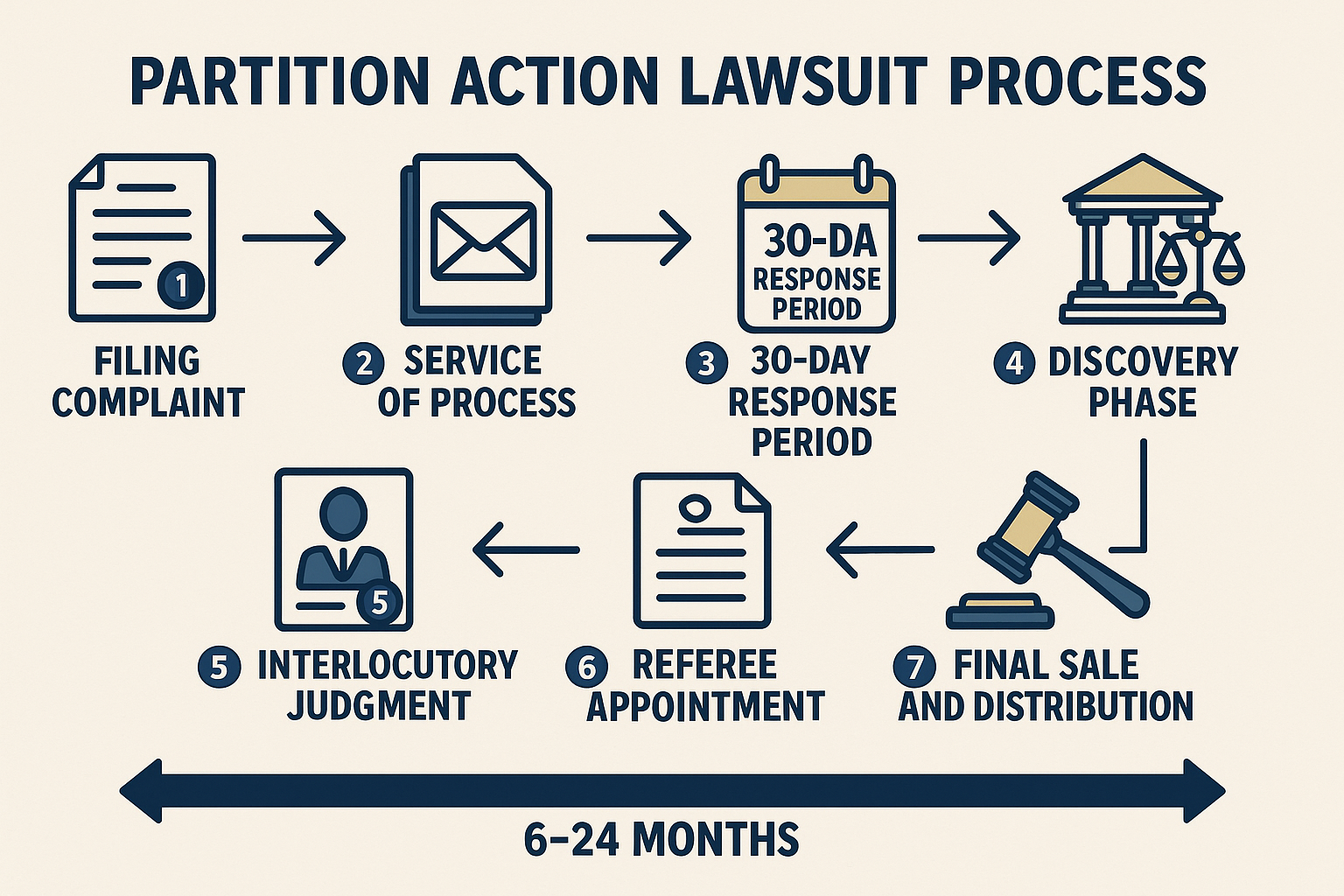
Step 1: Filing the Partition Complaint (2-4 Days)
The partition action officially begins when the plaintiff files a partition complaint in the Superior Court of the county where the property is located.[1][4] The complaint must include:
- Complete legal description of the property
- Names and ownership interests of all co-owners
- Basis for partition (inability to agree)
- Request for specific relief (sale or division)
- Supporting documentation (deed, title report)
: Filing typically takes 2 to 4 days, depending on whether additional documentation is necessary and court processing times.[1]
Step 2: Recording Lis Pendens (Concurrent with Filing)
Upon filing the complaint, a notice of pendency of action (lis pendens) is recorded with the County Recorder’s Office. This legal notice:
- Alerts potential buyers that litigation affects the property
- Prevents co-owners from selling or refinancing without court approval
- Protects the plaintiff’s interest during proceedings
- Appears in title searches and public records[6]
The lis pendens essentially freezes the property until the lawsuit resolves, ensuring all parties’ interests remain protected.
Step 3: Service of Process (Few Days to Several Weeks)
All co-owners named as defendants must be formally served with the complaint and summons. Service methods include: Personal Service: A process server delivers documents directly to defendants. This takes just a few days when whereabouts are known.[1] Substituted Service: Documents left with another adult at defendant’s residence or workplace, followed by mailed copy. Service by Publication: When defendants cannot be located, legal notices appear in newspapers. This process takes considerably longer but ensures due process. Proper service is critical—any defects can delay proceedings or invalidate the action.
Step 4: Defendant Response Period (30 Days)
Co-owners have exactly 30 days after being served to file a response. Response options include:[1] 📄 Answer to Complaint: Acknowledging the partition but potentially disputing terms 📄 Agreement to Partition: Consenting to the action and proposed method 📄 Disputes on Terms: Contesting ownership percentages or distribution 📄 Cross-Complaints: Requesting reimbursement for mortgage payments, property taxes, or improvements made
Important: If a co-owner fails to respond within 30 days, the court may issue a default partition judgment, allowing the partition to proceed without their input.[1]
Step 5: Discovery Phase (Variable Duration)
The discovery phase allows both sides to gather evidence through:
- Depositions (sworn testimony)
- Interrogatories (written questions)
- Document requests (financial records, receipts)
- Property appraisals
- Title examination
because the facts are straightforward—co-owners exist, they disagree, and partition is warranted.[1] However, discovery becomes important when disputes involve:
- Ownership percentage calculations
- Reimbursement claims for improvements
- Allegations of waste or mismanagement
- Questions about property value
Step 6: Interlocutory Judgment (As Little as 49 Days)
Once the court decides to proceed with partition, it issues an interlocutory judgment. This preliminary ruling: ✓ Confirms partition will occur ✓ Determines the method (sale or physical division) ✓ Establishes ownership percentages ✓ Appoints a partition referee to oversee the process With proper legal representation and simple cases, this judgment can be obtained in as little as 49 days after the defendant is served.[1] More complex cases take several months.
Step 7: Referee Appointment and Property Sale
The court appoints a partition referee—typically a real estate professional or attorney—to oversee the partition process. The referee’s responsibilities include:
- Conducting or obtaining property appraisal
- Marketing the property for sale (if partition by sale)
- Accepting and reviewing offers
- Reporting to the court on proceedings
- Recommending offer acceptance
- Coordinating closing and distribution
The referee acts as the court’s agent, ensuring the process proceeds fairly and efficiently. Their fees typically range from 1-3% of the property’s sale price.[7]
Step 8: Sale Completion and Distribution
Once a buyer is found and the sale closes:
- Proceeds are collected by the referee
- Costs are deducted (court fees, attorney fees, referee fees, liens, back taxes)
- Remaining funds are distributed to co-owners according to their ownership percentages
- Final accounting is filed with the court
Step 9: Final Judgment (2-4 Weeks After Distribution)
The final judgment is issued 2-4 weeks after proceeds are properly distributed. This judgment:
- Confirms the sale and distribution
- Dissolves the co-ownership
- Terminates the lis pendens
- Closes the legal case[1]
At this point, the partition action is complete, and former co-owners have no further legal relationship regarding the property.
Partition Action Process Timeline: Visual Flowchart
| Phase | Action | Typical Duration | Cumulative Time |
|---|---|---|---|
| 1 | File partition complaint | 2-4 days | 2-4 days |
| 2 | Record lis pendens | Concurrent | 2-4 days |
| 3 | Serve all defendants | Few days to 4 weeks | 1-5 weeks |
| 4 | Defendant response period | 30 days | 6-9 weeks |
| 5 | Discovery (if needed) | 0-6 months | 6 weeks – 9 months |
| 6 | Interlocutory judgment | 49 days – 6 months | 3-12 months |
| 7 | Referee appointment & sale | 3-12 months | 6-24 months |
| 8 | Distribution of proceeds | 2-4 weeks | 6.5-24.5 months |
| 9 | Final judgment | 2-4 weeks | 7-25 months |
: 6-9 months ⏱️ Average Cases: 12-18 months ⏱️ Complex Cases: 18-24+ months
Costs and Timeline: What to Expect Financially
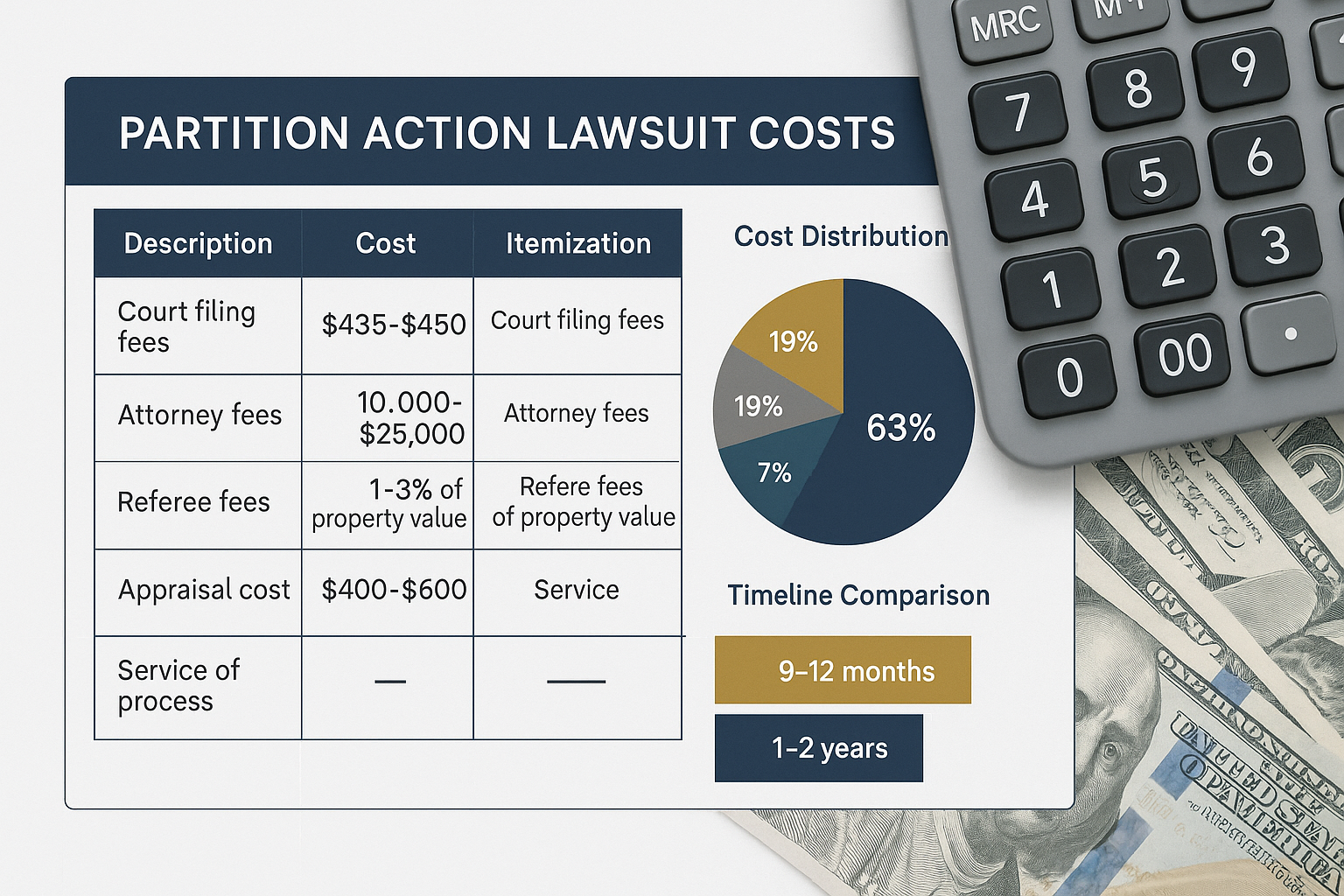
Understanding the Partition Action Lawsuit: Process, Cost & Timeline Explained requires honest discussion about expenses. Partition actions involve significant costs that ultimately reduce the proceeds each co-owner receives.
Comprehensive Cost Breakdown
| Expense Category | Typical Cost Range | Who Pays |
|---|---|---|
| Court filing fees | $435 – $450 | Initially plaintiff, ultimately shared |
| Attorney fees | $10,000 – $25,000+ | Initially plaintiff, ultimately shared |
| Partition referee fees | 1-3% of sale price | Deducted from proceeds |
| Property appraisal | $400 – $600 | Shared from proceeds |
| Service of process | $50 – $200 per defendant | Initially plaintiff, ultimately shared |
| Lis pendens recording | $75 – $150 | Initially plaintiff, ultimately shared |
| Title search/report | $300 – $500 | Shared from proceeds |
| Real estate commission | 5-6% of sale price | Deducted from proceeds |
| Property maintenance | Variable | Ongoing during case |
| Expert witnesses | $2,000 – $5,000+ (if needed) | Shared from proceeds |
💰 Total Estimated Costs: $10,000 – $30,000+ depending on complexity
How Costs Are Allocated
Generally, all costs are deducted from the sale proceeds before distribution to co-owners. This means everyone shares the financial burden proportionally, even defendants who opposed the action. However, courts may order different allocations when:
- One party acted in bad faith
- Unreasonable opposition delayed proceedings
- A co-owner caused waste or damage to the property
- Cross-complaints for reimbursement are granted
Factors That Increase Costs
Several factors can significantly increase partition action expenses: 🔴 Contested ownership percentages – Requires extensive documentation and possibly expert testimony 🔴 Multiple defendants in different locations – Service costs multiply 🔴 Defendants who cannot be located – Service by publication adds time and expense 🔴 Complex title issues – Liens, judgments, or unclear ownership require resolution 🔴 Reimbursement disputes – Claims for improvements or expenses require evidence and valuation 🔴 Property in poor condition – May require repairs before sale 🔴 Difficult real estate market – Extended marketing time increases holding costs
Timeline Variables: What Affects Duration
The Partition Action Lawsuit: Process, Cost & Timeline Explained varies considerably based on several factors:[5][7] ⚡ Fast Track (6-9 months):
- All co-owners easily located and served
- No contest to partition itself
- Simple ownership structure
- Property in good condition and marketable
- Strong real estate market
- Minimal discovery needed
- Cooperative referee process
:
- Some defendants difficult to locate
- Minor disputes about terms or percentages
- Average property condition
- Normal real estate market
- Moderate discovery requirements
- Standard court scheduling
:
- Multiple defendants across jurisdictions
- Contested ownership or reimbursement claims
- Complex title issues or liens
- Property requiring significant repairs
- Slow real estate market
- Extensive discovery
- Court backlog or scheduling delays
- Appeals or motions practice
Expert Insight: “With proper legal representation and simple cases, the partition action process can take as little as 6 months, but overall partition actions typically take one to two years depending on funding, court schedules, complexity, and discovery requirements.”[5][7]
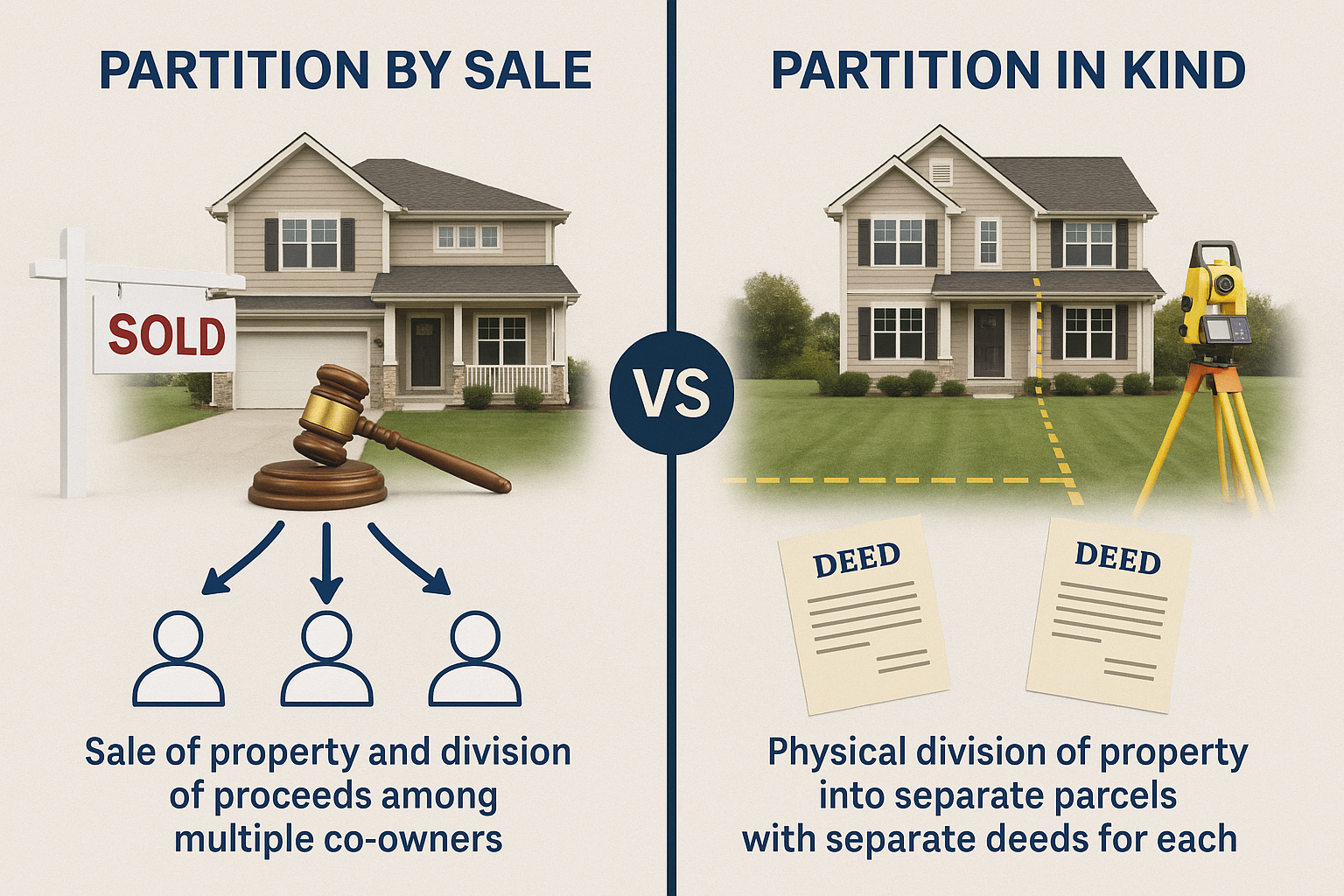
Partition by Sale vs. Partition in Kind
When the court grants partition, it must decide the method of partition. Understanding these two options is crucial to the Partition Action Lawsuit: Process, Cost & Timeline Explained.
Partition by Sale 🏡➡️💵
Partition by saleinvolves selling the entire property and dividing the proceeds among co-owners according to their ownership percentages. This is the most common outcome in partition actions.[1] When Courts Order Partition by Sale: ✓ Physical division is impractical or impossible ✓ Property is a single-family home or condominium ✓ Division would significantly reduce individual parcel values ✓ Property cannot be divided without violating zoning laws ✓ One or more co-owners prefer sale Advantages of Partition by Sale:
- Clean break from co-ownership
- Each owner receives liquid cash
- No ongoing disputes about property management
- Fair market value established through competitive sale
- Simpler than physical division
:
- Forced sale may occur during unfavorable market conditions
- Emotional attachment to family property lost
- Transaction costs reduce proceeds
- No one retains the property
Partition in Kind 📏➗🏡
Partition in kindinvolves physically dividing the property into separate parcels, with each co-owner receiving a portion. When Courts Order Partition in Kind: ✓ Property is large enough to divide (typically vacant land) ✓ Division won’t substantially diminish value ✓ Zoning allows separate parcels ✓ Access to public roads can be provided to all parcels ✓ Division can be accomplished equitably Advantages of Partition in Kind:
- Co-owners retain property ownership
- No forced sale in unfavorable market
- Preserves family land or investment
- Each owner controls their portion independently
:
- Surveying and legal costs
- Potential unequal value of divided parcels
- May create landlocked parcels requiring easements
- Ongoing neighbor relationships between former co-owners
- Rarely feasible for improved property (homes, buildings)
Court Preference and Determination
Historically, courts preferred partition in kind as it allowed co-owners to retain property interests. However, modern courts recognize that partition by sale often serves everyone’s interests better, particularly with residential properties.[3] The court considers:
- Property characteristics and location
- Feasibility of physical division
- Relative value impact of division
- Co-owners’ preferences
- Practical considerations
: Trial is extremely rare in partition actions because the elements required for an interlocutory judgment are so limited that most cases settle or are resolved through motion practice rather than litigation.[1][4]
Resolving Family Property Disputes: Alternatives and Strategies
While partition actions provide a legal solution, they also create family stress and significant expenses. Exploring alternatives with helpful guidance from industry experts often produces better outcomes.
Mediation: A Collaborative Approach
Mediationinvolves a neutral third party facilitating discussion between co-owners to reach voluntary agreement. This process offers: 🤝 Preserved relationships – Less adversarial than litigation 💰 Lower costs – Mediation fees far less than partition lawsuit ⏰ Faster resolution – Weeks instead of months or years 🎯 Creative solutions – Options beyond sale or division 🔒 Confidentiality – Private discussions, not public court records Successful mediation might result in:
- Buyout agreements with payment plans
- Temporary rental arrangements with future sale timeline
- One co-owner managing property with compensation
- Refinancing to cash out some owners
- Gradual transition plans
Working with Property Solutions Experts
Companies specializing in complex property situations provide helpful solutions for co-owners facing difficult circumstances. Sure Path Property Solutions, for example, helps owners navigate:
- Multiple heir situations where family members disagree
- Properties with back taxes that complicate sales
- Liens or judgments affecting clear title
- Unclear ownership requiring title work
- Properties difficult to sell through traditional means
Their friendly and caring approach coordinates with counties, title professionals, and legal experts to guide property owners toward clear, practical solutions. This expert service often resolves disputes without litigation.
Negotiation Strategies for Co-Owners
Before filing a partition action, try these negotiation approaches: 1. Get a Professional Appraisal Disagreements about property value often fuel disputes. An independent appraisal establishes fair market value and creates a foundation for buyout discussions. 2. Calculate Total Costs of Partition Show all co-owners the estimated costs ($10,000-$30,000+) that will reduce everyone’s proceeds. Sometimes seeing these numbers motivates voluntary agreement. 3. Propose Structured Buyouts If one owner wants to keep the property but lacks immediate funds, propose payment plans or seller financing to other co-owners. 4. Address Reimbursement Claims Early If some owners paid property taxes, mortgage, or made improvements, acknowledge these contributions and include reimbursement in settlement discussions. 5. Set Clear Deadlines Propose specific timelines: “If we can’t reach agreement by [date], we’ll need to pursue partition.” Deadlines create urgency and focus discussions. 6. Use Written Proposals Put offers in writing with specific terms. Written proposals feel more official and require considered responses.
When Partition Action Becomes Necessary
Despite best efforts, partition actions sometimes become the only viable path forward. File when:
- Repeated good-faith negotiation attempts fail
- Co-owners refuse to communicate
- Financial burden becomes unsustainable
- Property deterioration creates liability
- Your life circumstances require resolution
In these situations, partition provides a legal certainty that negotiations cannot guarantee. The court will resolve the dispute definitively, allowing everyone to move forward.
Legal Considerations and State Variations
Partition law exists in all states, but specific procedures and rules vary by jurisdiction. Understanding these variations is important for the Partition Action Lawsuit: Process, Cost & Timeline Explained.
State-Specific Partition Laws
While the basic partition framework remains consistent, states differ on: Statute of Limitations: Most states have no time limit for partition actions, but some impose restrictions in specific circumstances. Partition Preferences: Some states statutorily prefer partition in kind; others default to partition by sale for residential property. Referee Requirements: States vary on who can serve as partition referee and their compensation limits. Notice Requirements: Service procedures and publication requirements differ by jurisdiction. Accounting Rules: How courts handle reimbursement claims for taxes, improvements, and expenses varies. Ouster Claims: Some states allow co-owners to claim rent from others who exclusively occupied the property.
Special Situations Affecting Partition Rights
Certain circumstances complicate or limit partition rights: 🏠 Homestead Exemptions: Some states protect a primary residence from partition while a spouse or minor children reside there. ⚖️ Prenuptial or Co-ownership Agreements: Contracts may restrict partition rights or specify dispute resolution procedures. 🏛️ Historic Properties: Designated historic properties may face restrictions on division or sale. 🌾 Agricultural Land: Some states provide special protections for family farms or agricultural property. ⛪ Life Estates: When someone holds a life estate, partition may be delayed until that interest terminates.
The Role of Legal Representation
While partition actions follow relatively standard procedures, legal representation is highly recommended because: ✓ Attorneys understand local court rules and procedures ✓ Proper complaint drafting prevents dismissal ✓ Service requirements must be followed precisely ✓ Reimbursement claims require proper documentation ✓ Negotiation often achieves better results than litigation ✓ Appeals or complex motions may arise Many partition attorneys work on contingency or fee arrangements where costs are paid from sale proceeds, making representation accessible even when co-owners lack upfront funds.
Protecting Your Interests During Partition
Whether you initiated the partition action or are a defendant, protecting your interests requires strategic thinking and proper documentation.
For Plaintiffs (Those Filing Partition)
📋 Document Everything:
- Keep records of all property expenses you’ve paid
- Document communication attempts with co-owners
- Maintain receipts for improvements or repairs
- Photograph property condition
:
- Select counsel experienced in partition actions
- Discuss fee arrangements and cost estimates upfront
- Ensure clear communication about strategy and timeline
:
- Remain open to reasonable settlement offers
- Calculate net proceeds after all costs
- Evaluate whether settlement provides similar outcome with less expense and time
:
- Don’t delay filing if partition is necessary
- Property deterioration and unpaid taxes compound problems
- Market conditions may change during lengthy delays
For Defendants (Those Served with Partition)
⏰ Respond Within 30 Days:
- Missing the deadline results in default judgment
- Even if you agree with partition, file a response to protect reimbursement rights
- Consult an attorney immediately upon service
:
- File cross-complaints for any amounts you’re owed
- Document property taxes, mortgage payments, insurance, or maintenance you paid
- Provide evidence of improvements that increased property value
:
- Partition will likely proceed regardless of opposition
- Settlement negotiations may achieve better terms
- Consider buyout options if you want to retain the property
:
- Don’t rely solely on plaintiff’s valuation
- Independent appraisal protects against undervaluation
- Provides foundation for buyout negotiations
Common Mistakes to Avoid
❌ Ignoring the lawsuit – Default judgments eliminate your input ❌ Emotional decision-making – Focus on financial realities, not family dynamics ❌ Failing to document expenses – Undocumented claims are difficult to prove ❌ Refusing all settlement offers – Litigation costs reduce everyone’s proceeds ❌ Neglecting property maintenance – Deterioration reduces sale value ❌ Assuming you can block partition – Courts almost always grant partition to requesting co-owners ❌ Hiring inexperienced counsel – Partition requires specific expertise
Frequently Asked Questions About Partition Actions
Can a partition action be stopped?
Once filed, partition actions are difficult to stop because partition is considered an absolute right of co-owners in most circumstances.[3] However, partition can be halted through:
- Settlement agreement among all parties
- Buyout of the plaintiff’s interest
- Proving a valid agreement restricting partition exists
- Demonstrating the plaintiff lacks ownership interest
How long does a partition lawsuit take?
Simple cases: 6-9 months Average cases: 12-18 months Complex cases: 18-24+ months[5][7] Timeline depends on defendant location, property complexity, discovery needs, and court schedules.
Who pays for a partition action?
Initially, the plaintiff pays filing fees and attorney costs. However, these expenses are typically deducted from sale proceeds and shared among all co-owners proportionally. Courts may allocate costs differently if one party acted in bad faith.
Can I force my siblings to sell inherited property?
Yes. If you inherited property as tenants in common with siblings, you have the legal right to file a partition action forcing sale even if your siblings object. The court will order the property sold and proceeds divided according to ownership shares.
What happens if one owner paid all the property taxes?
Co-owners who paid more than their proportional share of property taxes, mortgage, insurance, or made improvements can file cross-complaints for reimbursement. The court will credit these amounts before distributing sale proceeds.
Is partition by sale or partition in kind more common?
Partition by saleis far more common, especially for residential properties. Physical division is typically only feasible for large vacant land parcels where division doesn’t substantially reduce value.
Conclusion: Moving Forward with Confidence
Understanding the Partition Action Lawsuit: Process, Cost & Timeline Explained empowers co-owners to make informed decisions about resolving property disputes. While partition actions involve significant time and expense, they provide legal certainty when co-ownership becomes unworkable.
Key Points to Remember
✅ Partition is a fundamental legal right available to co-owners ✅ The process typically takes 6 months to 2 years with costs ranging from $10,000 to $30,000+ ✅ Partition by sale is the most common outcome ✅ Settlement and mediation often provide better results than litigation ✅ Early legal consultation protects your interests and explores all options ✅ Documentation of expenses is crucial for reimbursement claims
Actionable Next Steps
If you’re facing a co-ownership dispute, take these steps: 1. Attempt Good-Faith Negotiation Before filing partition, make documented attempts to reach voluntary agreement. Propose specific solutions and set reasonable deadlines. 2. Consult Partition Attorneys Schedule consultations with attorneys experienced in partition actions. Discuss costs, timeline, and likelihood of success in your specific situation. 3. Explore Property Solutions Services Consider working with experts like Sure Path Property Solutions who provide trustworthy service navigating complex property situations. Their helpful guidance coordinates with legal and title professionals to find practical resolutions. 4. Get Professional Property Valuation Independent appraisal establishes fair market value and provides foundation for buyout discussions or partition proceedings. 5. Document All Expenses Maintain detailed records of property taxes, mortgage payments, insurance, maintenance, and improvements you’ve funded. 6. Consider Mediation Professional mediation often resolves disputes faster and cheaper than partition litigation while preserving family relationships. 7. Make Informed Decisions Evaluate whether partition, settlement, or buyout best serves your financial interests and life circumstances.
Finding the Right Path Forward
Co-ownership disputes create stress and financial burden, but solutions exist. Whether through negotiated settlement, professional property solutions, or partition action, you can resolve the situation and move forward. The partition action process provides legal certainty, ensuring that no co-owner remains trapped in an unwanted ownership arrangement indefinitely. While the process involves time and expense, it delivers definitive resolution when other approaches fail. For those navigating multiple heirs, back taxes, liens, or complex title issues, expert service from industry professionals provides helpful solutions. Companies like Sure Path Property Solutions offer friendly and caring guidance through complicated situations, coordinating with counties and title experts to clear obstacles and create practical paths forward. Remember: you don’t have to navigate this challenging situation alone. Legal counsel, property solution experts, and industry professionals stand ready to provide the helpful guidance needed to resolve co-ownership disputes and protect your interests. Whether you choose negotiation, mediation, professional property solutions, or partition action, understanding your rights and options empowers you to make the best decision for your unique circumstances. Take action today to begin resolving your property dispute and moving toward a clear, positive solution.
References
[1] Partition action process and timeline information – Legal procedures and court requirements for partition lawsuits [2] Co-ownership rights and partition law fundamentals – Property law principles governing joint ownership [3] Partition as absolute right of co-owners – Legal precedent establishing partition rights [4] Interlocutory judgment and partition complaint requirements – Court procedures and filing standards [5] Partition action timeline variations – Factors affecting case duration from filing to final judgment [6] Lis pendens recording requirements – Notice of pendency procedures and effects [7] Partition action costs and referee fees – Financial considerations and expense allocation in partition cases[/et_pb_text][/et_pb_column][/et_pb_row][/et_pb_section]
Sure Path is a family-owned, curative-title cash buyer. We handle the paperwork and pay what’s owed at closing — no fees, no repairs, no pressure.
See how we help with multiple-heir property sales →