
Can a Jointly Owned Property Be Sold by One Owner? Your Complete Guide

Imagine inheriting your childhood home alongside three siblings, only to discover that one sibling desperately needs to sell while the others want to keep it in the family. Or picture co-owning an investment property with a business partner who suddenly wants out, leaving you wondering about your rights and options. These scenarios happen every day across America, creating confusion, frustration, and sometimes family conflict.
The question “can a jointly owned property be sold by one owner” doesn’t have a simple yes-or-no answer. The reality depends on how the property deed was structured when ownership was established, state laws governing real estate, and the specific circumstances surrounding the sale. Understanding these nuances can mean the difference between a smooth transaction and years of costly legal battles.
This comprehensive guide explores every aspect of selling jointly owned property, from understanding different ownership structures to navigating partition actions and buyout agreements. Whether you’re dealing with inherited property, investment real estate, or a shared family home, you’ll find helpful solutions to move forward with confidence.
Key Takeaways
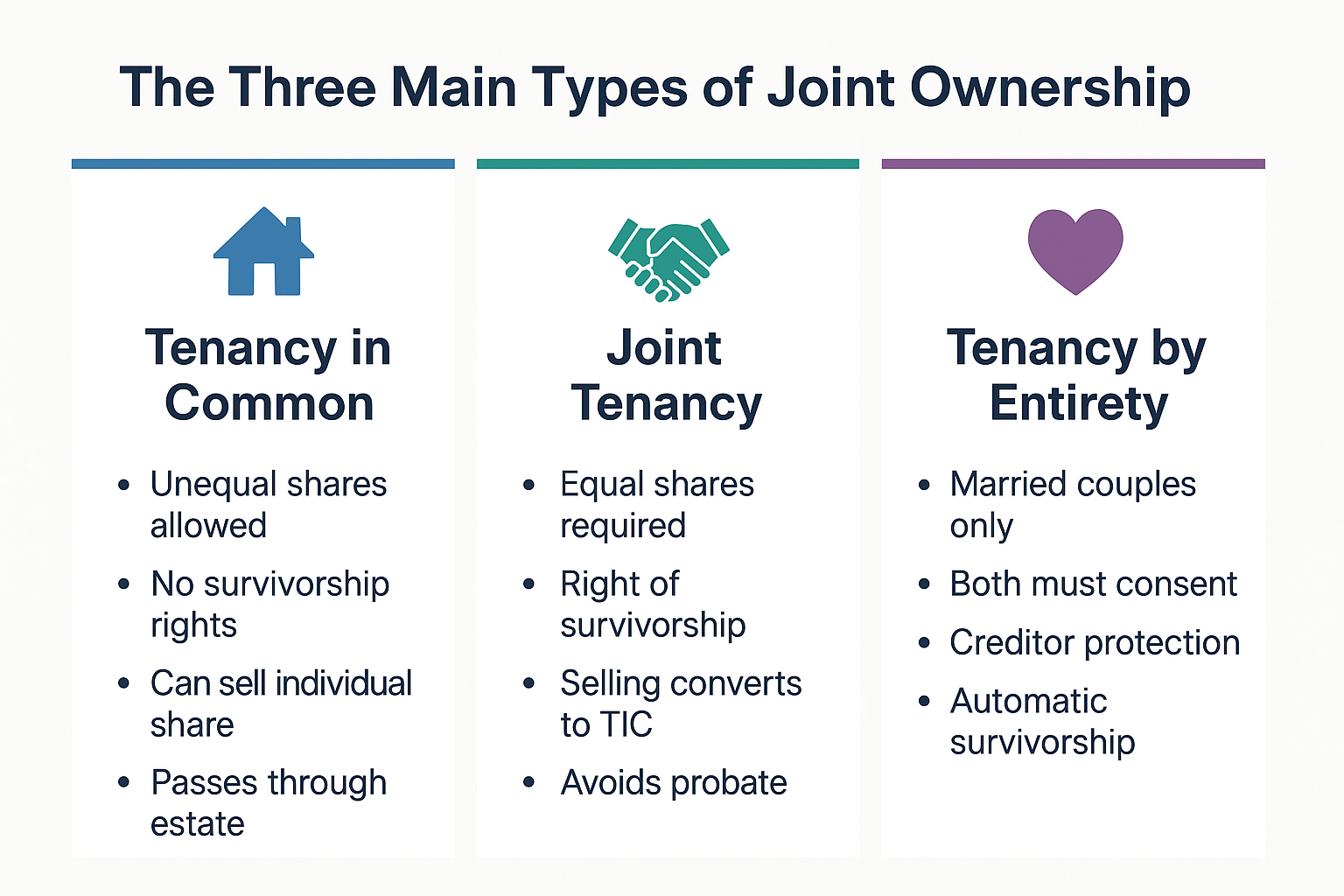
- Ownership type determines everything: The specific legal structure listed on your property deed—tenancy in common, joint tenancy, or tenancy by the entirety—dictates whether one owner can sell independently
- Individual shares can sometimes be sold: In tenancy in common arrangements, one owner can legally sell their portion without consent from co-owners, though finding buyers for partial interests proves extremely difficult
- Legal remedies exist for disputes: Partition actions allow co-owners to force a court-ordered sale or physical division when owners disagree about selling
- Buyout agreements offer the best path: Negotiating with co-owners to purchase the departing owner’s share typically costs less and preserves relationships better than litigation
- Professional guidance is essential: The complexity of jointly owned property requires consultation with real estate attorneys and industry experts who understand your specific situation
Understanding Joint Property Ownership: The Foundation
Before addressing whether one owner can sell, it’s crucial to understand what joint ownership actually means. Joint ownership occurs when two or more individuals hold title to the same property simultaneously. This arrangement commonly arises through inheritance, marriage, business partnerships, or investment purchases.
The ownership structure isn’t just a technicality—it’s the legal framework that governs every decision about the property, from who pays taxes to who can sell and under what conditions.
Why Ownership Structure Matters
Think of property ownership like a business partnership agreement. Just as business partners need clear terms about decision-making authority, property co-owners need defined rules about their rights and responsibilities. The ownership type serves as this rulebook, establishing:
- Whether owners hold equal or unequal shares
- What happens when an owner dies
- If one owner can sell without others’ permission
- How disputes get resolved
- Whether creditors can claim an individual owner’s share
Without understanding these fundamentals, co-owners often make costly assumptions that lead to conflict and legal complications.
The Three Main Types of Joint Ownership
The legal world recognizes three primary forms of joint property ownership, each with distinct characteristics that directly impact the answer to “can a jointly owned property be sold by one owner.”
Tenancy in Common: Maximum Individual Control
Tenancy in common represents the most flexible and common form of joint ownership. In this arrangement, each owner holds a separate, distinct share of the property that they control independently.
Key characteristics include:
- Owners can hold unequal shares (one person might own 60% while two others own 20% each)
- Each owner can sell, mortgage, or transfer their share without permission from other co-owners
- When an owner dies, their share passes through their estate to heirs, not automatically to surviving co-owners
- No right of survivorship exists between owners
- Creditors can place liens on individual shares to satisfy debts
Can one owner sell in a tenancy in common? ✅ Yes, but with significant limitations. An owner can legally sell their individual share without consent from other co-owners. However, this doesn’t give the buyer ownership of the entire property—only the seller’s fractional interest.
The practical challenge? Finding a buyer willing to purchase a partial interest in property they’ll co-own with strangers proves nearly impossible for residential properties. Investment companies sometimes purchase these shares at steep discounts, but this rarely represents the best financial outcome.
Joint Tenancy: Unity and Survivorship
Joint tenancy creates a unified ownership where all owners hold equal, undivided interests in the entire property. This structure includes the critical feature of “right of survivorship.”
Defining features:
- All owners must hold equal shares (three joint tenants each own one-third)
- Right of survivorship means when one owner dies, their share automatically transfers to surviving joint tenants
- All owners must acquire their interest at the same time through the same deed
- Each owner has equal rights to use the entire property, not just their portion
- The property avoids probate when an owner dies
Can one owner sell in a joint tenancy? ⚠️ Partially. A joint tenant can sell their share, but doing so automatically converts that portion to a tenancy in common. This breaks the joint tenancy for the sold share while remaining owners continue as joint tenants among themselves.
For example, if three siblings own property as joint tenants and one sells their share to an outsider, the buyer becomes a tenant in common holding one-third, while the two siblings remain joint tenants sharing the other two-thirds.
Tenancy by the Entirety: Married Couples Only
Tenancy by the entirety exists exclusively for legally married couples in certain states. This ownership form treats the married couple as a single legal entity.
Special protections include:
- Both spouses must consent to any sale, mortgage, or transfer
- Creditors of only one spouse cannot force a sale or place liens (except for joint debts or federal tax liens)
- Automatic right of survivorship to the surviving spouse
- Property avoids probate upon the first spouse’s death
- Divorce typically converts ownership to tenancy in common
Can one owner sell in a tenancy by the entirety? ❌ No. Neither spouse can sell the property without the other’s explicit consent, a court order, or proof of the other spouse’s death. This structure provides maximum protection against individual creditors and unilateral decisions.[1]
Can a Jointly Owned Property Be Sold by One Owner? The Detailed Answer
Now we arrive at the central question with the understanding that context determines everything.
When One Owner CAN Sell (Their Share)
In tenancy in common arrangements, one owner possesses the legal right to sell their individual share without obtaining permission from co-owners. This right exists because each tenant in common holds a separate, divisible interest in the property.
However, several critical realities limit this theoretical right:
🏠 Finding buyers proves extremely difficult: Most people won’t purchase a fractional interest in residential property where they’ll share ownership with strangers. Would you buy one-third of someone’s family home?
💰 Prices get heavily discounted: The few investors who purchase fractional interests typically offer 30-50% below market value for the share, knowing the complications involved.
⚖️ Relationships suffer damage: Selling your share to a third party without consulting co-owners often destroys family relationships and creates ongoing conflict.
📋 Title companies hesitate: Many title insurance companies won’t insure partial interest sales due to complexity and risk.
When One Owner CANNOT Sell Independently
In joint tenancy and tenancy by the entirety structures, one owner cannot sell the entire property without consent from all other owners. The unity of ownership prevents unilateral sales.
While a joint tenant can technically sell their share (converting it to tenancy in common), they cannot:
- Force the sale of the entire property
- Sell another owner’s interest
- Transfer the property without all owners signing the deed
- Mortgage the entire property alone
For tenancy by the entirety, even selling an individual share requires both spouses’ consent in most states.
The Practical Reality
Legal rights and practical outcomes often diverge significantly. Even when one owner legally can sell their share, the better question becomes: Should they?
The expert service approach involves exploring all options—buyouts, negotiations, mediation, and only pursuing partition actions as a last resort when co-owners cannot reach agreement.
Legal Options When Co-Owners Disagree About Selling
Disagreements between co-owners about whether to sell jointly owned property create some of the most challenging real estate situations. Fortunately, several legal remedies exist to resolve these disputes.
Partition Actions: The Legal Hammer
A partition action represents a lawsuit filed by one or more co-owners asking the court to either divide the property physically or order its sale with proceeds distributed according to ownership shares.
Two types of partition exist:
Partition in Kind (Physical Division)
- The court physically divides the property into separate parcels
- Each owner receives a portion corresponding to their ownership percentage
- Most practical for large land parcels that can be subdivided
- Rarely used for single-family homes or buildings
Partition by Sale (Forced Sale)
- The court orders the property sold at public auction or private sale
- Sale proceeds are distributed to owners based on their ownership shares
- Most common remedy when physical division isn’t feasible
- Can result in below-market sale prices
How Partition Actions Work
The partition process typically follows these stages:
- Filing: One or more co-owners file a partition lawsuit in the county where the property is located
- Notice: All co-owners receive formal legal notice of the action
- Response: Other owners can contest the partition or negotiate alternatives
- Accounting: The court determines each owner’s share and credits/debits for property expenses, improvements, or exclusive use
- Determination: The court decides whether partition in kind or partition by sale is appropriate
- Sale or Division: The court appoints a referee to oversee the physical division or sale
- Distribution: Proceeds are distributed according to the court’s accounting
Important considerations:
⏱️ Time-consuming: Partition actions typically take 6-18 months to complete
💵 Expensive: Legal fees, court costs, and referee fees often total $15,000-$50,000 or more
📉 Lower sale prices: Court-ordered sales frequently achieve below-market prices
👨⚖️ Right to partition: In most states, any co-owner has an absolute right to partition—courts cannot deny the request, only determine the method[2]
Buyout Agreements: The Better Alternative
Before resorting to partition litigation, co-owners should seriously explore buyout agreements where remaining owners purchase the departing owner’s share.
Advantages of buyouts include:
✅ Cost savings: Avoiding litigation saves tens of thousands in legal fees
✅ Fair market value: Negotiated sales typically achieve better prices than forced sales
✅ Relationship preservation: Cooperative negotiations maintain family and business relationships
✅ Control: Owners control the timeline and terms rather than court-imposed decisions
✅ Privacy: Private transactions avoid public court proceedings
The buyout process typically involves:
- Property appraisal: Hiring a professional appraiser to determine fair market value
- Share calculation: Determining the departing owner’s percentage and dollar amount
- Financing: Remaining owners secure financing if needed to purchase the share
- Agreement drafting: Creating a written purchase agreement with clear terms
- Title transfer: Recording a new deed transferring ownership to remaining owners
Mediation: Finding Middle Ground
Mediation offers a structured negotiation process where a neutral third-party mediator helps co-owners reach agreement without litigation.
Mediation benefits:
- Confidential discussions in a non-adversarial setting
- Flexible solutions tailored to specific family or business situations
- Cost-effective compared to litigation (typically $2,000-$5,000 total)
- Faster resolution (often completed in 1-3 sessions)
- Higher satisfaction rates as parties control the outcome
Mediation works particularly well for inherited properties where family relationships matter and creative solutions (like delayed sales, life estates, or installment buyouts) can address everyone’s concerns.
Selling Your Share to a Third Party: What to Expect
If buyouts and negotiations fail, some co-owners consider selling their individual share to a third-party buyer. Understanding this process and its limitations helps set realistic expectations.
The Fractional Interest Market
A small market exists for fractional property interests, primarily consisting of:
Investment companies that specialize in purchasing partial interests, then either:
- Negotiating buyouts with remaining owners at a profit
- Filing partition actions to force sales
- Holding the interest long-term for eventual appreciation
Individual investors looking for discounted real estate opportunities who understand the complexities
Family or friends of remaining co-owners who may purchase as a favor or investment
Realistic Pricing Expectations
Fractional interests typically sell at significant discounts from their proportionate share of full market value:
| Property Type | Typical Discount Range |
|---|---|
| Single-family residential | 40-60% below proportionate value |
| Multi-family residential | 30-50% below proportionate value |
| Commercial property | 30-45% below proportionate value |
| Vacant land | 25-40% below proportionate value |
Example: If a home worth $300,000 has three equal tenants in common, each one-third share represents $100,000 in proportionate value. However, that share might only sell for $50,000-$70,000 to a third-party investor.
The Sale Process for Fractional Interests
Selling a fractional interest involves unique challenges:
- Title examination: Buyers require thorough title review to confirm ownership type and percentage
- Limited financing: Most lenders won’t finance fractional interest purchases, requiring cash buyers
- Title insurance issues: Many title companies refuse to insure fractional interests
- Disclosure requirements: Sellers must disclose the co-ownership situation and any disputes
- Deed preparation: The deed must clearly convey only the seller’s specific interest
- Notification: While not legally required in most states, notifying co-owners maintains relationships
State-Specific Considerations and Legal Variations
Property law operates primarily at the state level, creating significant variations in rules governing jointly owned property. Understanding your state’s specific requirements proves essential.
Community Property States
Nine states follow community property rules for married couples: Arizona, California, Idaho, Louisiana, Nevada, New Mexico, Texas, Washington, and Wisconsin (with Alaska offering it as an option).
In these states:
- Property acquired during marriage is presumed community property owned equally by both spouses
- Both spouses must consent to sell community property
- Different rules may apply to separate property owned before marriage
- Death of one spouse gives the survivor automatic ownership of their half
Tenancy by the Entirety Availability
Only about 25 states recognize tenancy by the entirety, including:
Alaska, Arkansas, Delaware, Florida, Hawaii, Illinois, Indiana, Kentucky, Maryland, Massachusetts, Michigan, Mississippi, Missouri, New Jersey, New York, North Carolina, Ohio, Oklahoma, Oregon, Pennsylvania, Rhode Island, Tennessee, Vermont, Virginia, and Wyoming.
If your state doesn’t recognize this ownership form, married couples typically hold property as joint tenants or tenants in common.
Partition Action Variations
While the right to partition exists in all states, specific procedures vary:
Statute of limitations: Some states impose time limits on partition actions for certain property types
Preference for partition in kind: Several states require courts to prefer physical division over forced sale when feasible
Buyout opportunities: Many states mandate that co-owners receive the first opportunity to purchase at the appraised value before public sale
Accounting rules: States differ on how they credit owners for improvements, property taxes paid, or exclusive use
Homestead Protections
Many states provide homestead exemptions protecting a primary residence from creditors. These protections can affect:
- Whether a creditor can force partition to satisfy one owner’s debt
- The amount of equity protected from creditor claims
- Rights of surviving spouses after death
Special Situations: Inheritance, Divorce, and Business Partnerships
Certain circumstances create unique considerations for jointly owned property sales.
Inherited Property with Multiple Heirs
When parents die leaving property to multiple children, tenancy in common typically results unless the will specifies otherwise. This creates common challenges:
Emotional attachments vary among siblings—some want to preserve the family home while others need cash
Financial situations differ—one heir may afford to maintain the property while others cannot
Geographic distance complicates decision-making when heirs live in different states
Unequal contributions to maintenance and taxes create resentment
Solutions for inherited property:
🤝 Family meetings: Open communication about goals, needs, and concerns
📊 Professional appraisal: Objective valuation removes speculation about property worth
💰 Buyout with payment plans: Allowing purchasing heirs to pay over time rather than requiring lump sums
🏠 Life estates: Granting a surviving parent or sibling lifetime use rights with sale occurring after
⚖️ Mediation: Professional facilitators help families navigate emotional decisions
The helpful guidance approach recognizes that inherited property involves both financial and emotional dimensions requiring sensitivity and creative problem-solving.
Divorce and Marital Property
Divorce transforms joint ownership, typically requiring property division through:
Divorce decree terms: The court order may specify that property be sold, awarded to one spouse, or retained as joint ownership temporarily
Buyout by one spouse: One spouse purchases the other’s interest, often through refinancing
Deferred sale: Particularly when children are involved, courts may delay sale until children reach adulthood
Partition actions: If divorced spouses can’t agree and the decree doesn’t specify, partition becomes available
Important divorce considerations:
- Tenancy by the entirety automatically converts to tenancy in common upon divorce
- Mortgage obligations continue for both spouses until refinanced or property sold
- Tax implications of property transfers incident to divorce
- Timing of sale relative to two-year capital gains exclusion for primary residences
Business Partnership Property
Investment properties or commercial real estate held by business partners present distinct issues:
Partnership agreements may contain specific provisions about:
- Buyout formulas and valuation methods
- Right of first refusal for remaining partners
- Dispute resolution procedures
- Restrictions on selling to competitors
Operating agreements for LLCs often include detailed exit strategies
Buy-sell agreements pre-establish terms for partner departures
When partnership documents lack clear provisions, partners face the same options as other co-owners: negotiation, buyout, mediation, or partition.
Financial Considerations: Taxes, Liens, and Mortgages
The financial complexity of jointly owned property extends beyond simple ownership percentages.
Tax Implications of Selling Jointly Owned Property
Capital gains taxes apply when property sells for more than its tax basis:
- Each owner reports their proportionate share of gain or loss
- Holding period determines whether gains are short-term or long-term
- Primary residence exclusion allows up to $250,000 ($500,000 for married couples) of gain exclusion if the property was a primary residence for 2 of the past 5 years
- Inherited property receives a stepped-up basis to fair market value at date of death, often eliminating capital gains
Example: Three siblings inherit a home worth $300,000 (stepped-up basis). They sell it three years later for $360,000. Each sibling reports $20,000 in capital gain ($60,000 total gain ÷ 3 owners), taxed at long-term capital gains rates.
Dealing with Liens and Judgments
Liens against one co-owner complicate property sales:
In tenancy in common: A creditor can place a lien on one owner’s share and potentially force partition to satisfy the debt
In joint tenancy: Liens typically attach only to the debtor’s share, not the entire property
In tenancy by the entirety: Creditors of only one spouse generally cannot force sale or place liens (except for joint debts, federal tax liens, or in some states, mortgage liens)
Clearing title before sale requires:
- Identifying all liens through title search
- Negotiating lien releases or payoffs
- Allocating lien responsibility among co-owners
- Ensuring sufficient sale proceeds to satisfy liens
Properties with complex lien situations benefit from professional guidance to navigate title clearing and ensure clean transfers.
Mortgage Complications
When jointly owned property has a mortgage, additional challenges arise:
All owners on the mortgage remain liable regardless of who wants to sell
Lender consent may be required for certain ownership transfers
Due-on-sale clauses in mortgages can trigger full loan payoff requirements when ownership changes
Refinancing requirements apply when one owner buys out others
Assumption options allow a purchasing co-owner to assume the existing mortgage in some cases
Step-by-Step: How to Navigate Selling Jointly Owned Property
Whether you’re the owner who wants to sell or one who wants to keep the property, following a systematic approach increases the likelihood of a positive outcome.
Step 1: Review the Property Deed 📄
Obtain a copy of the recorded deed from the county recorder’s office and identify:
- Ownership type: Tenancy in common, joint tenancy, or tenancy by the entirety
- Ownership percentages: Equal or unequal shares
- All owners’ names: Ensuring accuracy and identifying all parties
- Legal description: Confirming the exact property boundaries
Step 2: Understand Your State’s Laws ⚖️
Research or consult with an attorney about:
- Specific rights under your ownership type in your state
- Partition action procedures and timelines
- Homestead protections that may apply
- Transfer tax implications
- Required disclosures for property sales
Step 3: Communicate with Co-Owners 💬
Before taking legal action:
- Initiate honest conversations about goals and concerns
- Listen actively to understand other owners’ perspectives
- Share financial information about property value, expenses, and potential sale proceeds
- Explore creative solutions that might address everyone’s needs
- Document discussions in writing to avoid future misunderstandings
Step 4: Obtain Professional Appraisal 🏡
Hire a licensed appraiser to determine:
- Fair market value of the entire property
- Comparable sales in the area supporting the valuation
- Condition factors affecting value
- Each owner’s proportionate share value
An objective appraisal removes speculation and provides a factual basis for negotiations.
Step 5: Explore Buyout Options 💰
If some owners want to keep the property:
- Calculate buyout amount based on appraisal and ownership percentage
- Investigate financing options for purchasing owners
- Structure payment terms including potential installment payments
- Draft purchase agreement with clear terms and timeline
- Plan for title transfer and deed recording
Step 6: Consider Mediation 🤝
If direct negotiations stall:
- Select a qualified mediator experienced in real estate disputes
- Prepare financial documentation and position statements
- Attend mediation sessions with open minds and willingness to compromise
- Explore creative solutions like delayed sales, life estates, or rental arrangements
- Formalize agreements in writing with attorney review
Step 7: Pursue Partition if Necessary ⚖️
As a last resort when all other options fail:
- Consult with a real estate attorney about partition procedures in your state
- File partition complaint in the appropriate court
- Prepare for costs including legal fees, court costs, and potential referee fees
- Participate in court proceedings including hearings and potential trial
- Cooperate with court-appointed referee managing the sale or division process
Step 8: Complete the Sale or Transfer 🔑
Whether through agreement or court order:
- Prepare property for sale including repairs and staging if selling to third parties
- Coordinate with title company to ensure clear title transfer
- Address all liens and encumbrances before closing
- Distribute proceeds according to ownership shares and any court accounting
- File appropriate tax documents including Form 1099-S for reportable transactions
Working with Professionals: Who You Need on Your Team
Successfully navigating jointly owned property sales requires expertise across multiple disciplines.
Real Estate Attorneys
A real estate attorney licensed in your state provides essential services:
- Reviewing property deeds and determining ownership type
- Explaining your rights and options under state law
- Drafting buyout agreements and purchase contracts
- Representing you in partition actions if necessary
- Ensuring proper title transfer and deed recording
- Advising on tax implications and legal strategies
When to hire: Consult an attorney before taking any legal action or signing agreements with co-owners.
Real Estate Appraisers
A licensed appraiser provides objective property valuation through:
- Physical inspection of the property
- Analysis of comparable sales in the area
- Adjustment for property condition and features
- Written appraisal report suitable for legal proceedings
- Expert testimony if partition litigation occurs
When to hire: Before negotiating buyouts or filing partition actions to establish fair market value.
Mediators
A professional mediator facilitates productive discussions by:
- Creating a neutral, structured environment for negotiations
- Helping parties identify underlying interests beyond positions
- Generating creative solutions that address multiple concerns
- Maintaining confidentiality and managing emotions
- Documenting agreements for attorney formalization
When to hire: When direct negotiations between co-owners reach an impasse but before filing litigation.
Real Estate Agents
An experienced real estate agent assists with:
- Marketing the property to maximize sale price
- Coordinating showings and open houses
- Negotiating with potential buyers
- Managing the transaction through closing
- Advising on market conditions and pricing strategies
When to hire: When co-owners agree to sell to a third party or when court orders a sale.
Title Companies and Escrow Agents
Title professionals ensure clean property transfers by:
- Conducting title searches to identify liens and encumbrances
- Providing title insurance protecting buyers and lenders
- Managing escrow accounts holding funds during transactions
- Coordinating document signing and recording
- Distributing proceeds according to settlement statements
When to hire: Essential for any property sale or ownership transfer.
Property Solutions Specialists
Companies specializing in complex property situations offer friendly and caring assistance with:
- Properties with multiple heirs or owners
- Title issues including liens and judgments
- Back taxes and tax sale situations
- Properties difficult to sell through traditional methods
- Coordination with counties and title professionals
When to hire: When traditional real estate channels can’t accommodate your situation’s complexity.
🏠 Joint Property Ownership Decision Tool
Answer a few questions to understand your options for selling jointly owned property
What type of ownership does your property deed specify?
Do all co-owners agree about selling the property?
What is your primary goal?
Are there any complicating factors?
Your Recommended Path Forward
Common Mistakes to Avoid When Dealing with Jointly Owned Property
Learning from others’ errors can save thousands of dollars and years of frustration. Here are the most common mistakes co-owners make:
❌ Assuming All Joint Ownership is the Same
The mistake: Believing that all jointly owned property operates under identical rules regardless of the deed language.
The reality: The specific ownership type—tenancy in common, joint tenancy, or tenancy by the entirety—creates fundamentally different rights and restrictions.
The solution: Always review the actual recorded deed before making assumptions about your rights.
❌ Selling Without Consulting Co-Owners
The mistake: One owner proceeding to sell their share to a third party without informing other co-owners.
The reality: While legally permissible in tenancy in common, this approach destroys relationships, creates ongoing conflict, and often results in lower sale prices.
The solution: Communicate openly with co-owners first, exploring buyouts and negotiated solutions before considering third-party sales.
❌ Ignoring Tax Implications
The mistake: Failing to consider capital gains taxes, inheritance tax issues, or the impact of sale timing on tax liability.
The reality: Poorly timed sales or failure to utilize available exclusions can result in unnecessary tax bills totaling tens of thousands of dollars.
The solution: Consult with a tax professional or CPA before finalizing any sale to understand and minimize tax consequences.
❌ Making Unilateral Improvements
The mistake: One co-owner investing significant money in property improvements without agreement from other owners, then expecting reimbursement.
The reality: Courts don’t automatically credit owners for voluntary improvements, and co-owners aren’t obligated to reimburse without prior agreement.
The solution: Get written agreements from all co-owners before making substantial improvements, documenting cost-sharing and reimbursement terms.
❌ Avoiding Difficult Conversations
The mistake: Letting disagreements fester for years without addressing them, hoping the situation resolves itself.
The reality: Unresolved disputes typically worsen over time as property taxes accumulate, maintenance issues develop, and relationships deteriorate further.
The solution: Address conflicts promptly through direct communication, mediation, or legal action rather than indefinite avoidance.
❌ Failing to Document Agreements
The mistake: Making verbal agreements with co-owners about property management, expense sharing, or future sale plans without written documentation.
The reality: Verbal agreements are difficult to enforce and easily disputed, especially as time passes or circumstances change.
The solution: Document all agreements in writing with signatures from all parties, preferably reviewed by an attorney.
Frequently Asked Questions About Selling Jointly Owned Property
Can I force the sale of jointly owned property?
Yes, through a partition action—a lawsuit asking the court to order the property’s sale or physical division. Any co-owner has the right to file for partition in most states, and courts cannot deny the request, only determine whether partition in kind (physical division) or partition by sale is appropriate. However, partition actions are expensive (typically $15,000-$50,000+) and time-consuming (6-18 months), making them a last resort after negotiation and mediation fail.
What happens if one owner dies in a joint tenancy?
In joint tenancy with right of survivorship, the deceased owner’s share automatically transfers to the surviving joint tenant(s) without going through probate. The property continues as joint tenancy among surviving owners. This automatic transfer cannot be prevented by the deceased owner’s will—the joint tenancy structure supersedes testamentary instructions.
Can I sell my share of inherited property?
Yes, if you hold the property as a tenant in common (the typical result when multiple heirs inherit). You can legally sell your individual share without permission from other heirs. However, finding buyers for fractional residential property interests is extremely difficult, and offers typically come at 40-60% discounts from proportionate value. Negotiating a buyout with other heirs usually produces better financial results.
How long does a partition action take?
Partition actions typically require 6-18 months from filing to final sale or division, though complex cases with multiple owners, accounting disputes, or appeals can extend to 2-3 years. The timeline includes filing, service of process, responses, discovery, potential settlement negotiations, hearings, referee appointment, property marketing (if partition by sale), and final distribution of proceeds.
Do all owners need to sign the deed when selling?
Yes, when selling the entire property to a third party, all owners must sign the deed regardless of ownership type. No single owner can transfer another owner’s interest without their consent (except through court-ordered partition). When selling only an individual share in tenancy in common, only the selling owner signs the deed transferring their specific interest.
What if my co-owner won’t communicate about selling?
When co-owners refuse to communicate, your options include:
- Certified letter: Send a formal written proposal via certified mail documenting your attempt to negotiate
- Mediation: Hire a mediator who can facilitate structured discussions
- Attorney letter: Have your attorney send a formal communication outlining options and potential partition action
- Partition lawsuit: File legal action forcing resolution through the court system
Document all communication attempts, as courts favor parties who demonstrate good-faith efforts to resolve disputes before litigation.
Can a creditor force the sale of jointly owned property?
It depends on the ownership type and debt:
- Tenancy in common: A creditor can typically place a lien on the debtor’s individual share and potentially force partition to satisfy the debt
- Joint tenancy: Liens generally attach only to the debtor’s share, not the entire property
- Tenancy by the entirety: Creditors of only one spouse usually cannot force sale or place liens (except for joint debts or federal tax liens)
State laws vary significantly on creditor rights against jointly owned property, requiring consultation with a local attorney.
Is mediation required before filing a partition action?
Most states don’t legally require mediation before filing partition lawsuits, though some courts may order mediation after the case is filed. However, attempting mediation voluntarily before litigation demonstrates good faith, often resolves disputes more cost-effectively, and preserves relationships better than adversarial court proceedings. Many attorneys recommend mediation as a practical step even when not legally mandated.
Real-World Scenarios: How Others Navigated Joint Ownership Sales
Learning from actual situations helps illustrate how the legal principles apply in practice.
Scenario 1: Three Siblings and an Inherited Home 🏡
Situation: Maria, James, and Susan inherited their parents’ home as tenants in common with equal one-third shares. Maria lived across the country and needed cash for medical bills. James wanted to keep the family home. Susan remained neutral but couldn’t afford to buy Maria’s share alone.
Resolution: After initial disagreement, they hired a mediator who helped them reach a creative solution. James and Susan agreed to purchase Maria’s one-third share through an installment payment plan over three years, with the first payment coming from a home equity line of credit. Maria received $85,000 for her share (based on a $255,000 appraisal), paid in monthly installments with 4% interest. James and Susan now own the home as equal tenants in common.
Cost: $3,500 for mediation and legal fees to document the agreement—far less than the estimated $25,000+ partition action would have cost.
Lesson: Creative financing solutions and professional mediation can resolve disputes that initially seem impossible.
Scenario 2: Business Partners and Commercial Property 🏢
Situation: Two business partners owned a commercial building as joint tenants. When their business relationship soured, one partner wanted to sell while the other wanted to keep the property as a long-term investment.
Resolution: They obtained a professional appraisal valuing the property at $680,000. The partner wanting to keep the property secured commercial financing to purchase the other partner’s 50% share for $340,000. The transaction converted the property to sole ownership, and both partners moved on to separate business ventures.
Cost: $2,500 for appraisal, $8,000 in legal fees, and standard loan costs for the purchasing partner.
Lesson: When one party has the financial capacity and desire to keep the property, buyouts provide clean exits for both parties.
Scenario 3: Divorced Couple and the Family Home 💔
Situation: After divorce, a couple held their former marital home as tenants in common (converted from tenancy by the entirety). The ex-wife lived in the home with their children, while the ex-husband wanted his equity out. The divorce decree required them to sell when their youngest child graduated high school in three years, but the ex-husband needed money sooner.
Resolution: They agreed the ex-wife would refinance the home in her name alone, buying out the ex-husband’s share at the current appraised value of $175,000 (50% of $350,000). She secured a new mortgage, paid off the existing joint mortgage, and paid him his share. This gave her sole ownership and him immediate liquidity.
Cost: Standard refinancing costs plus $1,500 in legal fees to modify their divorce agreement and transfer the deed.
Lesson: Life circumstances change, and property agreements may need modification. Refinancing buyouts work well when one party has sufficient income and credit.
Scenario 4: Multiple Heirs and Complicated Title 📜
Situation: Five cousins inherited a property from their grandmother, but title research revealed unclear ownership due to missing probate from a previous generation. The property also had $12,000 in back taxes and a contractor’s lien for $8,000. Traditional real estate agents refused to list it.
Resolution: The family worked with property solutions specialists who coordinated with the county on the tax issue, negotiated lien releases, and cleared the title through proper legal channels. Once title was clear, they sold the property for $195,000, with proceeds distributed among the five heirs after paying back taxes, liens, and service fees.
Cost: Title clearing, back taxes, lien settlements, and professional fees totaled approximately $35,000, leaving $160,000 to distribute ($32,000 per heir).
Lesson: Complex title situations require specialized expertise but can be resolved with proper professional guidance and coordination.
When to Seek Professional Help: Red Flags and Warning Signs
Certain situations signal that professional assistance isn’t just helpful—it’s essential.
🚩 You should consult professionals immediately if:
Title Complications
- Multiple generations of inheritance without proper probate
- Missing heirs or unknown co-owners
- Conflicting deeds or boundary disputes
- Easements or restrictions affecting property use
Financial Issues
- Back taxes exceeding $5,000 or spanning multiple years
- Multiple liens from different creditors
- Foreclosure proceedings initiated
- Bankruptcy by one or more co-owners
Legal Disputes
- Co-owners threatening litigation
- Disagreement about ownership percentages
- Claims of adverse possession or prescriptive easements
- Allegations of fraud or undue influence in property acquisition
Communication Breakdown
- Co-owners refusing to respond to contact attempts
- Hostile or threatening communications
- Complete inability to reach consensus
- Family relationships severely damaged
Complex Ownership Structures
- More than four co-owners
- Mix of ownership types (some tenants in common, some joint tenants)
- Corporate or LLC ownership combined with individual ownership
- Trust ownership requiring trustee coordination
Time Sensitivity
- Impending tax sale or foreclosure
- Health crisis requiring immediate funds
- Deadline in divorce decree or court order
- Property deteriorating rapidly
In these situations, attempting to navigate alone often worsens problems and increases eventual costs. Trustworthy service from experienced professionals can prevent costly mistakes and find solutions that protect your interests.
The Emotional Side: Managing Relationships During Property Disputes
While legal and financial considerations dominate discussions of jointly owned property, the emotional dimension often determines whether situations resolve smoothly or devolve into bitter conflicts.
Family Dynamics and Inherited Property
Inherited property carries emotional weight beyond its financial value. The family home represents memories, childhood experiences, and connection to deceased parents or relatives. These emotional attachments create challenges when practical decisions must be made.
Common emotional triggers include:
😢 Grief: Selling feels like losing the parent a second time
😠 Resentment: Siblings who contributed more to parents’ care feel entitled to larger shares
😰 Guilt: Wanting to sell feels like betraying family legacy
😤 Fairness: Perception that one sibling benefits more than others
Strategies for managing emotions:
- Acknowledge feelings: Recognize that emotional responses are valid and normal
- Separate sentiment from finance: Distinguish between emotional value and financial value
- Create memory preservation: Take photos, videos, or items before selling to maintain connections
- Use neutral facilitators: Mediators help depersonalize discussions and focus on practical solutions
- Set clear timelines: Indefinite delays often worsen anxiety and conflict
- Consider compromises: Delayed sales, life estates, or first right of refusal can address multiple concerns
Business Partnership Property
When business relationships end, property co-ownership can become contentious. Former partners may harbor resentment about business failures, financial losses, or perceived betrayals.
Protective approaches include:
- Focus on business interests: Frame discussions around financial outcomes rather than personal grievances
- Use attorneys as buffers: Let legal representatives handle contentious communications
- Document everything: Written records prevent disputes about agreements or statements
- Set firm deadlines: Establish clear timelines for decisions to prevent indefinite conflict
- Consider binding arbitration: Pre-agreed arbitration clauses can resolve disputes faster than litigation
Maintaining Relationships Through Difficult Decisions
Even when disagreements exist, preserving family or business relationships often matters more than maximizing financial outcomes.
Relationship-preserving strategies:
🤝 Prioritize communication: Regular, honest discussions prevent misunderstandings
💬 Listen actively: Understand others’ concerns and constraints before advocating your position
🎯 Seek win-win solutions: Creative approaches often address multiple parties’ needs
⏰ Be patient: Rushing decisions increases resistance and conflict
🙏 Show respect: Acknowledge others’ perspectives even when disagreeing
📝 Use written agreements: Documentation prevents future disputes about verbal understandings
Remember that property can be replaced, but relationships cannot. When possible, choose solutions that preserve family harmony over those that maximize short-term financial gain.
Looking Ahead: Preventing Future Joint Ownership Disputes
For those acquiring property with others or creating estate plans, thoughtful planning prevents the disputes discussed throughout this guide.
Best Practices When Purchasing Property with Others
Before buying jointly owned property:
📋 Create a co-ownership agreement addressing:
- Each owner’s percentage share
- Contribution requirements for mortgage, taxes, insurance, and maintenance
- Decision-making procedures for major property decisions
- Buyout formulas if one owner wants to exit
- Dispute resolution mechanisms (mediation, arbitration)
- Right of first refusal if one owner wants to sell
🏦 Choose ownership type deliberately based on:
- Relationship between co-owners (married, family, business partners)
- Estate planning goals
- Asset protection needs
- Tax considerations
💰 Establish financial systems including:
- Joint account for property expenses
- Regular contribution schedules
- Accounting for unequal contributions
- Reserve fund for major repairs
Estate Planning to Avoid Heir Conflicts
Parents leaving property to multiple children should:
🎯 Consider alternatives to joint inheritance:
- Sell property during lifetime and distribute cash
- Leave property to one child with cash equalization to others
- Create a trust with clear management and distribution terms
- Include specific instructions about property disposition
📝 If leaving property to multiple heirs, include:
- Clear instructions about whether to sell or keep
- Timeframe for making sale decisions
- Tie-breaking mechanisms if heirs disagree
- Professional trustee or executor with authority to force sale if needed
💬 Communicate plans while alive:
- Discuss property disposition intentions with all heirs
- Explain reasoning behind decisions
- Address concerns and adjust plans if appropriate
- Document wishes in writing beyond just the will
Regular Review and Adjustment
Co-ownership situations should be reviewed:
- Annually: Check that all owners remain satisfied with arrangements
- After major life events: Marriage, divorce, births, deaths, job changes
- When circumstances change: Financial hardship, relocation, health issues
- Every 3-5 years: Update co-ownership agreements to reflect current wishes
Proactive planning and regular communication prevent most joint ownership disputes before they develop.
Conclusion: Your Path Forward with Jointly Owned Property
The question “can a jointly owned property be sold by one owner” reveals itself to be more nuanced than a simple yes or no. The answer depends on your specific ownership structure, state laws, co-owner relationships, and the practical realities of the real estate market.
The key insights to remember:
✅ Ownership type is everything: Your property deed determines your legal rights—tenancy in common offers the most individual control, while tenancy by the entirety requires spousal consent for any sale
✅ Legal rights differ from practical options: Even when you can legally sell your share, finding buyers and achieving fair prices proves extremely difficult for residential properties
✅ Communication comes first: Most successful resolutions involve negotiation, buyouts, and compromise rather than litigation
✅ Professional guidance protects your interests: Real estate attorneys, mediators, appraisers, and property specialists provide expertise that saves money and prevents costly mistakes
✅ Multiple solutions exist: From buyout agreements to partition actions, you have options for resolving disputes and moving forward
Your immediate action steps:
- Obtain and review your property deed to confirm ownership type and percentages
- Research your state’s specific laws governing your ownership structure
- Initiate conversations with co-owners about goals, concerns, and potential solutions
- Consult with qualified professionals including real estate attorneys and appraisers
- Explore negotiated solutions before considering litigation
- Document all agreements in writing with proper legal review
Whether you’re dealing with inherited property, a business partnership dissolution, or a divorce situation, remember that solutions exist. The path forward may require patience, compromise, and professional assistance, but jointly owned property disputes can be resolved.
For situations involving complex title issues, multiple owners, liens, back taxes, or properties difficult to sell through traditional channels, specialized helpful solutions can guide you through the process with expert service and caring support.
Your jointly owned property situation is unique, but you’re not alone in facing these challenges. Thousands of property owners successfully navigate these issues every year by understanding their rights, exploring all options, and seeking appropriate professional guidance.
Take the first step today by reviewing your deed and understanding your specific ownership structure. From there, the path forward becomes clearer, and solutions emerge that protect your interests while preserving important relationships.
References
[1] Cornell Law School Legal Information Institute. “Tenancy by the Entirety.” Retrieved from https://www.law.cornell.edu/wex/tenancy_by_the_entirety
[2] American Bar Association. “Partition Actions: Forcing the Sale of Co-Owned Property.” Real Property, Trust and Estate Law Section, 2024.