
How to Force Sale Jointly Owned Property: Your Legal Rights

Imagine owning a property with someone who refuses to sell, while you desperately need to access your share of the equity. Maybe it’s an inherited family home with siblings who can’t agree on next steps. Perhaps it’s a business partnership gone sour, or an ex-spouse blocking your financial future. Whatever the situation, being stuck in joint ownership with an uncooperative co-owner can feel like being trapped in financial quicksand.
Understanding how to force sale jointly owned property: your legal rights is essential when voluntary negotiations fail. The good news? The law provides helpful solutions that protect your ownership rights and give you a path forward, even when other owners disagree. This comprehensive guide will walk you through the legal mechanisms available, the partition action process, your rights as a co-owner, and the practical steps to take when you need to force a sale.
Key Takeaways
- Partition actions are legal proceedings that allow any co-owner to force the sale or division of jointly owned property when agreement cannot be reached
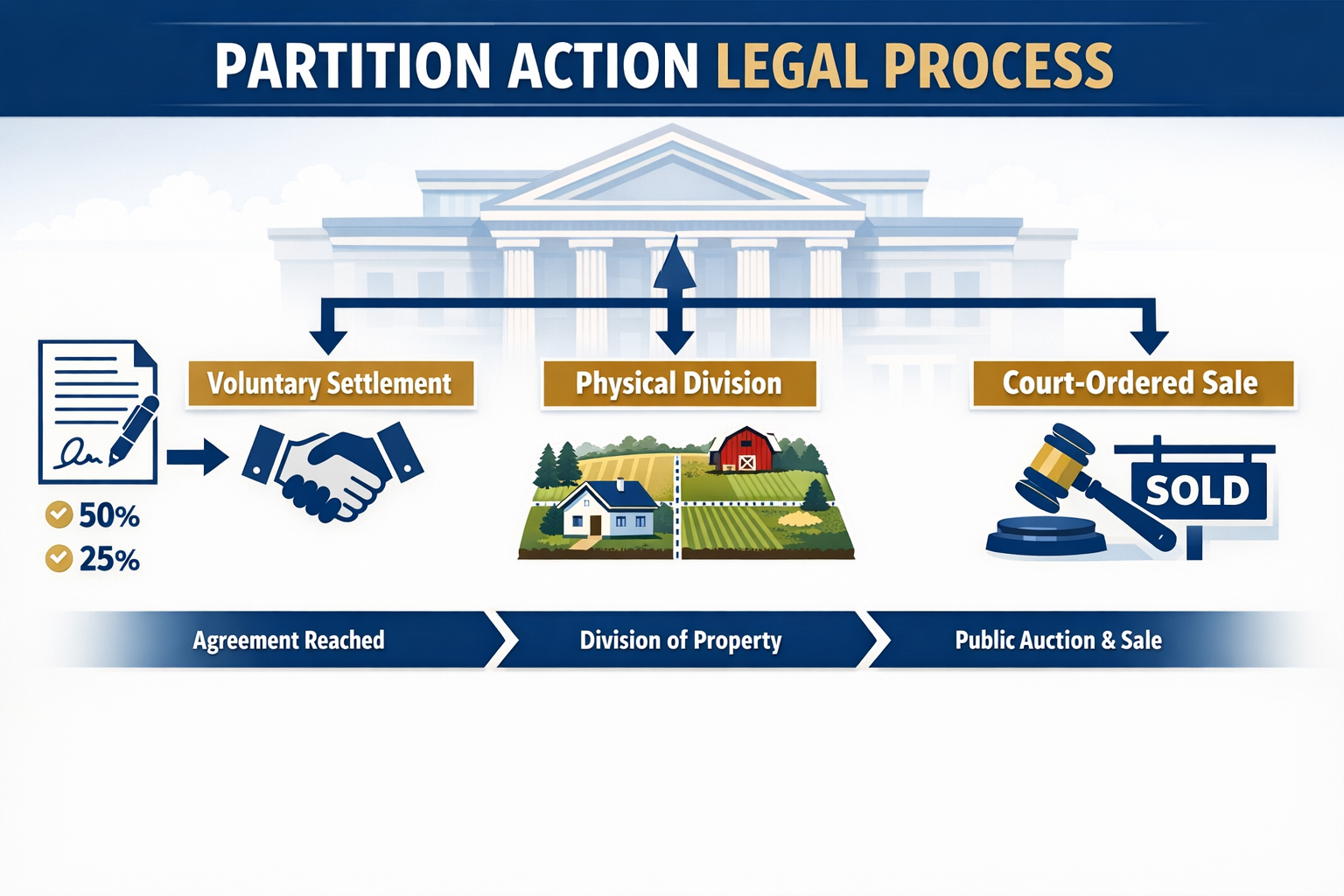
- Two main types of partition exist: partition in kind (physical division of property) and partition by sale (court-ordered sale with proceeds divided)
- All co-owners have the right to petition for partition in most jurisdictions, regardless of ownership percentage or other owners’ wishes
- The process typically takes 6-12 months and involves filing a lawsuit, property appraisal, court hearings, and potentially a public auction
- Alternative solutions like buyouts, mediation, or working with expert service providers can often resolve disputes faster and more affordably than litigation
Understanding Joint Property Ownership Types
Before exploring how to force sale jointly owned property: your legal rights, it’s crucial to understand the different types of co-ownership. The type of ownership structure directly impacts your rights and the legal process required.
Tenancy in Common
Tenancy in common is the most flexible form of co-ownership. Each owner holds a distinct, divisible share of the property—these shares don’t need to be equal. One person might own 60% while another owns 40%.
Key characteristics include:
- Individual shares that can be sold, transferred, or inherited independently
- No right of survivorship—when an owner dies, their share passes to their heirs, not other co-owners
- Equal rights to possess the entire property, regardless of ownership percentage
- Most common form of ownership for investment properties and inherited real estate
Joint Tenancy
Joint tenancy creates unified ownership where all owners hold equal, undivided interests in the property.
Distinguishing features:
- Right of survivorship—when one owner dies, their interest automatically transfers to surviving co-owners
- Equal ownership shares required (each person must own the same percentage)
- Four unities required: time, title, interest, and possession
- Can be severed by one owner selling their interest, converting it to tenancy in common
- Popular for married couples and family estate planning
Tenancy by the Entirety
Available only to married couples in certain states, tenancy by the entirety offers the strongest protection against individual creditors.
Characteristics include:
- Both spouses own 100% of the property as a unified legal entity
- Right of survivorship automatically transfers full ownership to surviving spouse
- Creditor protection—individual creditors cannot place liens against the property
- Cannot be severed unilaterally—both spouses must agree to changes
- Limited availability in roughly half of U.S. states
Understanding your ownership type is the foundation for knowing your legal rights. If you’re dealing with inherited property with multiple owners, the ownership structure significantly affects your options.
What Is a Partition Action?
A partition action is a legal proceeding that allows co-owners to divide or sell jointly owned property when they cannot reach a voluntary agreement. Think of it as the legal “escape hatch” that prevents any single owner from holding others hostage in an unwanted ownership arrangement.
The Legal Foundation
Partition rights are rooted in centuries-old property law principles. The fundamental concept is simple: no person should be forced to remain in co-ownership against their will. This right is considered so fundamental that it’s nearly impossible to waive permanently.
Most jurisdictions recognize partition as an absolute right for tenants in common and joint tenants. Courts view forced co-ownership as contrary to public policy because it can lead to property deterioration, family disputes, and economic inefficiency.
How Partition Actions Work
The partition process begins when one or more co-owners file a lawsuit against the other owners. The court then determines:
- Whether partition is appropriate (nearly always yes for tenants in common)
- What type of partition serves everyone’s interests best
- How to divide the property or sale proceeds fairly
The court acts as a neutral arbiter, ensuring that all owners receive their fair share of the property’s value, even if they disagree on everything else.
Who Can File for Partition?
Generally, any co-owner can initiate a partition action, regardless of:
- Their ownership percentage (even a 1% owner can file)
- Whether other owners agree
- How they acquired their interest (purchase, inheritance, gift)
- Whether they live on the property
There are limited exceptions. For example, owners who signed valid partition agreements waiving their rights for a specific period, or properties held in certain types of trusts, may face restrictions.
If you’re wondering whether one owner can sell jointly owned property without the others’ consent, a partition action provides the legal mechanism to accomplish this goal.
Types of Partition: In Kind vs. By Sale
Courts have two primary tools for resolving partition actions: partition in kind (physical division) and partition by sale (selling the property and dividing proceeds). Understanding the difference is essential when considering how to force sale jointly owned property: your legal rights.
Partition in Kind (Physical Division)
Partition in kind involves physically dividing the property into separate parcels, with each co-owner receiving a portion corresponding to their ownership interest.
When it works well:
- Large tracts of land that can be subdivided
- Agricultural properties with multiple fields
- Commercial properties with separate units
- Properties where zoning allows division
Example: Three siblings inherit a 90-acre farm. The court divides it into three 30-acre parcels, each with road access and similar value. Each sibling receives a deed to their individual parcel.
Advantages:
✅ Each owner gets actual property, not just money
✅ Preserves family legacy and emotional connections
✅ Avoids forced sale in declining markets
✅ No capital gains tax event (typically)
Disadvantages:
❌ Often impractical for residential homes
❌ May create irregular or less valuable parcels
❌ Requires surveying and subdivision approval
❌ One parcel may be more valuable than others
For a detailed comparison, see our guide on partition in kind vs partition by sale.
Partition by Sale
Partition by sale involves selling the entire property (usually at public auction or through a court-appointed commissioner) and distributing the proceeds according to ownership percentages.
When it’s preferred:
- Single-family homes that cannot be physically divided
- Properties where division would substantially decrease value
- Situations with many co-owners
- Properties with mortgages or liens that complicate division
Example: Four cousins inherit a three-bedroom house. Physical division is impossible, and they can’t agree on who should buy out the others. The court orders a sale, and each cousin receives 25% of the net proceeds.
Advantages:
✅ Works for any property type
✅ Provides clean break and liquidity
✅ Eliminates ongoing co-ownership disputes
✅ Fair market value determines price
Disadvantages:
❌ May sell below market value at auction
❌ Forces sale even if market conditions are poor
❌ Creates taxable event
❌ Ends family ownership permanently
Courts generally prefer partition in kind when feasible, as it’s considered less disruptive. However, most residential property cases result in partition by sale because physical division simply isn’t practical.
The Partition Action Process: Step-by-Step
Understanding the partition lawsuit process helps you prepare for the journey ahead when learning how to force sale jointly owned property: your legal rights. While specific procedures vary by jurisdiction, the general framework remains consistent.
Step 1: Attempt Voluntary Resolution
Before filing a lawsuit, try to negotiate with co-owners. Courts appreciate good-faith efforts to resolve disputes without litigation.
Helpful approaches:
- Propose a buyout arrangement where one owner purchases others’ shares
- Suggest professional mediation with a neutral third party
- Obtain a professional appraisal to establish fair market value
- Present clear financial analysis showing costs of continued co-ownership
Document all communication attempts. If negotiations fail, this evidence demonstrates your reasonable efforts to avoid litigation.
Step 2: Hire an Experienced Real Estate Attorney
Partition actions are complex legal proceedings requiring expert service from an attorney who specializes in real estate litigation. Look for someone with:
- Specific partition action experience
- Knowledge of local property laws and court procedures
- Strong negotiation skills (many cases settle before trial)
- Transparent fee structure
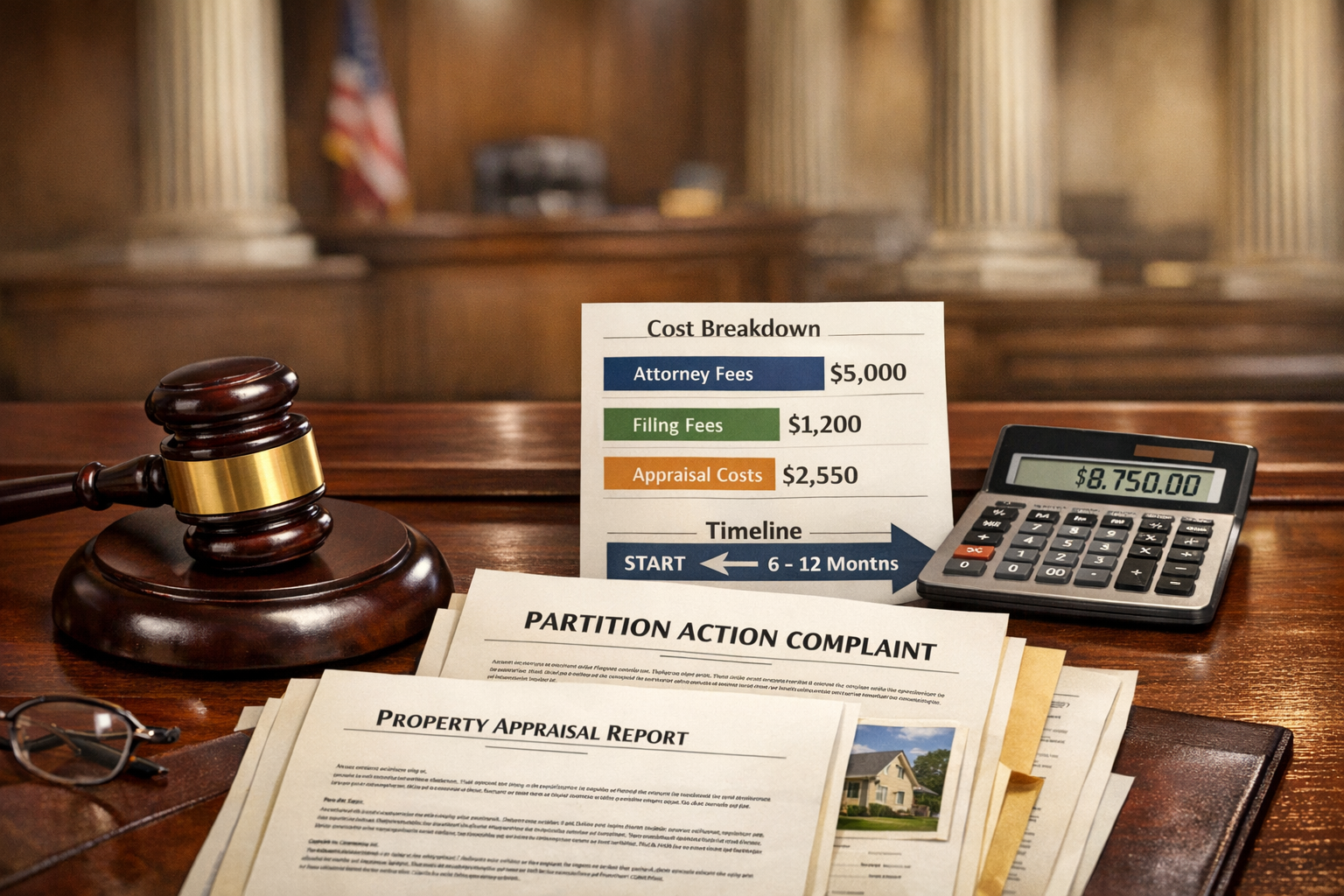
Cost considerations: Attorney fees typically range from $5,000 to $25,000+ depending on case complexity, property value, and whether the case goes to trial. Some attorneys work on hourly rates ($200-$500/hour), while others may offer flat fees for straightforward cases.
Step 3: File the Partition Complaint
Your attorney will prepare and file a partition complaint in the county where the property is located. This legal document:
- Identifies all co-owners and their ownership interests
- Describes the property in detail
- Explains why partition is necessary
- Requests specific relief (partition in kind or by sale)
Filing fees typically range from $200-$500, varying by jurisdiction.
Step 4: Serve Notice to Co-Owners
All other co-owners must receive formal legal notice of the partition action. This ensures everyone has an opportunity to respond and participate in the proceedings.
Service methods include:
- Personal service by a process server
- Certified mail with return receipt
- Publication in local newspapers (if owners cannot be located)
If you’re dealing with missing heirs, special procedures may be required to provide adequate notice.
Step 5: Co-Owners Respond
Defendants (other co-owners) typically have 20-30 days to file a response. They may:
- Agree to the partition and negotiate terms
- Contest the partition (though success is rare for tenants in common)
- Request partition in kind instead of sale (or vice versa)
- Claim a larger ownership share than alleged
- Request to purchase the property themselves at fair market value
Step 6: Property Appraisal and Discovery
The court usually orders a professional appraisal to determine fair market value. This becomes crucial for:
- Deciding whether partition in kind is equitable
- Setting minimum bid prices for auction sales
- Calculating buyout amounts if an owner wants to purchase others’ shares
- Distributing sale proceeds fairly
Both parties may conduct discovery, exchanging documents and information about:
- Property improvements and who paid for them
- Maintenance costs and contributions
- Rental income and how it was distributed
- Outstanding mortgages, liens, or taxes
Step 7: Court Hearings and Determination
The court holds hearings to determine:
Type of partition: The judge decides whether partition in kind or partition by sale better serves all parties’ interests.
Accounting issues: The court addresses claims about:
- Unequal contributions to mortgage payments
- Property improvements made by individual owners
- Rental income collected by one owner
- Property taxes or insurance paid disproportionately
Referee appointment: For partition by sale, the court appoints a referee or commissioner to oversee the sale process.
Step 8: The Sale Process
If the court orders partition by sale, the process typically involves:
Public auction: The property is sold at public auction, often on the courthouse steps. The referee conducts the auction, and the highest bidder wins.
Private sale: In some jurisdictions, the court may authorize a private sale through a real estate agent if it’s likely to achieve a better price than auction.
Minimum bid: The court sets a minimum acceptable bid (usually based on the appraisal) to prevent the property from selling far below market value.
Confirmation hearing: After the sale, the court holds a hearing to confirm the sale and ensure it was conducted properly.
Step 9: Distribution of Proceeds
After the sale closes, the referee:
- Pays all liens and encumbrances (mortgages, tax liens, judgment liens)
- Deducts partition action costs (attorney fees, court costs, appraisal fees, referee fees)
- Addresses accounting adjustments (reimbursements for improvements, unequal payments)
- Distributes remaining proceeds to co-owners according to ownership percentages
Timeline: The entire partition process typically takes 6-12 months from filing to final distribution, though complex cases may take longer.
If you’re dealing with a sibling who won’t sell an inherited house, understanding this timeline helps you plan accordingly.
Your Legal Rights as a Co-Owner
When exploring how to force sale jointly owned property: your legal rights, it’s empowering to understand the specific protections the law provides.
The Right to Partition
Your right to partition is fundamental and nearly absolute. Courts recognize that:
- No person should be imprisoned in unwanted co-ownership
- Property should be put to its highest and best use
- Economic efficiency benefits society
- Forced co-ownership breeds conflict and property deterioration
This right cannot be permanently waived. While co-owners can sign agreements postponing partition for a reasonable period (typically 10 years or less), courts generally won’t enforce perpetual partition waivers.
Right to Possess the Entire Property
Regardless of your ownership percentage, you have the right to possess and use the entire property. A 10% owner has the same possessory rights as a 90% owner.
Practical implications:
- Other owners cannot exclude you from the property
- You can live on the property (subject to reasonable co-owner agreements)
- You can use the property consistent with its nature
- You cannot exclude other co-owners from their possessory rights
Right to Income from the Property
If the property generates rental income, you’re entitled to your proportionate share of net income (after expenses).
Example: You own 40% of a rental property generating $24,000 annual net income. You’re entitled to $9,600 annually, even if another co-owner collects all the rent.
If a co-owner collects rental income without distributing your share, you can:
- Demand an accounting in the partition action
- Sue for your share separately
- Seek contribution for property expenses you paid
Right to Reimbursement for Improvements
If you’ve made substantial improvements to the property, you may be entitled to reimbursement during partition proceedings.
What qualifies:
✅ Major renovations (new roof, HVAC system, foundation repairs)
✅ Additions that increase property value
✅ Necessary repairs that preserve the property
What typically doesn’t qualify:
❌ Routine maintenance
❌ Improvements made solely for your personal benefit
❌ Cosmetic updates without value increase
Important: Keep detailed records—receipts, contracts, before/after photos—to support reimbursement claims.
Right to Contribution for Necessary Expenses
When you pay more than your proportionate share of necessary expenses, you can seek contribution from other co-owners.
Necessary expenses include:
- Property taxes
- Mortgage payments (if you’re protecting the property from foreclosure)
- Insurance premiums
- Essential repairs (fixing a leaking roof, broken furnace)
Example: You own 50% of a property but paid 100% of the $6,000 property tax bill. You can seek $3,000 contribution from the other 50% owner.
Protection Against Waste
Co-owners have a duty not to commit waste—actions that damage the property or substantially decrease its value.
Types of waste:
- Affirmative waste: Actively damaging the property (demolishing structures, removing fixtures)
- Permissive waste: Allowing the property to deteriorate through neglect
- Ameliorative waste: Making changes that alter the property’s character, even if they increase value
You can seek court intervention to stop waste and recover damages.
Right to Sell Your Individual Interest
Even without other owners’ consent, you can sell your individual ownership share to a third party. The buyer steps into your shoes as a co-owner with the same rights you had.
Practical reality: Finding buyers for partial interests is challenging because:
- They’ll own property with strangers
- They cannot possess the property exclusively
- Financing is typically unavailable
- The other owners may file for partition
However, specialized investors and companies do purchase partial interests. If you’re interested in this option, explore selling your undivided interest in property.
Costs of Forcing a Property Sale
Understanding the financial investment required is crucial when considering how to force sale jointly owned property: your legal rights. While partition actions protect your ownership rights, they come with significant costs.
Attorney Fees
Range: $5,000 – $25,000+
Attorney fees represent the largest expense in most partition actions. Costs vary based on:
- Case complexity: Simple cases with two co-owners and clear ownership settle faster than cases with multiple parties, disputed ownership percentages, or complicated accounting issues
- Geographic location: Urban areas typically have higher legal fees than rural regions
- Cooperation level: Contested cases requiring extensive discovery and trial preparation cost substantially more
- Property value: Higher-value properties often justify more attorney time and expense
Fee structures:
- Hourly billing: $200-$500/hour depending on attorney experience and location
- Flat fees: Some attorneys offer fixed pricing for straightforward partition cases
- Retainer agreements: Upfront payment with ongoing billing against the retainer
Cost recovery: In many jurisdictions, partition action costs (including reasonable attorney fees) are deducted from sale proceeds before distribution. This means all co-owners effectively share the cost proportionally, though the initiating party must typically pay upfront.
Court Filing Fees
Range: $200 – $500
Filing fees vary by county and state but represent a relatively minor expense compared to attorney fees.
Appraisal Costs
Range: $300 – $1,500+
Professional appraisals are nearly always required. Costs depend on:
- Property type and size
- Location and market conditions
- Complexity of valuation (unique properties cost more)
- Whether multiple appraisals are needed
For complex commercial properties or large land tracts, appraisal costs can exceed $5,000.
Referee or Commissioner Fees
Range: $2,000 – $10,000+
Court-appointed referees charge fees for:
- Overseeing the sale process
- Conducting auctions
- Preparing accounting of proceeds
- Filing required court reports
Referee fees are typically a percentage of the sale price (1-5%) or hourly charges, depending on jurisdiction.
Survey Costs (for Partition in Kind)
Range: $500 – $5,000+
If the court orders partition in kind, professional surveying is required to:
- Establish new property boundaries
- Create legal descriptions for new parcels
- Prepare subdivision plats
- Mark physical boundaries
Large properties or complex divisions cost more.
Title Work and Closing Costs
Range: $1,000 – $3,000+
Standard closing costs apply, including:
- Title search and insurance
- Recording fees for new deeds
- Transfer taxes (varies widely by location)
- Escrow fees
Total Cost Estimate
For a typical residential partition by sale:
| Expense Category | Estimated Cost |
|---|---|
| Attorney Fees | $8,000 – $15,000 |
| Court Filing Fees | $300 – $500 |
| Appraisal | $500 – $800 |
| Referee Fees | $3,000 – $6,000 |
| Title & Closing | $1,500 – $2,500 |
| Total | $13,300 – $24,800 |
These costs are typically deducted from sale proceeds, reducing the net amount distributed to all co-owners.
Cost-Benefit Analysis
Before initiating a partition action, consider:
When partition makes financial sense:
✅ Your ownership share is substantial (generally 25% or more)
✅ The property has significant equity
✅ Other resolution methods have failed
✅ Continued co-ownership is costing you money (unpaid expenses, lost opportunities)
✅ The property value exceeds $100,000
When alternatives may be better:
❌ Your ownership share is very small (under 10%)
❌ The property has little or negative equity
❌ Partition costs would consume most proceeds
❌ A buyout agreement is achievable
❌ You can sell your individual interest to an investor
For properties with complicated titles or multiple legal issues, working with industry experts who handle complex situations may provide more cost-effective helpful solutions.
Alternatives to Partition Lawsuits
Before pursuing litigation to force sale jointly owned property, exploring alternatives can save time, money, and relationships. These options often provide helpful guidance toward resolution without court intervention.
Voluntary Buyout Agreement
The cleanest solution is often one co-owner buying out the others’ interests.
How it works:
- Obtain a professional appraisal establishing fair market value
- Calculate each owner’s share based on ownership percentage
- Negotiate payment terms (lump sum or installment payments)
- Draft a purchase agreement
- Close the transaction with proper deed transfer
Advantages:
✅ Faster than partition litigation (can close in 30-60 days)
✅ Lower costs (appraisal and attorney for deed preparation only)
✅ Preserves family relationships
✅ Buyer gains full ownership and control
✅ Sellers receive fair market value without auction discount
Financing considerations: The buying co-owner may need to:
- Refinance existing mortgages in their name alone
- Obtain a new mortgage or home equity loan
- Use cash reserves or retirement funds
- Arrange seller financing with installment payments
If you need a fast solution, some companies specialize in buying out co-owners quickly.
Professional Mediation
Mediation involves a neutral third party facilitating negotiation between co-owners to reach a mutually acceptable resolution.
When mediation works well:
- Co-owners are willing to negotiate but need structure
- Emotional conflicts prevent productive direct communication
- Multiple resolution options exist (buyout, continued co-ownership with agreement, sale)
- Preserving relationships matters
The mediation process:
- Select a qualified mediator (often an attorney or retired judge)
- Each party presents their position and interests
- Mediator facilitates discussion and generates options
- Parties negotiate terms with mediator’s guidance
- If successful, formalize agreement in writing
Costs: $200-$500 per hour, split among parties. Most mediations resolve in 4-8 hours ($800-$4,000 total), far less than litigation.
Success rates: Mediation resolves 60-80% of property disputes, making it a worthwhile first step.
For more information, see our guide on partition lawsuit alternatives.
Structured Co-Ownership Agreement
If co-owners want to continue joint ownership but need clear rules, a comprehensive co-ownership agreement can prevent future disputes.
Key provisions:
- Decision-making process: How major decisions are made (unanimous consent, majority vote, specific allocation)
- Expense sharing: Who pays what percentage of taxes, insurance, maintenance
- Use rights: Who can occupy the property and when (especially for vacation homes)
- Rental income: How rental income is collected and distributed
- Buyout provisions: Right of first refusal if one owner wants to sell
- Dispute resolution: Mediation or arbitration requirements before litigation
- Exit strategy: Conditions triggering sale (specific date, life events, deadlock)
Example: Three siblings inherit a lakefront cabin. They create an agreement specifying each family gets the property for specific weeks annually, maintenance costs are split equally, and any sibling can trigger a sale after giving two years’ notice.
Selling to a Third-Party Investor
Specialized real estate investors purchase partial ownership interests from co-owners who want to exit without forcing a partition sale.
How it works:
- Investor evaluates the property and ownership structure
- Investor makes a cash offer for your ownership share (typically 50-70% of proportionate market value)
- You sell your interest and receive immediate payment
- Investor becomes the new co-owner
Advantages:
✅ Quick exit (close in 7-30 days)
✅ No litigation costs
✅ Cash payment without waiting for partition
✅ Avoids conflict with co-owners
Disadvantages:
❌ Receive less than full proportionate value
❌ Other co-owners now own property with an investor
❌ Investor may immediately file for partition
This option works best when you need liquidity quickly and your ownership share is small enough that partition costs would consume much of your proceeds.
Listing the Property for Traditional Sale
If all co-owners agree to sell but disagree on other issues, listing with a real estate agent provides the highest sale price.
Requirements for traditional sale:
- All co-owners must consent to the sale
- All co-owners must sign the listing agreement
- All co-owners must sign the purchase contract
- All co-owners must sign closing documents
Challenges:
- One uncooperative owner can block the sale
- Disagreements about listing price, agent selection, or offer acceptance can derail the process
- Property must be in showable condition
- Can take 3-6 months or longer
Solutions for common disagreements:
- Listing price: Agree to list at the average of two independent appraisals
- Agent selection: Each owner nominates an agent; interview all and vote
- Offer acceptance: Agree in advance to accept any offer above a specific price
- Property preparation: One owner advances costs for repairs, reimbursed at closing
For properties with title complications, tax issues, or liens, traditional sales may not be feasible. In these situations, selling to experts who handle complex properties provides helpful solutions.
Temporary Rental Agreement
For co-owners who aren’t ready to sell but can’t agree on use, converting the property to a rental can generate income while delaying the sale decision.
Structure:
- Hire a professional property management company
- Establish a separate bank account for rental income and expenses
- Create clear accounting procedures
- Distribute net income proportionally
- Set a future date to revisit the sale decision
Benefits:
✅ Generates income instead of being a pure expense
✅ Professional management reduces conflict
✅ Maintains property value
✅ Delays decision until market improves or circumstances change
Risks:
❌ Landlord liability shared by all owners
❌ Requires agreement on property management
❌ Doesn’t resolve fundamental disagreement
❌ May complicate future sale (tenant occupancy)
Special Situations and Considerations
Certain circumstances create unique challenges when learning how to force sale jointly owned property: your legal rights. Understanding these special situations helps you navigate the complexities effectively.
Inherited Property and Heirs Property
Heirs property—real estate passed through inheritance without formal probate—creates particularly complex co-ownership situations.
Common challenges:
- Multiple generations of heirs: A property originally owned by grandparents may now have 15+ heirs spread across the country
- Unclear ownership percentages: Without formal probate, determining exact ownership shares can be difficult
- Missing or unknown heirs: Some heirs may be impossible to locate
- Clouded title: Lack of proper estate administration creates title defects
Solutions:
- Quiet title action: Legal proceeding to establish clear ownership and resolve title defects
- Probate administration: Opening delayed probate to formally transfer title
- Heir property statutes: Some states have special laws (like the Uniform Partition of Heirs Property Act) providing additional protections
If you’re dealing with heir property complications, specialized legal guidance is essential.
Properties with Mortgages or Liens
Encumbered properties require special attention during partition actions.
Key considerations:
Mortgage obligations: If the property has a mortgage:
- All co-owners are typically jointly and severally liable (each is responsible for the full debt)
- Partition sale proceeds must pay off the mortgage before distribution
- If proceeds are insufficient, co-owners may owe the deficiency
- Some mortgages have due-on-sale clauses triggered by ownership changes
Tax liens: Properties with back taxes or tax liens must satisfy these obligations from sale proceeds.
Judgment liens: Judgment liens against individual co-owners may attach to their ownership interest.
Mechanic’s liens: Mechanic’s liens for unpaid contractor work attach to the property itself.
Priority of liens: Liens are generally paid in this order:
- Property tax liens (highest priority)
- First mortgage
- Second mortgage/home equity loans
- Judgment liens (by date recorded)
- Mechanic’s liens
Understanding lien priority is crucial for determining whether partition will yield any proceeds for distribution.
Marital Property and Divorce
Divorcing couples face unique partition considerations.
Community property states: In the nine community property states, marital property is owned 50/50 regardless of whose name is on the title.
Equitable distribution states: Other states divide marital property equitably (fairly) but not necessarily equally.
Partition vs. divorce proceedings:
- Property division is typically handled within divorce proceedings, not separate partition actions
- Divorce courts have broader powers than partition courts
- Divorce courts can award the entire property to one spouse with offsetting assets
- Partition actions may still be necessary for property owned before marriage or received by inheritance
Domestic violence considerations: Courts may restrict partition rights temporarily to protect victims of domestic violence.
Commercial Property and Business Partnerships
Business-related property involves additional complexities.
Partnership agreements: Unlike residential co-ownership, business partnerships typically have detailed operating agreements that may:
- Restrict partition rights
- Require mediation or arbitration before litigation
- Establish buyout formulas and procedures
- Specify business valuation methods
Valuation challenges: Commercial property valuation is more complex than residential, often requiring:
- Income approach analysis (capitalization of net operating income)
- Consideration of lease agreements and tenant quality
- Business goodwill valuation (if property and business are intertwined)
- Specialized commercial appraisers
Ongoing business operations: Courts are reluctant to disrupt functioning businesses through partition, preferring solutions that maintain business continuity.
Properties Held in Trust
Trust property has special rules regarding partition.
Revocable living trusts: Trustees typically have authority to sell trust property according to trust terms, potentially avoiding partition.
Irrevocable trusts: Trust terms may restrict or prohibit partition, and beneficiaries’ rights depend on:
- Whether they have present or future interests
- Trust language regarding property disposition
- State trust law provisions
Multiple beneficiaries: When a trust has multiple beneficiaries with present interests, partition-like disputes may arise, resolved through:
- Trust modification proceedings
- Trustee’s exercise of discretionary powers
- Beneficiary agreement and trust termination
For guidance on selling property held in trust, consult both a real estate attorney and a trust specialist.
Homestead Properties
Homestead exemptions protect primary residences from certain creditors but can complicate partition actions.
Key issues:
- One co-owner may claim homestead protection while others want to sell
- Homestead rights may delay partition until the claiming owner dies or abandons the property
- State laws vary dramatically on homestead protections
- Some states provide absolute homestead protection; others allow partition despite homestead claims
Example: In Florida, which has strong homestead protections, a surviving spouse’s homestead rights may prevent partition by adult children from a previous marriage.
Working with Property Solutions Experts
When facing the challenge of how to force sale jointly owned property: your legal rights, partnering with industry experts who specialize in complex property situations can provide helpful guidance and practical alternatives to lengthy litigation.
When Expert Help Makes Sense
Consider working with property solutions specialists when:
✅ Multiple complications exist: The property has title issues, liens, back taxes, AND co-owner disputes
✅ Time is critical: You need to resolve the situation quickly due to financial pressure or life circumstances
✅ Traditional sale isn’t viable: The property’s condition or legal complications prevent conventional listing
✅ Partition costs are prohibitive: Legal fees would consume a large portion of your expected proceeds
✅ Relationships matter: You want to avoid family conflict from adversarial litigation
✅ You own a minority interest: Your small ownership percentage makes partition economically questionable
How Property Solutions Companies Help
Sure Path Property Solutions and similar companies provide helpful solutions by:
Purchasing partial interests: Buying your ownership share directly, allowing you to exit without forcing other owners to sell.
Facilitating buyouts: Helping one co-owner purchase others’ interests by:
- Providing bridge financing
- Coordinating with title companies
- Resolving lien and tax issues
- Simplifying the transaction process
Buying the entire property: When all co-owners want to sell but face complications:
- Making cash offers that close quickly (often 7-14 days)
- Purchasing properties “as-is” without repairs
- Handling title curative work
- Coordinating lien payoffs and tax resolution
- Managing complex closing logistics
Coordinating with counties and title professionals: Leveraging relationships and expertise to:
- Resolve title defects efficiently
- Negotiate tax payment plans or settlements
- Clear mechanic’s liens and judgments
- Obtain necessary legal documents
The Expert Service Advantage
Working with property solutions experts offers several benefits over traditional partition litigation:
Speed: Close in days or weeks instead of 6-12 months for partition.
Certainty: Guaranteed cash offer versus uncertain auction results.
Cost savings: No attorney fees, court costs, or appraisal expenses.
Simplicity: One point of contact handles all complexities.
Flexibility: Creative solutions tailored to your specific situation.
Relationship preservation: Avoid adversarial litigation with family members.
What to Look for in a Property Solutions Partner
Not all property buyers are created equal. Look for companies that demonstrate:
🏆 Proven expertise: Specific experience with co-ownership disputes, heir property, and title complications
🏆 Transparent process: Clear explanation of how they determine offers and what to expect
🏆 Fair pricing: Competitive offers that reflect property value and your ownership percentage
🏆 Professional credentials: Licensed, insured, and established business with verifiable track record
🏆 Trustworthy service: Positive reviews, testimonials, and references from previous clients
🏆 Friendly and caring approach: Respectful communication and genuine concern for your situation
🏆 No-pressure consultation: Willingness to explain options without high-pressure sales tactics
Sure Path Property Solutions embodies these qualities, offering expert service to property owners navigating complicated real estate issues. Whether you’re dealing with back taxes, multiple heirs, liens, judgments, or unclear title, the team provides helpful guidance toward clear, practical solutions.
Real-World Success Stories
Example 1: Three Siblings, One House
Three siblings inherited their parents’ home in Oklahoma. One wanted to keep it, one wanted to sell immediately, and one was indifferent but lived out of state. After months of disagreement, the sibling wanting to sell contacted Sure Path Property Solutions. The company:
- Purchased that sibling’s 33.3% interest for fair market value
- Closed in 10 days with cash payment
- Allowed the other siblings to continue ownership without forced partition
- Saved everyone from $15,000+ in partition litigation costs
Example 2: Investment Property with Tax Liens
Two former business partners co-owned a rental property with $23,000 in back taxes and a deteriorating roof. Neither wanted to invest more money, but the property couldn’t sell traditionally with the tax lien. Sure Path Property Solutions:
- Made a cash offer accounting for the tax debt
- Coordinated with the county to resolve the tax lien at closing
- Purchased the property as-is without roof repairs
- Closed in 12 days, giving both partners their share of equity
Example 3: Heir Property with 11 Owners
A family farm passed through three generations without formal probate, resulting in 11 heirs with varying ownership percentages. Some wanted to sell; others wanted to keep the property. The situation was deadlocked until Sure Path Property Solutions:
- Purchased the interests of the 6 heirs wanting to sell
- Allowed the remaining 5 heirs to retain ownership
- Handled all title work and legal documentation
- Provided a fair, efficient solution without forcing partition
These examples demonstrate how expert service from property solutions specialists can resolve seemingly impossible situations with helpful solutions that work for everyone involved.
Protecting Your Interests During the Process
Whether you pursue partition litigation or alternative solutions, protecting your legal and financial interests is paramount when navigating how to force sale jointly owned property: your legal rights.
Document Everything
Meticulous record-keeping strengthens your legal position and supports claims for reimbursement or contribution.
Essential documentation:
📄 Ownership documents: Deed, title insurance policy, estate documents showing how you acquired your interest
📄 Financial records: Bank statements, canceled checks, receipts for all property-related expenses
📄 Improvement documentation: Contracts, invoices, before/after photos for any improvements you funded
📄 Communication records: Emails, text messages, letters documenting attempts to negotiate with co-owners
📄 Rental income: Lease agreements, rent receipts, accounting of income distribution
📄 Property tax records: Payment receipts showing who paid taxes and when
📄 Insurance documentation: Policies and payment records
📄 Maintenance logs: Records of repairs, maintenance, and who performed/paid for them
Organization tips:
- Create a dedicated folder (physical or digital) for all property-related documents
- Scan paper documents for digital backup
- Maintain a spreadsheet tracking all expenses and payments
- Take dated photos of property condition regularly
- Save all communication with co-owners
Maintain the Property
Preventing waste protects everyone’s investment and strengthens your legal position.
Your responsibilities:
✅ Essential maintenance: Keep the property in reasonable condition
✅ Prevent deterioration: Address issues that could cause damage (roof leaks, plumbing problems)
✅ Secure the property: Ensure doors and windows are locked; property is safe
✅ Pay necessary expenses: Property taxes, insurance, mortgage (if you can afford it)
What to avoid:
❌ Making major improvements without co-owner agreement (you may not be reimbursed)
❌ Allowing the property to deteriorate (you could be liable for waste)
❌ Collecting rent without distributing co-owners’ shares
❌ Excluding co-owners from the property
Balancing act: You’re not required to make improvements or pay more than your share of expenses, but doing so strategically can protect the property’s value and support reimbursement claims.
Communicate Professionally
Maintaining professional communication with co-owners, even during conflict, can facilitate resolution and looks favorable to courts.
Best practices:
✉️ Use written communication: Email or certified letters create documentation
✉️ Stay factual and unemotional: Focus on facts, numbers, and legal rights rather than personal grievances
✉️ Be specific: Clearly state what you want and why
✉️ Document verbal conversations: Follow up with written summaries (“This confirms our phone conversation on…”)
✉️ Propose solutions: Don’t just complain; offer specific resolution proposals
✉️ Set reasonable deadlines: “Please respond by [date]” creates urgency without being aggressive
Example of effective communication:
“Dear Co-Owner,
I’m writing to propose a resolution to our shared ownership of the property at [address]. As you know, I’ve paid 100% of the property taxes for the past two years ($12,000 total) while owning a 50% interest.
I propose three options:
- You reimburse me $6,000 for your share of taxes paid, and we list the property for sale with a mutually agreed agent
- You purchase my 50% interest for $150,000 (based on the recent appraisal)
- I purchase your 50% interest for $150,000
If we cannot reach agreement by [30 days from now], I will need to consult an attorney about a partition action to protect my interests.
I hope we can resolve this cooperatively. Please respond by [date].”
This approach is professional, specific, and demonstrates good faith while protecting your rights.
Know When to Compromise
Strategic compromise can achieve your core goals while avoiding the cost and delay of litigation.
Consider compromising on:
- Timeline: Agreeing to delay sale for 6-12 months if a co-owner needs time to arrange financing for a buyout
- Sale method: Accepting a traditional listing instead of immediate partition if all owners agree
- Price: Accepting a slightly lower buyout price to avoid partition costs and delays
- Property preparation: Splitting improvement costs to maximize sale price
Don’t compromise on:
- Your fundamental right to exit co-ownership
- Your proportionate share of proceeds or value
- Your right to reimbursement for documented expenses you’ve paid
- Protection from ongoing financial liability
Calculate your bottom line: Before negotiating, determine your minimum acceptable outcome considering:
- Your ownership percentage × property value
- Minus estimated partition costs
- Minus time value of money (what you could earn investing the proceeds now)
- Plus value of avoiding stress and preserving relationships
If a settlement offer meets or exceeds this calculation, seriously consider accepting it.
Seek Professional Guidance Early
Early consultation with professionals can save money and expand your options.
Key professionals:
👨⚖️ Real estate attorney: Consult before filing partition to understand your rights, costs, and likelihood of success
👨💼 Certified public accountant: Understand tax implications of partition sale, especially for inherited property
🏠 Real estate appraiser: Obtain professional valuation to support negotiations or court proceedings
💰 Financial advisor: Evaluate how partition proceeds fit into your overall financial plan
🤝 Mediator: Facilitate negotiation before resorting to litigation
Cost-benefit of early consultation: Spending $500-$1,500 for professional consultations early can save $10,000-$25,000 in litigation costs and achieve better outcomes.
Tax Implications of Forced Property Sales
Understanding tax consequences is crucial when learning how to force sale jointly owned property: your legal rights. Partition sales create taxable events with potentially significant financial impact.
Capital Gains Tax Basics
When property sells for more than your cost basis, the profit is subject to capital gains tax.
Cost basis calculation:
For purchased property:
- Original purchase price
- Plus: Closing costs when you bought
- Plus: Capital improvements you made
- Equals: Your cost basis
For inherited property:
- Fair market value on date of death (stepped-up basis)
- Plus: Capital improvements since inheritance
- Equals: Your cost basis
Example: You inherited a house worth $200,000 when your parent died. You made $15,000 in improvements. Your basis is $215,000. If partition sale yields $250,000, your capital gain is $35,000.
Capital Gains Tax Rates (2026)
Long-term capital gains (property held over one year):
| Tax Filing Status | 0% Rate | 15% Rate | 20% Rate |
|---|---|---|---|
| Single | Up to $47,025 | $47,026-$518,900 | Over $518,900 |
| Married Filing Jointly | Up to $94,050 | $94,051-$583,750 | Over $583,750 |
Short-term capital gains (property held one year or less): Taxed as ordinary income at your marginal tax rate (10%-37%).
State taxes: Many states impose additional capital gains taxes (0%-13.3% depending on state).
Primary Residence Exclusion
If the property was your primary residence for at least 2 of the past 5 years, you may exclude:
- $250,000 of gain (single filers)
- $500,000 of gain (married filing jointly)
Co-ownership consideration: Each co-owner who used the property as their primary residence can claim their individual exclusion on their share of the gain.
Example: Two siblings co-own an inherited home. One sibling lived in it as their primary residence for 3 years; the other never lived there. The sibling who lived there can exclude up to $250,000 of their share of the gain; the other sibling cannot.
Partition-Specific Tax Issues
Partition in kind: Generally not a taxable event. Receiving physical property in exchange for your ownership interest is treated as a non-taxable exchange. Taxes are deferred until you later sell your individual parcel.
Partition by sale: Taxable event in the year the property sells. Each co-owner reports their proportionate share of the gain.
Unequal distribution: If partition results in unequal distribution (one owner receives more than their proportionate share due to improvements or other factors), complex tax consequences may arise. Consult a tax professional.
Deductible Expenses
Certain expenses reduce your taxable gain:
✅ Selling costs: Real estate commissions, title fees, attorney fees, transfer taxes
✅ Partition action costs: Legal fees, court costs, appraisal fees (if selling)
✅ Capital improvements: Major improvements that added value (not routine maintenance)
❌ Not deductible: Routine maintenance, repairs, property taxes, mortgage interest (these were deductible in the years paid, not at sale)
Tax Planning Strategies
Timing the sale: If you’re near the end of a tax year and expect lower income next year, consider delaying the sale to the following tax year.
Installment sales: If one co-owner buys out the others with installment payments, the sellers can spread the gain over multiple years (subject to complex rules).
1031 exchange: For investment property, a 1031 like-kind exchange can defer taxes, though coordination among multiple co-owners is challenging.
Offset with losses: Capital losses from other investments can offset partition sale gains.
Charitable donation: If appropriate, donating your interest to charity before partition may provide a tax deduction (consult a tax advisor about complex rules).
Reporting Requirements
Form 1099-S: The closing agent typically issues Form 1099-S reporting the gross proceeds from the sale. Each co-owner receives a 1099-S for their proportionate share.
Schedule D: Report the sale on Schedule D (Capital Gains and Losses) of your tax return.
Form 8949: Provide details about the sale, including date acquired, date sold, proceeds, cost basis, and gain/loss.
State tax returns: Report the sale on your state tax return if your state has income tax.
Professional Tax Guidance
Consult a CPA or tax attorney before partition, especially if:
- The property has been in the family for generations (complex basis calculation)
- You’ve made substantial improvements (documentation required)
- The property was partially used for business or rental (mixed-use allocation)
- You’re considering installment sale or 1031 exchange
- Your gain will be substantial (over $100,000)
- You have questions about primary residence exclusion eligibility
Tax professionals can help you structure the transaction to minimize tax liability legally and ensure proper reporting.
Conclusion: Taking Action on Your Co-Ownership Challenge
Navigating how to force sale jointly owned property: your legal rights can feel overwhelming, but understanding your options empowers you to take control of your financial future. Whether you’re dealing with an inherited family home, an investment property with an uncooperative partner, or any other co-ownership dispute, you have legal protections and practical solutions available.
Your Path Forward: Next Steps
1. Assess Your Situation
Take stock of where you stand:
- What type of co-ownership exists? (tenancy in common, joint tenancy, etc.)
- What percentage do you own?
- What is the property’s approximate value and equity?
- Are there mortgages, liens, or back taxes?
- What have you already tried to resolve the dispute?
2. Explore Voluntary Solutions First
Before initiating litigation:
- Obtain a professional appraisal to establish fair market value
- Propose specific solutions to co-owners in writing (buyout, listing, mediation)
- Set reasonable deadlines for response
- Document all communication attempts
- Consider professional mediation if co-owners are willing
3. Consult with Professionals
Seek expert guidance from:
- Real estate attorney: Understand your legal rights and partition process in your jurisdiction
- Property solutions specialist: Explore alternatives like selling your interest or facilitating a buyout
- Tax professional: Understand tax implications before making decisions
- Real estate appraiser: Obtain accurate property valuation
4. Make an Informed Decision
Weigh your options considering:
- Timeline: How quickly do you need resolution?
- Costs: What will each option cost, and can you afford upfront expenses?
- Relationships: How important is preserving relationships with co-owners?
- Financial outcome: What net proceeds can you expect from each option?
- Certainty: How much risk and uncertainty can you tolerate?
5. Take Action
Once you’ve made your decision:
- If pursuing partition: Hire an attorney and file the complaint
- If selling your interest: Contact property solutions companies or investors
- If negotiating buyout: Formalize agreements in writing with attorney review
- If listing traditionally: Get all co-owners to sign listing agreement
Why Sure Path Property Solutions Can Help
If you’re facing co-ownership challenges complicated by title issues, liens, back taxes, or uncooperative co-owners, Sure Path Property Solutions offers helpful solutions tailored to your unique situation.
Our expert service includes:
🏆 Purchasing partial ownership interests: Get cash for your share without forcing other owners to sell
🏆 Facilitating co-owner buyouts: We help one owner purchase others’ interests smoothly
🏆 Buying properties with complications: We purchase properties with title issues, liens, tax problems, and multiple owners
🏆 Fast closings: Close in as little as 7-14 days with cash payment
🏆 No repairs required: We buy properties as-is in any condition
🏆 Title curative expertise: We coordinate with counties and title professionals to resolve complex issues
🏆 Compassionate, professional approach: We understand the emotional and financial stress of property disputes
Our friendly and caring team has helped hundreds of property owners navigate complicated situations and move forward with their lives. We provide trustworthy service backed by industry experts who genuinely care about finding the right solution for your circumstances.
Your Rights Are Protected
Remember these fundamental truths about how to force sale jointly owned property: your legal rights:
✅ You have the legal right to exit co-ownership through partition action in nearly all circumstances
✅ Courts recognize partition as a fundamental property right that cannot be permanently waived
✅ You’re entitled to your proportionate share of property value, income, and proceeds
✅ You can seek reimbursement for expenses you’ve paid and improvements you’ve made
✅ Alternatives to litigation often exist that can save time, money, and relationships
✅ Professional help is available from attorneys, mediators, and property solutions experts
Don’t Wait—Your Financial Future Matters
Co-ownership disputes rarely resolve themselves. Property deteriorates, taxes accumulate, opportunities pass, and relationships worsen. Taking action now—whether through negotiation, partition, or working with property solutions experts—puts you back in control.
The situation may feel complicated, but the solution doesn’t have to be.
Sure Path Property Solutions stands ready to provide helpful guidance and practical solutions for your co-ownership challenge. We simplify complex situations, coordinate with counties and title professionals, and guide property owners toward clear, practical solutions.
Contact us today for a no-obligation consultation. Share your situation, and we’ll explain your options clearly and honestly. Whether we ultimately work together or you choose another path, you’ll gain the clarity and confidence to move forward.
Your property ownership should work for you, not against you. Let’s find the solution that gets you where you want to be.