
Sharing property ownership with another person can feel like navigating a maze with no clear exit. Whether you inherited a house with siblings, purchased investment property with a business partner, or found yourself co-owning real estate through divorce, the day often comes when one owner wants out—or when you want to take full control. Understanding how to execute a Tenants in Common Buyout: How to Buy Out a Co-Owner can transform a complicated shared ownership situation into a clean, straightforward path to sole ownership.
This comprehensive guide walks through every step of the buyout process, from initial valuation to final title transfer, providing helpful solutions for even the most complex co-ownership scenarios.
Key Takeaways
- Tenants in common ownership allows multiple owners to hold different percentage shares of a property with individual rights to sell or transfer their portion
- Property valuation is the critical first step—obtain a professional appraisal to establish fair market value before negotiating a buyout price
- Financing options for buyouts include cash purchases, refinancing, home equity loans, seller financing, or partnership with real estate solution companies
- Legal documentation must be properly executed, including purchase agreements, deed transfers, and title updates to ensure clean ownership transfer
- Professional guidance from real estate experts, attorneys, and title professionals can help navigate complex situations involving liens, judgments, or title issues
Understanding Tenants in Common Ownership
Before diving into the buyout process, it’s essential to understand what tenants in common ownership actually means and how it differs from other co-ownership structures.
What Is Tenants in Common?
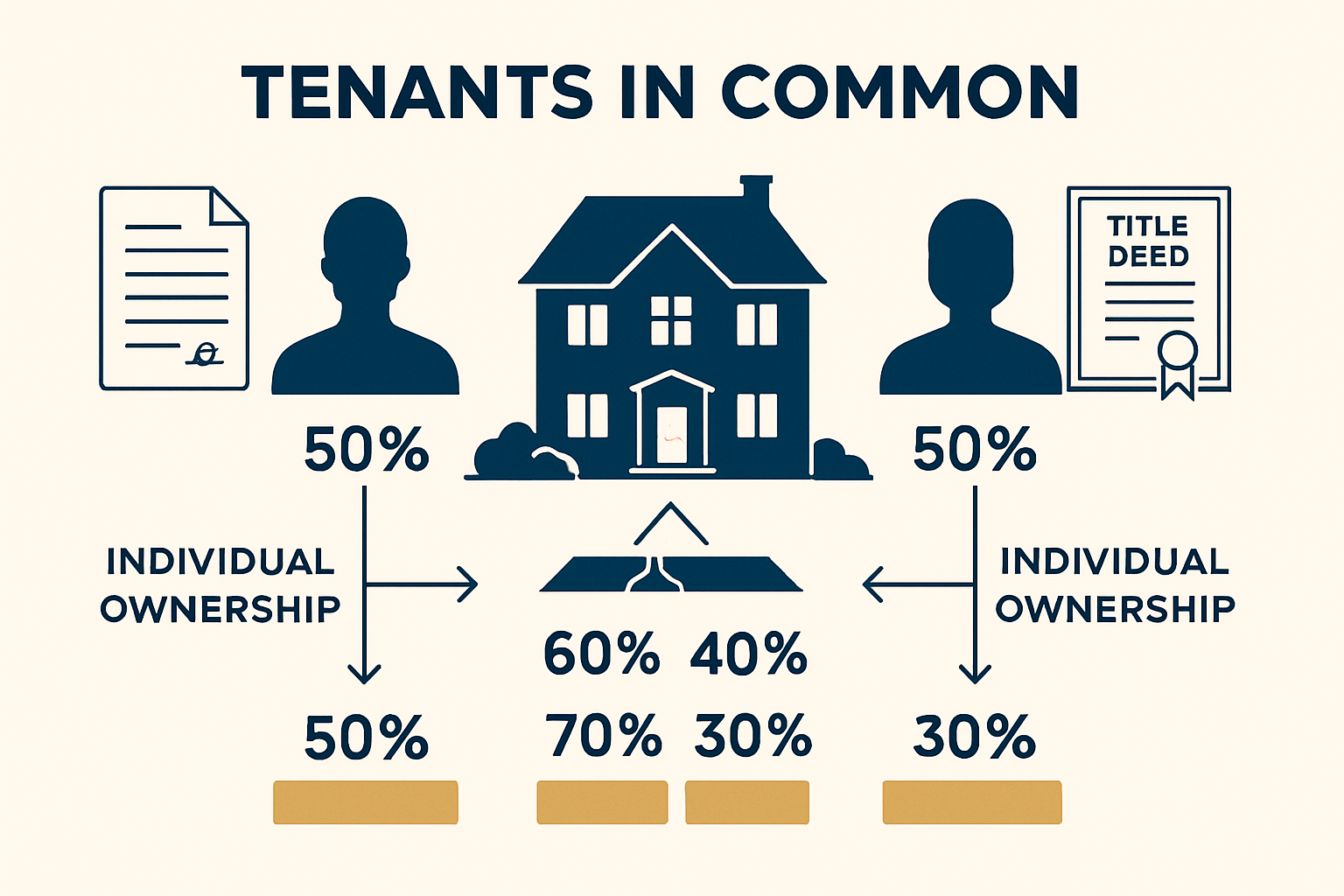
Tenants in common (TIC) is a form of concurrent property ownership where two or more people hold undivided interests in real estate. Unlike joint tenancy, each tenant in common:
- Owns a specific percentage of the property (not necessarily equal shares)
- Can sell, transfer, or mortgage their portion independently
- Can pass their share to heirs through a will or estate
- Has no automatic right of survivorship
Think of it like owning slices of a pie. One person might own 60% while another owns 40%. Each owner has rights to the entire property, but their financial stake differs.
Common Scenarios Leading to TIC Ownership
Several situations frequently result in tenants in common arrangements:
🏠 Inheritance: Multiple siblings inherit a family home and become co-owners
💼 Investment partnerships: Business partners purchase rental property together
💔 Divorce settlements: Former spouses maintain shared ownership temporarily
👨👩👧👦 Family purchases: Parents and adult children buy property together
🤝 Unmarried couples: Partners purchase real estate without marriage
Each scenario brings unique challenges when one party wants to exit the arrangement. That’s where understanding the Tenants in Common Buyout: How to Buy Out a Co-Owner process becomes invaluable.
Why Co-Owners Seek Buyouts
The reasons for pursuing a buyout are as varied as the ownership arrangements themselves:
- Financial strain: One owner can’t afford ongoing expenses like property taxes, insurance, or maintenance
- Disagreements: Co-owners clash over property use, rental decisions, or improvement plans
- Life changes: Relocation, marriage, divorce, or career shifts make continued ownership impractical
- Estate planning: Simplifying assets before retirement or for inheritance purposes
- Investment strategy: One owner wants to liquidate while the other wants to hold long-term
When multiple owners of property can’t agree on the future, a buyout often provides the cleanest resolution.
Preparing for a Tenants in Common Buyout: How to Buy Out a Co-Owner
Successful buyouts don’t happen by accident. They require careful preparation, clear communication, and strategic planning.
Step 1: Review Your Ownership Agreement
Start by examining any existing co-ownership documents:
- Deed: Confirms ownership percentages and how title is held
- Partnership agreements: May outline buyout procedures or first-refusal rights
- Operating agreements: For LLC-owned properties, these govern transfer procedures
- Trust documents: If property is held in trust, review trustee powers
Many co-owners discover they’ve already agreed to specific buyout terms without realizing it. These documents provide the legal framework for your transaction.
Step 2: Communicate Your Intentions
Open, honest communication sets the foundation for a smooth buyout:
Best practices for initial conversations:
✅ Choose a neutral, private setting
✅ Explain your reasons without blame or emotion
✅ Express willingness to negotiate fairly
✅ Propose a timeline for the process
✅ Suggest bringing in professional help
What to avoid:
❌ Making ultimatums or threats
❌ Discussing buyouts during heated arguments
❌ Presenting it as a done deal before negotiation
❌ Involving too many outside parties initially
Remember, the goal is reaching a mutually beneficial agreement. Approaching the conversation with helpful guidance and respect increases the likelihood of success.
Step 3: Determine Property Value
Accurate valuation is the cornerstone of any fair buyout. Without it, negotiations lack a solid foundation.
Valuation methods include:
| Method | Best For | Pros | Cons |
|---|---|---|---|
| Professional appraisal | All situations | Most accurate, legally defensible | Costs $300-$600 |
| Comparative Market Analysis (CMA) | Standard residential | Free from real estate agents | Less formal than appraisal |
| Broker Price Opinion (BPO) | Investment properties | Middle ground on cost/accuracy | Not as detailed as appraisal |
| Online estimators | Initial estimates only | Free, instant | Often inaccurate, not legally valid |
Pro tip: When co-owners disagree on value, consider hiring two independent appraisers and averaging their valuations, or agreeing to use a single appraiser selected jointly.
For properties with complications like liens and judgments or property tax issues, professional valuation becomes even more critical. These issues affect both current value and the buyout structure.
Step 4: Calculate the Buyout Amount
Once you have the property value, calculating the buyout amount involves several considerations:
Basic formula:
Buyout Amount = (Property Value × Co-owner's Percentage) - Adjustments
Common adjustments include:
- Outstanding mortgage balance: Who pays what portion?
- Property improvements: Did one owner invest more in upgrades?
- Deferred maintenance: Has one owner neglected their share of upkeep?
- Unpaid expenses: Are there outstanding property taxes, insurance, or HOA fees?
- Rental income: Has one owner collected rent without sharing?
Example calculation:
Property appraised value: $400,000
Co-owner’s share: 50%
Base buyout amount: $200,000
Less: Their share of mortgage ($100,000 × 50%): -$50,000
Less: Unpaid property taxes they owe: -$3,000
Net buyout amount: $147,000
This calculation can become complex quickly. When dealing with inherited property or properties with multiple liens, professional guidance ensures all factors are properly accounted for.
Financing Your Tenants in Common Buyout: How to Buy Out a Co-Owner
Having the funds to complete the buyout is often the biggest hurdle. Fortunately, several financing options exist.
Cash Purchase
The simplest approach is paying cash for your co-owner’s share.
Advantages:
- No loan approval process
- Faster closing
- No interest costs
- Stronger negotiating position
Considerations:
- Requires substantial liquid assets
- May deplete emergency reserves
- Opportunity cost of invested funds
Refinancing the Existing Mortgage
If the property has an existing mortgage, refinancing allows you to pay off the current loan and buy out your co-owner simultaneously.
How it works:
- Apply for a new mortgage in your name only
- New loan amount covers remaining mortgage balance plus buyout amount
- At closing, existing mortgage is paid off and co-owner receives their share
- You become sole owner with a new mortgage
Requirements:
- Sufficient income to qualify alone
- Good credit score (typically 620+)
- Adequate equity in the property
- Debt-to-income ratio under 43-50%
Example:
Current property value: $500,000
Existing mortgage balance: $200,000
Co-owner’s 50% share: $250,000
Less their mortgage portion: -$100,000
Buyout amount needed: $150,000
New mortgage amount: $350,000 ($200,000 existing + $150,000 buyout)
Loan-to-value ratio: 70% (generally acceptable)
Home Equity Loan or HELOC
If you already own other property, tapping that equity can fund the buyout.
Home Equity Loan:
- Lump sum payment
- Fixed interest rate
- Predictable monthly payments
- Typically allows borrowing up to 80-85% combined loan-to-value
Home Equity Line of Credit (HELOC):
- Draw funds as needed
- Variable interest rate
- Interest-only payments during draw period
- More flexibility for staged buyouts
Seller Financing
Sometimes the co-owner being bought out is willing to finance the purchase themselves.
Structure:
- You make a down payment (typically 10-30%)
- Co-owner holds a note for the remaining balance
- You make monthly payments with agreed interest
- After full payment, they sign over their share
Benefits for both parties:
For the buyer:
- Easier qualification than traditional loans
- Potentially lower closing costs
- Flexible terms
For the selling co-owner:
- Earns interest on the sale
- Spreads tax liability over multiple years
- Maintains some security interest until paid
Important: Seller financing arrangements should always be formalized with proper legal documentation to protect both parties.
Partnership with Real Estate Solution Companies
When traditional financing isn’t available or the situation is complex, partnering with companies that specialize in complicated real estate scenarios offers an alternative path.
Sure Path Property Solutions provides expert service for owners facing challenging situations like:
- Properties with significant back taxes
- Multiple heirs with conflicting interests
- Clouded title issues
- Properties in pre-foreclosure
- Situations where traditional buyers can’t or won’t engage
These industry experts can help structure creative solutions, coordinate with counties and title professionals, and provide the helpful guidance needed to navigate complex buyout scenarios.
The Legal Process of Buying Out a Co-Owner
Once financing is secured, the legal mechanics of transferring ownership must be executed properly.
Essential Legal Documents
A complete buyout requires several key documents:
1. Purchase Agreement
This contract outlines:
- Purchase price and payment terms
- Closing date
- Contingencies (financing, title review, etc.)
- Representations and warranties
- Who pays closing costs
- Default provisions
2. Quitclaim or Warranty Deed
The transferring co-owner signs a deed conveying their interest:
- Quitclaim deed: Transfers whatever interest the grantor has, with no warranties
- Warranty deed: Guarantees clear title and defends against claims
Most buyouts use quitclaim deeds between co-owners, but warranty deeds provide more protection.
3. Settlement Statement
Documents all financial aspects of the transaction:
- Purchase price
- Prorations (taxes, insurance, HOA fees)
- Payoffs (mortgages, liens)
- Closing costs
- Net proceeds to each party
4. Mortgage Documents
If obtaining new financing:
- Loan application
- Promissory note
- Mortgage or deed of trust
- Disclosure documents
5. Title Insurance Policy
Protects against undiscovered title defects. When buying out a co-owner, obtaining an owner’s title insurance policy in your name alone is wise protection.
Working with Professionals
Attempting a buyout without professional help is like performing surgery on yourself—technically possible but highly inadvisable.
Key professionals to engage:
👨⚖️ Real Estate Attorney
- Reviews and drafts legal documents
- Ensures compliance with state laws
- Handles title issues
- Represents your interests
- Cost: $500-$2,500 depending on complexity
📊 Real Estate Appraiser
- Provides objective property valuation
- Creates detailed appraisal report
- Defends valuation if challenged
- Cost: $300-$600 for residential
🏦 Mortgage Lender or Broker
- Evaluates financing options
- Pre-approves loan applications
- Coordinates closing
- Cost: Paid through loan fees/interest
📋 Title Company
- Conducts title search
- Identifies liens and encumbrances
- Issues title insurance
- Facilitates closing
- Cost: Varies by location, typically $500-$2,000
🏠 Real Estate Solution Specialists
For complicated situations, companies like Sure Path Property Solutions offer comprehensive support, coordinating between all parties and providing trustworthy service throughout the process.
Title Search and Clearing Issues
Before completing the buyout, a thorough title search identifies any problems that could affect ownership:
Common title issues:
- Outstanding liens (tax, judgment, mechanic’s)
- Unpaid property taxes
- Undisclosed heirs or ownership claims
- Errors in prior deeds
- Easements or encroachments
- Unreleased mortgages
If issues are discovered, they must be resolved before clean title can transfer. This might involve:
- Paying off liens
- Obtaining lien releases
- Filing quiet title actions
- Correcting deed errors
- Negotiating with creditors
Properties with judgment liens or tax liens require special attention. These encumbrances typically must be satisfied before or at closing.
Negotiating the Buyout Terms
Even with a fair valuation, negotiation skills can make the difference between a smooth transaction and a contentious battle.
Key Negotiation Points
Purchase price: While the appraisal provides a baseline, the final price is negotiable based on:
- Market conditions
- Property condition
- Urgency of either party
- Comparable sales
- Unique property features
Payment structure:
- Lump sum at closing
- Installment payments over time
- Combination of cash and note
- Assumption of debts in lieu of cash
Closing timeline:
- Immediate (30-45 days)
- Extended (6-12 months to arrange financing)
- Contingent on specific events
Responsibility for costs:
- Closing costs
- Title insurance
- Attorney fees
- Appraisal costs
- Recording fees
- Transfer taxes
Interim property management:
- Who maintains the property during the buyout process?
- How are expenses shared until closing?
- Who collects rent if it’s an investment property?
Strategies for Successful Negotiation
1. Lead with fairness: Approach negotiations seeking a win-win outcome, not trying to “beat” your co-owner.
2. Document everything: Put all agreements in writing, even preliminary ones.
3. Stay objective: Remove emotion from the process. Focus on facts, numbers, and fair market value.
4. Consider their perspective: Understanding what your co-owner truly wants (quick cash, maximum value, tax advantages) helps structure appealing offers.
5. Build in flexibility: Offering options (e.g., “We can close in 30 days for $145,000 or 90 days for $150,000”) often breaks deadlocks.
6. Know your limits: Determine your maximum price and minimum terms before negotiating.
7. Use professional mediators: If direct negotiation stalls, a neutral mediator can facilitate productive discussions.
When Negotiations Fail: Legal Alternatives
Sometimes, despite best efforts, co-owners can’t reach agreement. Legal remedies include:
Partition Action
A partition action lawsuit forces the sale or physical division of property when co-owners can’t agree.
Two types:
- Partition in kind: Physical division of the property (rare for residential)
- Partition by sale: Court-ordered sale with proceeds divided
Downsides:
- Expensive (often $10,000-$50,000+ in legal fees)
- Time-consuming (6-18 months or more)
- Court-supervised sale often yields below-market prices
- Damages relationships permanently
When it makes sense:
- All other negotiation attempts have failed
- One co-owner refuses to engage
- Ownership percentages are disputed
- The property is generating losses
Partition should be a last resort. The costs and stress usually exceed what either party would lose by compromising.
Tax Implications of a Tenants in Common Buyout
Understanding the tax consequences helps both parties make informed decisions and avoid surprises.
For the Selling Co-Owner
Capital Gains Tax
When selling their share, the co-owner may owe capital gains tax on any profit.
Calculation:
Capital Gain = Sale Price - (Original Cost Basis + Improvements - Depreciation)
Tax rates (2025):
- Short-term (owned less than 1 year): Ordinary income rates (10-37%)
- Long-term (owned more than 1 year): 0%, 15%, or 20% depending on income
Example:
Original purchase price (50% share): $100,000
Improvements paid by this owner: $15,000
Buyout price received: $150,000
Capital gain: $150,000 – $115,000 = $35,000
Tax (15% bracket): $5,250
Primary residence exclusion: If the property was the seller’s primary residence for 2 of the last 5 years, they may exclude up to $250,000 ($500,000 married) of gain.
Installment sale treatment: If receiving payments over time, taxes can be spread across multiple years using installment sale reporting.
For the Buying Co-Owner
New cost basis: The buying owner’s new basis includes:
- Their original ownership share cost
- Amount paid for co-owner’s share
- Acquisition costs (legal fees, title insurance, etc.)
This higher basis reduces future capital gains if the property is later sold.
No immediate tax: Simply buying out a co-owner doesn’t trigger taxable income for the buyer.
Mortgage interest deduction: Interest on loans used to buy out a co-owner may be deductible if the property is:
- Your primary residence
- A qualified second home
- A rental property (deducted as business expense)
Gift Tax Considerations
If the buyout price is below fair market value, the IRS may consider the difference a gift.
2025 gift tax rules:
- Annual exclusion: $18,000 per recipient
- Lifetime exemption: $13.61 million
- Gifts exceeding annual exclusion require filing Form 709
Example: If a property share worth $200,000 is sold to a co-owner for $150,000, the $50,000 difference could be considered a gift.
Professional Tax Advice
Tax rules are complex and change frequently. Both parties should consult with tax professionals before finalizing buyout terms to:
- Optimize tax treatment
- Understand reporting requirements
- Structure the transaction tax-efficiently
- Avoid unexpected tax bills
Special Situations in Tenants in Common Buyouts
Certain scenarios add layers of complexity to the buyout process.
Inherited Property with Multiple Heirs
When siblings or other heirs inherit property as tenants in common, emotions often run high.
Common challenges:
- Sentimental attachment: One heir wants to keep the family home while others want to sell
- Unequal financial capacity: Some heirs can afford buyouts, others can’t
- Geographic distance: Heirs live in different states or countries
- Family dynamics: Old conflicts resurface during negotiations
Helpful solutions:
✅ Establish clear communication: Regular family meetings (in person or virtual) keep everyone informed
✅ Hire a neutral appraiser: Removes accusations of favoritism in valuation
✅ Consider creative structures: One heir might buy the property but grant others lifetime visitation rights
✅ Explore estate loans: Some lenders specialize in loans to heirs for buyout purposes
✅ Work with specialists: Companies experienced in inherited property situations can mediate and facilitate solutions
Properties with Existing Liens or Judgments
Liens complicate buyouts because they must be addressed before clear title can transfer.
Types of liens affecting buyouts:
- Mortgage liens: Must be paid or assumed
- Tax liens: Federal, state, or local tax debts
- Judgment liens: From lawsuit judgments
- Mechanic’s liens: From unpaid contractor work
- HOA liens: Unpaid homeowner association fees
Resolution strategies:
- Pay at closing: Liens are satisfied from buyout proceeds
- Negotiate payoff: Sometimes creditors accept less than full amount
- Dispute invalid liens: Challenge liens that shouldn’t exist
- Structure around them: Buyer assumes certain liens with price adjustment
Understanding how to sell a house with a lien provides valuable insights applicable to buyout situations.
For properties with multiple complications, working with industry experts who specialize in liens ensures nothing is overlooked.
Investment Properties with Tenants
When the property being divided has tenants, additional considerations arise:
Lease obligations: Existing leases typically transfer with ownership and must be honored
Security deposits: Must be properly transferred or accounted for in the buyout
Rental income: How is income divided during the transition period?
Property management: Who handles tenant issues until closing?
Tenant notification: In some states, tenants must be notified of ownership changes
Best practice: Include lease assignments and security deposit transfers in the buyout agreement.
Properties in Foreclosure or Pre-Foreclosure
When a property faces foreclosure, time pressure intensifies.
Challenges:
- Limited time before foreclosure sale
- Damaged credit for all owners
- Reduced property value
- Difficulty obtaining traditional financing
Options:
- Quick buyout with cash: If one owner has funds available
- Short sale: Both owners agree to sell to third party with lender approval
- Loan modification: Bring loan current and refinance into one owner’s name
- Deed in lieu: Transfer property to lender to avoid foreclosure
Properties in pre-foreclosure require immediate action. Consulting with professionals who understand foreclosure timelines and alternatives is critical.
Step-by-Step Process: Executing Your Buyout
Here’s a practical timeline for completing a Tenants in Common Buyout: How to Buy Out a Co-Owner:
Weeks 1-2: Initial Planning
- Review ownership documents (deed, agreements)
- Have initial conversation with co-owner
- Consult with real estate attorney
- Order professional appraisal
- Assess your financing options
Weeks 3-4: Valuation and Offer
- Receive appraisal report
- Calculate fair buyout amount
- Prepare written offer
- Present offer to co-owner
- Begin negotiations
Weeks 5-6: Agreement and Due Diligence
- Reach agreement on price and terms
- Execute purchase agreement
- Order title search
- Apply for financing (if needed)
- Review title report for issues
Weeks 7-8: Resolving Issues
- Address any title problems
- Obtain lien releases if necessary
- Finalize loan approval
- Review all closing documents
- Schedule closing date
Weeks 9-10: Closing
- Conduct final walkthrough (if applicable)
- Wire funds or confirm cashier’s check
- Sign all closing documents
- Co-owner signs deed transferring interest
- Record new deed with county
- Receive title insurance policy
- Update property insurance
- Celebrate sole ownership! 🎉
Note: This timeline assumes a relatively straightforward transaction. Complex situations may take 3-6 months or longer.
Common Mistakes to Avoid
Learning from others’ errors can save time, money, and relationships.
1. Skipping Professional Appraisal
The mistake: Using online estimates or “gut feelings” about value
Why it’s problematic: Creates disputes and undermines negotiation credibility
The solution: Invest in a professional appraisal from a licensed, independent appraiser
2. Ignoring Hidden Costs
The mistake: Focusing only on the buyout price
Overlooked expenses:
- Closing costs (2-5% of purchase price)
- Attorney fees
- Title insurance
- Recording fees
- Loan origination fees
- Appraisal costs
- Inspection fees
- Prorated property taxes and insurance
The solution: Create a comprehensive budget including all transaction costs
3. Verbal Agreements Only
The mistake: Relying on handshake deals or verbal promises
Why it fails: Memories differ, circumstances change, and verbal agreements are difficult to enforce
The solution: Document everything in writing, even preliminary agreements
4. Neglecting Title Issues
The mistake: Assuming title is clear without verification
Potential problems:
- Undisclosed liens
- Judgment attachments
- Tax delinquencies
- Easement disputes
- Prior deed errors
The solution: Order a title search early and address issues before closing
5. Poor Communication
The mistake: Avoiding difficult conversations or communicating through third parties
Consequences: Misunderstandings, hurt feelings, and failed negotiations
The solution: Maintain direct, respectful, honest communication throughout the process
6. Unrealistic Timelines
The mistake: Expecting to complete a buyout in days or weeks
Reality: Most buyouts take 2-4 months, complex situations take longer
The solution: Set realistic expectations and build buffer time into your timeline
7. Ignoring Tax Implications
The mistake: Failing to consider tax consequences until after closing
Potential issues: Unexpected tax bills, missed deductions, inefficient structuring
The solution: Consult tax professionals before finalizing terms
Alternatives to Buying Out a Co-Owner
Sometimes a buyout isn’t the best solution. Consider these alternatives:
Option 1: Sell to a Third Party
Instead of one co-owner buying out the other, sell the property to an outside buyer and split proceeds.
Advantages:
- Neither owner needs financing
- Market determines price (less dispute)
- Clean break for both parties
- Potentially higher sale price
Disadvantages:
- Both owners must agree to sell
- Transaction costs reduce net proceeds
- Neither retains the property
- May trigger larger capital gains
Option 2: Continue Co-Ownership with New Agreement
Sometimes the relationship can be salvaged with clearer terms.
Create a formal co-ownership agreement addressing:
- Decision-making processes
- Expense sharing formulas
- Property use schedules
- Maintenance responsibilities
- Exit strategies
- Dispute resolution procedures
When this works:
- The property is profitable
- Disagreements are about process, not fundamental goals
- Both owners want to retain ownership
- The relationship can be repaired
Option 3: Lease Your Share
If you want out but your co-owner can’t buy you out, consider leasing your ownership interest to them.
Structure:
- Co-owner pays you monthly rent for your share
- They have exclusive use of the property
- You retain ownership and appreciation potential
- Option to revisit buyout later
Considerations:
- Requires careful legal documentation
- You remain liable for your share of mortgage and taxes
- Creates landlord-tenant relationship with co-owner
Option 4: Exchange Properties
If both co-owners have other real estate, consider trading assets.
Example: You own 50% of Property A together. Your co-owner also owns Property B alone. They transfer Property B to you in exchange for your share of Property A.
Advantages:
- No cash needed
- Both parties get sole ownership
- Potential tax advantages through 1031 exchange
Challenges:
- Properties must have similar values
- Complex tax implications
- Requires both properties to be investment/business use for 1031 treatment
Working with Sure Path Property Solutions
When your co-ownership situation involves complications like back taxes, liens, judgments, or unclear title, partnering with specialists can make all the difference.
Sure Path Property Solutions provides friendly and caring support for property owners facing challenging circumstances:
How We Help with Complex Buyouts
Situation assessment: We evaluate your unique circumstances and identify the best path forward
Title resolution: Our team coordinates with counties and title professionals to clear title issues
Creative solutions: We structure deals that work when traditional approaches fail
Multiple owner coordination: We facilitate communication and agreement among multiple co-owners
Back tax resolution: We help navigate property tax issues that complicate ownership
Lien negotiation: We work with creditors to resolve liens that block clean transfers
Who We Serve
Our expert service is particularly valuable for:
- Properties with significant delinquent taxes
- Multiple heirs who can’t agree on property disposition
- Co-owners facing foreclosure
- Properties with clouded or defective title
- Situations where traditional buyers won’t engage
- Owners who need to sell quickly due to financial hardship
Our Approach
We believe in providing helpful guidance with transparency and integrity. Our process:
- Free consultation: Discuss your situation with no obligation
- Comprehensive evaluation: We research title, liens, taxes, and ownership structure
- Clear options: We present solutions in plain language
- Coordinated execution: We handle details and keep all parties informed
- Clean closing: We ensure proper documentation and title transfer
When you’re facing a complicated co-ownership situation, you don’t have to navigate it alone. Contact our team to discuss how we can help.
Frequently Asked Questions
Can I force my co-owner to sell their share to me?
No, you cannot force a co-owner to sell to you specifically. However, you can file a partition action to force a sale of the entire property, with proceeds divided among owners. This is expensive and should be a last resort.
What if my co-owner refuses to cooperate at all?
If a co-owner completely refuses to engage, your options include:
- Hiring a mediator to facilitate communication
- Having an attorney send a formal proposal
- Filing a partition lawsuit
- Selling your share to a third-party investor (though this may be at a discount)
How long does a typical buyout take?
A straightforward buyout typically takes 60-90 days from initial agreement to closing. Complex situations involving title issues, difficult financing, or legal disputes can take 6-12 months or longer.
Do I need an attorney for a buyout?
While not legally required in all states, hiring a real estate attorney is highly recommended. The cost ($500-$2,500) is minimal compared to the protection and expertise provided.
Can I buy out a co-owner if there’s an existing mortgage?
Yes, but the existing mortgage must be addressed. Options include:
- Refinancing in your name alone
- Assuming the existing mortgage (if lender allows)
- Paying off the mortgage as part of the buyout
- Having the co-owner remain on the mortgage temporarily (risky for them)
What happens if we can’t agree on the property value?
If co-owners dispute value, solutions include:
- Each hiring an appraiser and averaging the results
- Agreeing to use a single appraiser chosen jointly
- Using a mediator to facilitate agreement
- One owner offering the other first right to buy at their stated price
Are buyout proceeds taxable?
For the selling co-owner, proceeds may be subject to capital gains tax on any profit over their cost basis. The primary residence exclusion may apply if they lived in the property. Consult a tax professional for your specific situation.
Can I buy out a co-owner with seller financing?
Yes, if the co-owner agrees. You would make a down payment and pay the balance over time with interest. This arrangement should be formalized with a promissory note and recorded mortgage or deed of trust.
What if the property has more debt than value?
If the property is underwater (mortgage exceeds value), a traditional buyout may not work. Options include:
- Negotiating a short sale with the lender
- Both owners contributing to pay down the mortgage
- Walking away and allowing foreclosure (damages credit for both)
- One owner taking over payments and assuming the negative equity
How do I remove my co-owner from the deed?
Your co-owner must voluntarily sign a quitclaim or warranty deed transferring their interest to you. This deed must be properly executed, notarized, and recorded with the county recorder’s office. They won’t do this until they receive their buyout payment.
Conclusion: Taking Control of Your Property Future
Navigating a Tenants in Common Buyout: How to Buy Out a Co-Owner can feel overwhelming, especially when emotions, finances, and legal complexities intersect. But with the right approach, professional guidance, and commitment to fairness, you can successfully transition from shared ownership to sole control of your property.
Key Steps to Remember
✅ Start with accurate valuation from a professional appraiser
✅ Explore all financing options including refinancing, home equity, seller financing, or partnership with solution specialists
✅ Document everything in writing from initial offers through final closing
✅ Address title issues early to avoid delays and surprises
✅ Engage qualified professionals including attorneys, title companies, and real estate experts
✅ Communicate openly and respectfully with your co-owner throughout the process
✅ Consider tax implications and consult with tax professionals before finalizing terms
✅ Be patient but persistent as the process takes time but yields valuable results
Your Next Steps
If you’re ready to move forward with buying out your co-owner:
- Gather your documents: Collect your deed, mortgage statements, and any co-ownership agreements
- Assess your situation: Identify any complicating factors like liens, back taxes, or title issues
- Get professional help: Consult with a real estate attorney and consider ordering an appraisal
- Explore financing: Talk to lenders about your options or consider alternative solutions
- Reach out for expert guidance: If your situation involves complications, contact Sure Path Property Solutions for a free consultation
When You Need Specialized Help
Co-ownership situations involving multiple heirs, significant back taxes, liens, judgments, or unclear title require specialized expertise. Sure Path Property Solutions has helped countless property owners navigate these exact challenges with trustworthy service and practical solutions.
We understand that every co-ownership situation is unique, and cookie-cutter approaches don’t work for complex scenarios. Our team takes time to understand your specific circumstances, research all aspects of your property, and present clear options that work for your situation.
Whether you’re trying to buy out siblings from an inherited property, dealing with a co-owner who’s stopped paying their share of expenses, or facing foreclosure on a jointly-owned property, we provide the helpful solutions and expert service you need.
Don’t let a complicated co-ownership situation prevent you from moving forward. The path to sole ownership—or a fair exit from shared ownership—is clearer than you might think with the right guidance.
Visit our blog for more helpful resources on property ownership challenges, or reach out to our team today to discuss your specific situation.
Your property future is too important to leave to chance. Take control today with a clear plan for your Tenants in Common Buyout: How to Buy Out a Co-Owner.
Sure Path is a family-owned, curative-title cash buyer. We handle the paperwork and pay what’s owed at closing — no fees, no repairs, no pressure.
See how we help with selling a property with multiple heirs →