

When siblings can’t agree on what to do with Mom’s house, or when cousins inherit land together but have completely different visions for its future, family relationships can deteriorate faster than the property itself. Family Property Dispute Resolution: Cash Sale Ends the Fight offers a practical path forward when emotions run high and traditional negotiations stall. Instead of spending years—and thousands of dollars—locked in legal battles, many families are discovering that selling to a cash buyer provides the clean break everyone needs to move forward with their lives and their relationships intact.
The statistics tell a sobering story: nearly 60% of families report significant conflict over inherited property, and partition lawsuits can drag on for 18-36 months while legal fees consume much of the property’s value. Meanwhile, the property sits vacant, taxes accumulate, and family gatherings become uncomfortable affairs filled with tension and resentment.
Key Takeaways
- Cash sales eliminate prolonged disputes by providing immediate liquidity and equal distribution among all parties, ending disagreements over property use, management, or sale timing
- Traditional sales often fail when co-owners disagree on listing price, repairs, or timing, while cash buyers purchase properties as-is regardless of condition or title complexity
- Legal costs can be avoided as cash sales bypass expensive partition actions, quiet title proceedings, and extended litigation that can consume 20-40% of property value
- Quick closings preserve relationships by resolving conflicts in weeks rather than years, allowing families to maintain bonds while achieving fair financial outcomes
- Professional guidance matters as experienced cash buyers and property solutions experts navigate complex ownership structures, liens, and title issues that traditional agents cannot handle
Understanding Family Property Disputes: Why They Happen and Why They Escalate

Family property disputes rarely begin with malicious intent. More often, they emerge from a combination of emotional attachment, financial pressure, and differing life circumstances that make consensus nearly impossible.
The Common Triggers of Property Conflict
Inherited properties create the most frequent disputes. When parents pass away without clear instructions—or sometimes even with a will—adult children face decisions about a property that holds decades of memories. One sibling may want to keep the family home for sentimental reasons. Another needs their inheritance immediately to pay off debt. A third lives across the country and sees the property as nothing more than a financial burden.
Divorce and separation also generate property conflicts, especially when a home was owned jointly or inherited during the marriage. The emotional wounds of relationship breakdown make rational property decisions nearly impossible.
Multiple generations of ownership without clear title create tangled webs of fractional ownership. A property might have started with grandparents, passed to their four children, and then to their twelve grandchildren—some of whom have never even seen the property but legally own a percentage of it.
Why Traditional Solutions Often Fail
The conventional wisdom says families should “just talk it out” or “hire a mediator.” But this advice ignores several harsh realities:
Emotional attachment clouds judgment. The house where you grew up isn’t just real estate—it’s every Christmas morning, every birthday party, every family dinner. One person’s cherished memories are another person’s obligation they never asked for.
Financial situations vary dramatically. One heir might be financially comfortable and willing to wait for the “right buyer” and maximum price. Another might be facing foreclosure on their own home and desperately need cash immediately. These incompatible timelines create resentment and deadlock.
Geographic distance complicates everything. When heirs live in different states or countries, coordinating property maintenance, showings, and decisions becomes a logistical nightmare. The sibling who lives closest often bears the burden of upkeep while others criticize from afar.
Legal complexity overwhelms families. Many inherited properties come with back taxes on inherited property, unclear titles, or liens that make traditional sales impossible without extensive—and expensive—legal work.
The True Cost of Prolonged Property Disputes
The financial and emotional toll of extended family property conflicts extends far beyond the obvious legal fees. Understanding these costs helps families recognize when it’s time to pursue a different solution.
Financial Hemorrhaging
Legal fees accumulate rapidly. Partition actions—lawsuits that force the sale or division of jointly-owned property—typically cost $15,000 to $50,000 or more. Attorneys charge hourly rates of $250-$500, and these cases often require multiple court appearances, depositions, and document preparation over many months.
Property taxes continue accruing. While families argue, county tax assessors don’t wait. Late fees and penalties compound, and in some states, properties can face property tax lien foreclosure after just a few years of non-payment.
Maintenance costs mount. Empty properties deteriorate faster than occupied ones. Pipes burst, roofs leak, vandals break in, and code violations accumulate. Insurance companies may cancel policies on vacant properties, leaving the asset unprotected.
Opportunity costs hurt everyone. Money tied up in a disputed property can’t be invested, used to pay down debt, or applied to life goals. Each month of delay represents lost financial opportunity for every heir.
Emotional and Relational Damage
The numbers don’t capture the full picture. Family disputes over property destroy relationships that took decades to build:
- Siblings stop speaking to each other
- Grandchildren grow up barely knowing their cousins
- Holiday gatherings become impossible
- Stress contributes to health problems
- Family members take sides, creating lasting divisions
One heir described it this way: “We spent $30,000 in legal fees fighting over a property worth $180,000. By the time we finally sold it, we’d lost $50,000 in value due to neglect, and my brother and I haven’t spoken in three years. Was it worth it? Absolutely not.”
The Deterioration Cycle
Disputed properties enter a vicious cycle:
- Disagreement prevents action → Property sits vacant
- Vacancy causes deterioration → Value decreases
- Decreased value increases frustration → Positions harden
- Hardened positions prevent compromise → Legal action becomes necessary
- Legal action depletes resources → Less money for everyone
- Resentment grows → Relationships suffer permanent damage
Breaking this cycle requires a different approach—one that prioritizes resolution over “winning.”
Family Property Dispute Resolution: Cash Sale Ends the Fight—How It Works
The concept is straightforward, but the execution requires expertise and coordination. Here’s how cash sales resolve family property disputes when traditional methods fail.
The Cash Sale Advantage
Speed eliminates prolonged conflict. Traditional real estate sales take 30-60 days minimum, assuming all parties agree on price, repairs, and timing. When co-owners disagree, the process can stretch to years. Cash buyers, particularly those specializing in problem properties, can close in as little as 7-14 days.
As-is purchases remove repair disputes. One of the most common family conflicts centers on property improvements. One heir wants to invest $30,000 in updates to maximize sale price. Another refuses to contribute money they don’t have. Cash buyers purchase properties in current condition, eliminating this source of conflict entirely.
Professional handling reduces emotional temperature. When families negotiate directly, every conversation becomes personal. Working with a professional cash buyer creates a buffer that keeps discussions focused on practical matters rather than old grievances.
Equal distribution satisfies fairness concerns. Cash proceeds are easily divided according to ownership percentages or estate instructions. Unlike keeping the property where one heir might live there while others receive nothing, cash sales ensure everyone receives their fair share simultaneously.
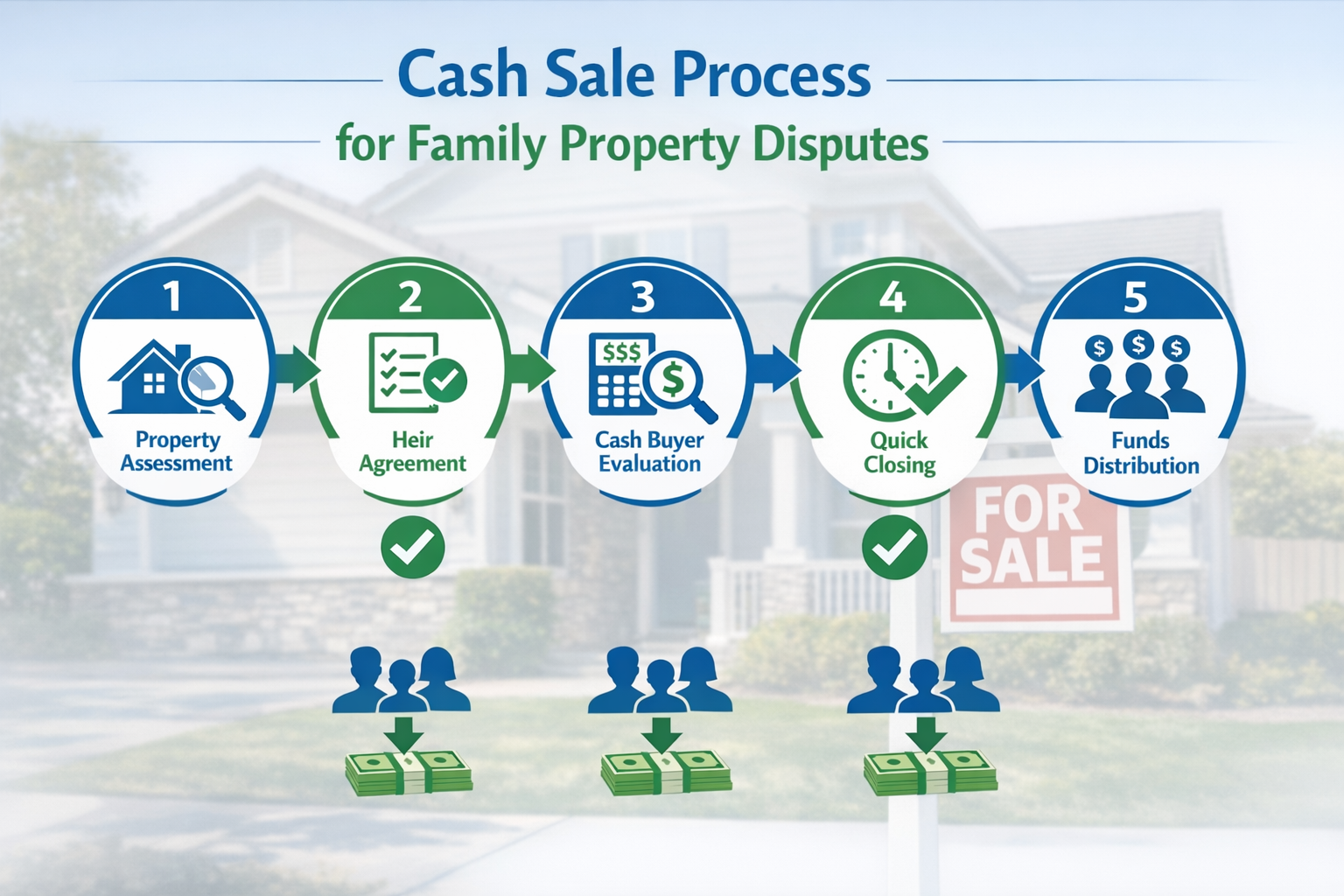
The Process Step-by-Step
Step 1: Initial Contact and Assessment
One or more co-owners reach out to a cash buyer or property solutions company that specializes in complex situations. The best companies provide helpful guidance without pressure, understanding that family situations require sensitivity.
During this phase, the company gathers information about:
- Ownership structure and percentages
- Property condition and location
- Outstanding liens, judgments, or tax issues
- Timeline needs and constraints
- Family dynamics and concerns
Step 2: Property Evaluation
Unlike traditional appraisals that can take weeks, cash buyers typically conduct quick property assessments. They evaluate:
- Current market value in as-is condition
- Repair costs and property issues
- Title complexity and clearing costs
- Comparable recent sales
- Carrying costs and timeline factors
This evaluation happens quickly—often within 24-48 hours of initial contact.
Step 3: Cash Offer Presentation
The buyer presents a no-obligation cash offer that includes:
- Purchase price and how it was calculated
- Proposed closing timeline
- What the buyer will handle (liens, back taxes, title issues)
- What sellers need to provide
- Distribution plan for proceeds
Transparent companies explain their offer clearly, helping families understand the trade-offs between speed/certainty and potentially higher prices through traditional sales.
Step 4: Heir Agreement and Coordination
This is where professional expertise matters most. Experienced buyers help coordinate:
- Communication with all co-owners
- Signature gathering for sale documents
- Resolution of any holdout situations
- Legal documentation ensuring proper authority
- Distribution instructions for closing proceeds
Companies like Sure Path Property Solutions specialize in navigating these complex multi-party situations with friendly and caring service that respects family dynamics.
Step 5: Title Work and Issue Resolution
Many disputed properties come with title complications. Professional cash buyers work with title companies to resolve:
- Clouded titles from unclear ownership history
- Outstanding liens and judgments
- Back taxes and assessment issues
- Missing documentation or signatures
- Probate complications
This work happens behind the scenes, with the buyer coordinating with industry experts to clear obstacles that would stop traditional sales.
Step 6: Closing and Distribution
At closing, the transaction completes and proceeds are distributed according to the agreed plan. Each heir receives their portion via wire transfer or check, and the property transfers to the buyer.
The entire process—from initial contact to money in hand—typically takes 2-4 weeks, compared to 6-24 months for partition actions or contested traditional sales.
Real-World Scenarios: When Cash Sales Save Families
Understanding how Family Property Dispute Resolution: Cash Sale Ends the Fight works in practice helps families recognize when this solution fits their situation.
Scenario 1: The Three Siblings and Mom’s House
The Situation: Three adult children inherited their mother’s home in equal shares. Sarah wanted to keep it as a rental property. Michael needed cash immediately for medical bills. Jennifer lived out of state and wanted nothing to do with property management.
The Problem: Traditional sale required unanimous agreement. Sarah refused to sell below $250,000. Michael couldn’t wait 6-9 months for a traditional sale. Jennifer just wanted her share without the hassle. The property had deferred maintenance issues and needed $40,000 in repairs to list traditionally.
The Cash Sale Solution: A cash buyer offered $185,000 with a 14-day closing, purchasing as-is. After calculating costs, the siblings realized:
- Traditional sale at $250,000 minus $40,000 repairs minus $15,000 agent commissions = $195,000 net
- Cash sale at $185,000 with no repairs, no commissions, and immediate closing = $185,000 net
- The $10,000 difference was worth it to Michael for immediate funds and to all of them to end the conflict
Each sibling received $61,666 within two weeks. Sarah used her portion as down payment on a rental property elsewhere. Michael paid his medical bills. Jennifer invested hers. They all attended Thanksgiving dinner together that year.
Scenario 2: The Inherited Land with Multiple Heirs
The Situation: Grandparents’ 40-acre property passed to their four children, who then passed portions to their children. By the third generation, 11 people owned fractional interests ranging from 3% to 18%. Some had never visited the property. Several lived internationally.
The Problem: Multiple heirs with one property created a coordination nightmare. Property taxes went unpaid for three years. The county was preparing tax lien foreclosure. Getting signatures from 11 people across four countries seemed impossible.
The Cash Sale Solution: A company specializing in heir property coordinated with all parties, handled back tax payoff, and structured a cash purchase that distributed proceeds according to ownership percentages. The buyer managed all document collection and international signature coordination.
Result: The property sold in 28 days. Each heir received their portion after tax payoff. The family avoided foreclosure and the complete loss of equity that would have resulted.
Scenario 3: The Divorce Property Deadlock
The Situation: A divorcing couple jointly owned a rental property. Neither wanted to keep it, but they couldn’t agree on anything—listing price, which agent to use, or whether to make repairs. Their divorce attorneys’ fees were already approaching $50,000, and the property dispute was adding thousands more.
The Problem: Every decision became a battle. He wanted to list at $320,000 and make $25,000 in improvements. She wanted to sell immediately at $280,000 as-is. The property had judgment liens from a contractor dispute, complicating traditional sales.
The Cash Sale Solution: Their attorneys recommended a cash buyer to remove the property from the divorce negotiations. The buyer offered $275,000, handled the lien payoff, and closed in 16 days. Each party received their 50% share, and the property was no longer an issue in their divorce proceedings.
The couple saved an estimated $15,000 in additional legal fees by removing this contentious issue from their divorce. The certainty of the cash sale allowed them to finalize their divorce three months earlier than projected.
Comparing Options: Cash Sale vs. Traditional Methods
When families face property disputes, they typically consider several resolution paths. Understanding the trade-offs helps make informed decisions.
Option Comparison Table
| Factor | Cash Sale | Traditional Sale | Partition Action | One Heir Buys Out Others |
|---|---|---|---|---|
| Timeline | 1-4 weeks | 3-9 months | 12-36 months | Varies widely |
| Costs | Minimal (no commissions, no repairs) | 6-10% in commissions + repairs | $15,000-$50,000+ legal fees | Appraisal + legal fees |
| Requires Agreement | Majority or court order | Unanimous | No (court-ordered) | Unanimous |
| Proceeds Distribution | Equal, immediate | Equal, delayed | Equal, heavily reduced | Buyout amount |
| Relationship Impact | Minimal (quick resolution) | Moderate (prolonged negotiations) | Severe (adversarial process) | Variable |
| Property Condition | Sold as-is | Usually requires repairs | Sold as-is (court-ordered) | As-is or improved |
| Success Rate | Very high | Moderate (if agreement reached) | 100% (court forces sale) | Low (financing challenges) |
When Cash Sales Make the Most Sense
Cash sales particularly fit situations involving:
✅ Multiple co-owners with conflicting goals – The more parties involved, the harder consensus becomes
✅ Urgent financial needs – When one or more heirs need money quickly for medical bills, debt, or other pressing matters
✅ Properties with complications – Back taxes, liens, title issues, or poor condition that make traditional sales difficult
✅ Geographic distance – When heirs live far apart and can’t easily coordinate property management or showings
✅ Relationship preservation priority – When maintaining family bonds matters more than maximizing every dollar
✅ Exhausted traditional options – When the property has been listed unsuccessfully or negotiations have stalled
When to Consider Alternatives
Cash sales aren’t always the right answer. Consider traditional methods when:
- All parties agree on approach and timeline
- The property is in excellent condition in a hot market
- No urgent financial pressures exist
- Time is available (6+ months)
- Maximum price is the only priority
- No title or legal complications exist
The key is honest assessment of your situation. Many families waste months or years pursuing traditional sales when the underlying disagreements make success impossible.
Legal Considerations and Protections
Understanding the legal framework helps families navigate property disputes confidently and avoid costly mistakes.
Ownership Structures and Their Implications
Joint Tenancy with Right of Survivorship means when one owner dies, their share automatically passes to surviving owners. This structure can simplify or complicate disputes depending on circumstances.
Tenants in Common is the most common structure for inherited property. Each owner holds a distinct percentage that can be sold, transferred, or willed to heirs. This flexibility also means one owner can force a sale through partition action.
Community Property (in certain states) means spouses own property equally. Divorce or death triggers specific rules about division or inheritance.
Understanding your ownership structure is the first step in any resolution strategy. Professional cash buyers experienced with jointly owned property can explain how your specific situation affects sale options.
Partition Actions: The Nuclear Option
When co-owners cannot agree, any owner can file a partition action—a lawsuit forcing either physical division of the property (rare for homes) or court-ordered sale with proceeds divided among owners.
Partition by Sale is most common for residential properties. The court orders the property sold at auction or through a court-appointed agent, with proceeds distributed according to ownership percentages.
Partition in Kind physically divides the property. This works for large land parcels but rarely for homes. Learn more about partition in kind vs. partition by sale options.
The Costs Are Staggering:
- Attorney fees: $15,000-$50,000+
- Court costs and filing fees: $2,000-$5,000
- Property appraisals: $500-$2,000
- Timeline: 12-36 months
- Emotional toll: Severe and lasting
Partition actions are adversarial by nature. Even when legally justified, they often permanently damage family relationships. Many families discover too late that the “winner” of a partition action still loses when legal fees consume 20-40% of the property’s value.
Protecting Your Interests in Cash Sales
When pursuing cash sales to resolve disputes, certain protections ensure fair treatment:
Independent Legal Review – Each party should have the opportunity to consult an attorney before signing sale documents. Reputable buyers encourage this and provide time for legal review.
Clear Distribution Agreements – Before closing, all parties should agree in writing on how proceeds will be distributed. This prevents post-sale disputes.
Title Insurance – Ensures the buyer is purchasing clear title and protects all parties from undisclosed liens or claims.
Escrow Protection – Using established title companies or escrow agents ensures funds are handled properly and distributed according to agreements.
Written Offers and Terms – Everything should be documented. Verbal agreements create confusion and disputes.
Trustworthy service providers prioritize transparency and protection for all parties. Companies like Sure Path Property Solutions work with established title companies and provide clear documentation at every step.
Tax Implications and Financial Planning
Selling inherited or jointly-owned property triggers tax consequences that vary based on circumstances. Understanding these implications helps families make informed decisions.
Capital Gains Considerations
Step-Up in Basis – When property is inherited, the cost basis typically “steps up” to fair market value at the date of death. This often means minimal or no capital gains tax when heirs sell shortly after inheriting.
Example: Parents bought a house in 1980 for $50,000. It’s worth $300,000 when they pass away in 2024. Heirs inherit with a stepped-up basis of $300,000. If they sell for $310,000 in 2026, they only pay capital gains tax on $10,000 profit, not $260,000.
Holding Period Matters – Inherited property is automatically considered “long-term” for capital gains purposes, qualifying for preferential tax rates even if sold immediately.
Primary Residence Exclusion – If one heir lived in the property as their primary residence for two of the past five years, they may qualify for up to $250,000 ($500,000 for married couples) in capital gains exclusion.
Dividing Proceeds Fairly
Equal Ownership Doesn’t Always Mean Equal Distribution – Several factors might justify unequal distribution:
- One heir paid property taxes or maintenance while others didn’t contribute
- One heir lived in the property rent-free
- One heir made improvements that increased value
- Estate documents specify unequal distribution
Document Everything – Create written agreements about any unequal distributions before closing. This prevents post-sale disputes and provides documentation for tax purposes.
Consider Tax Efficiency – Different heirs may have different tax situations. Strategic planning might minimize overall family tax burden, though this requires professional tax advice.
Professional Guidance Matters
Tax laws are complex and change frequently. Before finalizing any property sale, consult with:
- Tax professionals who understand real estate transactions
- Estate attorneys if the property is part of an estate
- Financial advisors to understand how proceeds fit into overall financial plans
The cost of professional advice (typically $500-$2,000) is minimal compared to potential tax savings or costly mistakes.
Finding the Right Cash Buyer: What to Look For
Not all cash buyers are created equal. Finding the right partner makes the difference between a smooth resolution and additional headaches.
Red Flags to Avoid
🚩 Pressure tactics – Legitimate buyers give families time to make informed decisions. High-pressure sales tactics signal problems.
🚩 Lack of transparency – Reputable buyers explain their offers clearly and answer questions patiently. Vague explanations or reluctance to provide details are warning signs.
🚩 Unusually low offers – While cash offers are typically below retail value, they should still be reasonable. Offers 40-50% below market value (unless the property has severe issues) suggest the buyer is taking advantage.
🚩 No local presence – Buyers with no physical office, local references, or established presence may disappear when problems arise.
🚩 Requests for upfront fees – Legitimate cash buyers never charge fees before closing. Any request for “processing fees,” “inspection fees,” or other upfront costs is a scam.
🚩 Poor communication – Difficulty reaching the buyer, unreturned calls, or inconsistent information indicates an unprofessional operation.
Green Flags of Reputable Buyers
✅ Established local presence – Physical offices, local references, and years of operation in the area
✅ Transparent process – Clear explanations of how offers are calculated and what happens at each step
✅ Professional references – Relationships with local title companies, attorneys, and other real estate professionals
✅ No-obligation offers – Time to review offers, consult advisors, and make informed decisions
✅ Experience with complex situations – Demonstrated expertise handling properties with liens, multiple owners, or title issues
✅ Positive reviews and testimonials – Verifiable feedback from previous clients in similar situations
✅ Clear contracts – Written agreements that specify all terms, contingencies, and obligations
Questions to Ask Potential Buyers
Before committing to work with a cash buyer, ask:
- How long have you been buying properties in this area?
- Can you provide references from previous sellers in similar situations?
- How did you calculate your offer? Can you explain the numbers?
- What closing costs will I be responsible for?
- What is your typical timeline from offer to closing?
- How do you handle properties with title issues or liens?
- What happens if unexpected problems arise during the process?
- Will you work with my attorney or other advisors?
- Can you provide proof of funds showing you can complete the purchase?
- What happens if I change my mind before closing?
Reputable buyers welcome these questions and provide clear, confident answers. Evasive responses or irritation at being questioned are red flags.
Working with Property Solutions Experts
Companies specializing in complex property situations offer advantages beyond simple cash purchases:
Coordination Services – Expert service managing communication among multiple heirs, attorneys, and other parties
Problem-Solving Expertise – Industry experts who’ve handled thousands of complicated situations and know how to resolve issues that stop traditional sales
Network of Professionals – Established relationships with title companies, probate attorneys, tax professionals, and other specialists
Customized Solutions – Helpful solutions tailored to specific family situations rather than one-size-fits-all approaches
Compassionate Approach – Understanding that property disputes involve emotions and relationships, not just transactions
Sure Path Property Solutions exemplifies this approach, offering friendly and caring service while providing expert guidance through complicated real estate situations.
Alternative Dispute Resolution Methods
While cash sales offer powerful solutions, families should understand all available options for resolving property conflicts.
Mediation: Facilitated Negotiation
Professional mediators help families reach agreements without litigation. A neutral third party facilitates discussions, helps identify common ground, and guides parties toward mutually acceptable solutions.
Advantages:
- Less expensive than litigation ($2,000-$5,000 typically)
- Preserves relationships through collaborative process
- Faster than court proceedings (weeks vs. years)
- Parties control the outcome rather than a judge
Limitations:
- Requires good faith participation from all parties
- No binding resolution if parties can’t agree
- May not address underlying title or legal issues
- Ineffective when parties are entrenched in positions
Mediation works best when relationships are strained but not destroyed, and when parties genuinely want to find solutions.
Family Meetings with Professional Facilitation
Before disputes escalate to legal action, structured family meetings can help. Unlike informal discussions that devolve into arguments, professionally facilitated meetings follow structured agendas:
- Establish ground rules – Respectful communication, no interrupting, focus on solutions
- Clarify the situation – Review ownership structure, property condition, financial obligations
- Identify each party’s needs and concerns – Understanding why people hold their positions
- Explore options – Brainstorm potential solutions without judgment
- Evaluate alternatives – Discuss pros and cons of each option
- Build consensus – Work toward agreements that address everyone’s core needs
Professional facilitators (often family therapists or specialized mediators) cost $200-$400 per session but can prevent thousands in legal fees.
Buyout Arrangements
Sometimes one heir wants to keep the property while others want to sell. Buyout arrangements allow one party to purchase others’ shares.
Challenges:
- The buying heir must qualify for financing or have cash
- Determining fair buyout price often requires appraisals
- Other heirs may distrust valuations
- Financing can take 30-60 days or longer
- Deals often fall through due to financing issues
When It Works:
- One heir has strong financial position and clear motivation
- Property has sentimental value to that heir
- Other heirs prefer cash to continued ownership
- Fair valuation process is agreed upon
Learn more about buying out a co-owner and the challenges involved.
Rental or Management Agreements
Some families avoid sale by agreeing to rent the property and share income. This works when:
- All parties can afford to wait for returns
- One heir is willing to manage the property
- Clear written agreements specify responsibilities and income distribution
- Property is in good condition and rentable condition
Risks:
- Management disputes often arise
- Maintenance cost disagreements
- Unequal effort (one person does work, others collect income)
- Market changes affect profitability
- Eventually, the property still needs to be sold
This approach postpones rather than resolves the fundamental issue of what to do with the property.
Taking Action: Steps to Move Forward
Understanding Family Property Dispute Resolution: Cash Sale Ends the Fight is valuable only if families take action. Here’s how to move from conflict to resolution.
Step 1: Assess Your Situation Honestly
Answer these questions truthfully:
- Can all parties genuinely agree on a traditional sale approach? If even one person is firmly opposed, traditional methods will fail.
- How urgent is resolution? Financial pressures, pending foreclosure, or deteriorating relationships may require faster solutions.
- What is the property’s true condition? Be realistic about repair needs and marketability.
- Are there title, lien, or tax issues? These complications often make traditional sales impossible without expensive legal work.
- What is the relationship cost of continued conflict? Sometimes preserving family bonds matters more than maximizing dollars.
- Can anyone afford to buy out others? If not, this option is off the table regardless of preference.
Step 2: Gather Essential Information
Before contacting buyers or attorneys, compile:
- Ownership documentation – Deeds, wills, probate documents showing who owns what percentage
- Property tax information – Current status, amount owed, payment history
- Lien and judgment records – Any claims against the property
- Property condition assessment – Honest evaluation of repairs needed
- Mortgage information – Outstanding balance if applicable
- Recent comparable sales – What similar properties sold for recently
This information helps buyers provide accurate offers and identifies issues that need resolution.
Step 3: Open Communication Channels
Even in strained relationships, attempt respectful communication:
- Send written communication to all parties outlining the situation and need for resolution
- Propose a family meeting or mediation session to discuss options
- Share information about cash sale options as an alternative to litigation
- Set a deadline for reaching agreement before pursuing legal options
- Remain respectful even if others are not
Document all communication attempts. This record may be important if legal action becomes necessary.
Step 4: Contact Professional Resources
Reach out to experts who can help:
- Cash buyers specializing in complex situations like Sure Path Property Solutions
- Real estate attorneys with experience in partition actions and property disputes
- Mediators trained in family and property conflict resolution
- Tax professionals who can explain financial implications of various options
Most offer free initial consultations. Use these to understand options without commitment.
Step 5: Evaluate Offers and Options
When you receive cash offers or other proposals:
- Compare net proceeds across different scenarios (cash sale vs. traditional sale vs. partition action)
- Consider timelines and how delay affects everyone’s situation
- Factor in certainty – a guaranteed cash offer vs. uncertain traditional sale
- Assess relationship impact – which option best preserves family bonds?
- Review with advisors – have attorneys or other professionals evaluate proposals
Create a simple comparison chart showing:
- Net proceeds to each party
- Timeline to completion
- Costs involved
- Certainty level
- Relationship impact
This objective analysis helps move past emotional positions to practical decisions.
Step 6: Make a Decision and Move Forward
Once you’ve evaluated options:
- Communicate clearly with all parties about the chosen path
- Document agreements in writing before proceeding
- Coordinate with professionals to handle legal and administrative requirements
- Stay focused on resolution rather than relitigating old grievances
- Complete the process efficiently to minimize additional conflict
The goal is resolution, not perfection. A good solution that everyone can live with beats a perfect solution that takes years to achieve.
Preventing Future Family Property Disputes
While this article focuses on resolving existing conflicts, prevention is always better than cure. Families can take steps to avoid property disputes in the first place.
Estate Planning Essentials
Clear wills and trusts that specify exactly what happens to property prevent ambiguity. Vague language like “divide my property equally among my children” leaves room for interpretation and conflict.
Specific instructions about whether property should be sold or kept, and if sold, under what conditions and timeline, eliminate common disputes.
Appointment of executors with authority to make decisions prevents deadlock. Some estates designate one heir as decision-maker for property matters.
Life insurance to equalize inheritances allows one heir to inherit property while others receive equivalent cash value, avoiding forced co-ownership.
Regular family discussions about estate plans while parents are alive help manage expectations and identify potential conflicts before they become crises.
Ownership Structure Considerations
When multiple people will own property together:
Create operating agreements that specify:
- How decisions will be made (majority vote, unanimous consent, etc.)
- How expenses will be shared
- What happens if one owner wants to sell
- How buyouts will be valued and executed
- Dispute resolution procedures
Consider LLC ownership for investment or rental properties, which provides structure and separates personal relationships from business decisions.
Build in exit strategies that allow owners to leave without forcing sales or litigation.
Regular reviews of arrangements ensure they still work for everyone as circumstances change.
Communication and Transparency
Regular family meetings about jointly-owned property keep everyone informed and prevent surprises.
Shared financial records showing income, expenses, and property condition build trust and prevent suspicions.
Clear roles and responsibilities so everyone knows who handles what aspects of property management.
Acknowledgment of different needs and willingness to adjust arrangements as circumstances change.
Preventing disputes requires ongoing effort, but it’s far less costly than resolving them after relationships have deteriorated.
Conclusion: Choosing Resolution Over Conflict
Family Property Dispute Resolution: Cash Sale Ends the Fight offers families a practical path forward when traditional approaches fail. The statistics are sobering: most family property disputes cost more in legal fees, lost value, and damaged relationships than any party gains from “winning.”
Cash sales provide speed, certainty, and equal treatment that preserve both financial value and family bonds. While the sale price may be somewhat lower than an ideal traditional sale, the total net proceeds—after accounting for repairs, commissions, carrying costs, and legal fees—often favor the cash approach. More importantly, the emotional and relational costs of prolonged conflict simply cannot be measured in dollars.
The families who navigate property disputes most successfully share common characteristics:
They prioritize relationships over maximizing every dollar. They recognize that family bonds built over decades are worth more than squeezing out the last few thousand dollars from a property sale.
They face reality honestly. They acknowledge when consensus is impossible and pursue solutions that work despite disagreements rather than waiting for unanimous agreement that will never come.
They seek expert guidance. They work with professionals who understand complex property situations and can navigate legal, financial, and emotional challenges with helpful guidance and trustworthy service.
They act decisively. They recognize that delay only increases costs and damage, so they move forward with resolution even when the path isn’t perfect.
If your family is struggling with property disputes, you have options. The conflict doesn’t have to consume years of your life and tens of thousands of dollars. Professional cash buyers who specialize in complicated situations can provide helpful solutions tailored to your specific circumstances.
Sure Path Property Solutions has helped hundreds of families navigate exactly these situations. With industry experts who understand the legal, financial, and emotional complexities of family property disputes, they provide friendly and caring service that guides families toward resolution.
Your Next Steps
- Assess your situation using the framework in this article
- Gather essential information about ownership, condition, and obligations
- Contact professional resources for free consultations and expert guidance
- Evaluate your options objectively, comparing costs, timelines, and outcomes
- Make a decision and move forward toward resolution
The path from conflict to resolution starts with a single step. Whether that’s reaching out to a cash buyer, scheduling a family meeting, or consulting with an attorney, taking action breaks the cycle of delay and deterioration.
Property disputes don’t resolve themselves. They escalate, consume resources, and damage relationships until someone chooses a different path. That someone can be you.
For families ready to end the fight and move forward, contact Sure Path Property Solutions today for a free, no-obligation consultation. Discover how cash sales can provide the clean resolution your family needs to preserve both financial value and the relationships that truly matter.
The fight can end. Resolution is possible. The choice is yours.
Sure Path is a family-owned, curative-title cash buyer. We handle the paperwork and pay what’s owed at closing — no fees, no repairs, no pressure.