
Missing Heirs Property Sale: How to Sell When Heirs Can’t Be Found

Imagine discovering you’ve inherited a valuable property, only to find out that several other heirs exist—but nobody knows where they are. This scenario plays out more often than most people realize, leaving families stuck with properties they can’t sell, maintain, or even properly claim. The Missing Heirs Property Sale: How to Sell When Heirs Can’t Be Found challenge affects thousands of property owners across America in 2026, creating legal tangles that seem impossible to unravel.
When heirs disappear, move without leaving forwarding addresses, or simply lose touch with their families over generations, the property they partially own becomes frozen in legal limbo. The good news? There are proven pathways forward, and with helpful guidance from industry experts, property owners can navigate even the most complex inheritance situations.
Key Takeaways
- Missing heirs create title defects that prevent property sales until resolved through legal processes like quiet title actions or probate proceedings
- Diligent heir searches must be conducted and documented before courts will approve sales involving unknown or missing co-owners
- Multiple legal solutions exist including partition actions, probate administration, and affidavits of heirship depending on your specific situation
- Professional help is essential when dealing with missing heirs—attempting DIY solutions typically results in costly delays and rejected title insurance
- Time and patience are required but properties with missing heirs can be successfully sold with proper legal procedures and expert service
Understanding the Missing Heirs Property Problem
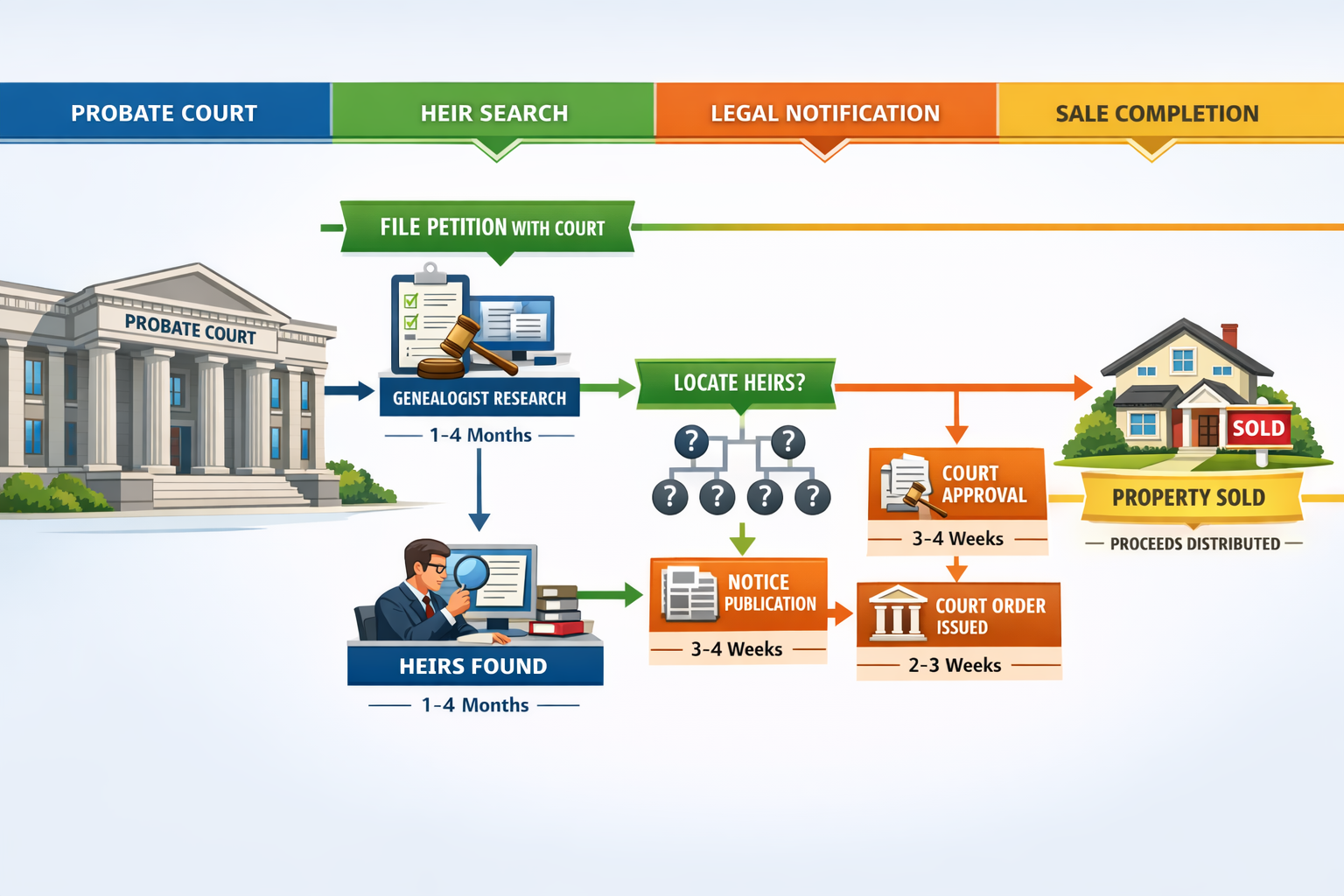
What Makes an Heir “Missing”?
An heir is considered missing when they have a legal ownership interest in property but cannot be located through reasonable search efforts. This situation commonly occurs when:
- Family members lose contact over decades or generations
- Heirs relocate without updating contact information with family
- No will exists and distant relatives inherit by intestate succession laws
- Multiple generations pass without proper estate settlement
- Records are incomplete or family history is poorly documented
The challenge intensifies with each passing generation. A property inherited in 1970 might have passed through three or four generations by 2026, with dozens of potential heirs scattered across the country—or the world.
How Missing Heirs Affect Property Ownership
When someone dies without a will or proper estate planning, their property passes to heirs according to state intestacy laws. These laws create a specific order of inheritance:
- Surviving spouse (if applicable)
- Children or their descendants
- Parents of the deceased
- Siblings or their descendants
- More distant relatives following state-specific rules
The problem? Each heir owns an undivided interest in the entire property. Even if you’ve located 90% of the heirs, that missing 10% creates a cloud on the title that prevents a clean sale.
“A property is only as marketable as its weakest title link. One missing heir with a 2% ownership interest can halt a million-dollar sale.” — Real Estate Title Attorney
Common Scenarios Leading to Missing Heirs
Generational Property Transfer
Grandparents pass away in the 1980s. Their children inherit but never formalize ownership. Those children pass away in the 2010s, and now grandchildren discover they own fractional interests in property—along with cousins they’ve never met.
Family Estrangement 🏚️
Siblings stop speaking after a parent’s death. One moves across the country, changes their name through marriage, and loses all contact with the family. Years later, the remaining siblings want to sell the family home but can’t locate their estranged sibling.
Incomplete Probate
An estate enters probate but never completes the process. The property remains in the deceased person’s name for years or decades, with heirs assuming they own it but lacking proper legal title.
Unknown Heirs
A property owner had relationships or children that other family members didn’t know about. These unknown heirs have legal rights to the property even if the family isn’t aware of their existence.
Legal Framework for Missing Heirs Property Sale
Property Rights of Missing Heirs
Just because an heir can’t be found doesn’t mean their property rights disappear. Under U.S. property law, missing heirs retain full legal ownership of their share until:
- They are legally declared deceased after a statutory period
- Their rights are extinguished through a court proceeding
- They voluntarily relinquish their interest (which requires locating them)
- Adverse possession occurs (typically 10-20 years of exclusive use)
This creates a fundamental challenge: you cannot sell what you don’t fully own, and you don’t fully own property when missing heirs hold partial interests.
State Laws Governing Heir Property
Each state has specific laws addressing heir property, also called “heirs’ property” or “tenancy in common” property. These laws vary significantly:
| State Approach | Description | Example States |
|---|---|---|
| Uniform Partition of Heirs Property Act (UPHPA) | Provides protections for heirs and requires fair market value buyouts | Georgia, Nevada, California, New York |
| Traditional Partition Laws | Allows any co-owner to force sale through partition action | Texas, Florida, Pennsylvania |
| Enhanced Notice Requirements | Requires extensive efforts to locate and notify all heirs | Illinois, North Carolina |
| Simplified Procedures | Offers affidavit-based solutions for small estates | Many states for estates under $50K-$150K |
Understanding your state’s specific framework is crucial for developing an effective strategy. Title issues like these require careful navigation of local laws.
Title Insurance and Missing Heirs
Title insurance companies protect buyers against ownership disputes. When missing heirs exist, title companies typically refuse to issue insurance until the title is cleared. This makes the property essentially unsellable on the traditional market.
A title search will reveal:
- ✅ Gaps in the chain of title where estates weren’t properly settled
- ✅ Multiple potential heirs based on family relationships
- ✅ Unresolved probate proceedings or missing documentation
- ✅ Potential claims from unknown or missing parties
Without title insurance, most buyers won’t proceed with a purchase. This is why resolving missing heir issues before attempting a sale is essential.
Conducting a Diligent Heir Search
Why Heir Searches Are Legally Required
Before courts will approve any sale or title-clearing action involving missing heirs, they require proof that a diligent search was conducted. This protects the due process rights of missing heirs and ensures they receive proper notice of legal proceedings affecting their property.
A diligent search demonstrates good faith efforts to locate all potential heirs through multiple channels and resources.
Professional Heir Search Methods
Public Records Research 📋
Professional heir search firms begin with comprehensive public records research:
- Vital records (birth, death, marriage, divorce certificates)
- Census records showing family relationships and locations
- Property records indicating where heirs might own real estate
- Court records including probate, civil, and criminal filings
- Military records for veterans and service members
- Social Security Death Index to confirm deaths
Genealogical Investigation
Heir search specialists use genealogical methods to construct complete family trees:
- DNA testing databases (with appropriate legal authorization)
- Historical newspaper archives for obituaries and announcements
- Church and cemetery records
- Immigration and naturalization documents
- Professional genealogy databases and resources
Modern Skip Tracing Techniques
For living heirs who have simply lost touch, skip tracing employs:
- Credit header information (name and address only, no credit data)
- Utility connection records
- Vehicle registration databases
- Professional licensing boards
- Social media investigation (LinkedIn, Facebook, etc.)
- Phone number databases and reverse lookups
Documenting Your Search Efforts
Courts require detailed documentation of all search efforts. Maintain records including:
- List of all resources searched with dates and results
- Copies of records obtained (death certificates, property records, etc.)
- Contact attempts made including certified mail receipts
- Responses received from potential heirs or their representatives
- Negative results showing databases checked with no findings
- Professional reports from hired heir search firms
This documentation becomes critical evidence when petitioning courts for permission to proceed with a sale despite missing heirs.
When to Hire Professional Heir Search Firms
Consider professional heir search services when:
- Multiple generations have passed since the original owner’s death
- Family relationships are complex with half-siblings, adoptions, or blended families
- Heirs lived in multiple states or countries
- Initial search efforts fail to locate critical heirs
- Court proceedings require certified professional searches
- Time is limited and you need efficient results
Professional firms typically charge $1,500-$5,000 for comprehensive searches, but this investment can save tens of thousands in legal fees and delays. When dealing with selling inherited property, professional searches often prove invaluable.
Legal Solutions for Missing Heirs Property Sale
Quiet Title Actions
A quiet title action is a lawsuit that asks the court to determine rightful ownership and “quiet” any competing claims. This powerful legal tool can clear title even when heirs cannot be located.
How Quiet Title Works:
- File a lawsuit naming all known heirs and “unknown heirs” as defendants
- Conduct and document a diligent heir search
- Provide legal notice through publication in newspapers
- Present evidence to the court of ownership and search efforts
- Obtain a court judgment declaring clear title
- Record the judgment to clear the title permanently
Timeline: 4-12 months depending on state requirements and case complexity
Cost: $3,000-$8,000 in legal fees plus court costs
Quiet title actions work well when you have clear evidence of ownership but simply cannot locate all heirs. The court’s judgment provides the legal certainty needed for title insurance. Learn more about quiet title action costs and timelines.
Probate Administration for Unsettled Estates
When the original property owner’s estate was never properly probated, opening probate proceedings can provide a framework for handling missing heirs.
Probate Solutions Include:
Formal Probate Administration
- Court supervises the entire estate settlement process
- Administrator is appointed to represent the estate
- Legal notice requirements protect missing heirs
- Court approves final distribution and/or sale
- Results in clean title transfer
Summary Probate Procedures
- Available for smaller estates (limits vary by state)
- Simplified process with reduced court supervision
- Faster timeline (2-6 months vs. 6-18 months)
- Lower legal costs
- Still provides legal protection
The probate court has authority to approve property sales even when some heirs cannot be located, provided proper notice procedures are followed. For detailed guidance, review our article on selling property in probate.
Partition Actions
A partition action allows any co-owner to force the division or sale of jointly owned property. This legal remedy can work even when some co-owners are missing.
Types of Partition:
Partition in Kind
- Physical division of the property into separate parcels
- Each heir receives their proportional share as separate property
- Rarely practical for residential properties
- Works better for large land tracts
Partition by Sale 💰
- Court orders the property sold at auction or private sale
- Sale proceeds are divided among all heirs
- Missing heirs’ shares are held by the court
- Provides clean title to the buyer
Partition Action Process:
- File a lawsuit against all co-owners (including missing heirs as “unknown defendants”)
- Provide legal notice through publication and certified mail
- Court appoints a referee or commissioner to oversee the sale
- Property is appraised and marketed
- Sale proceeds are distributed or held for missing heirs
- Buyer receives clear title free of heir claims
Important: The Uniform Partition of Heirs Property Act (UPHPA), adopted in several states, provides additional protections. Under UPHPA, heirs have the right to purchase the shares of others at fair market value before a forced sale occurs.
Understanding partition action lawsuits helps you determine if this solution fits your situation.
Affidavit of Heirship
An affidavit of heirship is a sworn statement documenting the heirs of a deceased person. While not as powerful as court judgments, affidavits can sometimes clear title in simpler cases.
When Affidavits Work:
- Estate value is below the state’s small estate threshold
- Family structure is straightforward with no disputes
- All known heirs agree on the ownership distribution
- The property has been in family possession for years
- State law specifically authorizes affidavits for title clearing
Limitations:
- Not all title companies accept affidavits as sufficient proof
- May not protect against later claims by missing heirs
- Generally works better for clearing old title defects than recent ones
- Some states don’t recognize affidavits for real property
Affidavits work best as part of a comprehensive strategy rather than as a standalone solution for complex missing heir situations.
Administrator or Executor Appointment
When an estate was never properly administered, courts can appoint an administrator (if no will exists) or executor (if a will is found) even years after death.
Benefits of Court-Appointed Representatives:
✅ Legal authority to act on behalf of the estate
✅ Can sign documents and deeds for property sales
✅ Authority to conduct heir searches and distribute assets
✅ Protection from personal liability when following court orders
✅ Ability to resolve creditor claims and clear liens
The appointed representative can petition the court for permission to sell property, even with missing heirs, when:
- The sale is necessary to pay estate debts or taxes
- The property is deteriorating and losing value
- Maintaining the property creates financial hardship
- The sale serves the best interests of all heirs
This approach combines well with probate administration and provides a clear legal framework for the entire process.
Step-by-Step Process for Selling Property with Missing Heirs
Step 1: Assess Your Ownership Situation
Begin by gathering all available information about the property and its ownership history:
Document Collection 📄
- Original deed or title documents
- Death certificates of deceased owners
- Any existing wills or trust documents
- Previous probate records (if any)
- Property tax records and payment history
- Family tree or genealogical information
Ownership Analysis
Determine:
- Who was the last clear owner of record?
- When did they pass away?
- Was their estate probated?
- Who are the legal heirs under state law?
- What percentage does each heir own?
- Which heirs can be located vs. which are missing?
Title Search
Order a professional title search to identify:
- Current vested ownership
- Gaps in the chain of title
- Outstanding liens or encumbrances
- Potential title defects
Understanding issues like breaks in the chain of title helps you plan your strategy effectively.
Step 2: Conduct Initial Heir Search
Before hiring professionals, conduct your own preliminary search:
Family Outreach
- Contact all known family members
- Ask about contact information for missing relatives
- Gather information about family history and relationships
- Document all conversations and information received
Online Research
- Search social media platforms
- Check online obituaries and genealogy sites
- Review public records available online
- Search property ownership records in likely locations
Direct Contact Attempts
- Send certified letters to last known addresses
- Contact through mutual family members
- Reach out via social media messaging
- Try phone numbers from online directories
Document every attempt and result. Even unsuccessful efforts contribute to demonstrating diligent search later.
Step 3: Consult with Legal and Real Estate Professionals
Attorney Consultation
Meet with an attorney experienced in:
- Probate and estate administration
- Real estate title issues
- Partition actions
- Quiet title proceedings
A qualified attorney can:
- Evaluate your specific situation
- Recommend the most efficient legal pathway
- Estimate timelines and costs
- Begin necessary legal proceedings
Title Company Review
Consult with a title company to:
- Understand what they need to insure the title
- Identify specific title defects requiring resolution
- Determine if any shortcuts or alternatives exist
- Get preliminary cost estimates for title insurance
Real Estate Professional Input
When dealing with complex situations, working with industry experts who understand complicated property issues provides helpful solutions tailored to your needs.
Step 4: Initiate Appropriate Legal Proceedings
Based on professional advice, begin the necessary legal process:
For Quiet Title Actions:
- Hire an attorney to draft and file the complaint
- Name all known heirs and “unknown heirs” as defendants
- Conduct and document the required heir search
- Publish legal notice in appropriate newspapers
- Attend court hearings and present evidence
- Obtain and record the final judgment
For Probate Administration:
- Petition the court to open or reopen the estate
- Request appointment as administrator/executor
- Provide required notices to heirs and creditors
- Complete required inventories and accountings
- Petition for authority to sell real property
- Obtain court approval for the sale terms
For Partition Actions:
- File partition lawsuit against all co-owners
- Serve or publish notice to all defendants
- Participate in court-ordered mediation (if required)
- Cooperate with court-appointed referee
- Follow court procedures for property sale
- Attend final hearing for distribution approval
Each process has specific requirements and timelines. Patience and careful attention to procedural rules are essential.
Step 5: Complete Required Notices and Publications
Legal notice requirements protect the due process rights of missing heirs. Typical requirements include:
Publication Notice 📰
- Publish in newspapers of general circulation
- Usually in the county where property is located
- May also require publication where heirs last resided
- Typically runs weekly for 3-4 consecutive weeks
- Must include specific legal language and case information
Certified Mail Notice
- Send to last known addresses of all heirs
- Use certified mail with return receipt requested
- Keep all receipts and returned mail as evidence
- May need to attempt multiple addresses
Posting Requirements
Some jurisdictions require:
- Physical posting of notice on the property
- Posting at the courthouse
- Publication on court or government websites
Waiting Periods
After publication and notice:
- Courts require waiting periods (typically 30-90 days)
- Missing heirs have time to respond and assert their rights
- No final action can occur until waiting periods expire
Strict compliance with notice requirements is critical. Defective notice can invalidate the entire proceeding.
Step 6: Obtain Court Approval and Clear Title
Once all procedures are complete:
Court Judgment or Order
The court will issue:
- Quiet title judgment declaring ownership
- Probate order approving sale
- Partition decree ordering sale and distribution
- Administrator appointment with authority to sell
Title Clearance
Record the court’s judgment or order:
- File with the county recorder’s office
- Ensure it references the specific property
- Obtain certified copies for title company
- Update property records to reflect clear ownership
Title Insurance Commitment
Work with your title company to:
- Submit all court documents and evidence
- Respond to any remaining title objections
- Obtain title insurance commitment
- Review and approve the commitment terms
With court-approved clear title and title insurance available, the property can now be sold through traditional or alternative channels.
Step 7: Market and Sell the Property
Traditional Sale Options:
If the property is in good condition and the market is favorable:
- List with a real estate agent
- Market to retail buyers
- Negotiate the best possible price
- Close through traditional escrow process
Alternative Sale Options:
For properties with remaining complications or time constraints:
- Sell to real estate investors who specialize in complex situations
- Consider companies that buy properties “as-is”
- Explore auction options for faster sales
- Work with professionals experienced in heir property
Companies like Sure Path Property Solutions specialize in helping property owners navigate these complex situations with friendly and caring expert service.
Distribution of Proceeds
After the sale:
- Pay all closing costs and legal fees
- Satisfy any liens or encumbrances
- Distribute shares to located heirs
- Deposit missing heirs’ shares with the court or state
- Obtain releases and final court approval if required
Special Considerations and Challenges
Dealing with Unknown vs. Missing Heirs
There’s an important distinction between missing heirs (known individuals who can’t be located) and unknown heirs (individuals whose existence is uncertain).
Unknown Heirs Scenarios:
- The deceased may have had additional children from unknown relationships
- Adoptions that weren’t documented in family records
- Marriages or divorces that family members weren’t aware of
- Children given up for adoption who have inheritance rights
- Illegitimate children who may have legal claims
Addressing Unknown Heirs:
Courts handle unknown heirs through:
- Comprehensive genealogical research
- DNA testing when appropriate
- Presumptions based on available evidence
- “Unknown heirs” as defendants in legal proceedings
- Publication notice to reach potentially unknown parties
The legal process is designed to protect even heirs whose existence isn’t confirmed, which is why thorough searches and proper legal procedures are so important.
Out-of-State and International Heirs
When heirs have moved far away, additional challenges arise:
Jurisdictional Issues 🌍
- Which state’s laws apply to the property?
- Where should legal proceedings be filed?
- How do you serve notice to international heirs?
- What if heirs are in countries without reciprocal legal agreements?
Communication Barriers
- Language differences requiring translation
- Time zone complications
- Different legal systems and property concepts
- Cultural differences in inheritance expectations
Solutions:
- Work with attorneys licensed in multiple jurisdictions
- Use international legal service providers
- Employ translation services for documents and communications
- Allow extra time for international notice and response periods
- Consider Hague Convention procedures for international service
Tax Implications of Missing Heir Property Sales
Property sales involving estates and missing heirs create complex tax situations:
Estate Tax Considerations
- Federal estate tax applies to estates over $13.61 million (2026)
- State estate taxes may apply at lower thresholds
- Estate tax returns may be required even if no tax is due
- Missing heirs’ shares may need to be held for tax purposes
Capital Gains Tax 💵
- Heirs receive “stepped-up basis” to fair market value at date of death
- Reduces or eliminates capital gains tax on inherited property
- Proper documentation of date-of-death value is essential
- Missing heirs still owe capital gains on their share
Income Tax on Estate Proceeds
- Estate may owe income tax on rental income or sale proceeds
- Missing heirs are responsible for taxes on their distributions
- Court-held funds for missing heirs may generate taxable interest
Property Tax Issues
- Unpaid property taxes create liens that must be satisfied
- Some jurisdictions offer relief for heir property
- Property tax liens can complicate sales and reduce proceeds
Consult with a tax professional experienced in estate and inheritance taxation to ensure compliance and minimize tax liability.
Properties with Multiple Issues
Missing heirs often occur alongside other property problems:
Combination Challenges:
- Missing heirs + delinquent property taxes
- Missing heirs + existing liens or judgments
- Missing heirs + code violations or property damage
- Missing heirs + title defects from previous generations
- Missing heirs + environmental issues
Comprehensive Solutions Required:
When multiple issues exist, you need a coordinated strategy:
- Prioritize issues based on legal requirements and cost-effectiveness
- Address title issues first since they affect your ability to sell
- Resolve liens that will consume sale proceeds
- Handle property condition issues that affect marketability
- Work with professionals who understand complex, multi-issue properties
Properties with clouded titles and missing heirs require patient, systematic resolution of each layer of complexity.
Working with Professionals Who Understand Missing Heir Situations
The Right Legal Team
Probate and Estate Attorneys
Look for attorneys with:
- Specific experience in heir property cases
- Knowledge of your state’s probate and partition laws
- Track record of successful quiet title actions
- Understanding of title insurance requirements
- Reasonable fee structures (flat fee vs. hourly)
Real Estate Attorneys
For properties with complex title issues, consider attorneys who:
- Specialize in title clearing and curative work
- Have relationships with title insurance companies
- Understand real estate transactions and closings
- Can coordinate with probate counsel when needed
Title Companies and Insurance
Not all title companies have equal experience with complex heir property situations.
Seek Title Companies That:
✅ Have underwriters willing to consider creative solutions
✅ Employ experienced title examiners familiar with heir property
✅ Provide helpful guidance on clearing specific title defects
✅ Offer preliminary title commitments before extensive legal work
✅ Maintain good communication throughout the process
Some national title companies have special departments for complex commercial and estate matters that can help with difficult heir property cases.
Real Estate Professionals Specializing in Complex Properties
Traditional real estate agents may not have experience with heir property challenges. Consider working with:
Investor-Focused Agents
- Understand properties with title issues
- Have buyer networks interested in complex situations
- Can market properties “as-is” when appropriate
- Know how to price properties with remaining issues
Property Solution Companies
Companies specializing in complex property situations, like Sure Path Property Solutions, offer:
- Direct purchase options that work around heir complications
- Coordination with legal professionals to clear title
- Experience with multiple heirs and one property
- Trustworthy service throughout the process
- Solutions for properties with liens, taxes, and title issues
Genealogists and Heir Search Firms
Professional heir search firms provide:
Comprehensive Search Services
- Access to specialized databases and records
- Experienced genealogical researchers
- Certified reports acceptable to courts
- International search capabilities
- Expert testimony if needed
Cost-Benefit Analysis
While professional searches cost $1,500-$5,000+, they:
- Save months of personal research time
- Provide court-acceptable documentation
- Often locate heirs that amateur searches miss
- Reduce the risk of later claims from overlooked heirs
- Can be essential for court approval of sales
Alternative Approaches and Creative Solutions

Negotiating with Located Heirs
Even when some heirs are missing, you can often make progress by working with those you can locate.
Buyout Agreements
Located heirs might agree to:
- Sell their interests to one heir who will pursue the sale
- Accept reduced shares in exchange for quick resolution
- Contribute to legal costs proportionally
- Sign agreements supporting specific legal strategies
Cooperative Legal Action
When located heirs cooperate:
- Legal costs can be shared among multiple heirs
- Court proceedings move faster with consenting parties
- Judges view cooperative efforts favorably
- Solutions like partition become more straightforward
Written Agreements
Document all agreements with:
- Clear terms signed by all participating heirs
- Attorney review to ensure enforceability
- Provisions for how missing heirs’ shares will be handled
- Dispute resolution procedures if disagreements arise
Understanding how to navigate situations when siblings won’t cooperate can help even when some heirs remain missing.
Selling Your Partial Interest
In some situations, you might consider selling just your ownership share rather than the entire property.
Partial Interest Sales:
- Investors sometimes purchase fractional interests in property
- Prices are typically discounted (often 30-60% of proportional value)
- Buyer assumes the burden of dealing with other heirs
- You receive immediate cash without legal proceedings
Pros:
- Quick resolution without legal costs
- No need to locate or coordinate with other heirs
- Immediate cash payment
- Eliminates your ongoing property tax obligations
Cons:
- Significantly reduced sale price
- Limited market for partial interests
- May complicate matters for remaining heirs
- Doesn’t fully resolve the property situation
This option works best when legal proceedings would be prohibitively expensive or when you need immediate funds and don’t want to invest time in the full resolution process.
Life Estate Considerations
Sometimes missing heirs hold life estates or remainder interests that complicate sales.
Life Estate Scenarios:
- Original owner gave someone a life estate (right to use property for their lifetime)
- Remainder interest passes to heirs upon life tenant’s death
- Life tenant may be missing or unable to be located
- Property can’t be sold without life tenant’s consent
Solutions:
- Locate life tenant and negotiate purchase of their interest
- If life tenant is deceased, obtain death certificate to extinguish life estate
- Court proceedings to terminate abandoned life estates
- Quiet title actions when life tenant can’t be found
Adverse Possession Considerations
In rare cases, long-term possession might provide an alternative pathway.
Adverse Possession Requirements:
Most states require:
- Continuous possession for statutory period (typically 10-20 years)
- Exclusive use without permission from other owners
- Open and notorious possession (not hidden or secret)
- Hostile (without permission of true owners)
- Actual possession with physical presence and use
Limitations for Heir Property:
Adverse possession rarely works for heir property because:
- Co-owners’ possession isn’t “hostile” to other co-owners
- Family members’ use is typically permissive
- Statutory periods are long and documentation is required
- Courts disfavor adverse possession against family members
While not typically a primary solution, adverse possession might apply in specific circumstances with proper legal guidance.
Preventing Future Missing Heir Problems
Proper Estate Planning
The best solution to missing heir problems is preventing them in the first place.
Essential Estate Planning Documents:
Last Will and Testament 📝
- Clearly identifies all heirs and beneficiaries
- Specifies exactly how property should be distributed
- Names an executor to manage the estate
- Reduces ambiguity and potential disputes
Living Trusts
- Avoids probate entirely
- Provides clear succession planning
- Maintains privacy (unlike probate)
- Allows for professional trustee management
Transfer-on-Death Deeds
- Available in many states
- Transfers property automatically at death
- Avoids probate for real estate
- Can be changed or revoked during lifetime
Beneficiary Deeds
- Similar to transfer-on-death deeds
- Names specific beneficiaries for property
- Takes effect automatically at death
- Keeps property out of probate
Learn more about selling trust property and how proper planning simplifies future transfers.
Maintaining Family Records and Communication
Family Documentation:
Create and maintain:
- Updated family tree with contact information
- Copies of important documents (deeds, wills, trusts)
- Property ownership records and history
- Contact information for all family members
- Regular updates as families grow and change
Regular Communication:
- Hold family meetings about property ownership
- Discuss inheritance plans openly
- Update contact information regularly
- Maintain relationships even with distant relatives
- Document family history and relationships
Timely Probate and Estate Settlement
Don’t Delay Probate:
When someone passes away:
- Begin probate proceedings within statutory timeframes
- Complete the process fully rather than abandoning it mid-way
- Obtain and record proper deeds transferring title
- Update property tax records to reflect new ownership
- Ensure all heirs receive proper documentation
Benefits of Timely Action:
✅ Prevents title gaps that complicate future sales
✅ Locates heirs while contact information is current
✅ Resolves issues while witnesses and documents are available
✅ Avoids accumulation of multiple generations of heirs
✅ Provides clear ownership for future transactions
Regular Property Maintenance and Tax Payment
Even when ownership is unclear:
Continue Property Maintenance:
- Pay property taxes to prevent tax liens and foreclosure
- Maintain insurance coverage
- Perform necessary repairs
- Secure vacant properties
Document Expenses:
- Keep records of all payments made
- These may be reimbursable from sale proceeds
- Demonstrates good faith stewardship
- Supports your claims in legal proceedings
Communicate with Co-Owners:
- Inform located heirs of expenses
- Request contribution to costs
- Document who pays what
- Establish agreements about ongoing expenses
Real-World Success Stories
Case Study 1: Three Generations of Missing Heirs
The Situation:
A family property in Georgia passed through three generations without proper probate. The original owner died in 1975, his children inherited but never formalized ownership, and those children passed away in the 2000s and 2010s. By 2026, there were 23 potential heirs, including 8 who couldn’t be located.
The Solution:
- Hired professional genealogist to construct complete family tree
- Located 15 of 23 heirs through heir search firm
- Filed quiet title action naming all heirs and “unknown heirs”
- Published legal notice in three newspapers for four weeks
- Presented evidence of diligent search to the court
- Obtained court judgment clearing title after 8 months
The Outcome:
Property sold for $185,000. After legal fees ($12,000), heir search costs ($4,500), and back taxes ($8,200), net proceeds of $160,300 were distributed among located heirs. Missing heirs’ shares ($48,000) were deposited with the state unclaimed property division.
Case Study 2: International Heir Located Through DNA
The Situation:
A property owner discovered that one of four heirs had emigrated to Australia in the 1980s and lost all contact with the family. Traditional search methods failed to locate the missing heir.
The Solution:
- Uploaded DNA to genealogical databases with court approval
- Matched with a distant cousin who had contact information
- Located the missing heir living in Melbourne
- Coordinated international legal notice and communication
- Negotiated buyout of the heir’s share ($32,000)
- Completed sale with all heirs’ cooperation
The Outcome:
The missing heir was grateful to be found and reconnected with family. The property sold quickly once all heirs were located and agreed to the sale terms. Total time from beginning search to completed sale: 11 months.
Case Study 3: Partition Sale with Court-Held Proceeds
The Situation:
Five siblings inherited a property, but two had completely disappeared—no contact with family for over 15 years. The three located siblings needed to sell due to mounting property taxes and maintenance costs.
The Solution:
- Filed partition action against all co-owners
- Conducted documented heir search for missing siblings
- Published legal notice as required
- Court appointed referee to oversee sale
- Property sold at auction for $215,000
- Missing siblings’ shares held by court pending their claim
The Outcome:
The three participating siblings received their shares ($129,000 total after costs). The two missing siblings’ shares ($86,000) remain with the court. If they appear within the statutory period (7 years in their state), they can claim their funds. If not, the funds eventually escheat to the state.
Frequently Asked Questions
How long does it take to sell property with missing heirs?
Timelines vary significantly based on the legal approach and complexity:
- Quiet title actions: 4-12 months
- Probate administration: 6-18 months
- Partition actions: 6-14 months
- Combined approaches: 12-24 months
The heir search phase alone can take 2-6 months. Court proceedings add additional time based on local court schedules and case complexity.
Can I sell property if I can only find some of the heirs?
Not through a traditional sale without legal proceedings. You need either:
- Consent from all heirs (requiring you to locate them all), or
- Court approval through quiet title, probate, or partition proceedings
Working with professionals who understand these situations can help you navigate the process.
What happens to missing heirs’ share of sale proceeds?
Missing heirs’ proceeds are typically:
- Held by the court for a statutory period (often 5-10 years)
- Deposited with the state’s unclaimed property division
- Paid to the missing heir if they later appear and prove their claim
- Eventually escheated (transferred) to the state if never claimed
Missing heirs retain their right to claim proceeds even after the property is sold.
How much does it cost to clear title with missing heirs?
Typical costs include:
- Attorney fees: $3,000-$15,000 depending on complexity
- Heir search services: $1,500-$5,000
- Court filing fees: $300-$800
- Publication costs: $200-$600
- Title insurance and closing costs: 2-4% of sale price
Total costs often range from $5,000-$25,000 depending on the property value and situation complexity.
Do I need an attorney for missing heir property sales?
While not legally required in all situations, attorney representation is strongly recommended because:
- Court procedures are complex with strict requirements
- Mistakes can invalidate proceedings and waste time and money
- Attorneys know what title companies need for insurance
- Legal advice protects you from personal liability
- DIY attempts usually cost more in the long run
Can title insurance be obtained for property with missing heirs?
Not until the title is cleared through appropriate legal proceedings. Title companies will not insure property with known ownership defects. However, once you obtain:
- A quiet title judgment
- Probate court approval
- Partition decree
- Other court-ordered title clearing
Title insurance becomes available, making the property marketable.
What if a missing heir appears after the property is sold?
If proper legal procedures were followed:
- The sale is valid and cannot be overturned
- The missing heir’s remedy is limited to claiming their share of proceeds
- Court-held funds are available for their claim
- The buyer’s ownership is protected
This is why following proper notice and legal procedures is so important—it protects both the buyer and the selling heirs.
Taking Action: Your Next Steps
Immediate Actions You Can Take Today
1. Gather Your Documentation 📋
Collect everything you have:
- Property deeds and title documents
- Death certificates
- Family information and contact details
- Property tax records
- Any existing wills or estate documents
2. Create a Preliminary Family Tree
Document:
- All known heirs and their relationships
- Contact information for those you can reach
- Last known information for missing heirs
- Dates of birth and death where known
3. Research Your State’s Laws
Understand:
- Whether your state has adopted UPHPA
- Probate requirements and thresholds
- Partition action procedures
- Quiet title requirements
4. Consult with Professionals
Schedule consultations with:
- Estate or probate attorney
- Title company
- Real estate professionals experienced with complex properties
- Property solution companies if appropriate
When to Seek Professional Help Immediately
Contact professionals right away if:
⚠️ Property taxes are delinquent and foreclosure is threatened
⚠️ The property is deteriorating and losing value
⚠️ Code violations or legal actions have been filed
⚠️ Multiple heirs are in conflict about the property
⚠️ You’ve received offers but can’t clear title
⚠️ Liens or judgments are accumulating
Time-sensitive situations require immediate action to preserve options and property value.
Working with Sure Path Property Solutions
When dealing with missing heirs and complex property situations, Sure Path Property Solutions provides:
Comprehensive Support:
- Expert service from industry experts who understand heir property
- Helpful guidance through every step of the process
- Coordination with attorneys and title professionals
- Friendly and caring approach to sensitive family situations
Flexible Solutions:
- Direct purchase options that work around title complications
- Assistance clearing title before traditional sale
- Solutions for properties with multiple issues
- Trustworthy service throughout complex transactions
No-Obligation Consultation:
Reach out to discuss your specific situation and explore helpful solutions tailored to your needs. Whether you need guidance on the legal process or want to explore direct sale options, experienced professionals can help you move forward.
Conclusion
The Missing Heirs Property Sale: How to Sell When Heirs Can’t Be Found challenge affects thousands of families across America, but it’s not insurmountable. While the process requires patience, proper legal procedures, and often professional assistance, properties with missing heirs can be successfully sold.
The key principles to remember:
✅ Missing heirs don’t eliminate property rights—proper legal procedures must be followed
✅ Multiple solutions exist—quiet title, probate, partition, and other approaches can work
✅ Professional help is essential—attorneys, title companies, and heir search firms provide critical expertise
✅ Documentation matters—thorough records of search efforts and legal compliance protect everyone
✅ Time and persistence pay off—while the process takes months, resolution is achievable
Whether you’re dealing with a property that’s been in your family for generations or you’ve recently discovered an inheritance with missing co-owners, taking action now prevents further complications. Each passing year adds complexity as families grow, heirs relocate, and memories fade.
Start with the immediate actions outlined above: gather documentation, create your family tree, research your state’s laws, and consult with professionals. With helpful guidance from industry experts and a clear understanding of your legal options, you can navigate even the most complex missing heir situations.
The property that seems impossibly tangled today can become a successfully completed sale tomorrow. With the right approach, professional support, and commitment to following proper procedures, you can resolve your missing heirs property situation and move forward with confidence.
Remember, you don’t have to navigate this journey alone. Trustworthy service from professionals who understand these complex situations—like the team at Sure Path Property Solutions—can make all the difference between frustration and successful resolution.
Take the first step today. Your path to selling property with missing heirs begins with a single action—reach out for expert help and start moving toward the clear, practical solution you need.