
Partition Lawsuit Alternatives: Faster, Cheaper Solutions

When multiple people own a property together and can’t agree on what to do with it, the situation can feel overwhelming. A partition lawsuit might seem like the only way out, but it’s often the most expensive and time-consuming option. The good news? Partition lawsuit alternatives: faster, cheaper solutions exist that can help co-owners resolve their disputes without the stress, delay, and financial drain of going to court. Whether dealing with inherited property, joint ownership gone wrong, or disagreements between family members, understanding these alternatives can save thousands of dollars and months—or even years—of frustration.
Key Takeaways
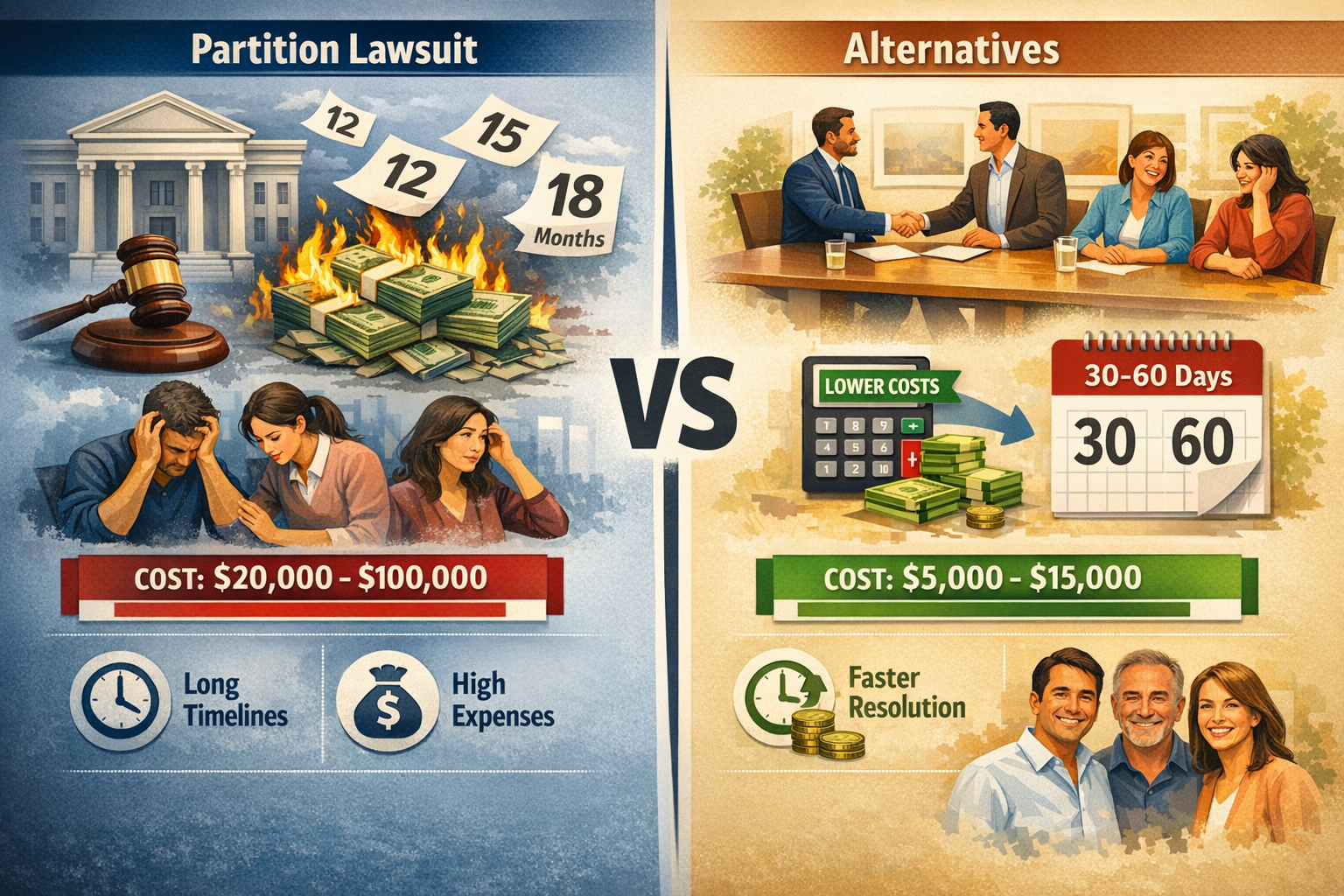
- 🚀 Partition lawsuits typically cost $20,000-$100,000 and take 12-18 months, while alternatives can resolve disputes in 30-90 days for a fraction of the cost
- 💰 Buyout agreements, voluntary sales, and mediation preserve more equity and maintain family relationships better than forced court sales
- 🤝 Professional mediation and negotiation services help co-owners reach fair agreements without destroying relationships or property value
- ⚡ Cash buyers specializing in co-owned properties offer quick exits for owners who want immediate resolution without court involvement
- 📋 Early intervention with alternative solutions prevents the emotional and financial devastation that partition lawsuits often cause
Understanding Partition Lawsuits and Why They’re Problematic
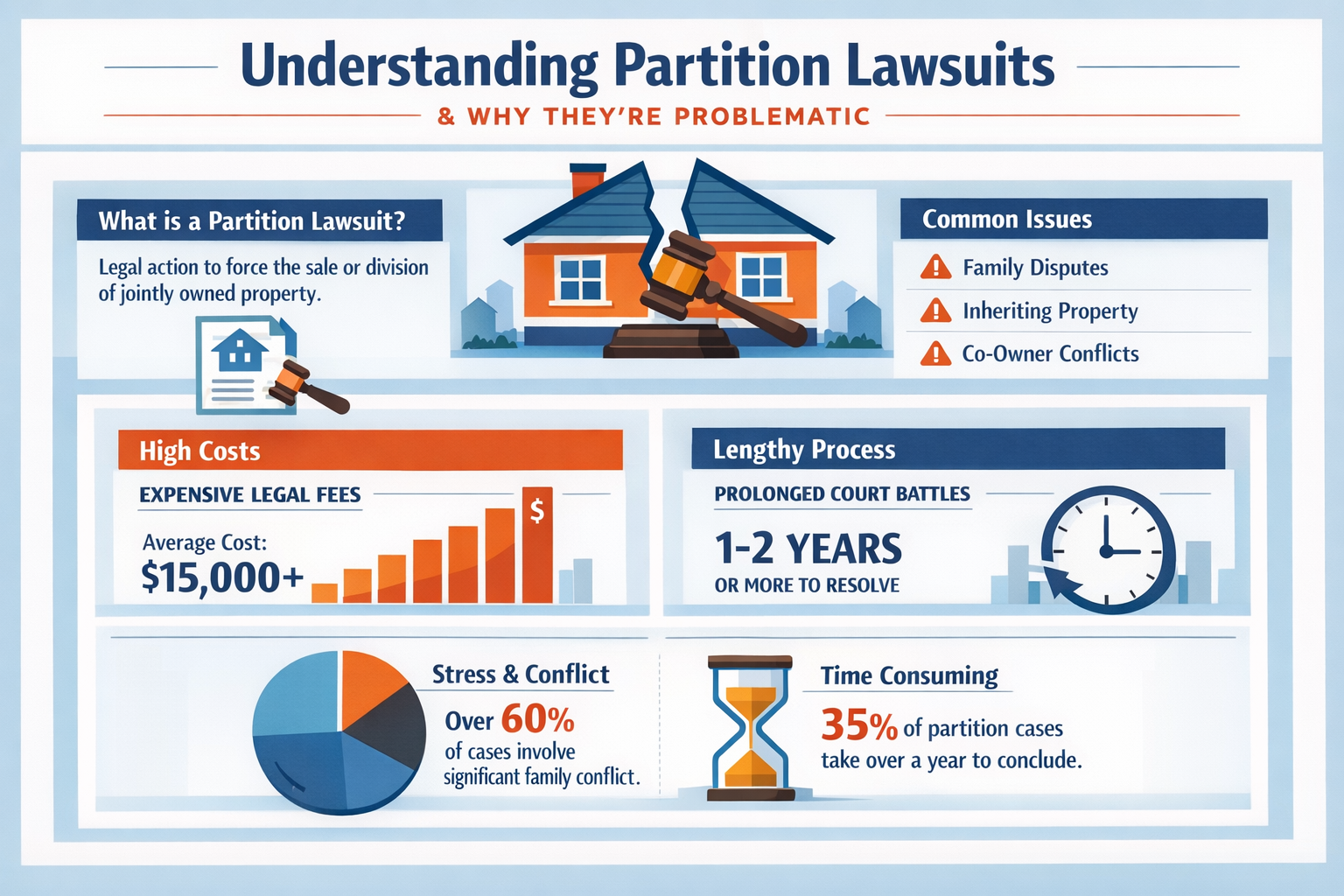
A partition lawsuit is a legal action that forces the sale or physical division of jointly owned property when co-owners cannot agree. While it’s a legitimate legal remedy, it comes with significant drawbacks that make it the option of last resort.
The True Cost of Partition Litigation
Partition lawsuits drain resources in multiple ways:
Financial costs include:
- Attorney fees ranging from $15,000 to $75,000 or more
- Court costs and filing fees ($500-$2,000)
- Property appraisal fees ($400-$800)
- Referee or commissioner fees ($5,000-$15,000)
- Accounting and expert witness fees
- Potential tax consequences from forced sales
Time costs are equally devastating:
- Initial filing and response: 2-4 months
- Discovery and motions: 3-6 months
- Trial preparation and hearing: 4-8 months
- Sale process if partition by sale ordered: 3-6 months
- Total timeline: 12-24 months on average
How Partition Lawsuits Damage Property Value
Court-ordered sales rarely achieve market value. Here’s why:
The property sells “as-is” with no repairs or improvements. Buyers know it’s a forced sale and make lower offers accordingly. The court-appointed referee prioritizes speed over maximum value. Marketing is often minimal compared to traditional real estate sales.
Properties in partition sales typically sell for 10-30% below market value, meaning co-owners lose substantial equity that could have been preserved through alternative solutions.
The Emotional Toll on Families
Beyond money and time, partition lawsuits destroy relationships. Siblings who inherited property together stop speaking. Extended family members take sides. Holiday gatherings become impossible. The adversarial nature of litigation turns disagreements into bitter feuds that last for generations.
When dealing with inherited property challenges, maintaining family harmony while resolving ownership disputes should be a priority—something partition lawsuits rarely achieve.
Partition Lawsuit Alternatives: Faster, Cheaper Solutions That Work
The good news is that multiple alternatives exist, each offering advantages over traditional partition litigation. These solutions prioritize cooperation, preserve value, and resolve disputes faster while costing significantly less.
1. Buyout Agreements Between Co-Owners
How it works: One or more co-owners purchase the ownership shares of the others, consolidating ownership and eliminating the dispute.
The process:
- Obtain a professional property appraisal from a licensed appraiser
- Calculate each owner’s share based on ownership percentage
- Negotiate payment terms (lump sum, installments, or seller financing)
- Draft a purchase agreement with clear terms
- Close the transaction and transfer ownership
Advantages:
- ✅ Keeps property in the family if desired
- ✅ Avoids court costs and attorney fees
- ✅ Completed in 30-60 days typically
- ✅ Preserves full market value
- ✅ Maintains family relationships
Challenges:
- One party must have financing or cash available
- All parties must agree on property value
- May require formal appraisal to establish fair price
Real-world example: Three siblings inherited their parents’ home valued at $300,000. One sibling wanted to keep it while the other two wanted cash. Rather than file a partition lawsuit, they hired an appraiser ($500), and the sibling who wanted to keep the property obtained a mortgage to buy out the others’ shares ($100,000 each). Total cost: approximately $3,500 in closing costs and appraisal fees, completed in 45 days.
For co-owners considering this option, understanding how to buy out a co-owner quickly can streamline the process significantly.
2. Voluntary Sale with Agreement
How it works: All co-owners agree to list and sell the property through traditional channels, splitting proceeds according to ownership percentages.
The process:
- All owners sign a listing agreement
- Select a real estate agent together
- Agree on listing price and terms
- Market property properly to achieve maximum value
- Review offers together and agree on acceptance
- Close sale and distribute proceeds
Advantages:
- ✅ Achieves full market value through proper marketing
- ✅ All owners participate in decision-making
- ✅ Costs only standard real estate commissions (5-6%)
- ✅ Typically completes in 60-120 days
- ✅ No court involvement or legal fees
Challenges:
- Requires all owners to cooperate
- Disagreements on price or terms can stall process
- Property must be in marketable condition
- May require repairs or updates to maximize value
Making voluntary sales work: The key is establishing clear communication and decision-making processes upfront. Consider designating one owner as the primary contact with the agent, but require all major decisions (price, repairs, offer acceptance) to be made unanimously or by majority vote.
When properties have title issues or complications, addressing these before listing ensures a smoother sale process.
3. Professional Mediation Services
How it works: A neutral third-party mediator facilitates negotiations between co-owners to reach a mutually acceptable resolution.
The mediation process:
- All parties agree to mediation and select a mediator
- Each party prepares their position and desired outcome
- Mediator meets with all parties (together or separately)
- Mediator helps identify common ground and creative solutions
- Parties negotiate terms with mediator’s guidance
- Agreement is documented and made legally binding
Advantages:
- ✅ Costs $2,000-$8,000 (fraction of litigation costs)
- ✅ Typically resolves in 1-3 mediation sessions
- ✅ Preserves relationships through collaborative process
- ✅ Allows creative solutions beyond court’s limited options
- ✅ Confidential process protects privacy
Types of mediators:
- Real estate mediators: Specialize in property disputes
- Family mediators: Focus on family dynamics and relationships
- Attorney-mediators: Provide legal insight while facilitating
- Retired judges: Offer experience and gravitas
What mediation can resolve:
- Who will buy out whom and at what price
- How to divide property physically if feasible
- Sale terms and timeline all parties accept
- How to handle property expenses during transition
- Distribution of proceeds or assets
Success rates: Studies show mediation resolves 70-80% of property disputes that would otherwise go to litigation, at a fraction of the cost and time.
4. Private Negotiation with Written Agreement
How it works: Co-owners negotiate directly (often with attorney guidance) and create a binding agreement without court involvement.
The process:
- Each party identifies their goals and priorities
- Owners meet to discuss options (in person or virtually)
- Negotiate terms that address everyone’s concerns
- Attorneys draft formal agreement
- All parties sign and execute the agreement
Advantages:
- ✅ Most cost-effective option ($1,000-$5,000 in legal fees)
- ✅ Fastest resolution (can complete in days or weeks)
- ✅ Complete control over outcome
- ✅ Maximum flexibility in structuring solutions
- ✅ Maintains privacy and confidentiality
Essential elements of the agreement:
- Clear identification of all parties and property
- Specific actions each party will take
- Timeline for completion of each step
- Financial terms and payment schedule
- What happens if someone doesn’t comply
- Dispute resolution process for future disagreements
When private negotiation works best:
- Co-owners have reasonable relationship
- Number of owners is small (2-4 people)
- Property value and ownership percentages are clear
- All parties are motivated to resolve quickly
- Communication channels are open
For situations involving multiple heirs and complex ownership, having helpful guidance from professionals who understand these dynamics makes private negotiation more successful.
5. Cash Buyer Solutions for Quick Resolution
How it works: Specialized investors or companies purchase the entire property quickly, allowing all co-owners to exit simultaneously with cash.
The process:
- Contact cash buyer specializing in co-owned properties
- Provide property details and ownership information
- Receive cash offer (typically within 24-48 hours)
- All owners review and accept offer
- Close in 7-30 days with cash distribution
Advantages:
- ✅ Fastest resolution (7-30 days typical)
- ✅ No repairs or improvements needed
- ✅ Eliminates ongoing holding costs
- ✅ Works even with difficult co-owners
- ✅ Certain outcome with no sale contingencies
Considerations:
- Offers typically 70-85% of market value
- Trade-off between speed/convenience and maximum price
- Best for situations where quick resolution is priority
- Ideal when property needs significant repairs
When cash buyers make sense:
- Co-owners cannot agree on any other solution
- Property has deferred maintenance or title issues
- Ongoing holding costs are draining resources
- Emotional toll of dispute is severe
- Time is critical (foreclosure, tax sale, etc.)
At Sure Path Property Solutions, we specialize in purchasing co-owned properties where traditional sales won’t work. Our expert service includes coordinating with all owners, handling title complications, and providing fair cash offers that allow everyone to move forward.
For properties with liens or judgments complicating ownership, cash buyers can often resolve these issues as part of the transaction, providing a clean exit for all parties.
Comparing Costs: Partition Lawsuit vs. Alternatives
Understanding the financial impact of each option helps co-owners make informed decisions. Here’s a realistic comparison:
| Solution | Typical Cost | Timeline | Value Preserved | Relationship Impact |
|---|---|---|---|---|
| Partition Lawsuit | $20,000-$100,000+ | 12-24 months | 70-90% of market value | Very negative |
| Buyout Agreement | $2,000-$8,000 | 30-60 days | 100% of market value | Neutral to positive |
| Voluntary Sale | 5-6% commission | 60-120 days | 95-100% of market value | Neutral to positive |
| Mediation | $2,000-$8,000 | 30-90 days | 95-100% of market value | Positive |
| Private Negotiation | $1,000-$5,000 | 7-60 days | 95-100% of market value | Positive |
| Cash Buyer | 15-30% discount | 7-30 days | 70-85% of market value | Neutral |
Real Cost Analysis Example
Property value: $400,000
Three equal co-owners: Each owns 33.33%
Partition lawsuit outcome:
- Court costs and fees: $35,000
- Property sells for: $320,000 (20% below market)
- Net proceeds: $285,000
- Each owner receives: $95,000
Voluntary sale outcome:
- Real estate commission (6%): $24,000
- Property sells for: $400,000 (full market value)
- Net proceeds: $376,000
- Each owner receives: $125,333
Difference: Each owner gains $30,333 by avoiding partition lawsuit 💰
This example shows how partition lawsuit alternatives preserve significantly more value for all parties involved.
Step-by-Step Guide to Implementing Alternatives
Ready to pursue an alternative to partition litigation? Follow this practical roadmap:
Step 1: Assess the Situation Honestly
Questions to answer:
- What does each co-owner want (keep property, sell, buy out)?
- What’s the current state of communication between owners?
- Are there financial constraints affecting options?
- What’s the property’s condition and marketability?
- Are there liens, back taxes, or title issues?
Document everything:
- Ownership percentages and deed information
- Property tax status and amount owed
- Outstanding liens or judgments
- Property condition and needed repairs
- Each owner’s contact information and position
Understanding complications like back taxes on inherited property helps identify which alternatives are most feasible.
Step 2: Open Communication Channels
Best practices:
- Initiate contact with a collaborative, non-confrontational tone
- Propose a specific meeting or call to discuss options
- Suggest bringing attorneys or advisors if it helps people feel comfortable
- Focus on shared goals (resolving situation, maximizing value)
- Avoid blame or rehashing past disagreements
Sample opening message:
“I’d like to discuss options for resolving our shared ownership of [property address]. Rather than pursuing expensive litigation, I believe we can find a solution that works for everyone. Would you be willing to meet or have a call next week to explore alternatives?”
Step 3: Explore All Available Options
Create a comparison chart:
List each alternative with its pros, cons, costs, and timeline. Share this with all co-owners so everyone understands the options objectively.
Consider hybrid solutions:
Sometimes combining approaches works best. For example, one owner might buy out a second owner while selling to a third party to raise the funds.
Get professional input:
- Real estate attorney for legal guidance
- Real estate agent for market value assessment
- Appraiser for formal valuation
- Mediator for facilitation if communication is difficult
- Financial advisor for tax implications
Step 4: Select the Best Alternative
Factors to weigh:
- Speed needed: How urgent is resolution?
- Financial resources: Who can afford what?
- Relationship priority: How important is maintaining family harmony?
- Property condition: Does it need work before selling?
- Market conditions: Is it a good time to sell?
Decision-making process:
If all owners can’t agree unanimously, consider:
- Majority vote if ownership agreement allows
- Mediation to break deadlock
- Each owner ranking preferences to find common ground
Step 5: Execute the Chosen Solution
For buyouts:
- Get formal appraisal
- Secure financing if needed
- Draft purchase agreement with attorney
- Schedule closing with title company
- Transfer deed and distribute funds
For voluntary sales:
- All owners sign listing agreement
- Prepare property for market
- Review offers together
- Accept offer meeting agreed criteria
- Close sale and distribute proceeds
For mediation:
- Select and hire mediator
- Prepare position statements
- Attend mediation sessions
- Document agreement reached
- Execute agreed-upon solution
For cash buyers:
- Contact reputable cash buying company
- Provide property information
- Review cash offer
- Get all owners to approve
- Close quickly and receive funds
Step 6: Document Everything Legally
Critical documentation:
- Written agreement signed by all parties
- Recorded deed changes reflecting new ownership
- Release documents from selling owners
- Distribution records showing funds paid
- Tax documentation for IRS reporting
Protect yourself:
Work with a real estate attorney to ensure all documents are properly prepared and recorded. This prevents future disputes and provides legal protection.
When to Consider Each Alternative
Choosing the right partition lawsuit alternative depends on your specific circumstances. Here’s helpful guidance on matching solutions to situations:
Choose Buyout Agreements When:
✅ One co-owner wants to keep the property
✅ That owner has access to financing or cash
✅ Other owners want immediate liquidity
✅ Property has sentimental value to one party
✅ Keeping property in family is important
Best for: Family homes, properties with one occupying owner, situations where one party has significantly stronger attachment to property.
Choose Voluntary Sale When:
✅ All owners want to liquidate
✅ Property is in good condition
✅ Market conditions are favorable
✅ Owners can cooperate on listing decisions
✅ Maximizing sale price is top priority
Best for: Investment properties, vacant land, properties in good condition, situations where all parties want to move on.
Choose Mediation When:
✅ Communication has broken down but isn’t hostile
✅ Owners have different goals that might be reconcilable
✅ Family relationships are worth preserving
✅ Creative solutions beyond simple sale might work
✅ Previous direct negotiations have stalled
Best for: Family disputes, complex ownership structures, situations where emotions are running high but goodwill remains.
Choose Private Negotiation When:
✅ Owners have reasonable working relationship
✅ Goals are relatively aligned
✅ Number of owners is small
✅ Fastest, cheapest resolution is priority
✅ Issues are straightforward
Best for: Business partners, friends who co-invested, siblings with good relationships, situations with clear solutions.
Choose Cash Buyers When:
✅ Speed is critical (foreclosure, tax sale approaching)
✅ Property needs significant repairs
✅ Co-owners cannot agree on anything else
✅ Ongoing costs are draining resources
✅ Title issues complicate traditional sale
✅ Emotional toll is severe and immediate exit needed
Best for: Distressed properties, situations with hostile co-owners, properties with title or lien issues, time-sensitive situations.
When dealing with properties that have liens or judgments, cash buyers often provide the most practical path forward since they can resolve these complications as part of the purchase.
Common Obstacles and How to Overcome Them
Even with the best alternatives, challenges arise. Here’s how to address common obstacles:
Obstacle 1: One Owner Refuses to Cooperate
The problem: One co-owner won’t respond to communications, refuses all proposals, or makes unreasonable demands.
Solutions:
- Send formal written notices via certified mail
- Engage an attorney to communicate on your behalf
- Propose mediation with professional facilitator
- Explore whether that owner’s share can be purchased by others
- As last resort, partition lawsuit may be necessary
Important note: Some states allow partition even without all owners’ agreement, but exploring alternatives first is still advisable.
Obstacle 2: Disagreement on Property Value
The problem: Co-owners have vastly different opinions on what the property is worth.
Solutions:
- Hire independent licensed appraiser (cost $400-$800)
- Get multiple broker price opinions from real estate agents
- Agree in advance to accept appraiser’s valuation as binding
- Consider averaging multiple professional opinions
- Review recent comparable sales together
Pro tip: Agreeing upfront on the valuation method prevents this from becoming a dealbreaker.
Obstacle 3: Insufficient Funds for Buyout
The problem: The owner who wants to keep the property can’t afford to buy out the others.
Solutions:
- Explore seller financing where buying owner pays in installments
- Consider partial buyout now with remaining payment upon refinance
- Investigate cash-out refinancing or home equity loans
- Bring in outside investor as new partner
- Sell to third party instead if buyout isn’t feasible
Creative approach: Sometimes the buying owner can trade other assets or provide services in exchange for reduced cash payment.
Obstacle 4: Property Has Title Issues or Liens
The problem: Clouds on title, liens, or judgments complicate any transaction.
Solutions:
- Order title search to identify all issues
- Work with title company to determine resolution requirements
- Negotiate with lienholders for reduced payoffs
- Explore quiet title action if needed
- Consider cash buyers who purchase despite title issues
Understanding how to resolve title problems opens more options for resolving co-ownership disputes.
Obstacle 5: Emotional Conflicts Overshadow Logic
The problem: Family history, hurt feelings, or grudges prevent rational decision-making.
Solutions:
- Engage professional mediator trained in family dynamics
- Focus discussions on financial facts rather than emotions
- Set ground rules for respectful communication
- Consider having attorneys or advisors present as buffers
- Take breaks when emotions escalate
- Remind everyone of shared goal: resolution
Perspective shift: Frame the decision as “What serves everyone’s best interests financially?” rather than “Who is right?”
Legal Considerations and Protections
While alternatives avoid court, legal protections remain essential:
Essential Legal Documents
For buyouts:
- Purchase and sale agreement
- Deed transferring ownership
- Settlement statement showing all financial terms
- Release and waiver from selling owners
- Affidavit of title from selling owners
For sales:
- Listing agreement signed by all owners
- Purchase agreement approved by all owners
- Closing documents with all signatures
- Distribution agreement showing split of proceeds
For negotiated agreements:
- Written settlement agreement
- Notarized signatures from all parties
- Recording of any ownership changes
- Release of claims
When to Hire an Attorney
Definitely hire an attorney when:
- Property value exceeds $100,000
- More than three co-owners involved
- Title issues or liens exist
- Tax implications are complex
- One party is uncooperative or hostile
- You’re unfamiliar with real estate transactions
Attorney costs for alternatives: $1,500-$5,000 typically—far less than partition litigation costs of $20,000-$100,000+.
Tax Implications to Consider
Potential tax issues:
- Capital gains tax on sale or buyout
- Gift tax if buyout price is below market value
- Estate tax considerations for inherited property
- Property tax reassessment after ownership change
- 1031 exchange possibilities for investment property
Recommendation: Consult with a CPA or tax attorney before finalizing any solution to understand tax consequences and optimize the structure.
How Sure Path Property Solutions Provides Helpful Solutions
At Sure Path Property Solutions, we understand that co-ownership disputes create stress and uncertainty. Our friendly and caring approach helps property owners navigate these complicated situations with expert service and helpful guidance.
Our Approach to Co-Ownership Situations
We provide:
🤝 Trustworthy service that treats all co-owners fairly and transparently
📋 Expert guidance on which alternatives work best for your specific situation
⚡ Fast solutions that resolve disputes in days or weeks, not months or years
💰 Fair cash offers that allow all owners to exit quickly when that’s the best path
🎯 Problem-solving expertise for properties with liens, title issues, or back taxes
Why Property Owners Choose Us
We specialize in complicated situations:
- Multiple heirs who can’t agree
- Properties with title clouds or breaks in chain of title
- Homes with back taxes or tax liens
- Properties with judgment liens or mechanics liens
- Situations where traditional sales won’t work
Our process is simple:
- Contact us with your property details
- We evaluate the situation and ownership structure
- Receive a fair cash offer within 24-48 hours
- We coordinate with all co-owners
- Close in 7-30 days with cash distribution to all parties
No hassles, no repairs, no waiting. We handle the complexity so you don’t have to.
Real Results for Real People
Our industry experts have helped hundreds of co-owners resolve disputes and move forward with their lives. Whether you need someone to buy out all owners quickly, guidance on which alternative to pursue, or helpful solutions for complicated title issues, we’re here to help.
Contact us today for a free consultation and cash offer on your co-owned property.
Preventing Future Co-Ownership Disputes
Once you’ve resolved the current situation, consider these strategies to prevent future problems:
Create a Co-Ownership Agreement
If you’ll be co-owning property (investment, vacation home, etc.), establish a written agreement covering:
- Decision-making process for major choices
- How expenses will be shared
- What happens if one owner wants to sell
- Right of first refusal for other owners
- Dispute resolution process
- Exit strategies and buyout formulas
Consider Ownership Structures Carefully
Options beyond simple joint tenancy:
- LLC ownership: Provides liability protection and clear operating rules
- Trust ownership: Allows designated trustee to make decisions
- Tenancy in common with agreement: Clarifies each owner’s rights
- Partnership agreement: Defines roles and responsibilities
Communicate Regularly
Prevention strategies:
- Schedule annual meetings to discuss property
- Share financial information transparently
- Address small disagreements before they escalate
- Keep all owners informed of decisions and expenses
- Document agreements in writing, even informal ones
Plan for Life Changes
Anticipate situations like:
- Death of an owner (have estate plan addressing property)
- Divorce affecting ownership
- Financial hardship requiring sale
- Desire to relocate or change use of property
- Disagreements about property management
Build flexibility into agreements to handle these situations without litigation.
Frequently Asked Questions
Can one owner force a sale without a partition lawsuit?
Generally, no—if co-owners can’t agree voluntarily, partition lawsuit is the legal mechanism to force sale. However, exploring alternatives with professional mediation or negotiation often achieves the same result (sale) without court involvement and its associated costs.
How long does mediation typically take?
Most property mediation resolves in 1-3 sessions spanning 30-90 days total. This is significantly faster than the 12-24 months typical for partition lawsuits.
What if one owner is living in the property?
The occupying owner often has stronger motivation to buy out the others. If they can’t afford it, options include: seller financing, bringing in a co-buyer, or agreeing to sell with the occupant getting first opportunity to purchase at market price.
Are partition lawsuit alternatives legally binding?
Yes, when properly documented and executed. Written agreements signed by all parties and recorded with the county (for ownership changes) are legally enforceable contracts.
What happens if someone violates the agreement?
Well-drafted agreements include enforcement provisions. Typically, the non-breaching party can seek specific performance (court order to comply) or damages. This is still far less expensive than a full partition lawsuit.
Can alternatives work with many co-owners?
Yes, though complexity increases with more parties. Mediation becomes more valuable with larger groups. Cash buyer solutions work regardless of the number of owners since everyone exits simultaneously.
How do I find a qualified mediator?
Contact your state or local bar association for mediator referrals. Look for mediators with real estate or family law specialization. Many retired judges also serve as mediators and bring valuable experience.
What if the property has significant repairs needed?
For voluntary sales, owners must decide whether to make repairs or sell as-is at reduced price. For buyouts, the buying owner accepts property in current condition. For cash buyers, no repairs are needed—we buy properties as-is.
Taking Action: Your Next Steps
Armed with knowledge about partition lawsuit alternatives, you’re ready to move forward. Here’s your action plan:
Immediate Actions (This Week)
- Assess your situation using the framework provided earlier
- Document property details including ownership, value, and condition
- Identify each co-owner’s position and desired outcome
- Research property value through online tools or agent consultations
- Review this article with co-owners to educate everyone on options
Short-Term Actions (This Month)
- Initiate communication with co-owners about alternatives
- Consult with a real estate attorney for legal guidance
- Get property appraisal if considering buyout
- Contact mediator if communication is challenging
- Request cash offer if quick exit is desired
- Review comparable sales to understand market value
Long-Term Actions (Next 90 Days)
- Select the best alternative based on everyone’s input
- Engage necessary professionals (attorney, mediator, agent, or cash buyer)
- Execute the chosen solution following the step-by-step process
- Complete all legal documentation properly
- Finalize transaction and distribute proceeds
- Move forward with your life free from the dispute
Conclusion
Partition lawsuits represent the most expensive, time-consuming, and relationship-damaging way to resolve co-ownership disputes. Fortunately, partition lawsuit alternatives: faster, cheaper solutions exist that preserve more value, resolve conflicts more quickly, and maintain important relationships.
Whether through buyout agreements, voluntary sales, professional mediation, private negotiation, or cash buyer solutions, co-owners have multiple paths to resolution that cost a fraction of litigation expenses and complete in weeks or months rather than years.
The key is taking action early, before positions harden and legal fees mount. Open communication, professional guidance, and willingness to compromise create opportunities for win-win solutions that serve everyone’s best interests.
Remember these essential points:
- Partition lawsuits cost $20,000-$100,000 and take 12-24 months
- Alternatives typically cost $1,000-$8,000 and resolve in 30-90 days
- Voluntary cooperation preserves 10-30% more property value
- Professional mediation resolves 70-80% of disputes
- Cash buyers provide fastest exit when speed is critical
- Early intervention prevents escalation and preserves relationships
Don’t let co-ownership disputes drain your finances and peace of mind. Explore alternatives first, engage professionals to guide you, and commit to finding a solution that works for everyone involved.
At Sure Path Property Solutions, we’re here to provide helpful solutions, trustworthy service, and expert guidance through these challenging situations. Our friendly and caring team of industry experts specializes in complicated property issues including co-ownership disputes, title problems, liens, and back taxes.
Ready to resolve your co-ownership dispute quickly and fairly? Contact Sure Path Property Solutions today for a free consultation and discover how we can help you move forward. Whether you need a fast cash offer, guidance on alternatives, or help navigating complex property issues, we’re here to provide the helpful solutions you need.
Your path to resolution starts with a single step. Take it today. 🏡✨