
Property Tax Lien Foreclosure: Timeline, Process & How to Stop It
Imagine opening your mailbox to find a notice that your home could be sold at auction in just a few months because of unpaid property taxes. For thousands of property owners across the country in 2025, this nightmare scenario becomes reality every year. Property Tax Lien Foreclosure: Timeline, Process & How to Stop It is critical information that can mean the difference between losing your property and finding a path forward.
Property tax lien foreclosure happens when local governments take legal action to collect unpaid property taxes by selling your property. Unlike mortgage foreclosure, tax foreclosure moves quickly and carries fewer protections for homeowners. The good news? Understanding the timeline and your options can help you take control of the situation before it's too late.
This comprehensive guide walks through everything property owners need to know about tax lien foreclosure—from the first missed payment to the final auction date. More importantly, it reveals the helpful solutions available at every stage of the process.
Key Takeaways
- Property tax lien foreclosure can begin as soon as 30-60 days after a missed payment, with timelines varying significantly by state and county
- Multiple intervention points exist throughout the foreclosure process where property owners can stop or reverse the proceedings
- Redemption periods allow owners to reclaim their property even after a tax sale, though timeframes are strictly limited
- Payment plans, settlements, and alternative solutions are often available through county tax offices and professional property solutions services
- Acting quickly is essential—the earlier you address the situation, the more options remain available
What Is Property Tax Lien Foreclosure?
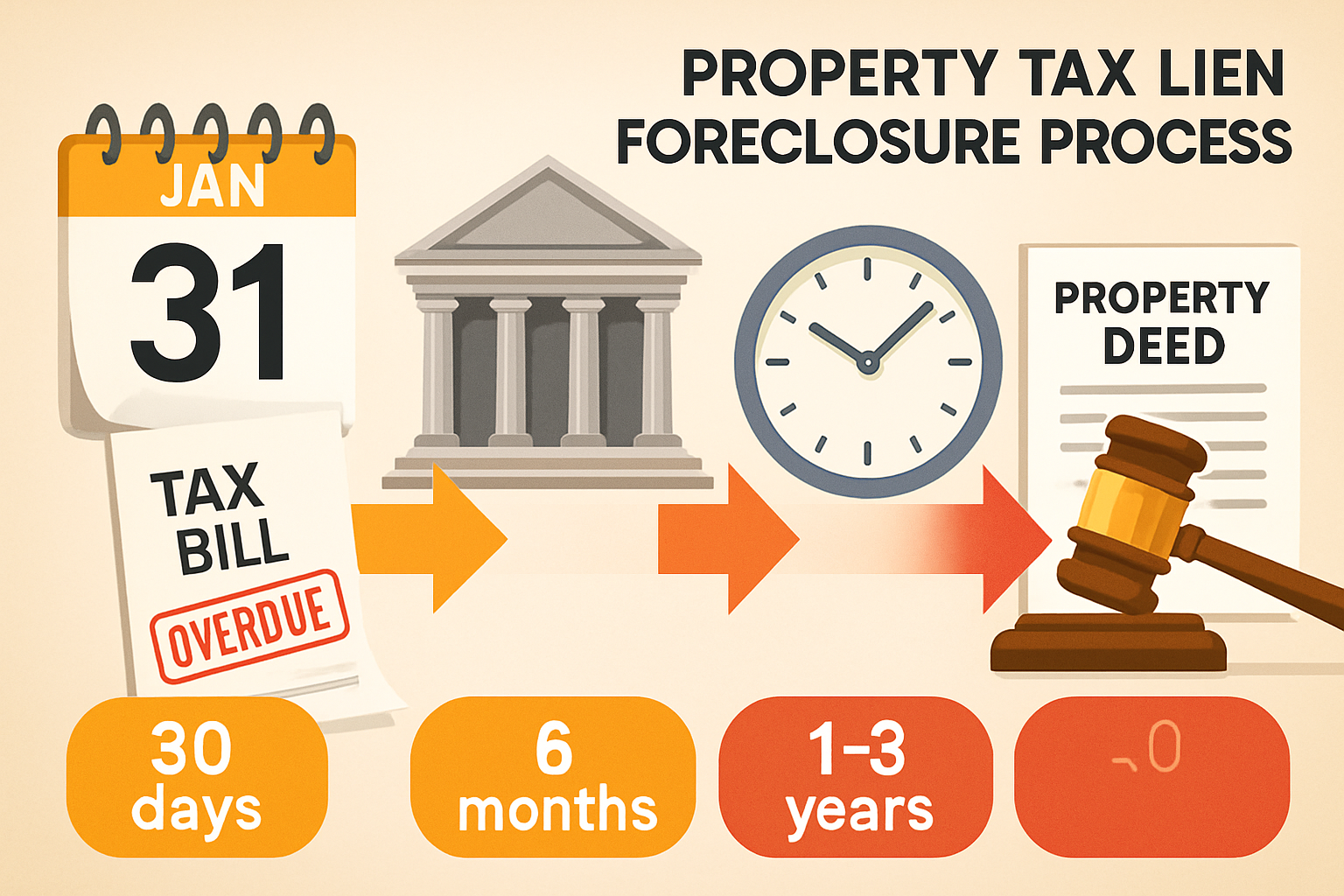
Property tax lien foreclosure represents the legal process through which local governments collect delinquent property taxes by seizing and selling real estate. When property taxes go unpaid, the county or municipality places a tax lien on the property, creating a legal claim that takes priority over nearly all other debts—including mortgages.
How Tax Liens Differ from Other Liens
Tax liens carry extraordinary power compared to other types of property liens. Here's what makes them unique:
Priority Status 🏆
Tax liens typically take first position, meaning they get paid before mortgage lenders, judgment liens, or other creditors when a property sells.
Automatic Attachment
Unlike voluntary liens (like mortgages) or judgment liens that require court action, tax liens attach automatically when taxes become delinquent.
Accelerated Timeline
While mortgage foreclosure can take 6-24 months, tax foreclosure often moves much faster, sometimes completing in as little as 6-12 months.
No Loan Required
You don't need to have borrowed money to face tax foreclosure. Simply owning property creates the tax obligation, and failure to pay triggers the lien.
Why Counties Pursue Tax Foreclosure
Local governments rely heavily on property tax revenue to fund essential services—schools, police, fire departments, road maintenance, and public infrastructure. When property owners don't pay their share, it creates budget shortfalls that affect entire communities.
Counties don't pursue foreclosure eagerly. Most tax offices prefer to work with property owners to establish payment arrangements. However, when communication breaks down and taxes remain unpaid for extended periods, foreclosure becomes the mechanism to:
- Recover lost revenue for public services
- Return properties to productive use and the tax rolls
- Maintain fairness among taxpayers who do pay their obligations
- Clear title issues on abandoned or neglected properties
Understanding that counties view foreclosure as a last resort—not a first option—opens the door to helpful solutions through communication and cooperation.
The Property Tax Lien Foreclosure Timeline Explained
The timeline for property tax lien foreclosure varies considerably depending on your location, but the process follows a predictable pattern. Understanding each phase helps property owners recognize where they stand and what actions remain available.
Phase 1: Initial Delinquency (Days 1-90)
What Happens:
Property taxes typically become due once or twice yearly, depending on your county's billing cycle. Missing a payment deadline immediately makes your account delinquent, though the consequences start gradually.
Typical Timeline:
- Day 1: Taxes become delinquent on the day after the due date
- Days 1-30: Grace period in some counties (not all)
- Days 30-60: First delinquency notice mailed
- Days 60-90: Additional notices and penalty assessments
Financial Impact:
Penalties and interest begin accruing immediately in most jurisdictions. Common penalty structures include:
| Timeframe | Typical Penalty | Interest Rate |
|---|---|---|
| 1-30 days | 1-3% of tax owed | 0.5-1% monthly |
| 31-90 days | 5-10% total | 1-1.5% monthly |
| 91+ days | 10-25% total | 1.5-2% monthly |
Your Options:
This phase offers the most flexibility. Property owners can:
- Pay the full amount to clear the delinquency completely
- Contact the tax office to discuss payment plan options
- Request penalty waivers if extenuating circumstances exist
- Explore refinancing or loan options to cover the tax debt
💡 Pro Tip: Don't ignore the first notice. A simple phone call to your county tax office can prevent months of stress and thousands in additional penalties.
Phase 2: Tax Lien Attachment (Months 3-12)
What Happens:
After several months of non-payment, the county officially files a tax lien against your property. This public record notifies the world that your property has unpaid taxes and the government has a legal claim.
Typical Timeline:
- Month 3-6: Official tax lien filed with county recorder
- Month 6-9: Property added to delinquent tax list
- Month 9-12: Notice of intent to sell or foreclose
Impact on Property Owners:
The tax lien creates immediate complications:
- Credit damage: Tax liens appear on public records and may affect credit scores
- Title problems: Selling the property becomes extremely difficult
- Refinancing barriers: Lenders won't refinance with an active tax lien
- Mounting costs: Interest and penalties continue accumulating
- Legal vulnerability: The path toward losing the property accelerates
Your Options:
Helpful solutions still exist at this stage:
✅ Full Payment: Paying the total amount owed (taxes + penalties + interest) releases the lien
✅ Payment Plans: Most counties offer installment agreements for delinquent taxes
✅ Lien Subordination: In some cases, counties may subordinate their lien to allow refinancing
✅ Property Sale: Working with industry experts who understand tax liens can help you sell before foreclosure
Phase 3: Pre-Foreclosure Notices (Months 12-18)
What Happens:
The county begins formal foreclosure proceedings. This phase involves extensive legal notifications designed to give property owners every opportunity to resolve the debt before losing their property.
Typical Timeline:
- Month 12-14: Notice of intent to foreclose mailed via certified mail
- Month 14-16: Public notice published in local newspapers
- Month 16-18: Final notice before foreclosure sale scheduled
Legal Requirements:
Counties must follow strict notification procedures, typically including:
- Certified mail to the property owner at all known addresses
- Posted notice on the property itself
- Published notice in the legal section of local newspapers
- Notice to lienholders including mortgage companies and other creditors
- Minimum waiting periods between notices (varies by state)
Your Options:
Even at this late stage, foreclosure isn't inevitable:
🛑 Emergency Payment Arrangements: Some counties allow last-minute payment plans
🛑 Redemption Rights: Many states allow you to "redeem" the property by paying all amounts owed
🛑 Bankruptcy Filing: Chapter 13 bankruptcy can halt tax foreclosure and provide time to catch up
🛑 Quick Sale: Selling your house in pre-foreclosure remains possible with expert service
"The weeks before a tax sale represent a critical window. Property owners who act decisively during this period can often avoid losing their home entirely. The key is reaching out for helpful guidance rather than hoping the problem will disappear." — Property Tax Resolution Specialist
Phase 4: Tax Sale or Foreclosure Auction (Month 18-24+)
What Happens:
The county conducts a public auction to sell either the tax lien itself (tax lien sale) or the property (tax deed sale). The type of sale depends on your state's laws.
Two Types of Tax Sales:
Tax Lien Sale (Tax Lien Certificate States):
The county auctions the right to collect the tax debt. An investor pays your taxes and receives a lien certificate. You still own the property but must repay the investor with interest (often 10-25% annually) within the redemption period, or the investor can foreclose.
States using this method: Arizona, Florida, Illinois, Iowa, Maryland, and about 20 others
Tax Deed Sale (Tax Deed States):
The county auctions the property itself. The highest bidder receives ownership (though redemption rights may still apply). The proceeds pay the tax debt, with any excess theoretically returned to the former owner.
States using this method: California, Georgia, Texas, New York, and about 20 others
Auction Process:
- Minimum bid set at tax debt plus penalties, interest, and costs
- Public bidding open to investors and individuals
- Highest bidder wins the lien certificate or property deed
- Payment required immediately or within 24-48 hours
- Title transfer processed (in deed states) or lien certificate issued
Your Options:
Options narrow significantly but don't disappear entirely:
⚠️ Attend the auction: You can bid on your own property to retain ownership
⚠️ Last-minute redemption: Some states allow payment up until the gavel falls
⚠️ Post-sale redemption: Many states provide redemption periods after the sale
⚠️ Legal challenges: Procedural errors in the foreclosure process may provide grounds to contest
Phase 5: Post-Sale Redemption Period (Varies Widely)
What Happens:
Many states provide a "redemption period" after the tax sale during which the original owner can reclaim the property by paying the full amount owed plus the investor's costs and statutory interest.
Redemption Period by State (Examples):
| State | Redemption Period | Interest Rate |
|---|---|---|
| Texas | 6 months – 2 years | 25-50% annually |
| Illinois | 2-3 years | Varies by county |
| Florida | None (lien sale only) | N/A |
| California | None for tax deed | N/A |
| Georgia | 12 months | 20% |
| Michigan | Varies by property value | Varies |
Your Options:
The redemption period offers a final opportunity:
🔄 Full Redemption Payment: Pay all amounts owed plus investor premiums
🔄 Negotiate with Purchaser: Some investors will settle for less than full redemption amount
🔄 Seek Financial Assistance: Family loans, refinancing other assets, or hardship programs
🔄 Legal Counsel: An attorney may identify procedural defects that invalidate the sale
After Redemption Period Expires:
Once the redemption window closes without payment, ownership transfers permanently to the tax sale purchaser. At this point, the original owner has lost all rights to the property and typically must vacate.
How to Stop Property Tax Lien Foreclosure
The most important thing to understand about property tax lien foreclosure: you have options at every stage. The earlier you act, the more choices remain available. Here are the most effective strategies for stopping foreclosure and protecting your property.
Strategy 1: Pay the Delinquent Taxes in Full
How It Works:
The most straightforward solution involves paying the entire tax debt, including penalties and interest. This immediately releases the lien and stops all foreclosure proceedings.
When This Works Best:
- Early in the delinquency (lower penalties)
- When you have access to funds through savings, family, or loans
- Before the tax sale date to avoid investor premiums
Funding Sources to Consider:
- Personal savings or emergency funds
- Home equity line of credit (HELOC) on another property
- Personal loans from banks or credit unions
- Family loans with clear repayment terms
- Retirement account loans (though this carries tax implications)
- Sale of other assets (vehicles, investments, valuables)
Pros: ✅ Immediate resolution ✅ Stops interest accumulation ✅ Protects credit ✅ Maintains full ownership
Cons: ❌ Requires significant funds ❌ Doesn't address underlying financial issues ❌ May not be feasible for everyone
Strategy 2: Negotiate a Payment Plan
How It Works:
Most county tax offices offer installment payment agreements that allow property owners to pay delinquent taxes over time while stopping foreclosure proceedings.
Typical Payment Plan Terms:
- Duration: 6-36 months depending on amount owed
- Down payment: Often 10-25% of total debt required upfront
- Interest: Continues accruing but at reduced rates in some counties
- Conditions: Must stay current on new taxes while paying old debt
- Default consequences: Missing payments restarts foreclosure
How to Request a Payment Plan:
- Contact the tax office immediately — Don't wait for them to contact you
- Explain your situation honestly — Counties want to help but need to understand your circumstances
- Propose a realistic payment amount — Base it on your actual budget, not wishful thinking
- Get everything in writing — Verbal agreements don't protect you legally
- Make payments on time — Even one missed payment can void the agreement
Pros: ✅ Stops foreclosure ✅ Manageable payments ✅ No need for large lump sum ✅ Preserves ownership
Cons: ❌ Interest continues ❌ Must stay current on new taxes ❌ Takes time to clear ❌ Strict default penalties
💡 Success Tip: When negotiating payment plans, demonstrate good faith by making the first payment immediately, even if it's small. This shows the county you're serious about resolving the debt.
Strategy 3: Apply for Tax Relief or Hardship Programs
How It Works:
Many states and counties offer property tax relief programs for qualifying property owners facing financial hardship. These programs can reduce, defer, or forgive portions of property tax debt.
Common Relief Programs:
Senior Citizen Exemptions
Reduce assessed value or freeze tax rates for homeowners over 65
Disability Exemptions
Provide tax reductions for disabled property owners
Veteran Programs
Offer exemptions or reductions for qualifying veterans
Homestead Exemptions
Reduce taxable value for primary residences
Hardship Deferral Programs
Allow tax payment postponement until property sale or owner's death
Low-Income Assistance
Provide grants or credits based on income thresholds
Eligibility Requirements Typically Include:
- Age, disability, or veteran status (for specific programs)
- Income below certain thresholds
- Property as primary residence
- Application before specified deadlines
- Documentation of financial hardship
How to Apply:
- Research programs available in your county or state
- Gather required documentation (income statements, medical records, etc.)
- Complete applications before deadlines
- Follow up to ensure processing
- Maintain eligibility requirements
Pros: ✅ Can significantly reduce debt ✅ May provide ongoing relief ✅ Specifically designed for hardship situations
Cons: ❌ Strict eligibility requirements ❌ Application deadlines ❌ May not cover full debt ❌ Requires documentation
Strategy 4: Sell Your Property Before Foreclosure
How It Works:
Selling your property before the tax sale allows you to pay off the tax debt from the proceeds and potentially keep any remaining equity. This option works particularly well when the property has value beyond the tax debt.
When This Makes Sense:
- Property value exceeds total debt (taxes + penalties + other liens)
- You don't want to keep the property long-term
- You need a fresh start without the tax burden
- The property requires repairs or maintenance you can't afford
Challenges When Selling with Tax Liens:
- Traditional buyers and their lenders won't close with active liens
- Real estate agents may be reluctant to list properties with title issues
- Time pressure as foreclosure date approaches
- Multiple liens or title problems complicate the process
The Solution:
Working with property solutions experts who specialize in tax lien situations provides helpful guidance through the selling process. These industry experts:
- Purchase properties with active tax liens
- Handle all lien payoffs at closing
- Close quickly to beat foreclosure deadlines
- Navigate complex title issues
- Provide fair offers based on actual property value
Pros: ✅ Eliminates tax debt ✅ Stops foreclosure ✅ May preserve equity ✅ Provides fresh start ✅ Fast resolution
Cons: ❌ Lose the property ❌ May sell below market value ❌ Moving costs and disruption
"Selling before foreclosure often represents the most practical solution for property owners who can't afford to keep the property long-term. The key is working with trustworthy service providers who understand the urgency and complexity of tax lien situations." — Real Estate Solutions Advisor
Strategy 5: File for Bankruptcy Protection
How It Works:
Filing bankruptcy triggers an "automatic stay" that immediately halts all collection actions, including tax foreclosure. This provides breathing room to reorganize finances and address the tax debt.
Chapter 13 Bankruptcy (Most Common for Stopping Tax Foreclosure):
- Creates a 3-5 year repayment plan
- Allows you to catch up on delinquent taxes over time
- Stops foreclosure during the repayment period
- Requires regular income to fund the plan
- Permits you to keep the property if you complete the plan
Chapter 7 Bankruptcy (Limited Effectiveness):
- Doesn't discharge property tax debt
- Provides only temporary foreclosure delay
- May help eliminate other debts to free up money for taxes
- Doesn't create a repayment plan for tax arrears
Important Considerations:
- Legal complexity: Requires bankruptcy attorney
- Credit impact: Severe negative effect on credit scores
- Cost: Attorney fees typically $2,000-$5,000+
- Long-term commitment: Must complete 3-5 year plan
- Risk: Dismissal if you miss plan payments
Pros: ✅ Immediately stops foreclosure ✅ Provides time to catch up ✅ May eliminate other debts ✅ Legal protection
Cons: ❌ Severe credit damage ❌ Expensive ❌ Complex process ❌ Long-term commitment ❌ Doesn't eliminate tax debt
Strategy 6: Challenge the Foreclosure Legally
How It Works:
If the county failed to follow proper legal procedures during the foreclosure process, you may have grounds to challenge the foreclosure in court. This requires identifying specific procedural violations.
Common Legal Defenses:
- Improper notice: County didn't provide required notifications
- Calculation errors: Tax amount, penalties, or interest incorrectly calculated
- Exemption eligibility: Property should have qualified for exemptions
- Payment disputes: You made payments that weren't properly credited
- Jurisdictional issues: County lacked authority to foreclose
When to Consider Legal Action:
- You have documented evidence of procedural violations
- The tax amount is substantially incorrect
- You were denied exemptions you qualified for
- The foreclosure timeline didn't meet legal requirements
Process:
- Consult with a real estate attorney immediately
- Gather all documentation (notices, payment records, correspondence)
- File legal challenge before foreclosure sale date
- Attend court hearings
- Present evidence of violations
Pros: ✅ May stop or delay foreclosure ✅ Can correct errors ✅ Legal protection ✅ May reduce debt
Cons: ❌ Expensive legal fees ❌ No guarantee of success ❌ Time-consuming ❌ Doesn't eliminate valid debt
Strategy 7: Seek Help from Property Solutions Experts
How It Works:
Professional property solutions companies specialize in helping owners navigate complicated real estate issues, including tax liens, foreclosure, and title problems. These experts provide helpful solutions tailored to your specific situation.
Services Provided:
- Situation assessment: Evaluate your options objectively
- County coordination: Communicate with tax offices on your behalf
- Title resolution: Address multiple liens and title issues
- Quick purchase options: Buy properties with tax problems
- Payment facilitation: Handle lien payoffs at closing
- Timeline management: Work within foreclosure deadlines
Why Professional Help Matters:
When facing property tax lien foreclosure, time pressure and complexity create overwhelming stress. Property owners often don't know where to start or what options truly exist. Industry experts who specialize in these situations bring:
- Experience with hundreds of similar cases
- Relationships with county tax offices and title companies
- Resources to solve problems quickly
- Objectivity to evaluate your best path forward
- Compassion to understand the human side of financial hardship
When to Seek Professional Help:
- Foreclosure sale scheduled within 90 days
- Multiple liens or complicated title issues
- Inherited property with tax problems
- No clear path to paying off tax debt
- Need objective assessment of options
Pros: ✅ Expert guidance ✅ Fast solutions ✅ Handles complexity ✅ Reduces stress ✅ Multiple options
Cons: ❌ May involve selling property ❌ Service fees (though often built into purchase price)
Understanding Your Rights During Tax Foreclosure
Property owners facing tax foreclosure retain important legal rights throughout the process. Understanding these protections helps ensure counties follow proper procedures and gives you leverage to protect your interests.
Right to Proper Notice
Counties must provide adequate notice at every stage of the foreclosure process. This typically includes:
Notice Requirements:
- Written notice sent via certified mail to all known addresses
- Minimum timeframes between notices (varies by state, typically 30-90 days)
- Clear language explaining the debt, deadline, and consequences
- Contact information for the tax office
- Redemption rights explanation
What to Do If Notice Is Improper:
- Document the deficiency (missing notice, wrong address, insufficient time)
- Consult an attorney immediately
- File a legal challenge before the sale date
- Request postponement of the sale
Right to Redemption
Most states provide redemption rights that allow property owners to reclaim their property after a tax sale by paying the required redemption amount.
Redemption Rights Include:
- Specific time period to exercise redemption (varies by state)
- Clear calculation of redemption amount
- Notice of redemption rights provided at time of sale
- Process for exercising redemption rights
Redemption Amount Typically Includes:
- Original tax debt
- Penalties and interest
- Investor's purchase price
- Statutory interest/premium (often 10-50% annually)
- Administrative costs
Right to Excess Proceeds
When a property sells at tax auction for more than the total debt owed, property owners have the right to claim the excess proceeds.
How Excess Proceeds Work:
- Property sells at auction for $100,000
- Total tax debt, penalties, and costs equal $25,000
- Excess proceeds of $75,000 should go to former owner
- Junior lienholders (mortgage companies, etc.) may also have claims
Claiming Excess Proceeds:
- File a claim with the county within specified timeframe (often 1-3 years)
- Provide proof of ownership
- Resolve competing claims from other lienholders
- Receive payment after verification
⚠️ Important: Many former owners never claim excess proceeds because they don't know they exist. Always check with the county after a tax sale to determine if excess proceeds are available.
Right to Challenge the Sale
Property owners can challenge tax foreclosure sales based on procedural defects, errors, or fraud.
Valid Grounds for Challenge:
- Improper notice procedures
- Calculation errors in tax amounts
- Sale conducted improperly
- Fraud or collusion
- Failure to follow state statutes
Time Limits:
Challenges must typically be filed within 30-180 days of the sale, depending on state law. Acting quickly is essential.
Right to Occupancy During Redemption
In states with post-sale redemption periods, former owners typically retain the right to occupy the property during the redemption period, though this varies by state.
Occupancy Rights May Include:
- Continued possession during redemption period
- Responsibility for property maintenance
- Liability for property damage
- Potential rent obligations to the purchaser
Protection from Harassment
While counties can pursue collection of tax debts, property owners have protections against harassment and unfair practices.
Prohibited Actions:
- Threatening criminal prosecution for civil tax debt
- Contacting you at unreasonable hours
- Using deceptive or misleading statements
- Failing to provide required notices
- Discriminatory enforcement
If You Experience Violations:
Document all interactions, file complaints with the county administration, and consult an attorney if harassment continues.
Special Situations in Property Tax Foreclosure

Certain circumstances create unique challenges and opportunities in tax foreclosure situations. Understanding how these special scenarios work helps property owners navigate their specific situations more effectively.
Inherited Property with Tax Liens
Inheriting property should be a blessing, but when the property comes with years of unpaid taxes, it creates immediate stress for heirs.
Common Scenarios:
- Elderly parent passed away with delinquent taxes
- Multiple heirs inherit property with tax debt
- Property discovered during estate settlement
- Taxes accumulated during probate process
Unique Challenges:
- Multiple heirs must agree on how to handle the situation
- Probate may delay action until estate settles
- Heirs may lack funds to pay accumulated debt
- Property may be in poor condition requiring additional investment
Solutions for Inherited Property:
- Sell the property to pay tax debt and split remaining equity among heirs
- One heir buys out others and resolves the tax debt
- Negotiate payment plan with county while deciding long-term plans
- Work with property solutions experts who handle inherited property with tax issues
Properties with Multiple Liens
Tax liens rarely exist in isolation. Properties facing tax foreclosure often have multiple liens creating complex priority and payoff issues.
Common Lien Combinations:
- Tax lien + mortgage + HOA lien
- Tax lien + judgment lien + mechanic's lien
- Tax lien + IRS lien + state tax lien
Lien Priority Generally Follows:
- Property tax liens (first position)
- IRS tax liens (special federal priority)
- Mortgage liens (based on recording date)
- Judgment liens (based on recording date)
- HOA liens (varies by state)
- Mechanic's liens (special priority in some states)
Impact on Foreclosure:
- Tax foreclosure may wipe out junior liens
- Mortgage companies may pay taxes to protect their interest
- Multiple lienholders may complicate sale process
- Total debt may exceed property value
Solutions:
- Lien negotiation: Some lienholders will settle for less than full amount
- Short sale: Sell for less than total debt with lender approval
- Strategic default: Allow foreclosure to eliminate some liens
- Professional coordination: Work with experts who handle complex lien situations
Vacant or Abandoned Properties
Properties that are vacant or abandoned present unique challenges in tax foreclosure situations.
Why Vacancy Complicates Matters:
- Notice may not reach property owner
- Property deterioration accelerates
- Vandalism and code violations accumulate
- Additional municipal liens may attach
- Squatters may occupy the property
Options for Vacant Properties:
- Sell quickly before additional problems accumulate
- Secure the property to prevent further damage
- Update contact information with county to ensure notice receipt
- Consider donation to charity for tax deduction (if equity is minimal)
Commercial Properties
Commercial property tax foreclosure follows similar processes but involves higher stakes and more complex considerations.
Unique Factors:
- Much higher tax amounts
- Business operations affected
- Commercial tenants involved
- More complex valuation issues
- Greater negotiation leverage with counties
Solutions:
- Commercial loan refinancing to pay taxes
- Sale-leaseback arrangements
- Investor partnerships
- Commercial property specialists
Properties in Trust or LLC Ownership
Properties owned by trusts or LLCs create additional procedural considerations in tax foreclosure.
Challenges:
- Notice must reach proper party
- Authority to act on behalf of entity
- Multiple beneficial owners
- Dissolved entities
Solutions:
- Ensure registered agent information is current
- Maintain proper entity status
- Document authority to act
- Consider entity restructuring
Preventing Future Tax Foreclosure
Successfully stopping a current tax foreclosure is only half the battle. Preventing future tax problems requires establishing systems and strategies to ensure timely payment going forward.
Set Up Automatic Tax Payments
Escrow Accounts:
If you have a mortgage, ensure property taxes are included in your monthly payment through an escrow account. The lender pays taxes directly to the county from the escrow funds.
Benefits:
- Automatic payment ensures taxes are never missed
- Budgeting becomes easier with consistent monthly amounts
- Lender monitors tax bills to catch errors
- No need to remember payment deadlines
Automatic Bank Payments:
For properties without mortgages, set up automatic payments from your bank account to the county tax office.
Create a Property Tax Savings Fund
How It Works:
Calculate your annual property tax amount and divide by 12. Set up automatic monthly transfers from your checking account to a dedicated savings account. When tax bills arrive, the funds are ready.
Example:
- Annual property taxes: $3,600
- Monthly savings needed: $300
- Set automatic transfer for $300 on the 1st of each month
- Account balance at tax due date: $3,600+
Additional Benefits:
- Earns interest while waiting for tax due date
- Provides buffer for tax increases
- Reduces financial stress
- Creates disciplined savings habit
Monitor Your Property Tax Bills
What to Check:
- Assessed value — Is it accurate for your property?
- Exemptions — Are you receiving all exemptions you qualify for?
- Tax rate — Has it increased significantly?
- Due dates — Mark them clearly on your calendar
- Payment confirmation — Verify the county received your payment
When to Challenge Assessments:
If your property's assessed value seems too high compared to similar properties or recent sales, file an appeal during your county's appeal period (typically 30-60 days after assessment notices).
Understand Tax Increases
Property tax bills can increase due to:
- Rising property values (reassessment)
- Increased tax rates (millage rate changes)
- Loss of exemptions (age, income changes)
- New special assessments
Staying Informed:
- Attend county budget meetings
- Review annual assessment notices carefully
- Understand how tax rates are set
- Vote on tax-related ballot measures
Apply for All Available Exemptions
Many property owners pay more in taxes than necessary because they don't apply for available exemptions.
Common Exemptions:
- Homestead exemption — Reduces taxable value for primary residence
- Senior citizen exemption — Age-based reductions
- Disability exemption — For disabled property owners
- Veteran exemption — For qualifying veterans
- Agricultural exemption — For farm/ranch properties
- Historic property exemption — For designated historic properties
How to Apply:
- Contact your county tax assessor's office
- Submit applications before deadlines (often April 1)
- Provide required documentation
- Reapply if circumstances change
Plan for Property Ownership Transitions
Life Events That Affect Property Taxes:
- Inheritance (establish payment responsibility immediately)
- Divorce (clarify who pays taxes in settlement)
- Death of co-owner (ensure survivor can make payments)
- Business ownership changes (update responsible party)
Proactive Steps:
- Update contact information with county when ownership changes
- Establish clear payment responsibility in legal documents
- Set up new payment systems immediately after transitions
- Verify exemptions still apply after ownership changes
Communicate with Your County Tax Office
Building a Relationship:
County tax offices want to collect taxes, not foreclose on properties. Establishing communication creates opportunities for helpful solutions when problems arise.
When to Contact Them:
- As soon as you know you'll have trouble paying
- When you receive notices you don't understand
- If you experience financial hardship
- To verify payment receipt
- To discuss exemption eligibility
What They Can Offer:
- Payment plan options
- Exemption information
- Penalty waivers in hardship cases
- Extended deadlines in some situations
- Helpful guidance on avoiding foreclosure
Frequently Asked Questions About Property Tax Lien Foreclosure
How long do you have before property tax foreclosure?
The timeline varies significantly by state and county, but generally:
- Minimum: 6-12 months from first missed payment
- Typical: 18-24 months for complete foreclosure
- Maximum: 3-5 years in some states with long redemption periods
Early intervention provides the most options. Contact your county tax office and property solutions experts as soon as you realize you'll have difficulty paying.
Can you stop a tax foreclosure the day before the sale?
Yes, in most cases. Most counties accept full payment of the tax debt (including penalties, interest, and costs) up until the moment the auction begins. Some states even allow redemption after the sale during specified redemption periods.
However, waiting until the last minute creates unnecessary risk:
- Payment processing may take time
- Redemption amounts are higher due to accumulated penalties
- Fewer alternative options remain available
- Extreme stress and pressure
Better approach: Act as early as possible to preserve maximum flexibility.
What happens to my mortgage if my property is sold for taxes?
Tax liens typically take priority over mortgage liens. When a property is sold at tax auction:
In tax deed states:
- The tax sale may wipe out the mortgage entirely
- The mortgage company loses its security interest
- The former owner still owes the mortgage debt (it becomes unsecured)
- Mortgage companies often pay delinquent taxes to prevent this
In tax lien certificate states:
- The mortgage remains on the property
- The tax lien certificate holder can eventually foreclose
- This would then wipe out the mortgage
Practical reality: Mortgage companies monitor tax payments closely and usually pay delinquent taxes themselves to protect their interest, then add the amount to your mortgage debt.
Can I buy my own property at a tax auction?
Yes, property owners can bid on their own properties at tax auctions. This might make sense if:
- You have funds available but prefer to acquire the property free of other liens
- The property has significant equity
- You want to eliminate junior liens
However, simply paying the delinquent taxes before the auction is usually simpler and cheaper than bidding at auction.
Do property tax liens expire?
No, property tax liens generally don't expire. They remain attached to the property until:
- The taxes are paid in full
- The property is sold at tax auction
- The county releases the lien (rare, usually only for errors)
Unlike some other types of debt, property tax obligations don't have statutes of limitations that would prevent collection.
Will bankruptcy eliminate property tax debt?
No, bankruptcy does not discharge (eliminate) property tax debt. However, Chapter 13 bankruptcy can:
- Stop tax foreclosure immediately through automatic stay
- Create a 3-5 year repayment plan for delinquent taxes
- Allow you to keep the property while catching up on taxes
- Eliminate other debts to free up money for tax payments
Chapter 7 bankruptcy provides only temporary delay and doesn't create a repayment plan for taxes.
How much does it cost to redeem property after a tax sale?
Redemption costs typically include:
- Original tax debt
- Penalties and interest
- Investor's purchase price at auction
- Statutory redemption premium (often 10-50% annually)
- Administrative fees and costs
- Any additional taxes that became due after the sale
Example:
- Original tax debt: $10,000
- Investor purchase price: $10,000
- 25% annual redemption premium: $2,500
- Administrative costs: $500
- Total redemption cost: $23,000 (for one year redemption period)
Redemption becomes increasingly expensive the longer you wait.
Can I sell my house if it has a tax lien?
Yes, you can sell a house with a tax lien, but it requires special handling. Traditional buyers and their lenders won't close with an active lien, so you need to either:
Option 1: Pay off the lien before or at closing from sale proceeds
Option 2: Work with buyers who specialize in properties with liens
Property solutions companies regularly purchase properties with tax liens, handling the lien payoff at closing and providing helpful solutions for owners facing foreclosure.
Conclusion: Taking Action on Property Tax Lien Foreclosure
Property tax lien foreclosure represents a serious threat to homeownership, but understanding the timeline, process, and available solutions empowers property owners to take control of their situations. The key insights to remember:
Act Early: The earlier you address tax delinquency, the more options remain available and the lower the total cost to resolve the situation.
Communication Matters: Counties prefer payment arrangements over foreclosure. Open, honest communication with your tax office creates opportunities for helpful solutions.
Multiple Solutions Exist: From payment plans to exemptions, from selling to bankruptcy, property owners have numerous strategies to stop foreclosure at every stage of the process.
Professional Help Is Available: You don't have to navigate this complex situation alone. Industry experts who specialize in tax lien situations provide trustworthy service, expert guidance, and practical solutions tailored to your circumstances.
Your Rights Matter: Understanding your legal rights—to proper notice, redemption, excess proceeds, and fair treatment—ensures counties follow proper procedures and protects your interests.
Your Next Steps
If you're facing property tax lien foreclosure, take these actions today:
-
Assess your situation — Determine exactly how much you owe, when the foreclosure sale is scheduled, and what stage of the process you're in
-
Contact your county tax office — Discuss payment plan options, exemptions, or other programs that might help
-
Explore your options — Review the strategies outlined in this guide and determine which best fits your circumstances and goals
-
Seek expert guidance — Connect with property solutions professionals who can provide objective assessment and helpful solutions
-
Make a decision and act — The worst choice is inaction. Choose a path forward and take the first step today
How Sure Path Property Solutions Can Help
At Sure Path Property Solutions, we understand that facing property tax foreclosure creates overwhelming stress and uncertainty. Our team specializes in helping property owners navigate complicated real estate issues, including:
✅ Back taxes and tax liens on houses and land
✅ Multiple liens and judgments creating title complications
✅ Inherited properties with tax problems and multiple heirs
✅ Foreclosure situations requiring quick, practical solutions
✅ Title issues preventing traditional sales
We provide friendly and caring, expert service that simplifies complex situations. Our industry experts coordinate with counties and title professionals to guide property owners toward clear, practical solutions—whether that means helping you keep your property or facilitating a fair sale that resolves your tax debt.
Our approach:
- Free consultation to assess your situation with no obligation
- Honest evaluation of your options and best path forward
- Quick closings to beat foreclosure deadlines when selling makes sense
- Fair offers based on actual property value, not distressed pricing
- Complete lien handling — we manage all payoffs at closing
- Compassionate service that recognizes the human side of financial hardship
Don't wait until the foreclosure sale date arrives. Contact Sure Path Property Solutions today for helpful guidance and trustworthy service from professionals who genuinely care about helping you find the right solution.
The path forward exists—even when the situation seems impossible. With the right information, expert support, and timely action, you can navigate property tax lien foreclosure and move toward a brighter financial future.