
Sell House with Tax Certificate: What You Need to Know
Discovering a tax certificate on your property can feel like a financial earthquake. One day you’re planning your future, and the next you’re facing official notices, looming deadlines, and the very real threat of losing your home. Whether you’ve inherited a property with back taxes, fallen behind during financial hardship, or just learned about a tax certificate through county correspondence, the question burning in your mind is simple: Can you still sell your house?
The answer is yes—and understanding how to sell house with tax certificate: what you need to know can transform this challenging situation into a manageable solution. This comprehensive guide walks you through every aspect of tax certificates, your selling options, and the practical steps to move forward with confidence.
Key Takeaways
- Tax certificates don’t prevent sales: You can sell a house with a tax certificate, though it adds complexity to the transaction
- Time is critical: Most tax certificates come with redemption periods (typically 1-3 years) before foreclosure proceedings begin
- Multiple selling options exist: Traditional sales, cash buyers, and redemption strategies each offer different advantages depending on your timeline
- Clear title is essential: Tax certificates must be resolved before closing, either through payoff, negotiation, or buyer assumption
- Professional guidance accelerates solutions: Working with experienced property professionals who understand tax certificate complexities can save time and money
What Is a Tax Certificate and How Does It Affect Your Property?
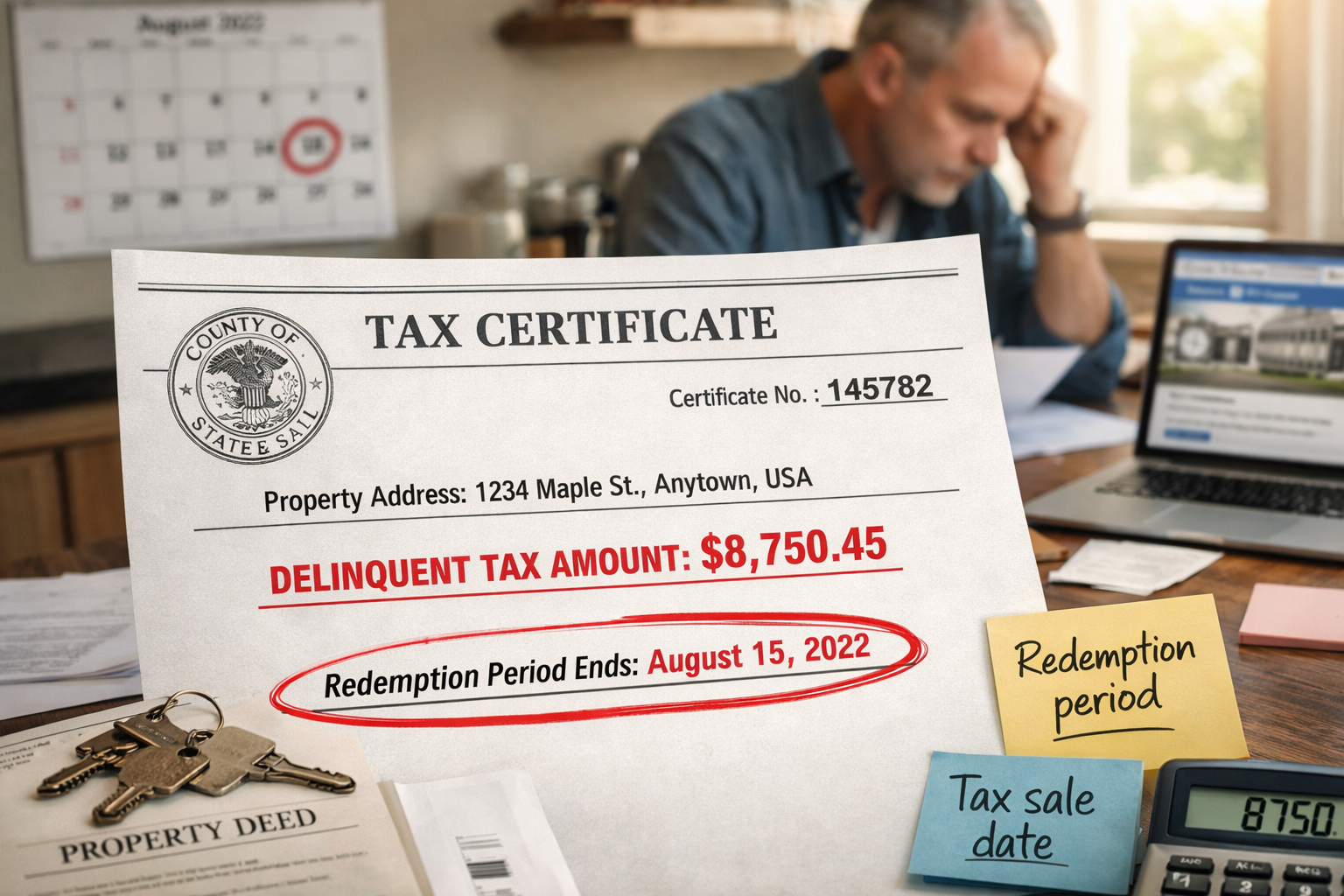
A tax certificate represents a legal claim against your property when property taxes remain unpaid. Think of it as the county’s way of saying, “This property owes us money, and we’re putting everyone on notice.”
The Tax Certificate Process Explained
When property taxes go unpaid, counties follow a specific process:
- Delinquency Notice: After missing payment deadlines, the county sends notices of delinquency
- Certificate Issuance: The county issues a tax certificate documenting the debt
- Certificate Sale: Many counties sell these certificates to investors who pay the taxes owed
- Redemption Period: Property owners get a window (usually 1-3 years) to repay the debt plus interest
- Tax Deed Sale: If unredeemed, the certificate holder can initiate foreclosure proceedings
Important distinction: A tax certificate is different from a tax lien or tax deed. The certificate is the first step—a documented claim. If unresolved, it can lead to a tax lien (formal legal claim) and eventually a tax deed (transfer of ownership).
How Tax Certificates Impact Property Ownership
Tax certificates create several complications for property owners:
- Cloud on title: The certificate appears in public records, making title unclear
- Sale obstacles: Most traditional buyers and lenders won’t proceed with clouded titles
- Accumulating costs: Interest and penalties continue adding to the debt
- Foreclosure risk: The redemption period countdown creates urgency
- Credit implications: Unpaid property taxes can affect creditworthiness
The good news? A tax certificate doesn’t immediately mean you’ve lost your property. You retain ownership during the redemption period, and you have options—including selling the house.
Can You Sell a House with a Tax Certificate? Understanding Your Options
Yes, you absolutely can sell a house with a tax certificate. However, the process requires addressing the certificate either before or during the sale transaction.
Three Primary Pathways to Selling
Option 1: Pay Off the Certificate Before Selling
This traditional approach involves:
- Contacting the county tax collector or certificate holder
- Requesting a payoff amount (including principal, interest, and fees)
- Paying the full amount to clear the certificate
- Obtaining a release or satisfaction document
- Proceeding with a standard property sale
Advantages: Clean title, access to traditional buyers and financing, potentially higher sale prices
Disadvantages: Requires upfront capital, takes additional time, may not be feasible if funds are unavailable
Option 2: Negotiate Payoff at Closing
Many sales handle the tax certificate through closing proceeds:
- List the property with the tax certificate disclosed
- Find a buyer willing to proceed (often cash buyers)
- Calculate payoff amount as of closing date
- Deduct certificate payoff from seller proceeds
- Title company coordinates payment and release
Advantages: No upfront payment required, certificate resolved automatically, seller receives net proceeds
Disadvantages: Reduces final proceeds, limits buyer pool, requires buyer acceptance
Option 3: Sell to Cash Buyers Specializing in Tax Issues
Companies that buy houses with tax problems offer streamlined solutions:
- Quick evaluation regardless of tax certificate status
- Cash offers that account for tax debt
- Fast closings (often 7-14 days)
- Buyer handles all tax certificate resolution
- No repairs, showings, or traditional sale hassles
Advantages: Speed, certainty, minimal effort, no upfront costs, expert handling
Disadvantages: Lower sale price compared to retail market, less negotiation leverage
Factors That Influence Your Best Option
Consider these elements when choosing your approach:
| Factor | Pay First | Closing Payoff | Cash Buyer |
|---|---|---|---|
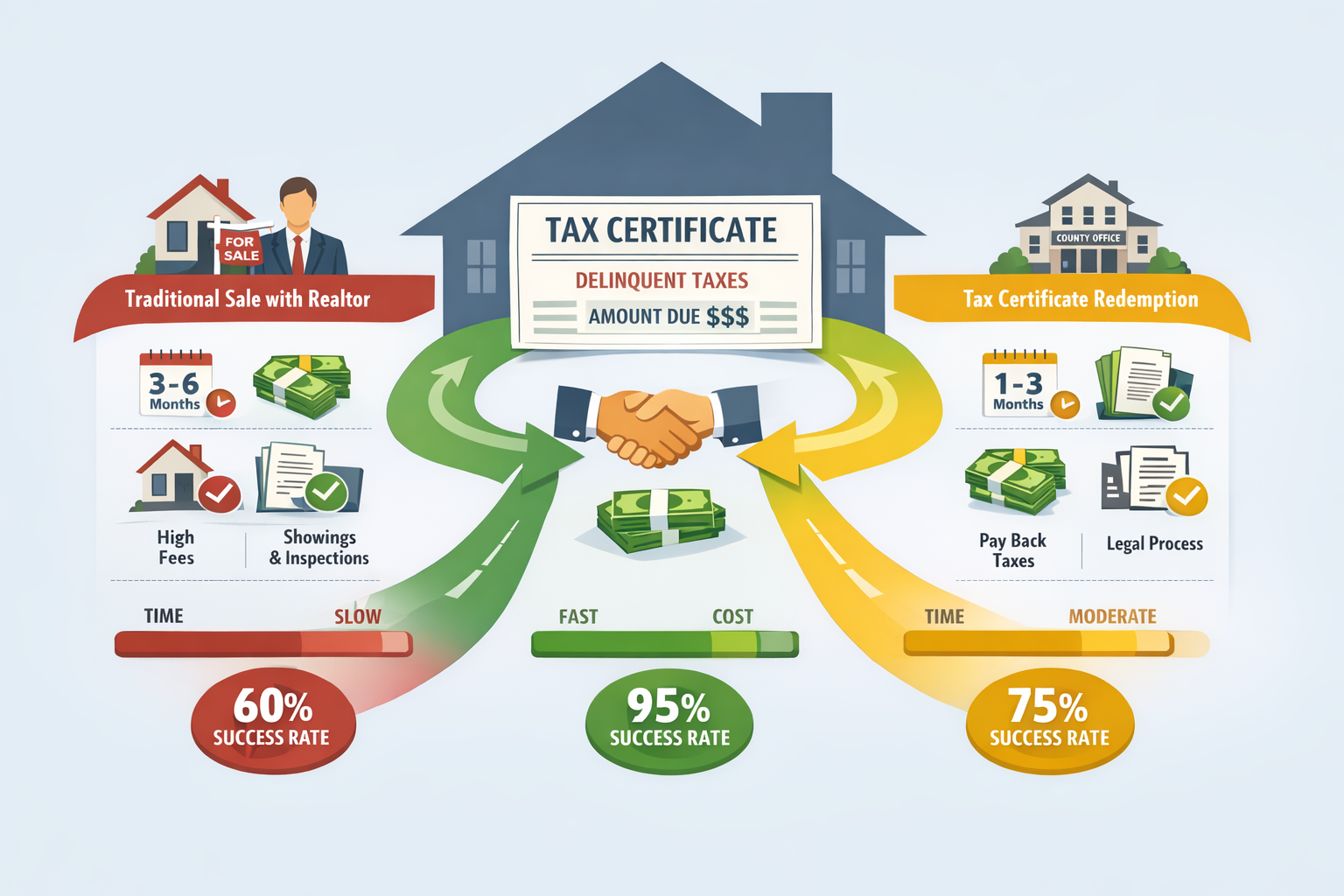
| Timeline urgency | Slow (2-6 months) | Moderate (1-3 months) | Fast (1-2 weeks) |
| Available capital | High need | Low need | No need |
| Property condition | Any | Good-excellent | Any |
| Redemption deadline | Flexible | Moderate pressure | High pressure |
| Desired proceeds | Maximum | High | Moderate |
Understanding how to sell property when you owe taxes provides additional context for making this decision.
The Step-by-Step Process to Sell House with Tax Certificate: What You Need to Know
Successfully navigating a sale with a tax certificate requires systematic action. Here’s your roadmap.
Step 1: Assess Your Tax Certificate Situation
Gather critical information:
- Obtain copies of all tax certificate documentation
- Identify the certificate holder (county or investor)
- Determine the redemption period deadline
- Calculate total amount owed (principal + interest + fees)
- Review any additional liens or claims on the property
Contact the appropriate authority:
- County tax collector’s office for county-held certificates
- Certificate holder directly for investor-owned certificates
- Request a formal payoff quote valid through a specific date
💡 Pro Tip: Get payoff quotes in writing with clear expiration dates. Amounts change daily due to accumulating interest.
Step 2: Determine Your Property’s Market Value
Understanding your equity position is essential:
Research comparable sales:
- Look at recent sales of similar properties in your area
- Adjust for property condition, location, and features
- Consider both retail and “as-is” values
Factor in all costs:
- Tax certificate payoff amount
- Additional liens or judgments
- Selling costs (commissions, closing costs, repairs)
- Mortgage payoff if applicable
Calculate net proceeds:
Estimated Sale Price
- Tax Certificate Payoff
- Other Liens/Mortgages
- Selling Costs
= Your Net Proceeds
If net proceeds are positive, you have equity to work with. If negative, you may need to bring money to closing or explore alternative solutions.
Step 3: Choose Your Selling Strategy
Based on your assessment, select the approach that best fits your situation:
For maximum proceeds with time available:
- Pay off the certificate using savings or a loan
- Make necessary repairs and improvements
- List with a traditional real estate agent
- Market to conventional buyers with financing
For balanced approach with moderate urgency:
- List the property “as-is” with tax certificate disclosed
- Target cash buyers or investors
- Plan for certificate payoff at closing
- Work with agents experienced in complicated transactions
For urgent situations or problem properties:
- Contact specialized cash buyers
- Request quick evaluation and offer
- Accept fair cash offer accounting for tax issues
- Close rapidly with buyer handling all complexities
Step 4: Navigate the Legal and Title Requirements
Tax certificates create title complications that must be resolved:
Title search and examination:
- Order a comprehensive title search
- Identify all liens, judgments, and encumbrances
- Prioritize payoffs based on lien priority
- Understand that tax liens typically have priority over other claims
Disclosure obligations:
- Provide written disclosure of the tax certificate to all potential buyers
- Share all relevant documentation
- Be transparent about redemption deadlines
- Disclose any additional property issues
Title clearance process:
- Coordinate with title company or attorney
- Obtain payoff letters from all lien holders
- Ensure proper documentation of certificate satisfaction
- Verify clear title before closing
Working with professionals who understand title problems can streamline this complex process significantly.
Step 5: Close the Transaction and Resolve the Certificate
The closing process with a tax certificate requires careful coordination:
Pre-closing preparation:
- Confirm final payoff amounts within days of closing
- Verify all parties have necessary documentation
- Ensure title company has disbursement instructions
- Coordinate timing if redemption deadline is approaching
At closing:
- Review settlement statement carefully
- Verify tax certificate payoff is properly listed
- Confirm title company will handle direct payment
- Obtain copies of all satisfaction documents
Post-closing verification:
- Ensure certificate satisfaction is recorded with the county
- Obtain confirmation that title is now clear
- Keep all documentation for your records
- Verify no additional tax obligations remain
Common Challenges When Selling with Tax Certificates and How to Overcome Them
Even with a solid plan, you may encounter obstacles. Here’s how to address the most common challenges.
Challenge 1: Limited Buyer Pool
The problem: Most conventional buyers and their lenders won’t touch properties with tax certificates.
The solution:
- Target cash buyers and investors specifically
- Work with agents who specialize in distressed properties
- Consider selling to companies that handle tax liens
- Price competitively to attract buyers willing to navigate complexities
Challenge 2: Insufficient Equity to Cover Payoff
The problem: The tax certificate amount plus selling costs exceed the property’s value.
The solution:
- Explore negotiating the tax debt with the certificate holder
- Investigate payment plans or settlements
- Consider bringing cash to closing if you have resources
- Explore deed-in-lieu options if foreclosure is imminent
Challenge 3: Approaching Redemption Deadline
The problem: Time pressure from an expiring redemption period.
The solution:
- Act immediately—don’t delay
- Contact cash buyers who can close in days
- Request redemption period extension from certificate holder (sometimes possible)
- Prioritize speed over maximum proceeds
- Consider professional help to accelerate the process
Challenge 4: Multiple Liens and Complications
The problem: Tax certificates often accompany other liens, judgments, or title issues.
The solution:
- Get a comprehensive title search to identify all issues
- Understand lien priority—tax liens are typically first
- Address issues systematically based on priority
- Work with professionals experienced in complex situations
- Consider selling to buyers who handle multiple problems simultaneously
Challenge 5: Inherited Property with Tax Certificates
The problem: You’ve inherited a property with existing tax certificates and possibly multiple heirs.
The solution:
- Determine who’s responsible for back taxes on inherited property
- Coordinate with all heirs on selling strategy
- Consider selling to buyers who handle heir property complications
- Resolve estate and title issues simultaneously
- Seek legal guidance on inheritance and tax obligations
Financial Considerations: Costs, Proceeds, and Tax Implications
Understanding the financial picture helps you make informed decisions.
Calculating Total Costs
When selling a house with a tax certificate, expect these expenses:
Tax certificate payoff components:
- Original delinquent tax amount
- Accumulated interest (rates vary by state, often 12-18% annually)
- Penalty fees and administrative costs
- Certificate holder’s additional fees (if investor-owned)
Standard selling costs:
- Real estate commissions (5-6% for traditional sales, $0 for cash buyers)
- Title insurance and search fees
- Transfer taxes and recording fees
- Attorney or closing agent fees
- Property repairs (if pursuing traditional sale)
Example calculation:
Property Value: $150,000
Tax Certificate Payoff: $15,000
Real Estate Commission (6%): $9,000
Closing Costs: $3,000
Mortgage Payoff: $80,000
─────────────────────────────
Net Proceeds: $43,000
Tax Implications of the Sale
Selling property with tax certificates has tax consequences:
Capital gains considerations:
- Calculate your cost basis (purchase price plus improvements)
- Determine holding period (short-term vs. long-term)
- Account for tax certificate amounts in your basis
- Consider primary residence exclusions if applicable
Deductibility of expenses:
- Property taxes paid (including certificate payoff) may be deductible
- Selling expenses reduce capital gains
- Consult a tax professional for specific guidance
1099-S reporting:
- Sales proceeds will be reported to the IRS
- Plan for tax liability from any gains
- Consider estimated tax payments if gains are substantial
“The tax certificate payoff is typically considered payment of delinquent property taxes, which may be deductible in the year paid, subject to IRS limitations. Always consult with a qualified tax advisor for your specific situation.” — Tax Planning Professional
Maximizing Your Net Proceeds
Strategies to improve your financial outcome:
Negotiate the payoff amount:
- Some certificate holders will accept less than full amount
- Particularly effective near the end of redemption periods
- Investors sometimes prefer quick payoff over lengthy foreclosure
- Present a reasonable offer with ability to close quickly
Choose the right selling method:
- Traditional sales yield highest gross but take longest
- Cash sales provide certainty and speed with lower proceeds
- Calculate net proceeds for each option, not just sale price
Timing considerations:
- Interest accrues daily—earlier sales save money
- Market conditions affect property values
- Balance speed versus maximum proceeds based on your situation
Working with Professionals: When and Who to Hire
Navigating tax certificate sales is complex. The right professionals provide helpful guidance and expert service.
Real Estate Professionals
Traditional real estate agents:
- When to hire: If you have time and want maximum proceeds
- What they provide: Market analysis, listing services, buyer access, negotiation
- Limitations: Many lack experience with tax certificates and complicated properties
- Selection criteria: Choose agents with demonstrated experience in distressed property sales
Specialized property buyers:
- When to hire: When speed is essential or property has multiple issues
- What they provide: Quick cash offers, simplified process, problem resolution
- Advantages: Handle all complications, close quickly, no repairs needed
- How to find: Research companies specializing in tax lien properties
Legal and Title Professionals
Real estate attorneys:
- When to hire: Complex situations, multiple liens, approaching foreclosure
- What they provide: Legal advice, document review, negotiation, representation
- Particularly valuable: Multi-state properties, estate issues, disputed claims
Title companies and agents:
- When to hire: Every sale requires title services
- What they provide: Title search, insurance, closing coordination, lien payoff handling
- Selection criteria: Experience with tax certificates and lien resolution
Tax and Financial Advisors
Tax professionals:
- When to hire: Before selling to understand tax implications
- What they provide: Tax planning, deduction optimization, reporting guidance
- Particularly valuable: Significant gains, inherited properties, complex situations
Financial planners:
- When to hire: When sale proceeds are substantial
- What they provide: Investment advice, financial planning, long-term strategy
The Sure Path Approach: Comprehensive Solutions
Sure Path Property Solutions offers a different approach—comprehensive support through the entire process:
✅ Expert evaluation of your specific tax certificate situation
✅ Multiple solution options tailored to your timeline and goals
✅ Coordination with counties and certificate holders
✅ Fair cash offers that account for all complications
✅ Fast closings when time is critical
✅ Friendly and caring guidance through every step
This trustworthy service combines industry experts with a genuine commitment to helpful solutions, making the complex process manageable and stress-free.
State-Specific Considerations for Tax Certificate Sales
Tax certificate laws vary significantly by state. Understanding your state’s specific rules is essential.
Redemption Period Variations
Different states provide different timeframes to resolve tax certificates:
| State | Typical Redemption Period | Key Features |
|---|---|---|
| Florida | 2 years | Certificate sold to investors, competitive bidding |
| Texas | 6 months – 2 years | Varies by property type, aggressive collection |
| Georgia | 12 months | Tax deed sales common, shorter timeline |
| California | 5 years | Longer redemption, installment plans available |
| Arizona | 3 years | Investor certificates, interest rates vary |
| Illinois | 2-3 years | Extended for occupied properties |
Interest Rate Differences
States set different interest rates on tax certificates:
- Florida: Up to 18% annually
- Texas: 25-50% penalty in first year
- Arizona: 16% annually
- Iowa: 24% annually
- Illinois: 18-36% depending on timing
Higher interest rates mean faster accumulation of debt—making quick action even more important.
Foreclosure Process Variations
How tax certificate foreclosure works differs by state:
Tax deed states (Florida, Georgia, Arizona):
- Certificate holder can apply for tax deed after redemption period
- Property sold at public auction
- Original owner loses all rights after deed issuance
Tax lien states (Illinois, Iowa, New Jersey):
- Certificate holder must file foreclosure lawsuit
- Court process required before ownership transfer
- Longer timeline, more opportunities for redemption
Hybrid states (Texas, California):
- Combination of deed and lien processes
- Varies by county or property type
- Multiple redemption options available
Understanding your state’s specific process helps you gauge urgency and plan accordingly. Consider researching property liens in your specific state for detailed guidance.
Frequently Asked Questions About Selling Houses with Tax Certificates
How long do I have before losing my property to a tax certificate?
The redemption period varies by state, typically ranging from 6 months to 5 years. However, don’t wait until the deadline approaches. Interest and penalties accumulate daily, and finding buyers takes time. Start the selling process as soon as you learn about the tax certificate.
Can I sell my house if someone else owns the tax certificate?
Yes. When investors purchase tax certificates from the county, you still own the property during the redemption period. You can sell, but the certificate must be satisfied at or before closing. The title company will coordinate payment to the certificate holder from your sale proceeds.
Will a tax certificate show up on a title search?
Absolutely. Tax certificates are public records that appear in title searches. This is why they must be resolved before closing—no title company will issue clear title insurance with an outstanding tax certificate.
What happens if I can’t pay off the tax certificate?
You have several options:
- Sell to a cash buyer who handles the payoff
- Negotiate a reduced settlement with the certificate holder
- Arrange a payment plan (sometimes possible)
- Explore deed-in-lieu arrangements
- Seek assistance from companies specializing in tax debt properties
Can I negotiate the amount owed on a tax certificate?
Sometimes. Certificate holders (especially investors) may accept less than the full amount to avoid foreclosure costs and delays. Your negotiating position improves as the redemption period nears its end. Present a reasonable offer with proof you can close quickly.
How does a tax certificate affect my credit?
Unpaid property taxes can negatively impact your credit score, though the effect varies. More importantly, if the tax certificate leads to foreclosure, that will severely damage your credit. Selling the property before foreclosure prevents this more serious consequence.
What’s the difference between a tax certificate, tax lien, and tax deed?
- Tax certificate: Initial documentation of unpaid taxes, often sold to investors
- Tax lien: Formal legal claim against the property (some states use this term instead of certificate)
- Tax deed: Actual transfer of property ownership after unredeemed certificate/lien
These terms are sometimes used interchangeably, but they represent different stages in the tax collection process.
Real-World Success Stories: Selling Houses with Tax Certificates
Case Study 1: Inherited Property with Multiple Years of Back Taxes
Situation: Maria inherited her aunt’s house in Florida with three years of unpaid property taxes totaling $18,000. The redemption period was expiring in 45 days. The house needed significant repairs and had outdated systems.
Challenge: Limited time, no funds for repairs or tax payoff, emotional attachment to family property.
Solution: Maria contacted a cash buyer specializing in tax certificate properties. They:
- Provided a fair offer accounting for the tax debt and repair costs
- Closed in 12 days, well before the redemption deadline
- Handled all tax certificate resolution directly with the county
- Allowed Maria to remove family heirlooms before closing
Outcome: Maria received $32,000 in net proceeds, avoided foreclosure, and preserved her credit. The speed and simplicity allowed her to move forward without the stress of traditional selling.
Case Study 2: Divorce and Financial Hardship
Situation: Robert and his ex-wife co-owned a property that fell into tax delinquency during their divorce. A tax certificate for $12,000 was issued, and they disagreed on how to handle the property.
Challenge: Co-ownership complications, communication difficulties, approaching deadline, neither party had funds for payoff.
Solution: They worked with a mediator and a specialized property buyer who:
- Provided a clear offer that both parties could accept
- Coordinated with both owners separately to streamline the process
- Handled the tax certificate payoff at closing
- Distributed proceeds according to their divorce agreement
Outcome: Both parties received their share of proceeds ($28,000 each), the tax certificate was satisfied, and they avoided further legal complications. The transaction closed in 18 days.
Case Study 3: Out-of-State Owner with Multiple Liens
Situation: James owned a rental property in Texas but lived in California. After his property manager disappeared, he discovered not only a tax certificate for $8,500 but also a mechanic’s lien for $6,000 and a judgment lien for $4,200.
Challenge: Multiple liens, out-of-state ownership, unclear lien priority, complicated title issues.
Solution: James worked with a company experienced in properties with multiple liens who:
- Conducted a comprehensive title search to identify all issues
- Negotiated with all lien holders to reduce payoff amounts
- Coordinated the entire process remotely
- Resolved all liens simultaneously at closing
Outcome: Despite owing $18,700 in liens, James received $41,000 in net proceeds from the $95,000 sale. The buyer handled all complexities, and James never had to travel to Texas.
Taking Action: Your Next Steps to Sell House with Tax Certificate
You now understand what you need to know about selling a house with a tax certificate. Knowledge is power, but action creates results.
Immediate Actions (This Week)
Day 1-2: Assess your situation
- Gather all tax certificate documentation
- Contact the county or certificate holder for current payoff amount
- Request written payoff quote valid for 30 days
- Review your redemption period deadline
Day 3-4: Evaluate your property
- Research comparable sales in your area
- Calculate estimated net proceeds using the formula provided earlier
- Determine your timeline based on redemption deadline and personal needs
- Identify any additional liens or title issues
Day 5-7: Choose your strategy
- Decide between traditional sale, closing payoff, or cash buyer
- Contact appropriate professionals (agents, attorneys, or cash buyers)
- Request evaluations or offers from multiple sources
- Compare options based on net proceeds, timeline, and certainty
Short-Term Actions (This Month)
Week 2: Initiate the selling process
- Select your selling method and professional partners
- Begin marketing (if traditional route) or accept offer (if cash buyer)
- Order title search to identify all issues
- Gather necessary documentation (deed, tax records, disclosures)
Week 3-4: Navigate the transaction
- Respond promptly to buyer inquiries or due diligence
- Coordinate with title company on lien payoffs
- Review and negotiate offers or contracts
- Prepare for closing logistics
Long-Term Actions (Next 1-3 Months)
Closing preparation:
- Confirm final payoff amounts within days of closing
- Review settlement statement carefully
- Ensure all parties have necessary documentation
- Coordinate timing if deadline is approaching
Post-closing follow-up:
- Verify tax certificate satisfaction is recorded
- Obtain confirmation of clear title
- Keep all documentation for tax purposes
- Consult tax advisor about reporting requirements
When to Seek Professional Help Immediately
Contact experienced professionals right away if:
- ⚠️ Your redemption period expires in less than 90 days
- ⚠️ You’ve received foreclosure notices or legal filings
- ⚠️ Multiple liens or judgments complicate your situation
- ⚠️ You’re uncertain about your legal rights or obligations
- ⚠️ The property is inherited with multiple heirs
- ⚠️ You lack funds to pay off the certificate before selling
Sure Path Property Solutions specializes in exactly these situations, providing helpful solutions with trustworthy service and expert guidance.
Conclusion: Moving Forward with Confidence
Selling a house with a tax certificate may seem overwhelming at first, but it’s absolutely achievable with the right approach. Thousands of property owners successfully navigate this challenge every year, and you can too.
Remember these essential points:
You have options. Whether you choose to pay off the certificate first, handle it at closing, or sell to a cash buyer, multiple pathways exist to resolve your situation.
Time is valuable. The sooner you act, the less interest accumulates and the more options you’ll have. Don’t let fear or uncertainty delay your decision.
Professional help makes a difference. Working with industry experts who understand tax certificates, title issues, and complicated property situations can transform a stressful process into a manageable one.
Your situation is unique. What works for one property owner may not be ideal for another. Evaluate your specific circumstances—timeline, equity position, property condition, and personal goals—to choose the best path forward.
The tax certificate on your property doesn’t define your future. It’s simply a challenge to overcome, and with the information in this guide, you’re equipped to make informed decisions and take effective action.
Whether you’re dealing with inherited property, financial hardship, or unexpected tax issues, helpful guidance and friendly, caring support are available. The path forward may have obstacles, but it’s absolutely navigable.
Ready to explore your options? Contact Sure Path Property Solutions today for a free, no-obligation evaluation of your property and situation. Our team of industry experts provides trustworthy service and helpful solutions tailored to your unique circumstances. Don’t let a tax certificate stand between you and your next chapter—take the first step toward resolution today.