
Sell Probate House Fast: Skip the Wait, Get Cash Now

Inheriting a house should feel like a blessing, not a burden. Yet for thousands of families across America in 2026, the probate process has turned what could be a financial opportunity into a months-long nightmare of court dates, legal fees, and mounting property expenses. If you’re facing the daunting task of selling a probate property while juggling multiple heirs, unclear titles, or mounting costs, there’s a better path forward. Sell Probate House Fast: Skip the Wait, Get Cash Now isn’t just a catchy phrase—it’s a real solution that’s helping property owners escape probate limbo and move forward with their lives.
The traditional probate process can drag on for 12 to 18 months or longer, draining resources and patience along the way. Meanwhile, the inherited property sits vacant, accumulating taxes, insurance costs, and maintenance expenses. But what if you could bypass most of these headaches and get cash in hand within weeks instead of months?
Key Takeaways
- Probate sales typically take 12-18 months through traditional channels, but cash buyers can close in as little as 7-14 days after court approval
- You can sell a probate property “as-is” without repairs, cleaning, or staging—saving thousands in upfront costs
- Cash sales eliminate financing contingencies that cause 20-30% of traditional probate sales to fall through
- Working with experienced buyers who understand probate means expert service navigating court requirements, heir agreements, and title issues
- Getting multiple heirs to agree is easier when presenting a solid cash offer with a clear timeline and no complications
Understanding the Probate Process and Why It Takes So Long
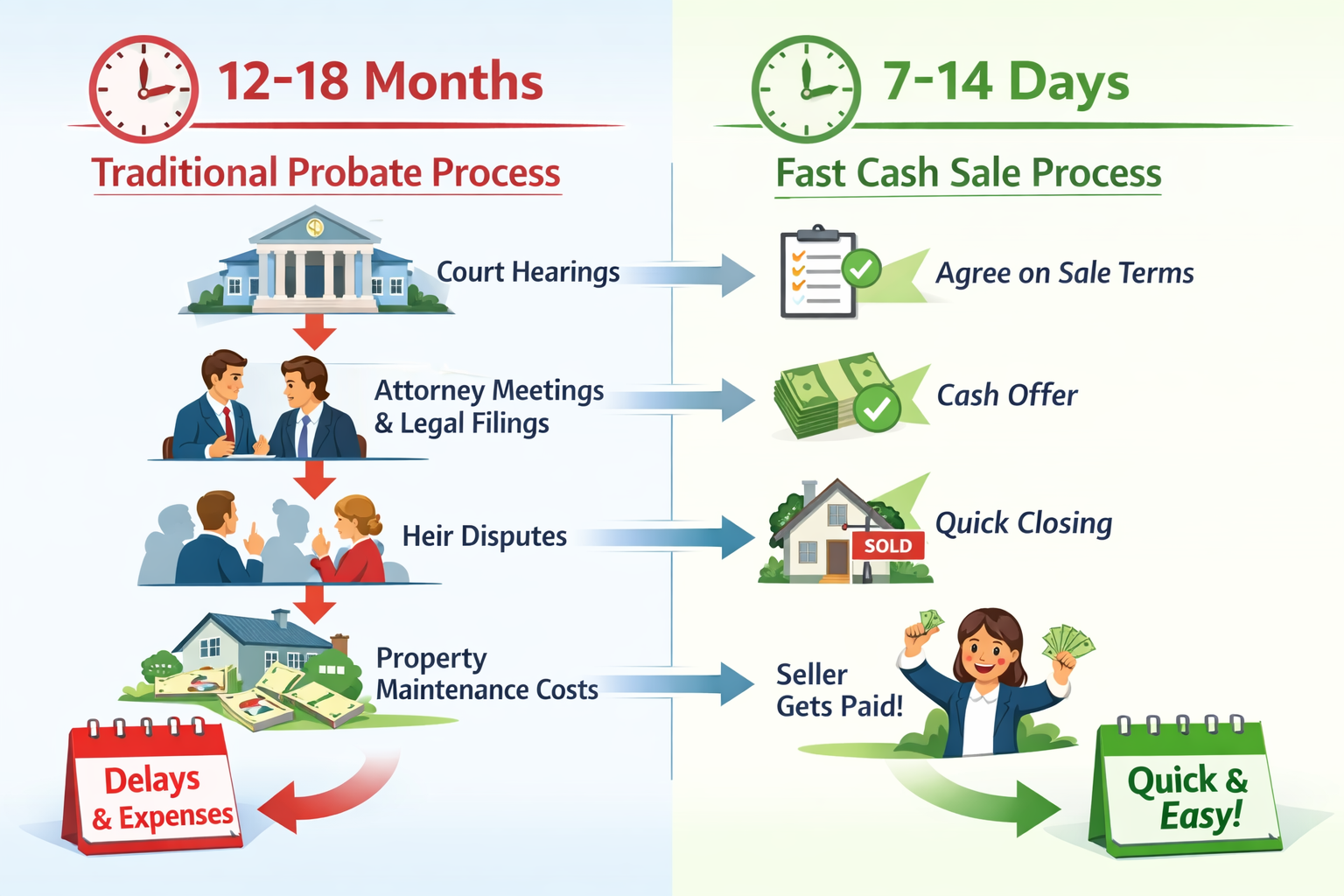
Probate is the legal process of settling a deceased person’s estate, including validating their will, paying debts, and distributing assets to heirs. When real estate is involved, this process becomes significantly more complex.
What Happens During Probate?
The probate court oversees the entire estate settlement. An executor or administrator must be appointed, creditors notified, debts paid, and assets inventoried. Only after these steps can property be distributed or sold.
Here’s what makes probate so time-consuming:
- Court schedules and backlogs – Courts in 2026 are still dealing with case backlogs, meaning your hearing dates may be months apart
- Creditor claim periods – Most states require a 3-6 month waiting period for creditors to file claims against the estate
- Heir notifications and agreements – All heirs must be properly notified and given time to respond
- Property appraisals and valuations – The court requires official valuations before approving sales
- Title searches and clearing – Discovering and resolving title issues can add months to the timeline
The Financial Burden of Waiting
Every month a probate property sits unsold costs money:
| Expense Type | Average Monthly Cost |
|---|---|
| Property taxes | $200-$800 |
| Insurance | $100-$300 |
| Utilities | $150-$400 |
| Maintenance/lawn care | $100-$500 |
| HOA fees (if applicable) | $100-$600 |
| Total monthly burden | $650-$2,600 |
Over a typical 15-month probate period, these costs can reach $10,000 to $40,000—money that comes directly out of the estate’s value before heirs receive anything.
“The hidden costs of probate aren’t just financial. The emotional toll of managing an inherited property while grieving, coordinating with siblings, and navigating legal complexities can be overwhelming.” — Estate Planning Expert
Why Traditional Sales Don’t Work Well for Probate Properties
Listing a probate house with a traditional real estate agent seems like the obvious choice, but it comes with unique challenges that often lead to frustration and failed sales.
The Complications of Traditional Probate Sales
Court approval requirements mean even after accepting an offer, you must wait for a court hearing—typically 4-8 weeks out. During this waiting period, the buyer can back out, and in many states, the court may require an “overbid” process where other buyers can outbid the original offer at the hearing.
Financing contingencies create massive uncertainty. When a buyer needs a mortgage, the sale depends on their loan approval, appraisal, and inspection. Statistics show that 20-30% of traditional probate sales fall through due to financing issues—and when that happens, you’re back to square one.
Property condition challenges are common with inherited homes. Many have been vacant for months or years, suffering from deferred maintenance. Traditional buyers expect move-in ready homes, requiring expensive repairs, updates, and staging before listing.
The Multiple Heir Problem
When selling inherited property with multiple owners, getting everyone to agree on listing price, repairs, and accepting offers becomes exponentially harder. Each heir may have different:
- Financial needs and timelines
- Emotional attachments to the property
- Opinions on property value
- Willingness to invest in repairs
Traditional sales require unanimous agreement at multiple decision points, creating friction and delays. One disagreeable heir can derail the entire process.
How to Sell Probate House Fast: Skip the Wait, Get Cash Now
The solution to probate property challenges is working with specialized cash buyers who understand the complexities and can navigate them efficiently.
What Makes Cash Sales Different?
Cash buyers purchase properties directly without involving banks, appraisers, or traditional financing. This fundamental difference eliminates most of the complications that plague traditional probate sales.
Key advantages include:
✅ No repairs needed – Sell the property exactly as-is, in any condition
✅ No financing contingencies – Cash buyers don’t need loan approval, eliminating a major failure point
✅ Faster closing – Complete transactions in 7-14 days after court approval instead of 60-90 days
✅ No agent commissions – Save 5-6% of the sale price in realtor fees
✅ Simplified process – One point of contact handles everything
✅ Certainty – Cash offers rarely fall through compared to financed offers
The Fast-Track Probate Sale Process
When you choose to sell probate house fast, here’s how the streamlined process works:
Step 1: Initial Contact and Property Assessment (Day 1-2)
Reach out to a reputable cash buyer who specializes in probate properties. They’ll ask about the property’s location, condition, probate status, and your timeline. Many offer free, no-obligation consultations.
Step 2: Property Evaluation (Day 3-5)
The buyer conducts a quick property walkthrough—no need to clean, repair, or stage anything. They assess the property’s value considering its current condition and local market factors.
Step 3: Cash Offer Presentation (Day 5-7)
You receive a written cash offer with no hidden fees or surprise deductions. The offer is straightforward: this is what you’ll receive at closing.
Step 4: Review and Acceptance (Day 7-10)
Take time to review the offer with co-heirs and your probate attorney. Reputable buyers provide helpful guidance without pressure, understanding that multiple heirs need to reach consensus.
Step 5: Court Approval Process (Week 2-6)
The executor files the necessary paperwork with the probate court to approve the sale. The cash buyer often provides documentation support and may have experience with local court requirements that speeds this process.
Step 6: Closing (Week 6-8)
Once the court approves the sale, closing happens quickly—often within days. You receive cash payment, and the property transfers to the new owner. The estate is relieved of all property-related expenses immediately.
Navigating Common Probate Obstacles
Experienced cash buyers who offer helpful solutions understand how to handle the complications that derail traditional sales:
Unclear or clouded titles – If the property has title problems, specialized buyers work with title professionals to resolve issues before or during closing.
Outstanding liens or judgments – Properties with liens or back taxes can still be sold. Cash buyers often coordinate lien payoffs as part of the closing process.
Multiple heirs with disagreements – When siblings won’t agree, a solid cash offer with clear terms and a fast timeline often brings everyone to the table. The certainty and simplicity help overcome objections.
Property in poor condition – Unlike traditional buyers, cash purchasers buy homes in any condition—from minor cosmetic issues to major structural problems, hoarding situations, or fire damage.
The Benefits of Working with Probate Property Specialists
Not all cash buyers are created equal. Working with industry experts who specialize in probate properties provides distinct advantages.
Experience with Probate Court Requirements
Probate specialists understand the specific documentation and procedures required by local courts. They’ve successfully completed dozens or hundreds of probate transactions and can anticipate potential roadblocks before they become problems.
This expertise means:
- Accurate paperwork submitted the first time, avoiding delays from rejections or corrections
- Realistic timelines based on actual local court processing speeds
- Proactive problem-solving when unexpected issues arise
- Helpful guidance for executors unfamiliar with their responsibilities
Coordination with Estate Professionals
The best probate property buyers maintain relationships with estate attorneys, title companies, and tax professionals. This network provides trustworthy service through coordinated efforts that benefit the estate.
For example, if selling property in probate reveals unexpected tax liens, a well-connected buyer can quickly bring in the right professionals to resolve the issue without derailing the sale.
Transparent, Fair Pricing
Reputable cash buyers provide clear explanations of how they calculate offers. While cash offers are typically 70-85% of after-repair market value, this must be weighed against:
- No repair costs (often $10,000-$50,000 or more)
- No agent commissions (5-6% of sale price)
- No carrying costs during months of traditional listing
- No risk of buyer financing falling through
- Certainty and speed that allow heirs to move forward with their lives
When you factor in these savings and benefits, cash offers often net more money than traditional sales—and always provide more peace of mind.
Real-World Scenarios: When Fast Cash Sales Make Perfect Sense
Let’s look at common situations where choosing to sell probate house fast: skip the wait, get cash now provides the best outcome.
Scenario 1: Out-of-State Heirs
The Situation: Three siblings inherit their parents’ home in Ohio, but they all live in different states—California, Texas, and Florida. None can easily travel to manage repairs, meet with contractors, or show the property to buyers.
The Problem: Traditional sales require someone local to coordinate repairs, stage the home, be available for showings, and handle maintenance. Long-distance property management is expensive and frustrating.
The Solution: A cash sale eliminates all these headaches. One video walkthrough or local property visit is all that’s needed. The buyer handles everything else, and closing can happen with remote document signing.
Scenario 2: Property in Poor Condition
The Situation: An inherited house has been vacant for two years. The roof leaks, the HVAC doesn’t work, there’s water damage in multiple rooms, and the yard is overgrown. Estimates for repairs exceed $45,000.
The Problem: Traditional buyers won’t touch it without major renovations. The heirs don’t have $45,000 to invest upfront, and getting a loan against an inherited property is complicated.
The Solution: Cash buyers purchase as-is, making an offer that accounts for needed repairs. The heirs receive cash without investing a penny in improvements.
Scenario 3: Urgent Financial Need
The Situation: The deceased had significant medical debts and outstanding bills. Creditors are filing claims against the estate, and the executor needs to settle these obligations quickly to protect the heirs from liability.
The Problem: Traditional sales take 6-12 months from listing to closing—far too long when creditors are demanding payment.
The Solution: A fast cash sale converts the property to liquid funds within weeks, allowing the executor to settle debts promptly and close the estate efficiently.
Scenario 4: Heir Disagreements
The Situation: Four siblings inherited a property, but two want to sell immediately while two want to hold it as a rental investment. Tensions are rising, and family relationships are suffering.
The Problem: Joint property ownership requires unanimous agreement for major decisions. Deadlock can lead to expensive partition lawsuits.
The Solution: A strong cash offer with clear terms and a fast timeline often breaks the deadlock. The certainty of cash and the ability to quickly distribute proceeds helps reluctant heirs see the benefits of selling.
Understanding Your Legal Options and Requirements
Before you can sell a probate property, certain legal requirements must be met. Understanding these helps set realistic expectations.
Executor Authority and Court Approval
The executor or administrator must have legal authority to sell estate property. This authority comes from:
- Letters Testamentary (if there’s a will) or Letters of Administration (if there’s no will)
- Court approval for the specific property sale
Some states grant executors independent authority to sell without court approval for each transaction, while others require court approval for every sale. Your probate attorney can clarify your state’s requirements.
Notice Requirements
Most states require formal notice to:
- All heirs and beneficiaries
- Known creditors
- Sometimes publication in local newspapers
These notice periods are designed to protect all interested parties but add time to the process. Cash buyers familiar with local requirements can help ensure proper notice is given efficiently.
Appraisal and Valuation
Courts typically require a formal appraisal or valuation to ensure the property sells for fair market value. However, “fair market value” for a property in poor condition, with title issues, or requiring fast sale is different from retail value for a renovated home.
Experienced probate buyers provide documentation supporting their offers, including comparable sales data and repair estimates that satisfy court requirements for fair value.
Tax Considerations
Selling inherited property has tax implications that vary based on:
- The property’s value at the date of death (stepped-up basis)
- The sale price
- How long the property was held before selling
- State-specific inheritance and estate taxes
Most heirs benefit from the stepped-up basis, which resets the property’s cost basis to its value at the date of death. This often eliminates or significantly reduces capital gains taxes. Consult with a tax professional to understand your specific situation.
How to Choose the Right Cash Buyer for Your Probate Property
Not all companies offering to buy probate houses provide the same level of service, fairness, or expertise. Here’s how to identify trustworthy partners.
Key Qualities to Look For
🏆 Proven probate experience – Ask how many probate properties they’ve purchased and request references from recent sellers. Companies with extensive probate experience understand the nuances and can navigate complications smoothly.
📋 Transparent process – Reputable buyers clearly explain each step, provide written offers with no hidden fees, and give you time to review everything with your attorney and co-heirs.
🤝 Friendly and caring approach – Selling an inherited property is often emotionally challenging. Look for buyers who show empathy and patience, not high-pressure sales tactics.
💼 Professional credentials – Check for proper licensing, insurance, and business credentials. Look for memberships in professional organizations and positive reviews from past clients.
🔍 Local market knowledge – Buyers familiar with your specific area provide more accurate offers and understand local court procedures, which speeds the process.
⚖️ Fair pricing – While cash offers are below retail value, they should be fair considering the property’s condition and the value you receive from a fast, certain sale. Get multiple offers to compare.
Red Flags to Avoid
❌ Pressure tactics – Legitimate buyers give you time to make informed decisions
❌ Vague offers – Watch out for offers with unclear terms or “subject to inspection” clauses that allow lowball revisions
❌ Upfront fees – You should never pay fees to receive a cash offer
❌ No local presence – Buyers without local knowledge may not understand your market or court requirements
❌ Poor communication – Difficulty reaching the buyer or getting questions answered is a warning sign
Questions to Ask Potential Buyers
Before committing to work with a cash buyer, ask:
- How many probate properties have you purchased in the past year?
- Can you provide references from recent probate sellers?
- What is your typical timeline from offer to closing for probate properties?
- How do you calculate your offers?
- What costs or fees will be deducted from the offer amount?
- Do you have experience with [our specific situation—liens, multiple heirs, title issues, etc.]?
- Will you provide documentation to support court approval?
- What happens if unexpected issues arise during the process?
The answers to these questions reveal whether you’re working with experienced professionals who provide expert service or opportunists looking to take advantage of your situation.
Maximizing Value When You Sell Probate House Fast
Choosing speed doesn’t mean leaving money on the table. Here’s how to ensure you get the best possible outcome.
Get Multiple Offers
Just as you would with traditional sales, obtain offers from multiple cash buyers. This allows you to:
- Compare pricing and terms
- Identify the most favorable offer
- Use competing offers as negotiation leverage
- Ensure you’re getting fair market value for a cash sale
Three to five offers give you a good sense of your property’s cash value range.
Understand What’s Included
Review each offer carefully to understand what’s included:
- Who pays closing costs?
- Are there any fees or deductions?
- What is the exact cash amount you’ll receive?
- What is the proposed timeline?
- Are there any contingencies?
The highest offer isn’t always the best if it comes with unfavorable terms or hidden fees.
Gather Important Documents
Having documentation ready speeds the process and may improve offers:
- Property deed
- Recent tax statements
- Any existing surveys or inspections
- Homeowners insurance information
- Documentation of liens, mortgages, or other encumbrances
- Probate court documents
Organized documentation demonstrates professionalism and helps buyers make accurate offers quickly.
Consider Timing
While fast sales are the goal, strategic timing can sometimes improve outcomes:
- Tax year considerations – Closing before or after year-end may have tax implications
- Market conditions – In rapidly appreciating markets, a few weeks’ delay might increase value
- Court schedules – Understanding court hearing schedules helps set realistic timelines
Discuss timing considerations with your probate attorney and tax advisor.
The Emotional Side of Selling an Inherited Property

Numbers and timelines tell only part of the story. Selling a parent’s or loved one’s home carries emotional weight that shouldn’t be ignored.
Grief and Decision-Making
Making major financial decisions while grieving is challenging. The probate process forces these decisions at a difficult time. Many people experience:
- Decision paralysis – Feeling overwhelmed by choices and responsibilities
- Guilt – Feeling disloyal to the deceased by selling their home
- Family conflict – Disagreements with siblings or other heirs about what to do
- Stress – Managing property responsibilities while handling grief and other life demands
The Relief of Resolution
Choosing to sell probate house fast often provides emotional relief alongside financial benefits:
✨ Closure – Completing the estate settlement allows everyone to move forward
✨ Reduced stress – No more worrying about property maintenance, expenses, or legal complications
✨ Family harmony – A clear, fair solution helps preserve relationships during a difficult time
✨ Peace of mind – Knowing the property is handled properly honors the deceased while meeting practical needs
“After months of stress trying to coordinate repairs and showings from three states away, the cash sale felt like a weight lifted. We could finally close this chapter and focus on healing as a family.” — Recent probate property seller
Honoring Memories While Moving Forward
Selling doesn’t mean forgetting. Before the sale, consider:
- Taking photos or videos of the property
- Collecting meaningful items or mementos
- Sharing stories and memories with family
- Creating a memory book or digital archive
These steps help preserve what matters while allowing practical resolution of the estate.
State-Specific Probate Considerations
Probate laws vary significantly by state, affecting timelines, court requirements, and sale procedures.
Community Property vs. Common Law States
Community property states (Arizona, California, Idaho, Louisiana, Nevada, New Mexico, Texas, Washington, Wisconsin) have different inheritance rules than common law states, particularly for married couples.
Common law states follow different rules for property ownership and inheritance. Understanding your state’s classification affects how property passes to heirs and what approvals are needed for sale.
States with Simplified Probate Procedures
Some states offer simplified or expedited probate for estates below certain value thresholds:
- California – Estates under $184,500 (2026)
- Texas – Small estate affidavit for estates under $75,000
- Florida – Summary administration for estates under $75,000
If your estate qualifies for simplified probate, the timeline for selling can be significantly shorter.
States Requiring Court Approval for Sales
Some states always require court approval for probate property sales, while others grant executors independent authority. States with stricter court approval requirements include:
- California (unless will grants independent authority)
- Florida (formal administration)
- New York (court approval typically required)
Working with local probate specialists who understand your state’s specific requirements ensures compliance and efficiency.
Alternatives to Consider Before Selling
While selling for cash offers many advantages, it’s worth considering alternatives to ensure you’re making the best choice.
Keeping the Property as a Rental
Pros:
- Potential ongoing income
- Property may appreciate over time
- Preserves family asset
Cons:
- Requires unanimous heir agreement
- Ongoing management responsibilities
- Maintenance and repair costs
- Tenant issues and vacancy risks
- Tax complications with multiple owners
For most heirs, especially those living far away or with different financial goals, rental property management creates more problems than it solves.
One Heir Buying Out Others
If one heir wants to keep the property, they can buy out the others’ shares. This requires:
- Agreed-upon property valuation
- Financing ability for the purchasing heir
- Legal documentation of the buyout
- Court approval in most cases
This works well when one heir has strong attachment to the property and financial means to complete the purchase.
Traditional Listing After Probate Closes
You could wait until probate closes, then list traditionally. This might make sense if:
- The property is in excellent condition
- You have time to wait for the best offer
- All heirs agree on this approach
- The local market strongly favors sellers
However, this extends the timeline significantly and maintains all carrying costs during the listing period.
Working with Sure Path Property Solutions
When you’re ready to sell probate house fast: skip the wait, get cash now, partnering with experienced professionals makes all the difference.
Sure Path Property Solutions specializes in helping property owners navigate complicated real estate situations—including probate sales with multiple heirs, title issues, liens, and properties in any condition.
Why Families Choose Sure Path
✓ Probate expertise – Extensive experience with probate properties across multiple states and court systems
✓ Compassionate approach – Understanding that inherited property sales involve grief and family dynamics, not just transactions
✓ Comprehensive solutions – Handling properties with liens, title problems, back taxes, and other complications
✓ Fair, transparent offers – Clear pricing with no hidden fees or surprise deductions
✓ Fast closings – Completing transactions in as little as 7-14 days after court approval
✓ Professional coordination – Working seamlessly with your attorney, title company, and court to ensure smooth processing
The Sure Path Difference
What sets Sure Path apart is the combination of expertise and empathy. The team understands that selling an inherited property isn’t just a financial transaction—it’s often a emotionally complex process involving family relationships, grief, and difficult decisions.
By providing helpful guidance throughout the process, Sure Path helps families navigate probate sales with confidence and peace of mind. The friendly and caring approach means you’re never pressured, always informed, and consistently supported.
Getting Started
Ready to explore your options? Contact Sure Path Property Solutions for a free, no-obligation consultation. You’ll receive:
- Honest assessment of your situation and options
- Fair cash offer with clear terms and no hidden fees
- Realistic timeline based on your specific circumstances
- Helpful guidance answering all your questions
There’s no pressure and no obligation—just helpful information to make the best decision for your family.
Frequently Asked Questions About Selling Probate Property Fast
Can you sell a house while it’s still in probate?
Yes, but you need proper authority and usually court approval. The executor must have letters testamentary or letters of administration, and most states require court approval before completing the sale. The specific requirements vary by state.
How long does it take to sell a probate property for cash?
After receiving executor authority, cash sales typically take 7-14 days from offer acceptance to closing, plus the time required for court approval (usually 4-8 weeks). Total timeline from initial contact to closing is often 6-10 weeks—compared to 12-18 months for traditional probate sales.
Do all heirs have to agree to sell the probate property?
Generally yes, all heirs must be notified and given opportunity to object. In practice, if the executor has authority and the court approves a fair sale, individual heir objections rarely block the sale. However, heir agreement makes the process much smoother.
What if the probate property has a mortgage or liens?
Properties with mortgages, tax liens, or judgment liens can still be sold. These debts are typically paid from sale proceeds at closing. Experienced cash buyers coordinate these payoffs as part of the transaction.
Will I get less money selling for cash versus listing traditionally?
Cash offers are typically 70-85% of after-repair retail value. However, when you factor in repair costs avoided (often $10,000-$50,000+), agent commissions saved (5-6%), months of carrying costs eliminated ($650-$2,600/month), and certainty of closing, cash sales often net similar or better proceeds—with far less stress and risk.
What happens if the property is in terrible condition?
Cash buyers purchase properties in any condition—from minor cosmetic issues to major structural problems, fire damage, hoarding situations, or complete disrepair. You don’t need to clean, repair, or improve anything. The offer accounts for the property’s current condition.
Can you sell probate property from out of state?
Absolutely. Modern technology allows remote document signing, video property tours, and digital communication. You don’t need to travel to the property location for a cash sale. Everything can be handled remotely with proper documentation.
What if there are title issues or unclear ownership?
Title problems are common with inherited properties. Experienced buyers work with title professionals to resolve issues like breaks in the chain of title, missing heirs, or unclear ownership before or during closing.
Taking Action: Your Next Steps
If you’re facing the challenge of selling an inherited property through probate, you now understand there’s a better path than the traditional 12-18 month ordeal.
Immediate Actions You Can Take
1. Assess your situation
- Identify all heirs and their contact information
- Gather property documents (deed, tax statements, etc.)
- Determine probate status and executor authority
- List any known issues (liens, title problems, condition issues)
2. Consult with professionals
- Speak with a probate attorney about your state’s requirements
- Contact a tax advisor about potential tax implications
- Reach out to experienced probate property buyers for free consultations
3. Get multiple cash offers
- Contact 3-5 reputable cash buyers
- Request written offers with clear terms
- Compare offers and ask questions
- Check references and reviews
4. Make an informed decision
- Review all options with co-heirs
- Consider both financial and emotional factors
- Choose the solution that best serves everyone’s interests
- Move forward with confidence
The Path Forward
Selling an inherited property doesn’t have to be a months-long nightmare of court dates, repairs, and uncertainty. When you sell probate house fast: skip the wait, get cash now, you choose:
✅ Speed over prolonged uncertainty
✅ Simplicity over complicated processes
✅ Certainty over risky contingencies
✅ Peace of mind over ongoing stress
Thousands of families have successfully navigated probate property sales using this approach, receiving fair cash offers and closing quickly while preserving family relationships and moving forward with their lives.
Conclusion
The probate process doesn’t have to control your timeline or drain your resources. While traditional probate property sales take 12-18 months and cost thousands in carrying expenses, cash sales offer a proven alternative that delivers results in weeks instead of months.
By choosing to sell probate house fast: skip the wait, get cash now, you’re not taking a shortcut or accepting less than you deserve. You’re making a strategic decision that:
- Eliminates months of property carrying costs
- Removes the risk of buyer financing falling through
- Avoids expensive repair and renovation requirements
- Simplifies heir agreement and coordination
- Provides certainty in an uncertain time
- Allows everyone to move forward with their lives
The key is working with experienced, trustworthy professionals who understand probate complexities and treat your situation with the care and respect it deserves. Companies like Sure Path Property Solutions provide the expertise, compassion, and helpful solutions that turn a potentially overwhelming process into a manageable, even positive experience.
Whether you’re dealing with multiple heirs, properties with liens, out-of-state properties, or homes in poor condition, the right partner makes all the difference.
Don’t let probate hold you hostage for another year. Explore your options, get fair cash offers, and discover how quickly you can resolve your inherited property situation. The relief and peace of mind are closer than you think.
Ready to skip the wait and get cash now? Contact Sure Path Property Solutions today for your free, no-obligation consultation and cash offer.