
Selling Heir Property Process: Navigating Complicated Titles

Imagine discovering you’ve inherited your grandmother’s house, only to learn that fourteen other relatives also have a claim to it—and some of them you’ve never even met. Welcome to the complex world of heir property, where family legacy meets legal confusion, and selling heir property process: navigating complicated titles becomes one of the most challenging real estate situations property owners face in 2026.
Heir property represents one of the most misunderstood and difficult real estate scenarios in America today. When property passes through generations without proper estate planning, it creates a tangled web of ownership that can trap families in legal limbo for decades. The good news? With the right guidance and understanding, even the most complicated heir property situations can be resolved successfully.
Key Takeaways
- Heir property occurs when someone dies without a will, causing the property to pass to multiple heirs who become co-owners, often creating clouded titles that prevent traditional sales
- All heirs typically must agree to sell the property, making the process complicated when dealing with multiple family members, missing heirs, or disagreements about the property’s future
- Title issues, back taxes, and liens frequently accompany heir property, requiring professional resolution before a sale can proceed through conventional channels
- Alternative solutions exist for families stuck in heir property situations, including partition actions, buyouts, and working with specialized cash buyers who handle complicated titles
- Professional guidance makes the difference between years of frustration and a smooth resolution that honors family legacy while providing financial relief
Understanding Heir Property and Why Titles Become Complicated

Heir property develops when a property owner dies without leaving a valid will or estate plan. Instead of transferring to a single designated person, the property automatically passes to all legal heirs according to state intestacy laws. This creates what’s called “tenancy in common,” where multiple people own undivided interests in the same property.
What Makes Heir Property Different from Traditional Ownership
Unlike joint tenancy or other ownership structures, heir property means each co-owner holds a fractional interest that they can theoretically sell, mortgage, or pass down to their own heirs. This creates several immediate complications:
Fractured ownership spreads across multiple family members, sometimes spanning several generations. A property might have five heirs in the second generation, but if one of those heirs dies without a will, their share splits among their children, creating even more co-owners.
No clear decision-maker exists because all owners have equal rights regardless of their percentage of ownership. A person with a 5% interest has the same legal standing as someone with a 40% interest when it comes to property decisions.
Title becomes clouded because there’s no clear chain of ownership documented through proper probate proceedings. Title companies and lenders view this as high-risk, making traditional sales nearly impossible.
How Heir Property Titles Become Increasingly Complex Over Time
The selling heir property process: navigating complicated titles becomes exponentially more difficult with each passing year. Here’s why:
Time works against heir property owners. When the original owner dies without a will, the property passes to their heirs. If those heirs also die without wills, their shares pass to their heirs. Within two or three generations, a single property might have dozens of co-owners scattered across different states or even countries.
Consider this real-world scenario: A grandmother bought a house in 1970. She died in 1995 without a will, leaving three children as heirs. One child died in 2010 without a will, leaving four children. Another died in 2022, also without a will, leaving two children. By 2026, that property has eight co-owners in the third generation, plus two surviving second-generation heirs—ten total owners who may have never met each other.
Common Title Problems Associated with Heir Property
Several specific issues plague heir property titles and complicate the selling process:
🏚️ Missing or unknown heirs create immediate roadblocks. Some heirs may have moved away decades ago, changed their names through marriage, or lost contact with the family entirely. Selling property legally requires all heirs to participate or be properly notified.
📋 Gaps in the chain of title occur when deaths weren’t properly recorded or probate proceedings never occurred. These breaks in the chain of title must be resolved before clear ownership can be established.
💰 Accumulated back taxes often pile up when no single person takes responsibility for payments. Back taxes on inherited property create liens that must be satisfied before sale.
⚖️ Existing liens and judgments against individual heirs can attach to their ownership interest, further complicating title clearance. Understanding how to sell a house with a lien becomes essential.
The Emotional and Financial Toll on Families
Beyond the legal complexities, heir property situations create significant emotional stress. Family members may have different visions for the property—some want to keep it for sentimental reasons, others need to sell for financial relief, and some may simply want nothing to do with it.
These disagreements can fracture family relationships and create lasting resentment. Meanwhile, the property may deteriorate from neglect, accumulate more debt, or face tax foreclosure, making the situation increasingly urgent.
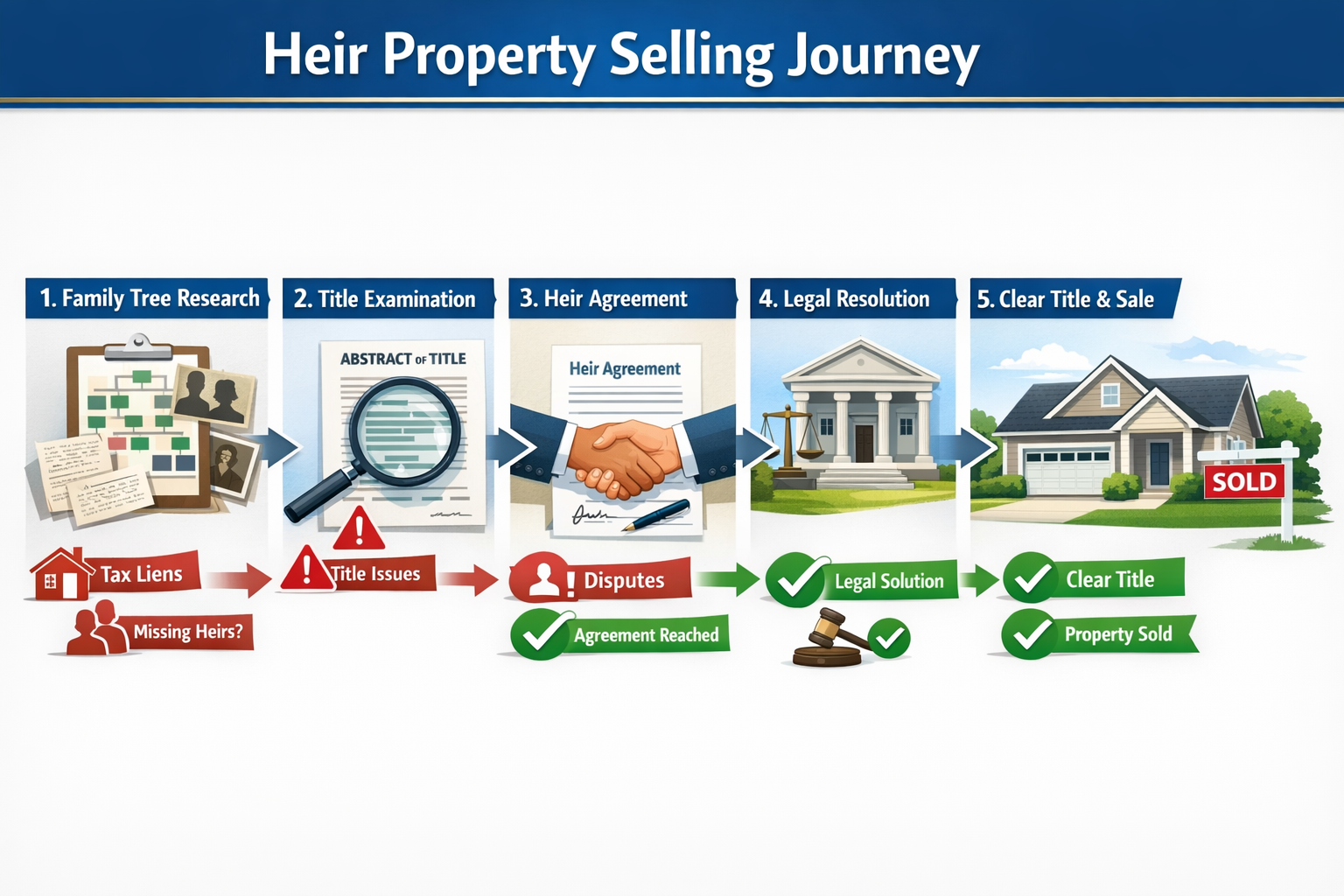
The Selling Heir Property Process: Navigating Complicated Titles Step-by-Step
Successfully selling heir property requires a methodical approach that addresses legal, financial, and family dynamics. While the process can seem overwhelming, breaking it down into manageable steps makes it achievable.
Step 1: Identify All Heirs and Their Ownership Interests
The first critical step involves creating a complete picture of who owns what. This requires:
Genealogical research to trace all descendants of the original property owner. This might involve examining birth certificates, death certificates, marriage licenses, and other vital records. Professional genealogists or probate attorneys often handle this research for complicated family trees.
Calculating ownership percentages based on state intestacy laws. Each state has specific formulas for how property divides among heirs. For example, if the original owner had three children, each would typically receive a one-third interest. If one child predeceased the owner, that child’s share would usually pass to their children.
Locating missing heirs through various methods including online databases, social media, private investigators, or legal notices published in newspapers. This step can take considerable time but is legally necessary before proceeding with a sale.
Step 2: Obtain a Professional Title Examination
A thorough title search reveals the full extent of complications affecting the property. This examination should identify:
- All recorded ownership interests and transfers
- Outstanding mortgages or liens
- Tax delinquencies and assessments
- Easements or encumbrances
- Judgments against any co-owners
- Any abstract of title problems that need resolution
Title companies specializing in complicated situations can provide this service, though they may require upfront payment given the property’s unclear status. The examination creates a roadmap for what needs to be resolved before sale.
Step 3: Achieve Heir Agreement on Selling
Getting all heirs to agree represents one of the biggest challenges in the selling heir property process: navigating complicated titles. This step involves:
Open communication among all co-owners about the property’s situation, condition, and financial obligations. Many heirs may be unaware they even own an interest in the property or understand the implications of heir property ownership.
Realistic expectations about the property’s value, especially if it has deferred maintenance, tax liens, or title issues. Professional appraisals help establish fair market value and prevent unrealistic demands from individual heirs.
Written agreements documenting each heir’s consent to sell, including terms for how proceeds will be divided. These agreements should be prepared or reviewed by an attorney to ensure enforceability.
Step 4: Address Outstanding Financial Obligations
Before any sale can close, financial clouds on the title must be cleared:
💵 Back taxes must be paid or negotiated. Some counties offer payment plans or tax lien settlements, while others may be approaching tax foreclosure. Understanding your options for selling a house with tax debt is crucial.
🔗 Liens must be satisfied or subordinated. This includes mechanics liens, judgment liens, or other encumbrances. Some liens can be negotiated down or paid from sale proceeds at closing.
📊 HOA dues or code violations need resolution if applicable. Municipalities may have placed liens for unpaid utilities, nuisance abatement, or code enforcement actions.
Step 5: Choose the Right Selling Method for Your Situation
Families facing heir property challenges have several options, each with advantages and disadvantages:
Traditional Sale Through a Real Estate Agent
Best for: Properties with clear heir agreement, resolved title issues, and good condition
Challenges: Requires clear title, all heirs must sign listing agreements and closing documents, property must be marketable to traditional buyers, and the process takes 60-120 days on average
Process: Hire an agent experienced with heir property, make necessary repairs, list on the MLS, negotiate offers, and coordinate all heir signatures at closing
Partition Action Through the Courts
Best for: Situations where heirs cannot agree on selling or property disposition
Challenges: Expensive (often $10,000-$50,000+ in legal fees), time-consuming (12-24 months), and may result in forced sale at auction for below-market value
Process: One or more heirs file a partition action lawsuit asking the court to either physically divide the property (partition in kind) or order its sale with proceeds divided among owners (partition by sale)
Selling to a Cash Buyer Specializing in Complicated Titles
Best for: Properties with significant title issues, heir disagreements, or financial distress
Advantages: Buyers purchase properties as-is, handle title complications, work with all heirs, close quickly (often 7-14 days), and eliminate the need for repairs or traditional financing contingencies
Process: Contact a reputable company that buys heir property with complicated titles, receive a fair cash offer, coordinate heir approval, and close on your timeline
Step 6: Navigate the Legal Requirements
Even with heir agreement, legal procedures must be followed:
Probate proceedings may be required to officially transfer title from the deceased owner to heirs, even years after death. Some states offer simplified probate for estates below certain values.
Affidavits of heirship can sometimes substitute for full probate in certain jurisdictions. These sworn statements document family relationships and heir status, signed by people with knowledge of the family history.
Quiet title actions may be necessary to clear clouded title issues and establish clear ownership. These lawsuits ask the court to declare who owns the property and eliminate competing claims.
Step 7: Coordinate the Closing Process
The final step involves bringing all parties together to complete the sale:
All heirs must sign closing documents unless some heirs have granted power of attorney to others. Remote notarization has made this easier in 2026, but coordination remains challenging with multiple parties.
Proceeds are distributed according to ownership percentages and any agreements among heirs. The closing agent will typically prepare a settlement statement showing each heir’s share after expenses.
Title insurance is issued to the buyer, confirming clear ownership transfer. This protects the buyer and their lender against future claims related to the property’s complicated history.
Legal Solutions for Complicated Heir Property Situations
When standard approaches don’t work, several legal mechanisms can break through heir property deadlocks and title complications.
Understanding Partition Actions: When Family Agreement Isn’t Possible
Partition actions represent the legal remedy when co-owners cannot agree on property disposition. While often viewed as a last resort, they sometimes provide the only path forward.
Partition by sale is most common for residential property. The court orders the property sold, typically at public auction, with proceeds divided among owners according to their interests. While this guarantees a sale, auction prices often fall 20-40% below market value.
Partition in kind physically divides the property among owners. This works for large land parcels that can be subdivided but rarely works for single-family homes. Each owner receives a portion of the property proportional to their interest.
The partition process begins when one or more co-owners file a lawsuit against the other co-owners. The court determines ownership interests, appoints commissioners to oversee any sale, and ultimately issues orders dividing proceeds or property.
Alternative Dispute Resolution Methods
Before resorting to partition litigation, families should explore less adversarial options:
Mediation brings all heirs together with a neutral third party who facilitates discussion and helps reach agreement. This voluntary process costs far less than litigation and preserves family relationships better than courtroom battles.
Buyout agreements allow interested heirs to purchase the interests of heirs who want to exit. This keeps the property in the family while providing liquidity to those who need it. Understanding how to buy out a co-owner quickly can facilitate these arrangements.
Family settlement agreements document negotiated solutions among heirs, including who will maintain the property, how expenses are shared, and future sale terms. These contracts can prevent future disputes and provide a framework for property management.
Working with Specialized Attorneys and Title Professionals
The complexity of heir property situations demands experienced professionals:
Probate attorneys understand intestate succession laws and can guide families through the legal process of establishing clear title. They prepare necessary court filings, represent heirs in proceedings, and ensure compliance with state requirements.
Real estate attorneys specializing in title issues can resolve clouds on title, negotiate with lienholders, and structure transactions that protect all parties. Their expertise becomes invaluable when dealing with multiple title complications.
Title companies with experience in complicated situations can sometimes insure properties that standard companies reject. They may require additional documentation or charge higher premiums, but they make sales possible when others won’t.
The Uniform Partition of Heirs Property Act (UPHPA)
As of 2026, over 20 states have adopted the UPHPA, which provides important protections for heir property owners facing partition actions:
Right of first refusal allows co-owners to purchase the property at the highest bid price before it’s sold to outside buyers at partition auction. This keeps property in the family when possible.
Market value sales are required instead of traditional auction procedures. Courts must order appraisals and set minimum bids at fair market value, protecting heirs from below-market forced sales.
Economic considerations must be weighed by courts before ordering partition by sale. Judges consider the property’s sentimental value, each owner’s wishes, and whether alternatives to sale exist.
Check whether your state has adopted UPHPA, as these protections significantly improve outcomes for heir property families facing partition.
Financial Considerations When Selling Heir Property
Understanding the financial landscape helps heirs make informed decisions and avoid costly mistakes during the selling process.
Tax Implications of Heir Property Sales
Selling inherited property triggers several tax considerations:
Capital gains taxes apply to the difference between the property’s value when inherited (stepped-up basis) and the sale price. Fortunately, inherited property receives a stepped-up basis to fair market value at the date of the original owner’s death, often eliminating or reducing capital gains.
Estate taxes may have applied when the original owner died, though federal estate tax only affects estates exceeding $13.61 million in 2026 (or $27.22 million for married couples). State estate taxes may apply at lower thresholds in some states.
Income tax reporting requires each heir to report their share of any gain on their personal tax return. The closing agent should provide documentation showing each heir’s proceeds.
Dealing with Property Tax Delinquencies
Accumulated property taxes represent one of the most common complications in heir property sales:
Tax liens take priority over most other claims and must be satisfied before clear title can transfer. Understanding the priority of tax liens helps in negotiating payment.
Penalties and interest compound over time, sometimes doubling or tripling the original tax amount. Some counties will negotiate settlements, especially if property is being sold to satisfy the debt.
Tax foreclosure timelines vary by state but typically occur after 2-5 years of non-payment. If foreclosure is imminent, selling quickly becomes critical to preserve any equity for heirs.
Calculating Fair Distribution Among Heirs
Dividing sale proceeds fairly requires careful calculation:
Ownership percentages determine each heir’s share of gross proceeds. These percentages depend on state intestacy laws and the family tree structure.
Expense allocation must account for costs like back taxes, liens, repairs, legal fees, and selling costs. Typically these are deducted proportionally from all heirs’ shares, though heirs sometimes negotiate different arrangements.
Special considerations might include crediting heirs who paid property expenses, maintained the property, or advanced funds for repairs. These arrangements should be documented in writing before the sale.
Understanding Offer Prices for Complicated Properties
Properties with heir property complications typically sell for less than comparable properties with clear title:
Traditional buyers often won’t consider properties with title issues, significantly reducing the buyer pool. Those who will consider them typically demand substantial discounts to compensate for risk and hassle.
Cash buyers who specialize in complicated properties offer convenience and certainty but typically pay 60-80% of after-repair market value. This discount reflects their costs for resolving title issues, making repairs, carrying costs, and profit margin.
Auction sales through partition actions often yield the lowest prices, sometimes 40-60% of market value, because the forced sale nature and auction format attract investor buyers seeking bargains.
When evaluating offers, heirs should consider not just the price but also the certainty of closing, timeline, and costs they’ll avoid by selling as-is to a buyer who handles complications.
Working with Sure Path Property Solutions: Expert Guidance for Heir Property Challenges
Navigating the selling heir property process: navigating complicated titles requires expertise, patience, and resources that most families don’t have. That’s where specialized professionals make all the difference.
How Sure Path Property Solutions Simplifies Complicated Heir Property Sales
At Sure Path Property Solutions, the team understands that heir property situations involve more than just real estate transactions—they involve family legacy, emotional attachments, and often urgent financial needs. The company provides helpful solutions specifically designed for properties that traditional buyers and agents won’t touch.
Comprehensive title resolution is handled by experienced professionals who work directly with counties, title companies, and attorneys to clear even the most complicated title issues. This includes resolving missing heir situations, clearing old liens, and addressing gaps in the chain of title.
Heir coordination services help families navigate the challenge of getting multiple owners aligned. The team communicates with all heirs, explains options clearly, and facilitates agreements that work for everyone involved.
Fast cash offers provide families with certainty and speed. Rather than waiting months for traditional sales that may never close due to title issues, families can receive fair offers within 24-48 hours and close in as little as 7-14 days.
The Sure Path Difference: Trustworthy Service and Expert Solutions
What sets Sure Path Property Solutions apart is the combination of industry experts with a genuinely caring approach:
✅ No obligation consultations help families understand their situation without pressure. The team provides helpful guidance even if families ultimately choose different solutions.
✅ Transparent communication ensures all heirs understand the process, timeline, and financial implications. No hidden fees or surprise deductions at closing.
✅ As-is purchases mean families don’t need to invest in repairs, cleanup, or maintenance. Properties are purchased in their current condition, regardless of issues.
✅ Flexible closing timelines accommodate family needs. Whether heirs need to close quickly to avoid foreclosure or need extra time to coordinate signatures, the team works on the family’s schedule.
Real Solutions for Real Families
The team at Sure Path Property Solutions has helped hundreds of families resolve heir property challenges that seemed impossible:
- Families with multiple heirs who couldn’t agree found common ground through fair cash offers
- Properties facing tax foreclosure were saved with quick closings
- Heirs scattered across different states coordinated remote closings
- Properties with decades of title complications were cleared and sold
This expert service comes from understanding that behind every complicated property is a family seeking resolution, financial relief, and peace of mind.
Getting Started: The Simple Path Forward
For families struggling with heir property complications, the path forward starts with a simple conversation. The Sure Path team offers friendly and caring consultations where they:
- Listen to your situation without judgment or pressure
- Explain your options clearly, including pros and cons of each approach
- Provide a fair cash offer if selling makes sense for your family
- Guide you through the process with helpful solutions at every step
Reaching out costs nothing and creates no obligation. It simply opens the door to understanding options and finding the right path for your specific situation.
Preventing Future Heir Property Situations
While this article focuses on resolving existing heir property complications, prevention deserves attention for those who want to protect their own families from similar challenges.
The Importance of Estate Planning
The single most effective way to prevent heir property is proper estate planning:
Wills and trusts designate exactly who receives property and in what manner. A simple will costs far less than the legal fees families later spend resolving heir property issues.
Transfer-on-death deeds allow property to pass directly to named beneficiaries without probate in many states. These deeds are recorded during the owner’s lifetime but only take effect upon death.
Life estate deeds let owners retain control during their lifetime while designating remainder beneficiaries who automatically inherit upon death.
Educating Family Members About Property Ownership
Open family discussions about property and estate plans prevent surprises and disputes:
- Share estate planning documents with heirs
- Explain the reasoning behind property disposition decisions
- Discuss whether heirs want to keep or sell inherited property
- Address potential conflicts before they become legal battles
Maintaining Clear Property Records
Property owners should maintain organized records including:
- Original deed and any subsequent transfers
- Property tax payment records
- Mortgage documents and payment history
- Maintenance and improvement receipts
- Insurance policies and claims
These records help heirs understand what they’re inheriting and facilitate smoother transitions.
Frequently Asked Questions About Selling Heir Property
Can heir property be sold if one heir disagrees?
Generally, no. Selling property requires all owners to consent and sign closing documents. However, heirs who want to sell have options including partition actions, buyout agreements, or selling their individual share to other co-owners or investors.
How long does it take to sell heir property?
Timelines vary dramatically based on complications. Properties with heir agreement and minor title issues might sell in 30-60 days. Properties requiring partition actions or extensive title work can take 12-24 months. Working with cash buyers who specialize in heir property can reduce timelines to 1-2 weeks.
What if we can’t find all the heirs?
Most states have legal procedures for selling property when heirs cannot be located. This typically involves publishing legal notices, conducting diligent searches, and potentially appointing a guardian ad litem to represent missing heirs’ interests. An experienced attorney can guide families through these requirements.
Do all heirs have to pay back taxes?
All co-owners are jointly and severally liable for property taxes, meaning the county can pursue any or all owners for the full amount. However, heirs can negotiate among themselves about who pays what, and tax liens are typically satisfied from sale proceeds rather than requiring heirs to pay out-of-pocket.
Is heir property more valuable or less valuable than regular property?
The property itself has the same inherent value, but heir property typically sells for less because of title complications, limited buyer pool, and the challenges of coordinating multiple owners. The discount varies based on the severity of complications but often ranges from 20-40% below clear-title market value.
What’s the difference between heir property and inherited property?
All heir property is inherited property, but not all inherited property is heir property. Property inherited through a will or trust with clear title designation is simply inherited property. Heir property specifically refers to property inherited without a will, creating multiple co-owners with clouded title.
State-Specific Considerations for Heir Property Sales
Heir property laws vary significantly by state, affecting everything from intestacy succession to partition procedures.
Community Property vs. Common Law States
Community property states (Arizona, California, Idaho, Louisiana, Nevada, New Mexico, Texas, Washington, Wisconsin) have different rules for how property passes when a married person dies. Surviving spouses may have automatic rights to portions of property regardless of intestacy laws.
Common law states follow traditional intestacy succession, typically dividing property among surviving spouses and children according to state-specific formulas.
State-Specific Intestacy Laws
Each state has unique rules determining which relatives inherit and in what proportions:
- Some states give surviving spouses 100% if no children exist
- Others split property between spouses and parents or siblings
- Percentages vary for children when a spouse survives
- Rules differ for children from previous relationships
Understanding your state’s specific laws is essential for determining ownership interests accurately.
Partition Law Variations
Partition procedures, timelines, and protections vary by state:
- States with UPHPA offer significantly better protections for heir property owners
- Some states require mediation before partition actions proceed
- Costs and timelines for partition vary from $5,000-$50,000+ and 6-24 months
- Some states allow private partition sales while others require public auction
Recording and Probate Requirements
States differ in requirements for establishing clear title:
- Some accept affidavits of heirship to transfer title without probate
- Others require full probate proceedings regardless of estate value
- Recording requirements for death certificates and heir documentation vary
- Title insurance standards differ by state and company
Working with professionals familiar with your specific state’s requirements ensures compliance and smoother transactions.
Common Mistakes to Avoid When Selling Heir Property
Families navigating heir property sales often make preventable mistakes that cost time, money, and relationships.
Mistake #1: Delaying Action
The problem: Many families postpone addressing heir property, hoping situations will resolve themselves or avoiding difficult conversations.
The consequence: Property deteriorates, taxes accumulate, more heirs enter the picture as time passes, and options narrow as foreclosure approaches.
The solution: Address heir property situations as soon as possible. Even small steps like identifying heirs or obtaining title reports move toward resolution.
Mistake #2: Attempting DIY Legal Solutions
The problem: Families try to handle complicated legal procedures without professional guidance to save money.
The consequence: Improperly filed documents, missed deadlines, invalid agreements, and ultimately spending more to fix mistakes than proper guidance would have cost.
The solution: Invest in experienced attorneys and title professionals from the beginning. Their expertise prevents costly errors and accelerates resolution.
Mistake #3: Failing to Communicate with All Heirs
The problem: Some heirs try to handle sales without involving or informing all co-owners.
The consequence: Legal challenges, invalid sales, lawsuits among family members, and deals falling through at closing.
The solution: Ensure transparent communication with all heirs from the start. Even heirs with small interests or those who seem disinterested must be properly involved.
Mistake #4: Unrealistic Price Expectations
The problem: Heirs expect to receive full market value for properties with significant complications.
The consequence: Properties sit unsold while taxes accumulate and conditions worsen, or families reject reasonable offers and end up with less through forced partition sales.
The solution: Understand that title complications, needed repairs, and heir property challenges legitimately reduce value. Get multiple opinions and consider the full picture including costs, time, and risks of alternatives.
Mistake #5: Ignoring Tax and Lien Issues
The problem: Families try to sell without addressing outstanding financial obligations on the property.
The consequence: Sales fall through at closing when title companies discover unresolved liens, or families are shocked by how much of the proceeds go to satisfy debts.
The solution: Obtain a complete title examination early and address all financial issues upfront. Factor these costs into expectations about net proceeds.
Mistake #6: Not Considering All Options
The problem: Families fixate on one solution (like traditional sale or partition) without exploring alternatives.
The consequence: Missing better options that could save time, money, or family relationships.
The solution: Consult with professionals who can explain all available options including their advantages, disadvantages, costs, and timelines. Make informed decisions based on complete information.
The Emotional Journey: Supporting Families Through Heir Property Sales
Beyond the legal and financial complexities, heir property situations involve significant emotional challenges that deserve recognition and support.
Honoring Family Legacy While Moving Forward
Many heir property situations involve family homes with deep sentimental value—places where generations gathered for holidays, where children grew up, where memories were made. Selling such properties can feel like betraying family legacy or dishonoring ancestors’ sacrifices.
Acknowledging these feelings is important. The decision to sell doesn’t diminish the property’s importance to family history. Sometimes the most respectful choice is letting go when maintaining the property creates conflict or financial hardship.
Creating closure rituals helps families transition. Before selling, consider gathering for final photos, sharing stories, or taking meaningful items. These actions honor the past while accepting the present reality.
Navigating Family Conflicts with Grace
Heir property situations often expose or exacerbate family tensions:
- Siblings may have different financial needs or attachment levels
- Generational divides create different perspectives on the property
- Old resentments or perceived favoritism resurface
- Disagreements about property value or distribution create conflict
Professional mediation can help families navigate these tensions constructively. A neutral third party facilitates difficult conversations and helps find common ground.
Focus on shared interests rather than positions. While heirs may disagree about whether to sell, most share interests in fair treatment, family harmony, and resolving the situation efficiently.
Finding Peace in Difficult Decisions
Ultimately, heir property decisions involve weighing competing values:
- Financial need vs. sentimental attachment
- Individual interests vs. family unity
- Immediate resolution vs. long-term possibilities
- Practical reality vs. ideal outcomes
There’s rarely a perfect solution that satisfies everyone completely. The goal is finding the best available option given the specific circumstances, then making peace with that choice.
Helpful guidance from experienced professionals who understand both the technical and emotional aspects of heir property makes this journey more manageable. The team at Sure Path Property Solutions recognizes that families need more than just transaction services—they need compassionate support through challenging transitions.
Taking Action: Your Next Steps for Resolving Heir Property Challenges
If you’re facing the selling heir property process: navigating complicated titles, the path forward starts with a single step. Here’s how to move from feeling stuck to finding resolution:
Step 1: Assess Your Situation Honestly
Take stock of your specific circumstances:
- How many heirs are involved?
- What’s the current condition of the property?
- Are there outstanding taxes, liens, or other financial obligations?
- What title complications exist?
- What’s the level of agreement among heirs?
- How urgent is the need to sell?
Writing down answers to these questions clarifies the situation and helps professionals provide targeted guidance.
Step 2: Gather Available Documentation
Collect whatever records you have:
- Property deeds or title documents
- Tax statements or assessments
- Death certificates for deceased owners
- Family tree information
- Any existing wills or estate documents
- Correspondence with other heirs
Don’t worry if documentation is incomplete—professionals can help fill gaps—but starting with what’s available accelerates the process.
Step 3: Consult with Experienced Professionals
Reach out to experts who specialize in complicated property situations. Contact Sure Path Property Solutions for a no-obligation consultation where you can:
- Explain your situation to professionals who’ve seen similar challenges
- Receive honest assessment of options and timelines
- Get answers to specific questions about your property
- Obtain a fair cash offer if selling makes sense
This consultation costs nothing and creates no obligation. It simply provides clarity and options.
Step 4: Communicate with Other Heirs
Share what you’ve learned with co-owners. Transparent communication prevents misunderstandings and helps build consensus. Consider:
- Scheduling a family meeting (in-person or virtual)
- Sharing professional assessments and options
- Listening to each heir’s concerns and preferences
- Working toward agreement on the best path forward
Step 5: Make a Decision and Move Forward
After gathering information and consulting with heirs and professionals, choose the option that best fits your situation:
- Traditional sale if you have heir agreement and can clear title issues
- Cash sale to specialists if you need speed, certainty, or have significant complications
- Partition action if heirs cannot agree and other options are exhausted
- Buyout arrangements if some heirs want to keep the property
Once you’ve decided, commit to the process and trust the professionals guiding you. Resolution is possible, even for the most complicated heir property situations.
Conclusion: Finding Your Path Through Heir Property Complexity
The selling heir property process: navigating complicated titles represents one of real estate’s most challenging situations. Multiple owners, clouded titles, financial obligations, family dynamics, and legal complexities create obstacles that can seem insurmountable. Yet thousands of families successfully resolve these situations every year by combining the right information, professional guidance, and commitment to finding solutions.
Remember these key principles as you navigate your heir property journey:
You’re not alone. Heir property affects millions of American families. The complications you’re facing are common, and solutions exist even for the most tangled situations.
Professional help makes the difference. Attempting to navigate heir property sales without experienced guidance typically leads to mistakes, delays, and additional costs. Investing in expert service from the beginning saves time, money, and stress.
Multiple solutions exist. Whether through traditional sales, partition actions, buyouts, or working with specialized cash buyers, families have options. The right choice depends on your specific circumstances, timeline, and priorities.
Taking action creates progress. The longest heir property journeys begin with a single step—making a phone call, sending an email, gathering documents, or having a conversation with other heirs. Each action moves toward resolution.
Family relationships matter. While resolving heir property is important, preserving family bonds is equally valuable. Approach the process with grace, patience, and willingness to compromise when possible.
If you’re ready to move forward with resolving your heir property situation, the team at Sure Path Property Solutions stands ready to provide helpful solutions with trustworthy service. Their industry experts bring both technical knowledge and genuine care to every family they serve.
Don’t let another year pass with your heir property situation unresolved. Reach out today for a no-obligation consultation and discover how friendly and caring professionals can guide you toward the clear, practical solutions you need. Your path to resolution starts with a simple conversation—take that first step today. 🏡✨