
Selling House with Legal Problems: Your Options & Solutions

Discovering legal issues attached to your property can feel like hitting a brick wall when you’re ready to sell. Whether it’s unpaid taxes, liens from creditors, title disputes, or complicated inheritance matters, these legal complications don’t have to trap you in an impossible situation. Selling House with Legal Problems: Your Options & Solutions exists—and understanding them can transform what feels like a dead end into a clear path forward.
The truth is, thousands of homeowners face these exact challenges every year. You’re not alone, and more importantly, you’re not stuck. While traditional real estate agents might turn away from properties with legal entanglements, specialized solutions and industry experts can help you navigate even the most complex situations. This comprehensive guide walks you through every type of legal problem that might affect your property sale, explains your realistic options, and provides actionable solutions to move forward with confidence.
Key Takeaways
- Legal problems don’t make your house unsellable—they simply require different strategies and specialized expertise to resolve or work around
- Common legal issues include tax liens, judgment liens, title defects, probate complications, and co-ownership disputes, each with specific solution pathways
- Multiple selling options exist beyond traditional listings, including cash buyers who specialize in problematic properties, selling after resolving issues, or negotiating lien payoffs at closing
- Professional guidance is essential—working with experienced property solutions companies, real estate attorneys, and title professionals can save time, money, and stress
- Taking action sooner rather than later prevents legal problems from compounding and typically results in better financial outcomes
Understanding Legal Problems That Affect Property Sales
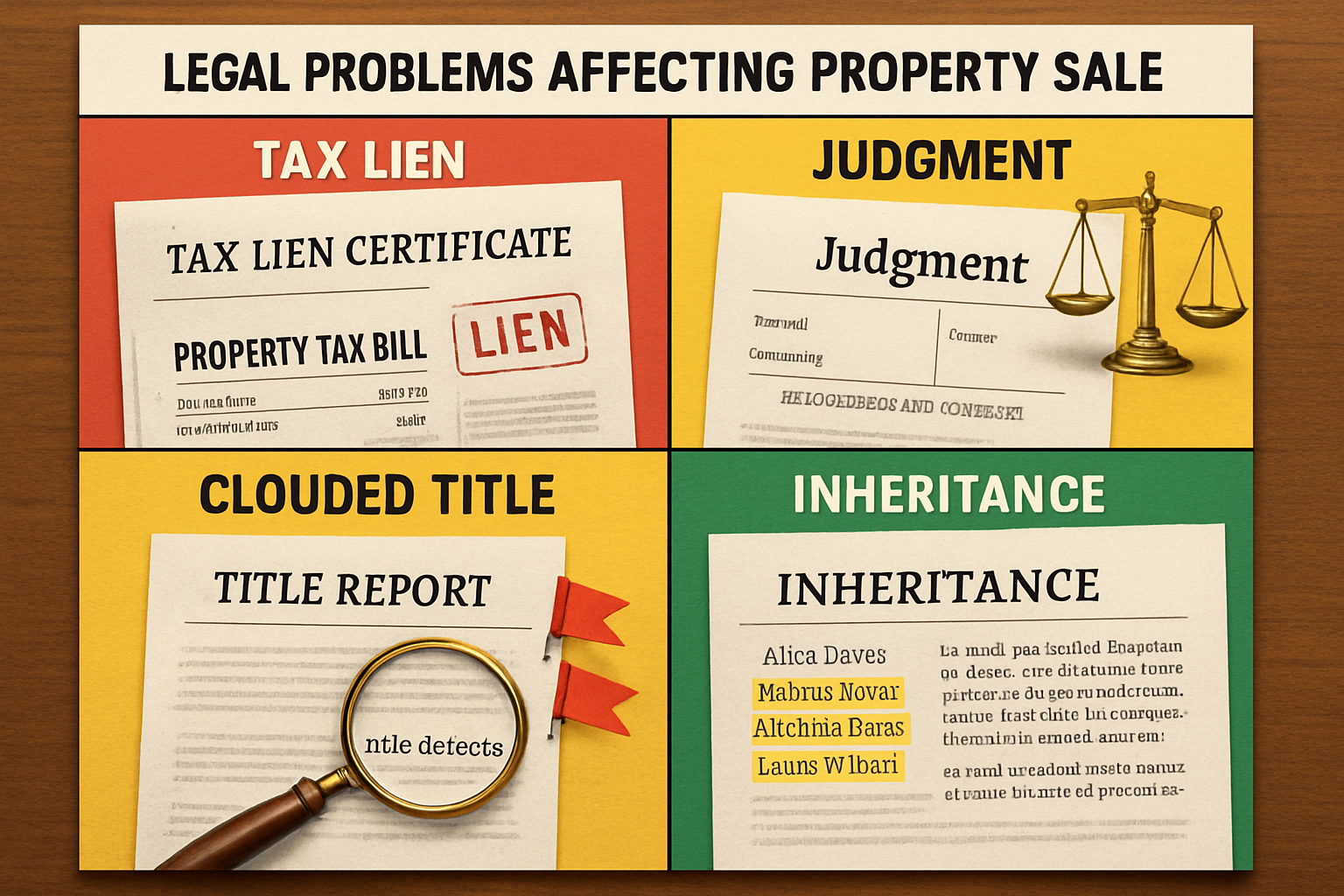
Legal complications come in many forms, and recognizing exactly what you’re dealing with is the crucial first step toward finding the right solution. These issues create clouds on your property title, making it difficult or impossible to transfer clean ownership to a buyer through conventional channels.
What Constitutes a “Legal Problem” in Real Estate?
A legal problem affecting property sales is any encumbrance, claim, dispute, or defect that prevents the clear transfer of ownership or creates liability concerns for potential buyers. These issues typically appear during the title search process—the investigation that occurs before closing to verify the seller has the legal right to transfer the property.
Common categories include:
- Liens: Legal claims against your property for unpaid debts
- Title defects: Errors, gaps, or disputes in the ownership chain
- Probate issues: Complications with inherited property
- Ownership disputes: Disagreements among co-owners or boundary conflicts
- Code violations: Unpermitted work or unresolved municipal citations
- Legal judgments: Court-ordered claims against the property owner
Each category requires different approaches and expertise to resolve. The good news? Industry experts who specialize in these situations have seen it all and developed proven strategies to address each type of complication.
Why Legal Issues Create Selling Obstacles
Traditional buyers and their lenders require “marketable title”—proof that ownership can transfer without legal disputes or hidden claims. When legal problems exist, title insurance companies typically refuse to issue policies, which means conventional mortgages won’t be approved.
This creates a domino effect:
- Traditional buyers can’t secure financing
- Real estate agents may decline to list the property
- The property sits unsold while problems potentially worsen
- Additional costs, penalties, or interest accumulate
- Stress and uncertainty multiply for the property owner
Understanding this chain reaction helps explain why specialized solutions and expert service become necessary. The traditional real estate system simply wasn’t designed to handle these complexities efficiently.
Types of Legal Problems and Their Impact on Sales
Let’s examine the most common legal complications in detail, so you can identify which situation applies to your property and understand the specific challenges each presents.
Tax Liens and Delinquent Property Taxes
Property tax liens are among the most common legal problems affecting house sales. When property taxes go unpaid, the county or municipality places a lien against the property, giving them a legal claim that must be satisfied before ownership can transfer.
Tax liens are particularly serious because they:
- Take priority over most other liens (even mortgages in many cases)
- Accumulate interest and penalties monthly
- Can lead to tax foreclosure if left unresolved
- Must typically be paid before closing can occur
The good news: Tax liens are usually the most straightforward to resolve because the amount owed is clearly defined, and counties are generally willing to work with property owners or accept payment at closing. Many cash buyers and property solutions companies regularly handle properties with tax lien complications and can coordinate directly with tax authorities.
“Property tax issues, while serious, are among the most solvable legal problems because the debt amount is definite and counties prefer payment over foreclosure proceedings.”
Judgment Liens and Creditor Claims
When someone wins a lawsuit against a property owner, they can often record a judgment lien against real estate owned by the debtor. These liens ensure the creditor gets paid when the property sells.
Common sources of judgment liens include:
- Credit card debt lawsuits
- Medical bill collections
- Business debt judgments
- Unpaid contractor disputes
- HOA assessment claims
Judgment liens complicate sales because the lien holder must either be paid in full or agree to release the lien. Unlike tax liens, creditors may be more difficult to negotiate with, and tracking down lien holders can sometimes prove challenging if the original creditor has sold the debt.
However, judgment liens can often be negotiated for less than the full amount, especially when the alternative is the creditor receiving nothing if the property goes to foreclosure. Experienced professionals know how to approach these negotiations and can often achieve favorable settlements.
Mechanics Liens and Contractor Disputes
Mechanics liens are filed by contractors, subcontractors, or suppliers who performed work or provided materials but weren’t paid. These liens give construction professionals a legal claim against the property where the work was performed.
Key characteristics:
- Time-sensitive (must be filed within specific deadlines)
- Can be filed even if you paid the general contractor (if they didn’t pay subs)
- May be invalid if not filed correctly
- Often negotiable or disputable
Mechanics liens require careful examination because they’re frequently filed incorrectly or after deadlines have passed, making them potentially invalid. A real estate attorney can review the lien filing for technical defects that might allow it to be removed without payment.
Title Defects and Clouded Titles
Title problems represent some of the most complex legal issues because they question the fundamental ownership chain. A clouded title means there are questions, gaps, or disputes about who legally owns the property.
Common title defects include:
- Missing heirs from previous estate transfers
- Forged signatures on past deeds
- Undisclosed divorces affecting ownership
- Errors in legal descriptions
- Unreleased mortgages from decades ago
- Boundary disputes with neighbors
- Fraudulent transfers
Title defects often require legal action called a quiet title action to resolve—a court proceeding that legally establishes clear ownership. While this process takes time and involves legal costs, it permanently clears the title and allows the property to be sold.
Inheritance and Probate Complications
Selling inherited property becomes complicated when probate hasn’t been completed, multiple heirs disagree, or estate administration has stalled.
Typical inheritance issues:
- Property stuck in probate court
- Multiple heirs with different goals
- Missing or uncooperative heirs
- Unclear or contested wills
- Administrator/executor disputes
- Estate debts and creditor claims
When multiple people inherit property together, disagreements about whether to sell, when to sell, and for how much can create deadlock. In extreme cases, a partition action lawsuit may be necessary to force the sale, though this legal route is expensive and time-consuming.
Helpful guidance from professionals experienced in heir property situations can often facilitate agreements among family members and navigate probate requirements efficiently.
Foreclosure and Pre-Foreclosure Status
Properties in pre-foreclosure or active foreclosure present unique legal complications. While technically you can still sell during this period, time constraints are severe, and the lender must approve any sale for less than the mortgage balance (called a short sale).
Foreclosure-related challenges:
- Extremely tight timelines before auction
- Lender approval required for short sales
- Multiple liens competing for limited equity
- Potential deficiency judgments
- Credit impact considerations
- Complex negotiations with loss mitigation departments
Despite these challenges, selling before foreclosure completion is almost always preferable to letting the property go to auction. You may preserve some equity, avoid deficiency judgments, and minimize credit damage. Companies specializing in distressed properties can often move quickly enough to close before foreclosure deadlines.
Co-Ownership Disputes
When property is jointly owned and co-owners disagree about selling, legal complications arise. Unless all owners consent, the property generally cannot be sold through normal channels.
Common co-ownership scenarios:
- Divorced couples still jointly owning property
- Business partners who’ve had a falling out
- Family members who inherited together
- Investment partners with different goals
- Unmarried couples who’ve separated
Resolution options range from buyouts (one owner purchasing the other’s share) to partition actions (court-ordered division or sale). Friendly and caring mediation can sometimes help co-owners reach agreement without costly litigation, but when that fails, legal intervention becomes necessary.
Your Options for Selling House with Legal Problems: Your Options & Solutions
Now that we’ve identified the problems, let’s explore the practical solutions. You have more options than you might think, and the right choice depends on your specific situation, timeline, and financial goals.
Option 1: Resolve Legal Issues Before Selling
The most straightforward approach is addressing legal problems before listing the property. This strategy works best when you have time, some financial resources, and want to maximize sale price through traditional channels.
Steps involved:
- Identify all legal issues through a comprehensive title search
- Consult with specialists (attorneys, title companies, tax professionals)
- Develop a resolution plan with timelines and cost estimates
- Execute the plan (pay liens, complete legal actions, resolve disputes)
- Obtain clear title and title insurance commitment
- List property through traditional real estate channels
Advantages:
- Potentially higher sale price through traditional market
- Access to conventional buyers with financing
- Clean transaction without complications
- Peace of mind knowing issues are permanently resolved
Disadvantages:
- Requires upfront capital to resolve issues
- Time-consuming (may take months or years for complex problems)
- No guarantee the investment will be recovered in sale price
- Ongoing carrying costs while resolving issues
This approach makes sense when the property has significant equity, the legal problems are relatively minor, and you have the resources and patience to see the process through.
Option 2: Sell to a Cash Buyer or Property Solutions Company
Specialized companies like Sure Path Property Solutions purchase properties with legal complications directly, handling the resolution process themselves. This option provides speed and certainty when traditional sales aren’t feasible.
How it works:
- Contact a property solutions company and describe your situation
- Receive a property evaluation considering current condition and legal issues
- Get a cash offer typically within days
- Choose your closing date (often possible within 1-2 weeks)
- Close the sale with the company handling lien payoffs and legal coordination
Advantages:
- Fast closing (weeks instead of months or years)
- No upfront costs to resolve issues
- Certainty of sale (no financing contingencies)
- Professional handling of complex legal coordination
- Sell “as-is” without repairs or preparations
- Avoid ongoing carrying costs and stress
Disadvantages:
- Sale price typically below retail market value
- Offer reflects the cost and risk of resolving legal issues
- Not ideal if maximizing price is the primary goal
This option shines when time is critical, you lack resources to resolve issues yourself, or the stress of managing the situation has become overwhelming. Companies specializing in these situations have established relationships with title companies, attorneys, and county offices, allowing them to navigate complications efficiently.
Option 3: Negotiate Lien Payoffs at Closing
In some cases, liens can be paid directly from sale proceeds at closing rather than beforehand. This approach requires cooperation from lien holders and sufficient equity to cover all claims.
Process overview:
- Obtain payoff amounts from all lien holders
- Calculate net proceeds after paying all liens and closing costs
- Find a buyer (may need to work with investors or cash buyers)
- Negotiate with lien holders if necessary to reduce amounts
- Coordinate with title company to ensure proper lien releases
- Close with simultaneous payoff of all liens from proceeds
When this works well:
- Property has enough equity to cover all liens and costs
- Lien holders agree to accept payment at closing
- Timeline allows for proper coordination
- Title company experienced with complex closings
Challenges to expect:
- Some lien holders may refuse to wait for closing
- Negotiations can extend timelines
- Requires precise coordination among multiple parties
- Buyer must be comfortable with the complexity
This middle-ground approach can work when you have some equity but lack liquid funds to pay liens upfront. Success depends heavily on having experienced professionals coordinating the various parties.
Option 4: Short Sale (For Underwater Properties)
When you owe more than the property is worth and can’t afford to bring money to closing, a short sale may be possible. This requires lender approval to accept less than the full mortgage balance.
Short sale considerations:
- Lender must approve the sale price and terms
- Process typically takes 3-6 months or longer
- Requires demonstrating financial hardship
- May still result in deficiency judgment (depending on state and lender)
- Impacts credit, though less severely than foreclosure
- All other liens must also be negotiated
Short sales are complex and require patience, but they can provide an alternative to foreclosure when you’re underwater and facing legal complications.
Option 5: Legal Action to Clear Title
For certain legal problems, court action may be necessary to clear title and enable sale. While more expensive and time-consuming, these legal remedies permanently resolve issues.
Common legal actions:
- Quiet title action: Establishes clear ownership when title is clouded
- Partition action: Forces sale when co-owners disagree
- Lien release lawsuit: Compels removal of invalid or satisfied liens
- Probate proceedings: Completes estate administration for inherited property
These options require working with a qualified real estate attorney and typically take several months to over a year. However, they may be the only path forward for certain complicated situations, particularly title defects and co-ownership disputes.
Step-by-Step Process: Selling House with Legal Problems
Regardless of which option you choose, following a structured process increases your chances of success and reduces stress along the way.
Step 1: Identify All Legal Issues
Begin with a comprehensive understanding of exactly what legal problems affect your property.
Action items:
- Order a title search from a title company (often free when considering a sale)
- Review all property tax records for delinquencies
- Check for recorded liens at the county recorder’s office
- Examine any pending lawsuits involving you or the property
- Identify all legal owners and confirm ownership percentages
- Review probate status if property was inherited
Don’t skip this step or assume you know all the issues. Hidden problems discovered late in the process can derail sales and waste time. Trustworthy service providers can help conduct thorough due diligence to uncover all complications upfront.
Step 2: Gather Documentation
Compile all relevant documents related to your property and the legal issues affecting it.
Essential documents:
- Current deed and prior deeds
- Mortgage statements and loan documents
- Property tax bills and payment history
- Lien notices and court judgments
- Probate documents or will (if inherited)
- Co-ownership agreements
- Correspondence with creditors or attorneys
- Property survey and legal description
- HOA documents (if applicable)
Organized documentation accelerates every solution path and demonstrates professionalism when working with buyers, attorneys, or property solutions companies.
Step 3: Consult with Professionals
Legal complications require expertise beyond what most property owners possess. Seeking professional guidance early prevents costly mistakes.
Key professionals to consider:
- Real estate attorney: Essential for complex legal issues, title defects, and court actions
- Property solutions company: Provides evaluation and purchase options for complicated properties
- Title company: Identifies issues and coordinates lien payoffs
- Tax professional: Advises on tax implications of various solutions
- Real estate agent (specializing in distressed properties): May help with traditional sale after issues are resolved
- Probate attorney: Necessary for inheritance complications
Many property solutions companies offer free consultations and can provide helpful solutions even if you ultimately choose a different path. The investment in professional advice typically pays for itself many times over.
Step 4: Evaluate Your Options and Choose a Path
With full information and professional input, weigh your options against your priorities.
Consider these factors:
| Factor | Traditional Sale After Resolution | Cash Buyer/Property Solutions | Short Sale | Legal Action |
|---|---|---|---|---|
| Timeline | 6-18+ months | 2-4 weeks | 3-6 months | 6-18+ months |
| Upfront Costs | High | None | Low | High |
| Sale Price | Highest potential | Below market | Below market | Highest potential (after resolution) |
| Certainty | Moderate | High | Low | Moderate |
| Effort Required | High | Low | Moderate | High |
| Best For | Maximum value, have time/money | Speed, simplicity, no resources | Underwater, avoiding foreclosure | Complex title issues |
Your choice depends on your unique circumstances, resources, timeline, and priorities. There’s no universally “best” option—only the best option for your situation.
Step 5: Execute Your Chosen Strategy
Once you’ve selected an approach, move forward decisively with expert service supporting you.
For traditional sale after resolution:
- Work with attorney to resolve legal issues
- Obtain clear title and title insurance commitment
- Make necessary property improvements
- List with experienced real estate agent
- Negotiate offers and close sale
For cash buyer/property solutions route:
- Contact property solutions companies for evaluations
- Review and compare offers
- Select the company offering the best combination of price, terms, and professionalism
- Provide requested documentation
- Choose closing date and sign paperwork
- Receive payment at closing
For short sale:
- Contact lender’s loss mitigation department
- Submit complete short sale package
- Find qualified buyer
- Submit offer to lender for approval
- Navigate lender negotiations
- Close once approval received
For legal action:
- Retain qualified real estate attorney
- File appropriate legal action
- Navigate court proceedings
- Obtain court order resolving issue
- Clear title and proceed with sale
Throughout execution, maintain regular communication with all parties involved and respond promptly to requests for information or documentation.
Step 6: Close the Sale and Move Forward
The final step brings closure to the process and allows you to move forward without the burden of a legally complicated property.
At closing, ensure:
- All legal issues are properly resolved or addressed
- Liens are paid and releases recorded
- Title insurance is issued (when applicable)
- All parties receive required documentation
- Funds are properly distributed
- You receive final settlement statement
After closing, keep all documentation in a safe place. You’ll need it for tax purposes and as proof that issues were properly resolved.
Common Mistakes to Avoid When Selling House with Legal Problems
Learning from others’ mistakes can save you time, money, and frustration. Here are the most common pitfalls and how to avoid them.
❌ Hiding Legal Problems from Buyers
The mistake: Attempting to sell without disclosing known legal issues, hoping they won’t be discovered.
Why it fails: Title searches reveal these problems before closing, derailing the sale and potentially exposing you to legal liability for non-disclosure.
The better approach: Full transparency from the beginning. Honest disclosure builds trust and attracts buyers or companies equipped to handle complications.
❌ Assuming Legal Problems Are Insurmountable
The mistake: Giving up without exploring options, believing the property is unsellable.
Why it’s wrong: Even properties with severe legal complications have solution pathways. Industry experts handle these situations regularly.
The better approach: Consult with professionals who specialize in complicated properties before concluding the situation is hopeless.
❌ Trying to Handle Complex Legal Issues Alone
The mistake: Attempting to negotiate with lien holders, navigate probate, or resolve title defects without professional help.
Why it backfires: Legal procedures have technical requirements, and mistakes can make problems worse or create new liability.
The better approach: Invest in qualified professionals whose expertise prevents costly errors and typically achieves better outcomes than DIY approaches.
❌ Waiting Too Long to Address Problems
The mistake: Procrastinating while legal issues accumulate interest, penalties, and additional complications.
Why it’s costly: Most legal problems worsen over time. Tax liens grow with penalties, foreclosure timelines progress, and title issues become more complex as years pass.
The better approach: Address legal problems as soon as you become aware of them, even if you’re not ready to sell immediately.
❌ Accepting the First Offer Without Comparison
The mistake: Working with the first cash buyer or property solutions company you contact without getting multiple evaluations.
Why it matters: Offers can vary significantly based on company expertise, resources, and business models.
The better approach: Contact several reputable companies, compare offers and terms, and choose based on the complete package, not just the highest price.
❌ Neglecting Tax Implications
The mistake: Focusing solely on the sale without considering tax consequences of various solution approaches.
Why it’s important: Different resolution methods have different tax treatments, affecting your net proceeds.
The better approach: Consult with a tax professional before finalizing your strategy to understand and plan for tax implications.
How Property Solutions Companies Help with Legal Problems
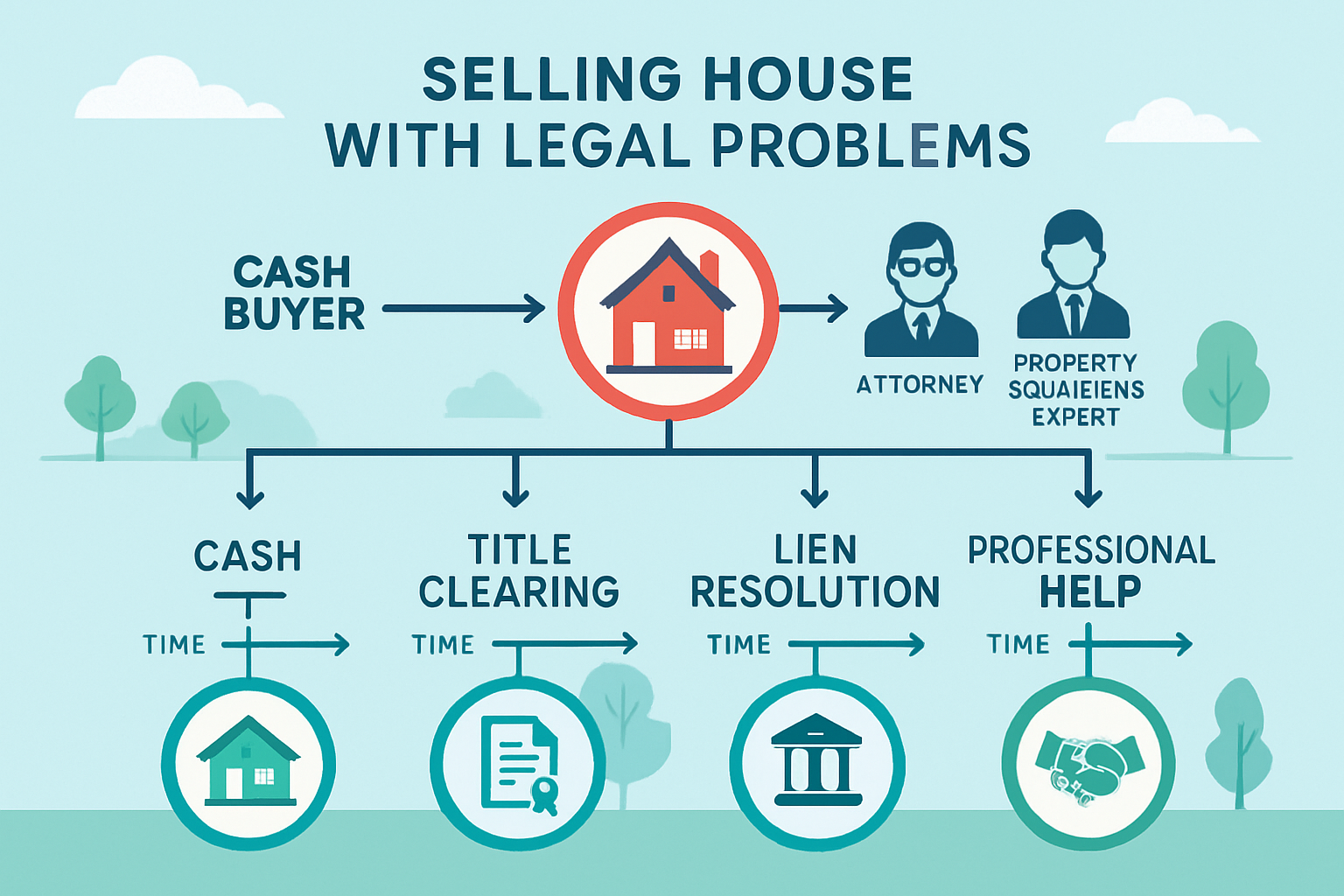
Understanding how specialized companies operate can help you decide if this option fits your situation and what to expect from the process.
What Property Solutions Companies Do
Companies like Sure Path Property Solutions specialize in purchasing properties that traditional buyers and real estate agents can’t or won’t handle. They have the expertise, resources, and systems to navigate legal complications efficiently.
Core services include:
✅ Comprehensive property evaluation considering both market value and legal complications
✅ Direct purchase with cash, eliminating financing contingencies
✅ Lien resolution coordination working directly with creditors and government agencies
✅ Title issue management partnering with title attorneys to clear defects
✅ Probate navigation helping heirs complete estate administration
✅ Multi-party coordination facilitating agreements among co-owners
✅ Fast closing timelines often completing purchases in 2-4 weeks
✅ Flexible terms accommodating seller needs for timing and arrangements
These companies profit by resolving legal issues themselves after purchase, then either reselling the property or holding it as an investment. This business model allows them to purchase properties that would otherwise sit unsold for months or years.
The Evaluation and Offer Process
Understanding how offers are calculated helps set realistic expectations.
Factors affecting cash offers:
- Current market value (what the property would sell for with clear title)
- Cost to resolve legal issues (lien amounts, legal fees, title work)
- Time and complexity (more complicated situations require larger discounts)
- Property condition (repair costs if applicable)
- Market conditions (buyer demand in the area)
- Company’s profit margin (typically 10-20% for the risk and service provided)
A fair offer accounts for all these factors while still providing meaningful value to the seller—relieving them of an unsellable property, stopping accumulating costs, and eliminating stress.
Questions to Ask Property Solutions Companies
Not all cash buyers are equal. Ask these questions to identify reputable, experienced companies:
Essential questions:
- How long have you been purchasing properties with legal complications?
- Can you provide references from past sellers in similar situations?
- What specific legal issues have you successfully resolved?
- How is your offer calculated, and can you explain the breakdown?
- What costs or fees do I pay? (Reputable companies typically charge no fees to sellers)
- What is your proposed timeline from offer to closing?
- How do you handle lien negotiations and payoffs?
- Will you work with my attorney if I choose to have one review documents?
- What happens if additional issues are discovered during title work?
- Are there any circumstances where you would back out after making an offer?
Companies providing clear, confident answers to these questions demonstrate the expertise and integrity you want in a partner for this transaction.
Real-World Scenarios: Solutions in Action
Seeing how others have successfully navigated similar situations can provide both hope and practical insights.
Scenario 1: Multiple Tax Liens and Judgment
Situation: Sarah inherited her mother’s house but discovered $47,000 in unpaid property taxes spanning eight years, plus a $12,000 judgment lien from a credit card lawsuit.
Challenge: Sarah lived out of state, the house needed significant repairs, and she couldn’t afford to pay the liens upfront.
Solution: Sarah contacted a property solutions company specializing in tax lien situations. They offered $85,000 for the property, coordinated directly with the county for tax payoff, negotiated the judgment lien down to $7,000, and closed in three weeks.
Outcome: After all liens were paid from proceeds, Sarah received $26,000 and avoided ongoing tax accumulation, property maintenance, and out-of-state property management stress.
Scenario 2: Clouded Title from Missing Heir
Situation: James wanted to sell his grandmother’s house, which he’d been living in for 15 years. A title search revealed his grandmother’s brother (who died 30 years ago) was never properly removed from the title, and tracking down that brother’s heirs proved impossible.
Challenge: Traditional buyers couldn’t get title insurance, and the property couldn’t sell through normal channels.
Solution: James worked with a real estate attorney to file a quiet title action, which took 14 months but permanently cleared the title. He then sold through a traditional agent for full market value.
Outcome: The legal process cost $8,500 in attorney fees and court costs, but James sold for $42,000 more than cash buyer offers he’d received, netting significantly more despite the time and expense.
Scenario 3: Co-Ownership Dispute Among Siblings
Situation: Three siblings inherited their parents’ property equally. Two wanted to sell immediately; one wanted to keep it in the family and live there but couldn’t afford to buy out the others.
Challenge: Deadlock prevented any action, while property taxes and maintenance costs continued.
Solution: After mediation failed, the two siblings wanting to sell filed a partition action. The court ordered the property sold at auction. A property solutions company purchased it at the partition sale, and proceeds were divided among the three siblings according to their ownership shares.
Outcome: The partition process took 11 months and cost $15,000 in legal fees (split among the siblings), but it broke the deadlock and allowed everyone to move forward. Each sibling received approximately $43,000 after all costs.
Scenario 4: Pre-Foreclosure with Multiple Liens
Situation: Michael fell behind on his mortgage after a medical emergency. By the time he recovered, foreclosure was scheduled in 45 days, and he also had a mechanics lien from an unpaid contractor and delinquent property taxes.
Challenge: Extremely tight timeline, insufficient equity to pay all liens through traditional sale, and damaged credit preventing refinancing.
Solution: Michael contacted a property solutions company experienced in pre-foreclosure situations. They negotiated with the lender, contractor, and county, purchasing the property for enough to satisfy the mortgage and taxes, negotiating the mechanics lien to 60% of the claimed amount, and closing in 28 days.
Outcome: Michael avoided foreclosure (preserving his credit from further damage), walked away with $8,000 cash, and eliminated the overwhelming stress of the situation.
Frequently Asked Questions
Can you really sell a house with legal problems?
Yes, absolutely. While traditional buyers typically can’t purchase properties with legal complications, specialized cash buyers and property solutions companies purchase these properties regularly. The key is working with buyers who have the expertise and resources to resolve legal issues after purchase.
How long does it take to sell a house with legal problems?
Timeline varies dramatically based on your chosen approach:
- Cash buyer/property solutions: 2-4 weeks
- Traditional sale after resolving issues: 6-18+ months
- Short sale: 3-6 months
- Legal action then sale: 6-18+ months
Your timeline depends on the complexity of legal issues and which solution path you choose.
Will I get less money selling to a cash buyer?
Cash offers are typically 60-80% of market value, depending on the extent of legal problems and property condition. However, this comparison can be misleading because:
- You avoid costs of resolving issues yourself (often $10,000-$50,000+)
- You eliminate months or years of carrying costs (taxes, insurance, utilities, maintenance)
- You receive certainty rather than the risk that issues can’t be resolved
- You save time and eliminate stress
When these factors are considered, cash sales often net similar or better amounts than attempting traditional sales after paying resolution costs.
What if I can’t afford to pay off liens before selling?
You have several options:
- Sell to a cash buyer who handles lien payoffs from purchase price
- Negotiate with lien holders to accept payment from closing proceeds
- Pursue a short sale if underwater
- In some cases, negotiate lien reductions before or at closing
You don’t necessarily need cash in hand to resolve liens—you need the right strategy and professional coordination.
Can I sell if I’m not the only owner?
Generally, all owners must consent to a sale. If co-owners disagree:
- Attempt negotiation or mediation first
- One owner may buy out the others
- As a last resort, file a partition action to force a sale through the court
- Some cash buyers will purchase partial ownership interests, though at significant discounts
Co-ownership situations require careful navigation, but solutions exist even when owners disagree.
Do I need an attorney to sell a house with legal problems?
While not always legally required, attorney involvement is highly recommended for:
- Complex title defects
- Partition actions or other litigation
- Probate complications
- Reviewing settlement agreements with lien holders
- Any situation where you’re unsure of your legal rights or obligations
Many property solutions companies have attorneys on staff or work closely with real estate attorneys, providing this expertise as part of their service.
What happens to liens when the property sells?
Liens must typically be satisfied (paid) at or before closing from the sale proceeds. The title company coordinates this process:
- Obtains payoff amounts from all lien holders
- Calculates net proceeds after paying liens
- Disburses funds to lien holders at closing
- Ensures lien releases are properly recorded
- Provides seller with remaining proceeds (if any)
In some cases, liens may be negotiated for less than full amount, particularly judgment liens and mechanics liens.
Taking Action: Your Next Steps
You’ve now explored the landscape of Selling House with Legal Problems: Your Options & Solutions. Knowledge is powerful, but only action transforms your situation.
Immediate Action Steps
This week:
- Identify your legal issues by ordering a title search and reviewing property records
- Gather documentation related to your property and any known legal problems
- Reach out to professionals for initial consultations (most offer free evaluations)
- Assess your priorities regarding timeline, sale price, and effort you can invest
- Create a preliminary plan based on your situation and goals
This month:
- Consult with specialists (property solutions companies, attorneys, or both)
- Get multiple evaluations if considering the cash buyer route
- Understand all costs associated with each potential solution path
- Make your decision about which approach fits your situation best
- Begin execution of your chosen strategy
Why Waiting Costs You Money
Every month you delay addressing legal problems typically costs you:
- Accumulating interest and penalties on tax liens and judgments
- Ongoing carrying costs (property taxes, insurance, utilities, maintenance)
- Potential additional legal complications as issues compound
- Market risk if property values decline
- Stress and mental burden affecting your quality of life
The best time to address legal problems was when they first appeared. The second-best time is right now.
Working with Sure Path Property Solutions
If your situation involves complicated legal issues like back taxes, liens, judgments, unclear title, or multiple heirs, Sure Path Property Solutions specializes in exactly these scenarios.
What sets Sure Path apart:
🏆 Specialized expertise in legally complicated properties
🏆 Comprehensive coordination with counties, title companies, and creditors
🏆 Transparent process with clear explanations of offers and procedures
🏆 Fast closings when time matters (often 2-3 weeks)
🏆 Flexible solutions tailored to your specific situation
🏆 No fees or commissions charged to sellers
🏆 Friendly and caring approach during stressful situations
Contact the team for a no-obligation evaluation of your property and situation. You’ll receive honest, helpful guidance about your options, whether that ultimately involves selling to Sure Path or pursuing a different solution path.
Conclusion
Legal problems affecting your property can feel overwhelming, but they don’t have to trap you in an impossible situation. As we’ve explored throughout this comprehensive guide, Selling House with Legal Problems: Your Options & Solutions are available regardless of how complicated your circumstances may seem.
Whether you’re dealing with tax liens, judgment liens, title defects, probate complications, co-ownership disputes, or multiple issues simultaneously, solution pathways exist. Your best option depends on your unique combination of timeline needs, financial resources, property equity, and personal priorities.
Remember these key principles:
✅ Legal problems don’t make properties unsellable—they simply require different approaches
✅ Professional expertise is invaluable and typically pays for itself many times over
✅ Multiple solution paths exist; choose based on your specific circumstances
✅ Taking action sooner rather than later prevents problems from compounding
✅ Transparency and honesty accelerate solutions and build trust with professionals helping you
✅ Even the most complex situations have been successfully resolved by others before you
The journey from discovering legal problems to successfully selling your property may involve challenges, but with the right guidance, realistic expectations, and appropriate professional support, you can navigate this path successfully.
Don’t let legal complications steal your peace of mind or financial future. Explore your options, consult with industry experts who specialize in these situations, and take the first step toward resolution today. Your path forward exists—and helpful solutions are closer than you might think.
For more information about navigating specific legal complications, explore additional resources in the Sure Path Property Solutions blog, where you’ll find detailed guides on liens and judgments, title issues, and property tax problems.