
Selling Inherited Property with Multiple Owners: Complete Guide

Inheriting property should feel like a blessing, but when multiple family members share ownership, it often becomes one of the most stressful situations imaginable. Brothers and sisters who once got along suddenly clash over whether to sell or keep the family home. Cousins disagree about listing prices. Distant relatives emerge from nowhere claiming their share. What started as a loved one’s final gift transforms into a source of family conflict, legal complexity, and financial uncertainty.
This comprehensive resource on Selling Inherited Property with Multiple Owners: Complete Guide will walk through every step of the process, from understanding your legal rights to successfully closing the sale. Whether you’re dealing with siblings, cousins, or multiple generations of heirs, the helpful guidance provided here will clarify the path forward and help preserve family relationships while achieving a fair outcome.
Key Takeaways
- All co-owners must agree to sell inherited property voluntarily, or legal action (partition lawsuit) may be necessary to force a sale
- Probate completion is essential before any sale can proceed—the property title must be clear and properly transferred to heirs
- Communication and written agreements among co-heirs prevent disputes and streamline the selling process significantly
- Tax implications vary based on stepped-up basis, capital gains, and individual heir circumstances—professional guidance is crucial
- Professional help from industry experts who understand complex ownership situations can resolve title issues, coordinate with counties, and simplify the entire process
Understanding Co-Ownership of Inherited Property
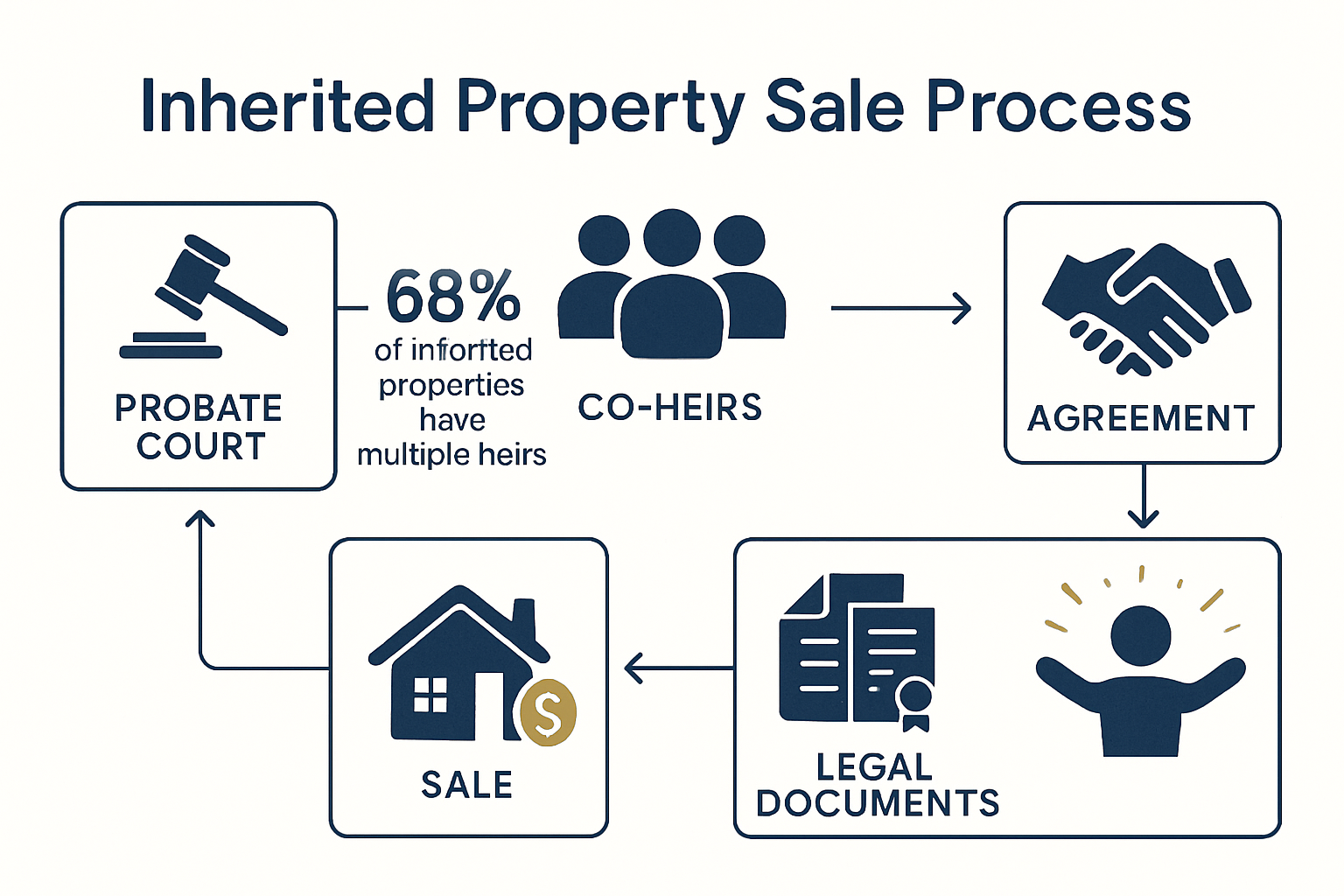
When multiple people inherit property together, they become co-owners with specific legal rights and responsibilities. Understanding the type of ownership structure determines how decisions get made and what options exist for selling.
Types of Co-Ownership
Tenants in Common is the most frequent ownership structure for inherited property. Each heir owns a specific percentage of the property (not a physical portion). These ownership shares can be equal or unequal depending on the will or state inheritance laws. Each tenant in common can sell their individual share, though finding a buyer for a partial interest proves extremely difficult.
Joint Tenancy with Rights of Survivorship sometimes applies when spouses inherit together or when the deceased specifically structured ownership this way. If one joint tenant dies, their share automatically transfers to the surviving joint tenants rather than to their heirs.
Tenancy by the Entirety applies exclusively to married couples in certain states and offers special protections against creditors.
Understanding which ownership type applies to the inherited property affects every decision moving forward. The deed and probate documents will specify the ownership structure.
Rights and Responsibilities of Each Co-Owner
Every co-owner holds equal rights to possess and use the entire property, regardless of their ownership percentage. This means a person with a 10% share has the same right to occupy the property as someone with a 50% share.
Co-owners share responsibility for:
- Property taxes (proportional to ownership share)
- Maintenance and repairs (though getting agreement on what’s necessary often causes disputes)
- Insurance premiums
- Mortgage payments (if the property has existing debt)
- HOA fees (when applicable)
When one co-owner pays more than their share of expenses, they may have legal claims for reimbursement from other owners. Keeping detailed records of all payments becomes essential.
🏠 Important Note: Even if co-owners disagree about selling, all must continue paying their share of expenses. Failure to do so can result in tax liens, foreclosure, or other complications that make selling even more difficult.
The Probate Process and Property Transfer
Before addressing the question of selling inherited property with multiple owners, the estate must complete probate. This legal process validates the will (if one exists), pays outstanding debts, and officially transfers property ownership to heirs.
How Probate Affects the Sale Timeline
Probate duration varies dramatically by state and estate complexity. Simple estates might clear probate in 6-9 months, while complicated situations involving disputes, creditor claims, or unclear wills can extend beyond two years.
No sale can legally proceed until probate concludes and the property title transfers to the heirs. Attempting to sell before probate completion creates serious legal problems and title defects that prevent closing.
The probate timeline typically includes:
- Filing the will with the probate court (1-2 weeks)
- Appointing an executor or personal representative (2-4 weeks)
- Notifying creditors and beneficiaries (3-6 months)
- Inventorying assets and appraising property (1-3 months)
- Paying debts and taxes (3-6 months)
- Distributing assets to heirs (1-2 months)
During probate, the executor manages the property and makes decisions about maintenance, insurance, and security. Co-heirs should communicate with the executor about their intentions regarding the property.
When You Can Sell During or After Probate
In most states, the executor can sell property during probate with court approval, especially if the estate needs liquidity to pay debts or taxes. This requires:
- Petition to the probate court
- Property appraisal
- Court hearing
- Judge’s approval of the sale terms
Selling during probate often makes sense when the property requires expensive maintenance, faces foreclosure risk, or when heirs unanimously agree to sell. The court oversees the sale to ensure fairness to all beneficiaries and creditors.
After probate closes, the property title transfers directly to the heirs, who then have full authority to decide whether to keep or sell. This is when the real challenges of selling inherited property with multiple owners typically emerge.
Challenges of Selling Inherited Property with Multiple Owners: Complete Guide
Coordinating a property sale among multiple owners presents unique obstacles that single owners never face. Understanding these challenges helps co-heirs prepare for and overcome them.
Disagreements Among Co-Heirs
Family dynamics complicate business decisions. Common sources of conflict include:
Emotional attachment vs. financial pragmatism — One sibling grew up in the house and wants to preserve it, while others view it purely as an asset to liquidate.
Different financial situations — An heir facing financial hardship needs immediate cash, while a financially comfortable co-owner prefers waiting for better market conditions.
Unequal involvement — The sibling who lived nearby and helped care for the parent feels entitled to a larger share or more decision-making authority.
Disagreement about property value — Without professional appraisals, co-owners often have wildly different opinions about what the property is worth.
Suspicion about motives — Family members may distrust each other’s intentions, especially if past conflicts exist.
These emotional and financial tensions can paralyze decision-making for months or years. The property deteriorates, taxes accumulate, and family relationships suffer permanent damage.
Legal Complications and Title Issues
Inherited property frequently comes with legal complications that complicate sales:
Unclear title — Missing heirs, improperly executed wills, or gaps in the chain of ownership create clouded title issues that must be resolved before selling.
Outstanding liens — The deceased owner may have left unpaid debts that created liens against the property, including tax liens, judgment liens, or mechanics liens.
Back taxes — Years of unpaid property taxes create tax liens that must be satisfied before or during the sale.
Mortgage debt — If the property has an outstanding mortgage, the lender must be paid from sale proceeds, reducing the amount distributed to heirs.
Boundary disputes — Unclear property lines or encroachments from neighboring properties create title defects.
These issues require expert service from title professionals, real estate attorneys, and specialists who understand how to navigate complex property situations. The industry experts at Sure Path Property Solutions regularly help families resolve these exact complications.
Financial Burdens During the Sale Process
While co-owners debate whether and how to sell, the property continues generating expenses:
- Monthly property taxes (which become delinquent if unpaid)
- Insurance premiums (lapsing coverage creates liability risks)
- Utilities (especially if the property remains occupied or requires climate control)
- Maintenance and repairs (deferred maintenance reduces sale value)
- HOA fees (which can result in liens if unpaid)
- Security costs (vacant properties attract vandalism and squatters)
These ongoing costs create financial pressure, especially when co-owners have unequal ability to contribute. The sibling who pays all expenses while others contribute nothing naturally feels resentment, further straining relationships.
Step-by-Step Process for Selling Inherited Property with Multiple Owners
Successfully navigating this complex situation requires a structured approach. Following these steps increases the likelihood of a smooth sale and preserved family relationships.
Step 1: Establish Open Communication Among All Owners
Before discussing sale logistics, establish communication ground rules:
Schedule a family meeting (in-person or video conference) where all co-owners can express their perspectives, concerns, and preferences. This initial conversation should focus on listening rather than deciding.
Acknowledge emotions — Recognize that selling a family home involves grief, memories, and attachment beyond financial considerations. Validating these feelings helps everyone feel heard.
Identify each person’s priorities — Does someone need quick cash? Does another want to maximize sale price? Does someone hope to keep certain family heirlooms? Understanding individual goals helps find compromises.
Designate a point person — Choose one co-owner (or hire a neutral professional) to coordinate communications, schedule meetings, and manage the sale process. This prevents confusion and duplicated efforts.
Commit to respectful dialogue — Agree that all co-owners will treat each other with respect, even during disagreements. Consider involving a family mediator if past conflicts suggest communication will be difficult.
Regular, transparent communication prevents misunderstandings and builds trust throughout the process.
Step 2: Obtain a Professional Property Appraisal
Before making any decisions, all co-owners need accurate information about the property’s value. Hire a licensed appraiser to provide an objective, professional assessment.
A formal appraisal:
- Establishes a realistic baseline for pricing discussions
- Reduces arguments about property value
- Helps co-owners make informed decisions
- Provides documentation for tax purposes
- Identifies needed repairs that affect value
All co-owners should receive a copy of the appraisal report. This shared information creates a factual foundation for subsequent discussions about listing price, sale timing, and whether to invest in repairs.
Consider getting multiple opinions if the property has unique characteristics or if co-owners remain skeptical of a single appraisal.
Step 3: Decide on Sale Terms and Document Everything
Once everyone understands the property’s value, the co-owners must agree on fundamental sale terms:
Listing price — Will you price at market value for a quick sale, or list higher and wait for the right buyer?
Sale timeline — Does everyone agree to sell immediately, or will you wait for a specific season or market condition?
Property improvements — Will you invest in repairs, staging, or cosmetic updates to increase value? Who pays for these improvements?
Proceeds distribution — How will sale proceeds be divided? (Usually according to ownership percentages, but families sometimes agree to different arrangements.)
Selling method — Will you list with a real estate agent, sell to a cash buyer, or pursue another option?
Decision-making authority — How will you handle offers? Must all co-owners approve, or will you use majority rule?
Document everything in writing. Create a co-ownership agreement that all heirs sign, specifying these terms. This written agreement prevents future disputes and provides clarity if disagreements arise.
A simple co-ownership agreement should include:
- Names and ownership percentages of all co-owners
- Agreed-upon listing price and acceptable price range
- Timeline and deadlines
- Distribution of sale proceeds
- Responsibility for expenses until closing
- Decision-making process for offers and counteroffers
- Signatures and dates from all co-owners
This document doesn’t require an attorney (though legal review is wise), but it must be signed by everyone to be effective.
Step 4: Address Outstanding Debts and Liens
Before listing the property, identify and address any liens or judgments that affect the title:
Order a title search to identify all recorded liens, judgments, and encumbrances. Title companies perform this service, typically for $200-500.
Categorize the debts:
- Mortgage balances (must be paid at closing)
- Property tax liens (must be paid at closing)
- Judgment liens (may need to be negotiated or paid)
- Mechanics liens (require resolution before sale)
- HOA liens (must be satisfied)
Determine payment responsibility — Will liens be paid from sale proceeds, or will co-owners contribute funds before closing?
Negotiate when possible — Some creditors accept reduced payoffs, especially for old judgments. Professional negotiation can save thousands of dollars.
Properties with complex lien situations benefit enormously from expert service providers who regularly coordinate with counties, title companies, and creditors to resolve these issues efficiently.
Step 5: Choose the Right Selling Method
Co-owners have several options for selling inherited property:
Traditional listing with a real estate agent works well when:
- The property is in good condition
- All co-owners agree on price and terms
- You can wait 3-6 months for the right buyer
- You’re willing to handle showings and negotiations
Selling to a cash buyer or investor makes sense when:
- The property needs significant repairs
- Co-owners want a quick, certain sale
- You want to avoid showings and staging
- Title issues or liens complicate traditional sales
- Family conflicts make a prolonged sale process untenable
Buyout by one co-owner resolves the situation if:
- One heir wants to keep the property
- They can secure financing for other heirs’ shares
- All parties agree on a fair buyout price
Auction sale provides an option when:
- Co-owners cannot agree on price
- The property has unique characteristics
- You want a definitive sale date
Each method has advantages and disadvantages. The right choice depends on property condition, co-owner agreement, financial circumstances, and timeline requirements.
Companies like Sure Path Property Solutions specialize in purchasing inherited properties with multiple owners, handling all the complexity while providing helpful solutions that work for everyone involved.
Step 6: Navigate the Legal Requirements
Selling property with multiple owners requires careful attention to legal requirements:
All co-owners must sign the listing agreement, purchase contract, and closing documents. A single holdout can prevent the sale.
Verify signing authority — Ensure the person signing on behalf of an estate has proper legal authority (executor, administrator, or heir with power of attorney).
Obtain required disclosures — Most states require sellers to disclose known property defects. All co-owners share responsibility for accurate disclosures.
Coordinate with the title company — Provide all necessary documentation proving ownership, probate completion, and lien resolution.
Plan for closing logistics — If co-owners live in different locations, arrange for remote notarization or document signing in advance.
Understand tax reporting — Each co-owner will receive a portion of the 1099-S form reporting the sale and must report their share on individual tax returns.
Working with an experienced real estate attorney familiar with multi-owner sales ensures compliance with all legal requirements and prevents costly mistakes.
Tax Implications of Selling Inherited Property
Understanding tax consequences helps co-owners make informed decisions and avoid surprises at tax time.
Stepped-Up Basis and Capital Gains
One significant advantage of inherited property is the stepped-up basis. Instead of using the original purchase price as the cost basis, heirs use the property’s fair market value on the date of the original owner’s death.
Example: Parents bought a house in 1980 for $50,000. When they died in 2024, the house was worth $350,000. The heirs’ cost basis is $350,000 (the stepped-up basis), not $50,000.
If the heirs sell the property for $360,000, they only pay capital gains tax on $10,000 ($360,000 sale price minus $350,000 basis), not $310,000.
This stepped-up basis significantly reduces or eliminates capital gains tax for most inherited property sales, especially when heirs sell relatively soon after inheriting.
Capital Gains Tax Rates
If the sale price exceeds the stepped-up basis, the profit is subject to capital gains tax:
Short-term capital gains (property held less than one year) are taxed as ordinary income at your regular tax rate (10%-37% depending on income).
Long-term capital gains (property held more than one year) receive preferential tax rates:
- 0% for single filers with income under $47,025 (married filing jointly: $94,050)
- 15% for single filers with income $47,026-$518,900 (married filing jointly: $94,051-$583,750)
- 20% for single filers with income above $518,900 (married filing jointly: above $583,750)
Note: These are 2025 tax brackets and may change annually.
Each co-owner reports their proportional share of the gain based on their ownership percentage.
Deductions and Expenses
Co-owners can reduce taxable gains by deducting certain expenses:
- Real estate commissions and fees
- Legal and professional fees related to the sale
- Title insurance and transfer taxes
- Property improvements made after inheriting (not repairs)
- Costs to resolve title defects or liens
Keep detailed records of all sale-related expenses to maximize deductions and minimize tax liability.
State and Local Tax Considerations
Beyond federal capital gains tax, some states and localities impose additional taxes:
- State capital gains tax (varies by state)
- Transfer taxes (paid at closing)
- Recording fees
- Special assessments
Tax laws vary significantly by jurisdiction. Consult with a tax professional familiar with your state’s requirements to understand the complete tax picture.
When to Consult a Tax Professional
Given the complexity of inherited property taxation, especially with multiple owners, professional tax guidance is essential when:
- The property has significantly appreciated since the date of death
- Co-owners have different tax situations or income levels
- The estate is large enough to trigger estate taxes
- You’re considering installment sales or other creative arrangements
- State tax laws add complexity
The cost of professional tax advice is minimal compared to the potential savings and peace of mind it provides.
What Happens When Co-Owners Cannot Agree?

Despite best efforts at communication and compromise, sometimes co-owners reach an impasse. Legal options exist to resolve these deadlocks.
Partition Actions Explained
A partition action is a lawsuit that forces the sale of jointly owned property when co-owners cannot agree. Any co-owner can file a partition action, regardless of their ownership percentage.
There are two types of partition:
Partition in kind — The court physically divides the property into separate parcels, each owned by individual co-owners. This rarely works for residential properties but may apply to large land parcels.
Partition by sale — The court orders the property sold and proceeds divided among co-owners according to their ownership percentages. This is the most common outcome for inherited homes.
The Partition Lawsuit Process
Filing a partition action involves several steps:
- Filing the complaint — The plaintiff (co-owner seeking partition) files a lawsuit in the county where the property is located
- Serving other co-owners — All co-owners receive legal notice of the action
- Court proceedings — Defendants can respond, and the court may hold hearings
- Appointment of a referee — The court appoints a neutral third party to oversee the sale
- Property sale — The referee lists and sells the property, typically at auction
- Distribution of proceeds — After paying legal fees and costs, remaining proceeds are distributed to co-owners
Costs and Timeline
Partition actions are expensive and time-consuming:
Costs include:
- Attorney fees ($5,000-$15,000 or more)
- Court costs and filing fees ($500-$2,000)
- Referee fees (percentage of sale price)
- Appraisal and other expert fees
Timeline typically spans:
- 6-12 months for uncontested cases
- 1-2 years for contested cases
- Additional time for appeals
These costs are usually paid from the property sale proceeds, reducing the amount each co-owner receives.
Alternatives to Partition Lawsuits
Before resorting to litigation, consider these alternatives:
Mediation — A neutral mediator helps co-owners reach agreement. This costs far less than litigation and preserves family relationships better than adversarial court proceedings.
Buyout negotiations — One co-owner purchases the others’ shares at an agreed-upon price. This can be structured with seller financing if the buyer lacks immediate funds.
Professional cash buyers — Companies specializing in complex property situations can purchase the property quickly, dividing proceeds among co-owners without litigation. This option provides certainty, speed, and simplicity.
Temporary rental — Co-owners agree to rent the property and share income until market conditions improve or circumstances change. This requires ongoing cooperation but can be formalized through a property management agreement.
The threat of a partition lawsuit often motivates holdout co-owners to negotiate reasonably, since litigation benefits no one except attorneys.
Special Situations and Considerations
Certain circumstances add additional complexity to selling inherited property with multiple owners.
When One Owner Wants to Keep the Property
If one co-heir wants to keep the family home while others want to sell, several options exist:
Buyout arrangement — The heir who wants to keep the property purchases the others’ shares. This requires:
- Professional appraisal to establish fair value
- Financing (conventional mortgage, home equity loan, or seller financing)
- Written agreement specifying terms and timeline
- Proper deed transfer once payment is complete
Rent-to-own agreement — The heir who wants to keep the property pays rent to other co-owners while working toward purchasing their shares. This provides income to selling heirs while giving the buyer time to secure financing.
Delayed sale agreement — Co-owners agree to postpone the sale for a specific period (e.g., allowing a sibling to live there until children graduate high school), with clear terms about who pays expenses during this period.
These arrangements work best when documented in writing and reviewed by an attorney to ensure enforceability.
Dealing with Out-of-State or Absent Co-Owners
When co-owners live in different states or countries, coordination becomes more challenging:
Communication strategies:
- Use video conferencing for important discussions
- Create a shared online folder for documents
- Establish regular update schedules
- Designate one local co-owner as the point person
Legal considerations:
- Remote notarization (now accepted in most states)
- Power of attorney allowing one co-owner to sign on behalf of others
- Electronic signature platforms for non-notarized documents
Financial logistics:
- Agree on how to handle immediate expenses
- Set up a joint account for property-related costs
- Use wire transfers for proceeds distribution
Distance doesn’t have to prevent successful sales, but it requires extra planning and clear communication protocols.
Properties with Tenants or Occupants
If the inherited property has tenants or if a family member is living there, additional considerations apply:
Existing leases — Honor valid lease agreements or negotiate early termination with proper compensation. Buyers typically prefer vacant properties, though some investors specifically seek tenant-occupied properties.
Family members in residence — If a sibling or other relative lives in the inherited home, establish clear expectations about:
- Move-out timeline
- Rent payments (or contribution to expenses) during occupancy
- Property access for showings and inspections
- Condition expectations when vacating
Eviction considerations — Removing a family member who refuses to leave requires formal eviction proceedings in most states. This process is emotionally painful and legally complex, but sometimes necessary.
Compassionate communication and reasonable timelines help navigate these sensitive situations while protecting everyone’s interests.
Properties in Disrepair or with Deferred Maintenance
Inherited properties often suffer from years of deferred maintenance, especially if the deceased owner was elderly or ill before passing.
Assessment options:
- Professional home inspection to identify all issues
- Contractor estimates for major repairs
- Determination of repair costs vs. potential value increase
Decision framework:
Co-owners must decide whether to:
- Invest in repairs before selling (increases sale price but requires upfront investment and time)
- Sell as-is to a traditional buyer (lower sale price, limited buyer pool)
- Sell to a cash investor who specializes in properties needing work (quick, certain sale at wholesale price)
For properties with significant issues—foundation problems, roof damage, code violations, or environmental hazards—selling to professional buyers who handle complicated situations often makes the most sense.
How Sure Path Property Solutions Can Help
Navigating the complexities of selling inherited property with multiple owners can feel overwhelming. That’s exactly why Sure Path Property Solutions exists—to provide helpful solutions for families facing these exact challenges.
Our Specialized Approach to Multi-Owner Properties
Sure Path Property Solutions brings industry experts who understand the unique dynamics of inherited property sales. The team recognizes that these transactions involve more than real estate—they involve family relationships, emotional attachments, and complicated legal situations.
What makes our approach different:
Coordination with all stakeholders — We communicate with all co-owners, ensuring everyone understands the process and feels heard. Our friendly and caring team serves as neutral facilitators who help families reach consensus.
Title and lien resolution — Our expert service includes working directly with counties, title companies, and creditors to resolve title issues, clear liens, and address property tax problems. We handle the complexity so families don’t have to.
Fair, transparent offers — We provide honest assessments and fair cash offers based on current market conditions and property condition. No hidden fees, no surprises.
Flexible closing timelines — Whether co-owners need to close in two weeks or two months, we accommodate the timeline that works best for the family.
Simplified process — We handle paperwork, coordinate with attorneys and title companies, and guide families through every step with helpful guidance and trustworthy service.
When Working with Us Makes Sense
Sure Path Property Solutions is particularly valuable when:
- Co-owners want a quick, certain sale without the uncertainty of traditional listings
- The property has title defects, liens, or back taxes that complicate traditional sales
- Family disagreements make a prolonged sale process untenable
- The property needs significant repairs that co-owners cannot or will not fund
- Co-owners live in different states and want simplified coordination
- Previous attempts to sell traditionally have failed
Our Process
Working with Sure Path Property Solutions follows a straightforward path:
- Initial consultation — Contact our team to discuss the property situation, ownership structure, and any complications
- Property evaluation — We assess the property condition, review title issues, and identify any liens or encumbrances
- Fair cash offer — Within days, we present a no-obligation cash offer based on current market conditions
- Coordination with co-owners — We ensure all co-owners understand the offer and answer questions
- Title resolution — Our team works with title professionals to clear any issues
- Flexible closing — We close on the timeline that works best for the family
- Proceeds distribution — Funds are distributed to co-owners according to their ownership percentages
Throughout the process, our team provides the helpful guidance and expert service that transforms a potentially contentious situation into a smooth, professional transaction.
Contact Sure Path Property Solutions to discuss your specific situation and learn how we can help.
Frequently Asked Questions
Can one co-owner force the sale of inherited property?
Yes, through a partition action lawsuit. Any co-owner can petition the court to force a sale, regardless of their ownership percentage or other owners’ objections. The court will typically order the property sold and proceeds divided among co-owners. However, partition lawsuits are expensive and time-consuming, so they should be a last resort after other negotiation attempts fail. Learn more about jointly owned property sales.
Do all heirs have to agree to sell inherited property?
For a voluntary sale, yes—all co-owners must agree and sign the necessary documents. If even one co-owner refuses, the property cannot be sold through traditional means. The only exception is a court-ordered partition sale, where a judge forces the sale despite objections from some co-owners.
How are sale proceeds divided among multiple owners?
Proceeds are typically divided according to each co-owner’s ownership percentage as specified in the deed or probate documents. If three siblings each inherited a one-third share, they each receive one-third of the net proceeds after paying off liens, mortgages, and closing costs. Co-owners can agree to different distributions, but this should be documented in writing before the sale.
What happens if one co-owner has been paying all the expenses?
The co-owner who has been paying more than their share of property taxes, insurance, maintenance, and other expenses may have a legal claim for reimbursement from other co-owners. These claims can be addressed during the sale, with the paying co-owner receiving their reimbursement from proceeds before distribution. Keep detailed records of all payments to support reimbursement claims.
Can we sell an inherited property before probate is complete?
Generally, no. The property cannot be legally sold until probate closes and title transfers to the heirs. However, in some states, the executor can petition the court for permission to sell during probate, especially if the estate needs funds to pay debts or taxes. This requires court approval and oversight of the sale process.
How long does it take to sell inherited property with multiple owners?
Timeline varies dramatically based on several factors:
- Probate completion: 6 months to 2+ years
- Co-owner agreement: immediate to indefinite
- Property condition and marketability: affects time to find a buyer
- Selling method: traditional listing (3-6 months average) vs. cash sale (2-4 weeks)
- Title and lien resolution: varies by complexity
From inheritance to closing, the process typically takes 9-18 months, though it can be much shorter with cooperative co-owners and professional buyers, or much longer with disputes and complications.
What if one heir wants to buy out the others?
This is often an ideal solution. The heir who wants to keep the property needs to:
- Obtain a professional appraisal to establish fair value
- Calculate each co-owner’s share based on ownership percentages
- Secure financing (conventional mortgage, home equity loan, or negotiate seller financing with other heirs)
- Create a written purchase agreement
- Complete the transaction through a title company to ensure proper deed transfer
This approach avoids listing the property and allows one family member to preserve the family home if desired.
Are there tax benefits to selling inherited property quickly?
The stepped-up basis minimizes capital gains regardless of when you sell, but selling quickly offers these advantages:
- Minimal appreciation beyond the stepped-up basis means minimal capital gains tax
- Reduced ongoing expense burden (property taxes, insurance, maintenance)
- Avoided risk of property value decline
- Prevented family conflict that often worsens over time
However, there’s no tax penalty for holding the property longer, so the decision should be based on overall circumstances rather than tax considerations alone.
Conclusion: Moving Forward with Confidence
Selling inherited property with multiple owners ranks among the most challenging real estate situations families face. The intersection of grief, family dynamics, legal complexity, and financial decisions creates a perfect storm of potential conflict and confusion.
Yet thousands of families successfully navigate this process every year by following the principles outlined in this guide:
✅ Establish open, respectful communication among all co-owners from the beginning
✅ Obtain professional appraisals and assessments to base decisions on facts rather than emotions or assumptions
✅ Document all agreements in writing to prevent misunderstandings and provide clarity
✅ Address title issues, liens, and legal complications proactively with expert help
✅ Consider all selling options including traditional listings, cash buyers, and buyout arrangements
✅ Understand tax implications and consult with professionals to minimize tax burden
✅ Seek professional help when situations involve complex title issues, family disagreements, or property condition challenges
The path forward becomes clearer when families recognize they don’t have to navigate this journey alone. Whether working with real estate agents, attorneys, mediators, or specialized companies like Sure Path Property Solutions, professional guidance transforms an overwhelming situation into a manageable process.
Your Next Steps
If you’re currently facing the challenge of selling inherited property with multiple owners, take these immediate actions:
- Schedule a family meeting with all co-owners to openly discuss intentions, concerns, and preferences
- Order a professional appraisal to establish the property’s current market value
- Obtain a title search to identify any liens, judgments, or title defects that need resolution
- Consult with professionals including real estate attorneys, tax advisors, and property specialists
- Explore your options by contacting both traditional real estate agents and companies that specialize in complex property situations
Remember that selling inherited property with multiple owners is ultimately about more than real estate—it’s about honoring a loved one’s legacy while preserving family relationships and achieving fair outcomes for everyone involved.
The industry experts at Sure Path Property Solutions have helped countless families navigate exactly these situations. Our trustworthy service, helpful guidance, and expert knowledge of complex property issues make us uniquely qualified to assist when traditional approaches fall short.
Contact our friendly and caring team today to discuss your specific situation and discover the helpful solutions that can move your family forward with confidence and clarity.
The journey may be challenging, but with the right guidance and professional support, you can successfully sell inherited property, distribute proceeds fairly, and preserve the family relationships that matter most.