
Sibling Won’t Sell Inherited House: Your Legal Options

Inheriting a family home should bring closure and security. Instead, many find themselves trapped in a frustrating standoff when a sibling refuses to sell.
You’ve inherited property alongside your brother or sister, but while you’re ready to move forward and sell, they’re digging in their heels. The house sits vacant, property taxes pile up, and family tensions escalate. When a sibling won’t sell inherited house, you’re not powerless—you have legal options that can resolve the deadlock and protect your financial interests.
This comprehensive guide explores your rights as a co-owner, the legal remedies available when siblings disagree about selling inherited property, and the practical steps you can take to move forward. Whether you’re dealing with emotional attachment, financial disagreements, or outright refusal to cooperate, understanding sibling won’t sell inherited house: your legal options empowers you to make informed decisions.
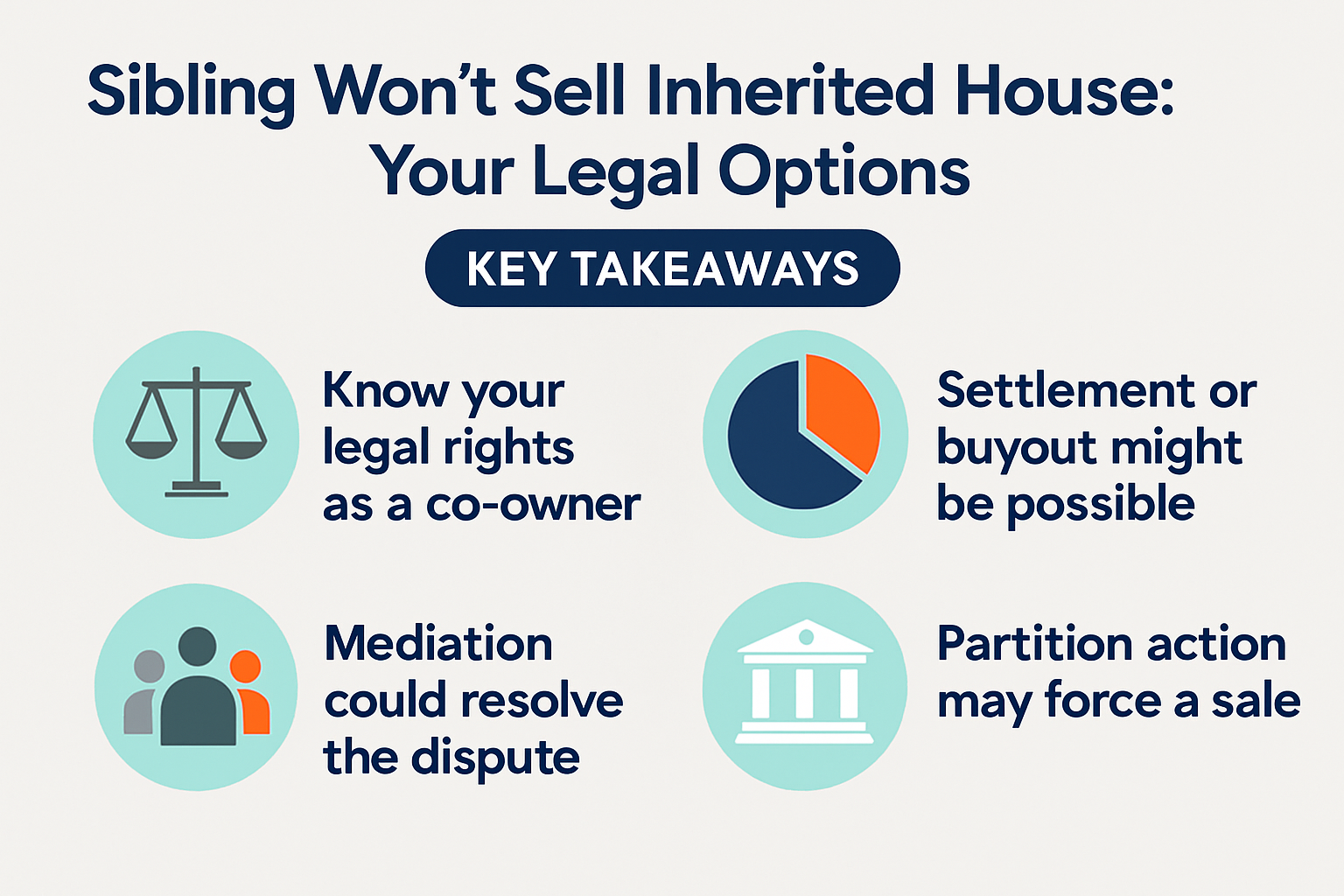
Key Takeaways
- Co-ownership rights: As a joint heir, you have equal ownership rights and cannot be forced to keep property indefinitely against your will
- Partition action: Filing a partition lawsuit is the most powerful legal remedy that can force the sale of inherited property when siblings disagree
- Buyout alternatives: Negotiating a buyout where one sibling purchases the other’s share can avoid costly litigation and preserve family relationships
- Timeline matters: Legal processes can take 6-18 months, so acting promptly protects you from accumulating costs and property deterioration
- Professional guidance: Working with industry experts who understand complex inheritance situations provides helpful solutions and reduces stress
Understanding Co-Ownership Rights in Inherited Property
When multiple siblings inherit a house, they typically become co-owners with equal rights to the property. This legal arrangement creates both opportunities and challenges.
Types of Co-Ownership
Most inherited properties fall into one of these ownership structures:
Tenancy in Common is the most common form of co-ownership for inherited property. Each sibling owns a specific percentage (often equal shares). Key characteristics include:
- Each owner can sell, mortgage, or transfer their share independently
- Shares don’t have to be equal
- No right of survivorship—your share passes to your heirs
- Most flexible arrangement for resolving disputes
Joint Tenancy includes right of survivorship, meaning when one owner dies, their share automatically transfers to surviving owners. This arrangement:
- Requires equal ownership percentages
- All owners must acquire property simultaneously
- Can complicate sale negotiations
- Less common in inheritance situations
Your Rights as a Co-Owner
Regardless of the ownership type, you possess fundamental rights:
✅ Right to occupy the property (though this can create complications)
✅ Right to receive your share of rental income if the property is leased
✅ Right to your portion of sale proceeds
✅ Right to force a sale through legal action (partition)
✅ Responsibility to contribute to expenses like taxes, insurance, and maintenance
Understanding these rights is the foundation for navigating disagreements. When selling inherited property becomes contentious, knowing your legal standing provides clarity and confidence.
Common Reasons Siblings Refuse to Sell
Before pursuing legal remedies, understanding why your sibling won’t sell can inform your approach:
Emotional attachment to the family home creates powerful resistance. The house represents memories, childhood, and connection to deceased parents.
Financial disagreements about property value, distribution of proceeds, or who should pay for repairs fuel conflicts.
Desire to live in the property or keep it as a rental investment motivates some siblings to block sales.
Spite or family conflict unrelated to the property sometimes manifests as refusal to cooperate.
Financial inability to find alternative housing may drive resistance, even when a sibling logically understands selling makes sense.
Recognizing the underlying motivation helps determine whether negotiation might succeed or legal action is necessary.
Sibling Won’t Sell Inherited House: Negotiation Strategies Before Legal Action
Before pursuing costly litigation, exhaust negotiation options. Many inheritance disputes resolve through communication and creative problem-solving.
Open Communication and Mediation
Start with honest conversation. Schedule a dedicated time to discuss concerns without distractions. Listen actively to understand your sibling’s perspective.
Ask questions like:
- What are your concerns about selling?
- What would make you comfortable moving forward?
- Are there specific outcomes you’re hoping for?
Professional mediation provides helpful guidance when direct communication fails. A neutral third-party mediator:
- Facilitates productive conversations
- Helps identify common ground
- Proposes creative solutions both parties might accept
- Costs significantly less than litigation
- Preserves family relationships better than court battles
Mediation sessions typically cost $200-$400 per hour and often resolve disputes in 2-4 sessions—a fraction of partition lawsuit expenses.
Buyout Options: Purchasing Your Sibling’s Share
If one sibling wants to keep the property, a buyout offers an elegant solution. Here’s how it works:
Step 1: Obtain a professional appraisal to establish fair market value. Both parties should agree on the appraiser or hire separate appraisers and average the results.
Step 2: Calculate each owner’s equity share. Subtract any outstanding mortgage, liens, or estate debts from the appraised value, then divide by the number of owners.
Example:
- Appraised value: $400,000
- Outstanding mortgage: $100,000
- Net equity: $300,000
- Two equal owners: $150,000 each
Step 3: Arrange financing. The sibling keeping the property must secure funds to buy out the other’s share through:
- Cash reserves
- Home equity loan or refinancing
- Personal loan
- Seller financing (installment payments to the selling sibling)
Step 4: Execute the transfer. Work with a real estate attorney to prepare a deed transferring ownership and ensure proper recording.
Buyouts work well when one sibling has emotional attachment or investment goals while the other needs liquidity.
Renting the Property as a Compromise
If neither sibling can afford a buyout but one opposes selling, renting the property provides middle ground:
Benefits:
- Generates income to cover expenses
- Preserves the asset for future appreciation
- Delays the sale decision during emotional processing
- Can satisfy a sibling who wants to keep the property in the family
Challenges:
- Requires agreement on property management
- Ongoing maintenance responsibilities and costs
- Potential disputes about reinvestment vs. distribution of rental income
- Delays resolution and continues co-ownership complications
Establish a written rental agreement between co-owners specifying:
- How rental income will be divided
- Who handles property management
- How maintenance costs are shared
- Timeline for revisiting the sale decision
- Exit strategy if the arrangement fails
This approach works best as a temporary solution, not a permanent arrangement.
Selling Your Share to a Third Party
You can sell your ownership interest to a third party without your sibling’s permission. However, this option has significant drawbacks:
Reality check: Your share will sell at a substantial discount (often 30-50% below market value) because:
- Buyers inherit the co-ownership dispute
- They gain no exclusive control
- The situation creates legal uncertainty
- Limited market exists for fractional property interests
Companies specializing in fractional interest purchases exist, but they offer low prices reflecting the complications involved.
Better alternative: Threatening to sell your share sometimes motivates an uncooperative sibling to negotiate seriously, either agreeing to a full property sale or buying you out at fair value.
This option should be a last resort before legal action, not a first choice.
Sibling Won’t Sell Inherited House: Your Legal Options Explained
When negotiation fails, legal remedies provide definitive solutions. Understanding these options empowers you to take decisive action.
Partition Action: Forcing the Sale
A partition action is a lawsuit that forces the sale of jointly owned property when co-owners cannot agree. This powerful legal remedy is available to any co-owner and rarely fails.
How Partition Actions Work
Filing the lawsuit: You (the plaintiff) file a partition action in the county where the property is located. The complaint identifies all co-owners and requests the court to divide or sell the property.
Court review: The court examines ownership records and confirms your right to partition. Unless unusual circumstances exist, courts almost always grant partition requests because it’s a fundamental property right.
Partition in kind vs. partition by sale:
- Partition in kind physically divides the property into separate parcels for each owner. This rarely works for houses (you can’t split a home down the middle) but sometimes applies to large land parcels.
- Partition by sale forces the property to be sold and proceeds divided among owners according to their ownership percentages. This is the typical outcome for inherited houses.
Commissioner appointment: The court appoints a commissioner (often a real estate professional or attorney) to oversee the sale process, ensuring it’s conducted fairly and achieves market value.
Sale and distribution: The property is sold, typically through public auction or listing with a real estate agent. After paying sale costs and any liens, the court distributes proceeds to co-owners according to their ownership shares.
For more details on this process, read our comprehensive guide on partition action lawsuits.
Timeline and Costs
Timeline: Partition actions typically take 6-18 months from filing to final sale, depending on:
- Court backlog in your jurisdiction
- Whether your sibling contests the action
- Property sale timeline
- Complexity of ownership issues
Costs: Budget for these expenses:
- Attorney fees: $5,000-$15,000+ depending on complexity
- Court filing fees: $200-$500
- Commissioner fees: Often 5-10% of sale proceeds
- Appraisal costs: $300-$600
- Title search and insurance: $500-$2,000
Important: These costs are typically paid from sale proceeds before distribution, so all co-owners share them proportionally.
When Partition Actions Make Sense
Pursue partition when:
✓ Your sibling absolutely refuses to sell or negotiate
✓ Communication has completely broken down
✓ The property is deteriorating or accumulating costs
✓ You need definitive resolution with a clear timeline
✓ Family relationship preservation is no longer a priority
Avoid partition if:
✗ Negotiation remains possible
✗ The costs would consume most of your equity
✗ You’re willing to accept a buyout at slightly below market value
✗ Preserving family relationships matters more than maximizing proceeds
Alternatives to Partition Lawsuits
Before filing partition, consider these legal alternatives:
Declaratory Judgment
A declaratory judgment asks the court to clarify ownership rights and responsibilities without forcing a sale. This option works when:
- Ownership percentages are disputed
- Questions exist about who should pay expenses
- You need legal clarity before negotiating
This approach costs less than partition but doesn’t force resolution—it just establishes the legal framework.
Accounting Action
An accounting action compels a co-owner to account for property income and expenses. File this when your sibling:
- Collects rent but doesn’t share it
- Lives in the property without paying fair rental value
- Makes unauthorized improvements and demands reimbursement
- Refuses to contribute to property taxes or maintenance
The court orders a full accounting and can award you compensation for unpaid rent or expenses.
Quiet Title Action
When title issues cloud ownership, a quiet title action resolves disputes about who legally owns the property. This applies when:
- The will’s validity is questioned
- Probate wasn’t properly completed
- Ownership records contain errors or conflicts
- Unknown heirs might have claims
Quiet title establishes clear ownership before proceeding with sale or partition.
Financial Considerations When a Sibling Won’t Sell
Property disputes create ongoing financial burdens. Understanding these costs helps you make informed decisions about timing and strategy.
Ongoing Property Expenses
While the dispute continues, someone must pay:
Property taxes accumulate regardless of occupancy. Unpaid taxes lead to:
- Penalties and interest charges
- Tax liens against the property
- Potential tax foreclosure
Learn more about selling property with tax issues if taxes have fallen behind.
Homeowners insurance protects against liability and property damage. Letting coverage lapse exposes all co-owners to:
- Personal liability for injuries on the property
- Total loss if fire or disaster strikes
- Difficulty selling later without clear insurance history
Maintenance and repairs prevent deterioration. Deferred maintenance:
- Reduces property value significantly
- Creates safety hazards and liability
- Leads to expensive emergency repairs
- Makes the property harder to sell
Utilities for vacant properties (at minimum, water and electricity to prevent pipe freezing and security system operation) add monthly costs.
Who Pays What?
Legal responsibility: All co-owners are jointly responsible for property expenses proportional to their ownership share.
Practical reality: Often one sibling pays everything while others contribute nothing. This creates additional conflict and resentment.
Your remedies:
- Document all payments meticulously with receipts and records
- Request reimbursement in writing, creating a paper trail
- Include unpaid expenses in partition action, asking the court to reimburse you from your sibling’s share of proceeds
- File an accounting action to compel repayment before partition
Pro tip: Courts generally reimburse co-owners who paid more than their share, but only with proper documentation. Keep detailed records from day one.
Tax Implications of Inherited Property Sales
Understanding tax consequences helps you evaluate options and timing:
Step-up in basis: Inherited property receives a stepped-up cost basis equal to fair market value on the date of death. This significantly reduces capital gains taxes.
Example:
- Parents bought house for $100,000 in 1980
- House worth $400,000 when parents died in 2024
- Your stepped-up basis: $400,000 (not $100,000)
- You sell for $425,000 in 2025
- Taxable capital gain: Only $25,000
Capital gains exclusion: The $250,000/$500,000 primary residence exclusion typically doesn’t apply to inherited property unless you move in and meet the two-year residency requirement.
Holding period: Inherited property automatically qualifies for long-term capital gains treatment regardless of how long you own it.
Deductions: You can deduct selling costs (commissions, legal fees, title insurance) from capital gains.
State taxes: Some states impose inheritance or estate taxes beyond federal obligations. Consult a tax professional familiar with your state’s rules.
Partition sale considerations: Forced sales through partition actions receive the same tax treatment as voluntary sales—the stepped-up basis still applies.
Protecting Your Interests During the Dispute
While working toward resolution, take steps to protect your financial and legal position.
Document Everything
Create a comprehensive paper trail:
📄 Save all communications with your sibling about the property (emails, texts, letters)
📄 Photograph the property’s condition regularly with dated images
📄 Keep receipts for every expense you pay (taxes, insurance, repairs, utilities)
📄 Record property visits and any changes or damage you observe
📄 Maintain a timeline of key events, conversations, and decisions
This documentation becomes critical evidence if you file partition or accounting actions. Courts rely on written records, not memories or verbal claims.
Prevent Unauthorized Actions
Your sibling might attempt to:
Move into the property without agreement or fair rent payment. While co-owners have occupancy rights, courts can order the occupying sibling to pay fair rental value to non-occupying owners.
Make major changes like renovations, additions, or demolition. Generally, co-owners cannot make substantial alterations without unanimous consent. Document unauthorized changes immediately.
Rent to third parties without your approval. Rental agreements typically require all co-owners’ consent. Unauthorized leases may be voidable.
Refinance or take loans against the property. Lenders require all owners’ signatures for mortgages on co-owned property, so this is difficult without your cooperation.
Your protection: Send a certified letter stating you don’t consent to any of these actions. If they proceed anyway, you have grounds for legal action and reimbursement.
Consider Professional Property Management
If the property remains unsold for an extended period, professional property management offers helpful solutions:
Benefits:
- Removes emotional conflict from day-to-day decisions
- Ensures proper maintenance and protection
- Generates rental income if you agree to lease
- Provides neutral documentation of property condition
- Reduces your personal time commitment
Costs: Typically 8-12% of rental income, or flat monthly fees for vacant property oversight ($100-$300/month).
Setup: Both siblings must agree to hire the management company and sign the contract. Include clear terms about decision-making authority and financial reporting.
This approach works well when siblings can agree on property management even if they disagree about selling.
Working with Real Estate Professionals and Attorneys

Complex inheritance situations benefit from expert service and trustworthy guidance.
When to Hire an Attorney
Consult an attorney immediately if:
⚖️ Your sibling threatens legal action against you
⚖️ Ownership percentages or will validity are disputed
⚖️ Significant money is at stake (generally $50,000+ in equity)
⚖️ You’re ready to file partition or other legal action
⚖️ Your sibling has hired an attorney
⚖️ Liens or judgments complicate the title
Choose an attorney who specializes in:
- Partition actions and co-ownership disputes
- Real estate litigation
- Probate and estate matters
- Your state’s property laws
Questions to ask potential attorneys:
- How many partition actions have you handled?
- What’s the typical timeline and cost range?
- What’s your success rate in achieving favorable outcomes?
- Can you estimate my net proceeds after all costs?
- Are there alternatives to partition we should try first?
How Sure Path Property Solutions Can Help
When a sibling won’t sell inherited house, the situation often involves multiple complications beyond just disagreement. Sure Path Property Solutions specializes in navigating these complex scenarios.
Our expert service includes:
🏠 Multiple heir coordination – We work with all co-owners to find solutions everyone can accept, reducing conflict and expediting resolution.
🏠 Title issue resolution – If clouded title or liens complicate the sale, we coordinate with title professionals to clear obstacles.
🏠 Back tax solutions – When property taxes have accumulated, we help navigate payment plans or facilitate sales that address tax obligations.
🏠 As-is purchases – We can purchase your ownership share or the entire property in current condition, eliminating repair costs and lengthy market sales.
🏠 Fast closings – Our streamlined process often closes in 2-4 weeks, providing quick resolution when you need it most.
Our friendly and caring approach recognizes that inheritance disputes involve family dynamics, not just financial transactions. We provide helpful guidance that respects your situation while moving toward practical solutions.
Contact our team to discuss your specific situation and explore options.
Alternative: Selling to Cash Buyers or Investors
When traditional sales seem impossible due to sibling disputes, cash buyers offer advantages:
Speed: Close in weeks instead of months, ending the dispute quickly.
No repairs needed: Sell in current condition without negotiating who pays for improvements.
Certainty: No buyer financing contingencies that might fall through.
Simplified process: Fewer parties involved means less coordination with uncooperative siblings.
Drawbacks: Cash offers typically range from 60-85% of retail market value, reflecting the convenience and certainty provided.
When this makes sense:
- The property needs substantial repairs
- You want immediate resolution
- Maximizing price matters less than ending the dispute
- Traditional sale attempts have failed
- Legal costs would consume much of your equity anyway
Caution: Even with cash buyers, all co-owners must agree to the sale unless you pursue partition. However, a concrete cash offer sometimes motivates resistant siblings to cooperate when abstract discussions failed.
Preventing Future Inheritance Disputes
If you’re creating your own estate plan, learn from these conflicts to protect your heirs.
Estate Planning Best Practices
Be specific in your will about property disposition:
✓ Name exactly who inherits what property
✓ Specify whether heirs should sell or keep property
✓ Include instructions for resolving disagreements
✓ Consider leaving property to one heir with cash to others
✓ Update your will when circumstances change
Consider a trust instead of direct inheritance:
- Trusts can include detailed instructions for property management
- Trustees can be empowered to make sale decisions
- Dispute resolution mechanisms can be built in
- Trusts avoid probate delays and costs
Include a dispute resolution clause requiring mediation or arbitration before litigation.
Equalize inheritances when possible. If one child receives the house, balance with other assets to remaining children.
Communicate your intentions while alive. Family meetings about estate plans reduce surprises and allow you to explain your reasoning.
Buy-Sell Agreements for Co-Owners
If you’re entering co-ownership voluntarily (not through inheritance), establish a buy-sell agreement upfront:
Key provisions:
- Predetermined valuation method (appraisal, formula, etc.)
- Right of first refusal if one owner wants to sell
- Buyout terms and payment schedules
- Dispute resolution procedures
- Triggering events (death, disability, bankruptcy, deadlock)
This contract creates a roadmap for resolving future disagreements, dramatically reducing litigation risk.
For inherited property: Even after inheriting, siblings can create a co-ownership agreement establishing rules for the property going forward. While not as powerful as having one from the start, it still provides helpful structure.
Real-World Scenarios and Solutions
Understanding how these principles apply in practice helps you navigate your specific situation.
Case Study 1: Emotional Attachment vs. Financial Need
Situation: Maria and her brother Carlos inherited their childhood home worth $350,000 with no mortgage. Maria lives across the country, needs cash for her daughter’s college tuition, and wants to sell. Carlos lives nearby, has strong emotional attachment, and refuses to sell.
Solution: After failed negotiations, Maria proposed a buyout. Carlos couldn’t afford $175,000 cash, but Maria agreed to seller financing: $50,000 down payment and $125,000 paid over five years at 5% interest. Carlos refinanced the home to make the down payment, and monthly payments fit his budget. Maria received immediate cash for tuition and ongoing income. Both siblings preserved their relationship.
Lesson: Creative financing arrangements can bridge the gap between conflicting needs.
Case Study 2: Partition Action Success
Situation: Three siblings inherited a rental property worth $500,000. Two wanted to sell and divide proceeds. The third, who managed the property, refused and stopped sharing rental income. After two years of conflict and unpaid property taxes accumulating, the two siblings filed a partition action.
Solution: The court ordered partition by sale. The property sold for $485,000 (slightly below appraised value due to forced sale). After paying $35,000 in legal costs, back taxes, and sale expenses, net proceeds of $450,000 were divided three ways ($150,000 each). The sibling who withheld rental income was ordered to reimburse the others $18,000 from his share.
Lesson: While partition reduces net proceeds due to costs, it provides definitive resolution when negotiation fails. Acting sooner (before taxes accumulated) would have preserved more value.
Case Study 3: Jointly Owned Property Complications
Situation: Two sisters inherited a house as joint tenants with right of survivorship. One wanted to sell; the other wanted to keep it as a vacation home. The resistant sister argued that as joint tenants, neither could force a sale.
Solution: The sister wanting to sell consulted an attorney who explained that joint tenancy doesn’t prevent partition—any co-owner can force a sale regardless of ownership type. She filed a partition action. Faced with inevitable court-ordered sale, the resistant sister agreed to buy out her sister’s half at appraised value, avoiding partition costs.
Lesson: Understanding your legal rights provides negotiating leverage. For more on this topic, see our guide on whether jointly owned property can be sold by one owner.
Frequently Asked Questions
Can I force my sibling to sell inherited property?
Yes. Through a partition action lawsuit, any co-owner can force the sale of inherited property. Courts almost always grant partition requests because it’s a fundamental property right. The process typically takes 6-18 months and involves legal costs, but it provides definitive resolution when siblings cannot agree.
What if my sibling is living in the inherited house?
A sibling living in the inherited house has occupancy rights as a co-owner, but this doesn’t prevent sale. You can request that they pay fair rental value for exclusive use, and if they refuse, file an accounting action. A partition action can still force the sale even with an occupying sibling—they’ll need to vacate when the property sells.
How much does a partition lawsuit cost?
Partition lawsuits typically cost $5,000-$15,000+ in attorney fees, plus court costs, appraisal fees, and commissioner fees (often 5-10% of sale proceeds). Total costs often reach $20,000-$40,000 depending on complexity. These expenses are usually paid from sale proceeds and shared proportionally by all co-owners.
Can I sell my share of inherited property without my sibling’s consent?
Yes, you can legally sell your ownership share to a third party without your sibling’s permission. However, your share will sell at a significant discount (typically 30-50% below market value) because buyers inherit the co-ownership dispute and gain no exclusive control. This option should be a last resort.
What happens if we can’t agree on a listing price?
If siblings cannot agree on a listing price, the dispute can be resolved through: (1) obtaining professional appraisals and averaging the results, (2) mediation where a neutral third party helps reach consensus, or (3) partition action where the court appoints a commissioner to determine appropriate pricing and oversee the sale.
How long do I have to file a partition action?
Statutes of limitation for partition actions vary by state but are typically quite long (often 10+ years). However, waiting is costly—you’ll continue paying property expenses, the property may deteriorate, and family relationships may worsen. Act as soon as you determine negotiation has failed.
Will partition ruin my relationship with my sibling?
Partition actions often strain family relationships, though many were already damaged by the underlying dispute. Some siblings maintain relationships after partition by recognizing it as a business decision, not a personal attack. Attempting mediation first and communicating clearly about your needs can help preserve relationships even if partition becomes necessary.
Conclusion: Taking Action When Your Sibling Won’t Sell Inherited House
Inheriting property with siblings creates complex legal and emotional challenges. When a sibling won’t sell inherited house, the situation can feel hopeless—but you have powerful options.
Start with communication. Honest conversations and professional mediation resolve many disputes without litigation. Understand your sibling’s concerns and explore creative solutions like buyouts, rental arrangements, or seller financing.
Know your rights. As a co-owner, you cannot be forced to keep property indefinitely. Partition actions provide a legal remedy that almost always succeeds in forcing a sale when negotiations fail.
Act decisively. Delaying resolution costs money through ongoing expenses, property deterioration, and accumulating taxes. The sooner you address the conflict, the more value you’ll preserve.
Seek expert guidance. Inheritance disputes often involve complications beyond simple disagreement—title issues, liens, tax problems, or multiple heirs. Working with professionals who specialize in these situations, like Sure Path Property Solutions, provides helpful solutions tailored to your specific circumstances.
Protect yourself. Document everything, understand your financial obligations, and consult an attorney when significant money is at stake or your sibling refuses to cooperate.
Your Next Steps
If you’re facing a sibling inheritance dispute:
- Assess the situation honestly. Is negotiation still possible, or has the relationship broken down completely?
- Gather documentation. Collect ownership records, expense receipts, communications, and property information.
- Consult professionals. Speak with a partition attorney to understand your legal options and a real estate professional to determine property value.
- Attempt negotiation. Make one final, good-faith effort to resolve the dispute through mediation or direct conversation.
- Take legal action if necessary. If negotiation fails, file a partition action to force resolution and protect your financial interests.
- Consider alternative buyers. If traditional sales seem impossible, explore cash buyers or companies specializing in complicated property situations.
The path forward exists, even when a sibling won’t cooperate. Your inheritance represents financial security and closure after a loved one’s passing. You deserve resolution, and with the right approach and expert service, you can achieve it.
Contact Sure Path Property Solutions today to discuss your inherited property situation. Our friendly and caring team provides helpful guidance for navigating complex co-ownership disputes, title issues, and property complications. We offer trustworthy service designed to move you toward clear, practical solutions—even in the most challenging circumstances.
Don’t let a sibling dispute trap you indefinitely. Take the first step toward resolution today. 🏠