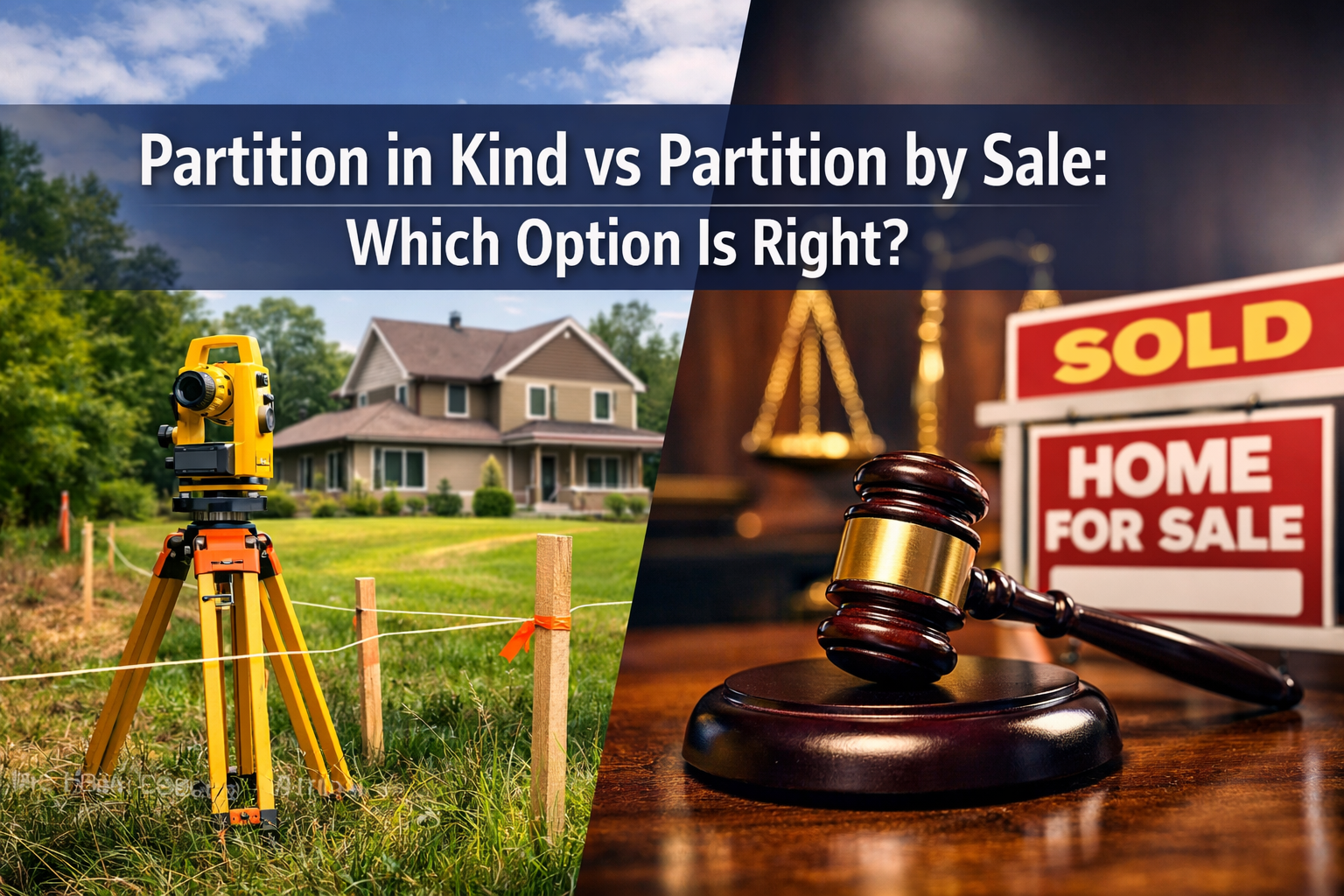
When multiple people own a property together and can’t agree on what to do with it, the situation can feel overwhelming. Perhaps you’ve inherited a family home with your siblings, or you co-own land with former business partners who have different visions for the future. Understanding Partition in Kind vs Partition by Sale: Which Option Is Right? becomes critical when co-ownership turns contentious.
This comprehensive guide will help you navigate these two legal remedies, understand their implications, and determine which path makes the most sense for your unique situation. Whether you’re dealing with inherited property or other co-ownership challenges, the right choice can save you time, money, and family relationships.
Key Takeaways
- Partition in kind physically divides property into separate parcels, allowing each co-owner to receive their own distinct piece of real estate
- Partition by sale forces the sale of the entire property through court order, with proceeds divided among co-owners according to their ownership percentages
- Courts generally prefer partition in kind when property can be fairly divided, but partition by sale is often more practical for residential homes
- The decision between these options depends on property type, divisibility, co-owner relationships, financial circumstances, and local zoning laws
- Legal costs for partition actions typically range from $10,000 to $50,000+, making voluntary agreements preferable when possible
- Working with industry experts who understand partition law can provide helpful guidance through this complex process
What Is a Partition Action?
A partition action is a legal lawsuit that allows co-owners of property to force a division or sale when they cannot agree on how to manage or dispose of their shared real estate. This powerful legal remedy exists because the law recognizes that no one should be forced to remain in a co-ownership arrangement indefinitely.
Think of partition actions as the “divorce” of property ownership. Just as marriage partners can legally separate their lives, property co-owners have the right to sever their ownership ties—even if other owners object.
When Partition Actions Become Necessary
Partition actions typically arise in several common scenarios:
Inherited property disputes 🏠 Multiple heirs receive a family home or land, but disagree about whether to keep, rent, or sell it. One sibling may want to preserve family memories while another needs immediate cash. These emotional situations often require helpful solutions that balance family dynamics with legal rights.
Investment partnerships gone wrong 💼 Business partners who purchased property together have a falling out or develop different investment strategies. When communication breaks down, partition becomes the path forward.
Divorce and separation 💔 Former spouses who can’t agree on what to do with jointly-owned property may pursue partition if traditional property division fails.
Tenants in common conflicts 📋 Unrelated co-owners with different ownership percentages struggle to make unified decisions about property management, improvements, or disposition.
Legal Grounds for Partition
In most states, any co-owner has an absolute right to partition, regardless of their ownership percentage. This means even a 1% owner can force partition against the wishes of a 99% owner—though the smaller owner’s share of proceeds or divided land would reflect their ownership interest.
The only exceptions occur when:
- Co-owners have signed a valid agreement waiving partition rights for a specific period
- The property is held in certain trust arrangements
- Special circumstances make partition inequitable or impossible
Understanding Partition in Kind
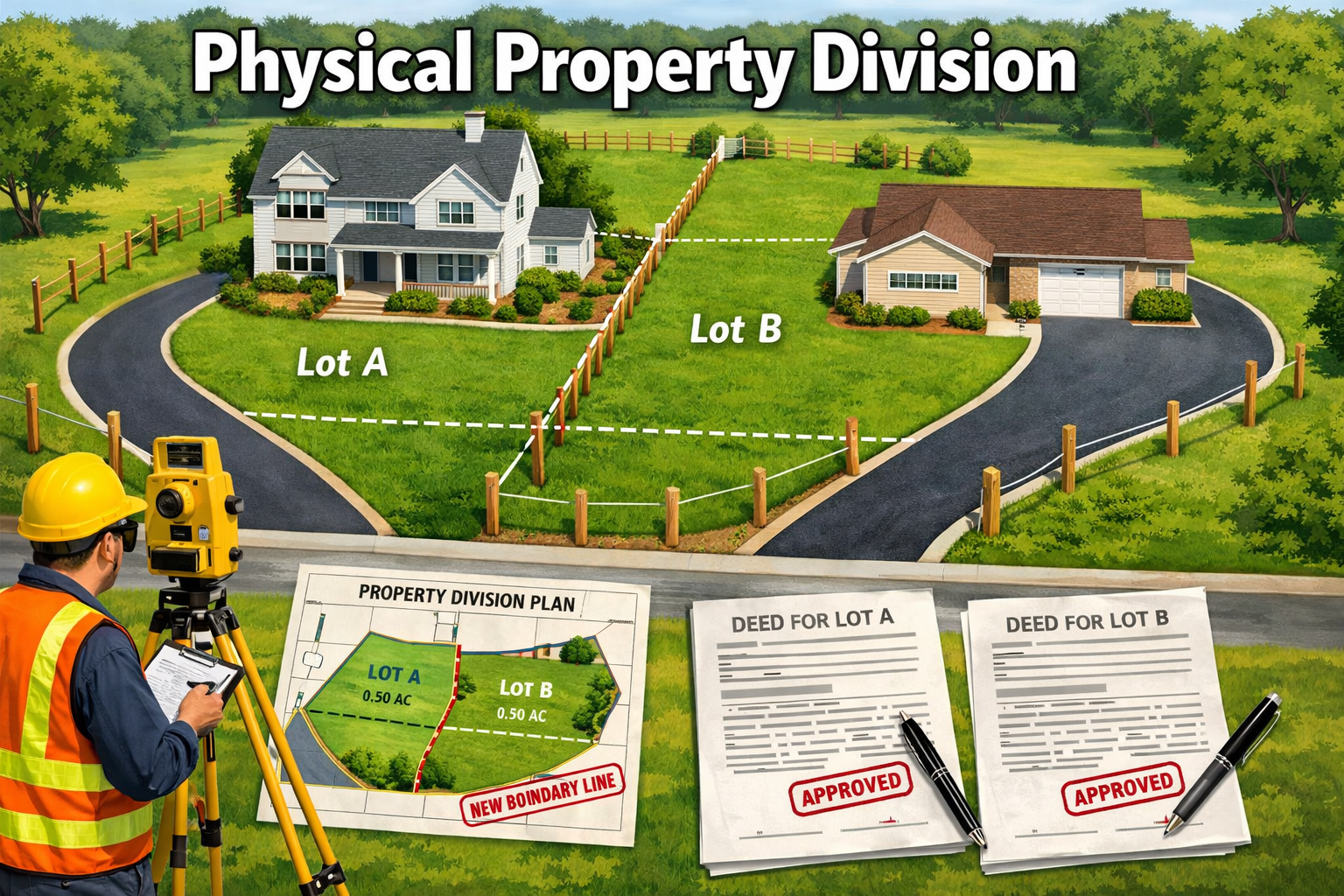
Partition in kind (also called “partition in specie”) is the physical division of property into separate parcels, with each co-owner receiving a distinct piece of real estate. This method allows co-owners to maintain ownership of real property rather than converting it to cash.
How Partition in Kind Works
The partition in kind process follows these general steps:
1. Court petition and hearing ⚖️ One or more co-owners file a partition lawsuit requesting physical division. The court reviews whether the property can be fairly divided.
2. Property appraisal and survey 📐 Professional appraisers determine the property’s total value, and surveyors assess how it could be physically divided into separate parcels of relatively equal value.
3. Division plan creation 📊 A court-appointed referee or commissioner develops a detailed plan showing how the property will be split. This plan considers factors like road access, utilities, topography, and zoning requirements.
4. Equalization payments 💰 If parcels can’t be divided into perfectly equal values, the co-owner receiving the more valuable portion may need to pay “owelty” (equalization money) to other co-owners.
5. New deeds and recording 📝 Once the court approves the division plan, new deeds are created for each separate parcel and recorded with the county, establishing independent ownership.
When Partition in Kind Makes Sense
This option works best in specific situations:
Large parcels of vacant land 🌾 A 40-acre tract can often be divided into four 10-acre parcels, each with road access and utility connections. Rural or agricultural land frequently lends itself to physical division.
Multi-unit properties 🏢 A duplex, triplex, or small apartment building might be divided so each co-owner receives separate units with their own entrances and utilities.
Commercial properties with distinct sections 🏪 A strip mall or commercial complex with separate storefronts could potentially be divided among co-owners.
Properties with natural divisions 🏞️ Land already separated by roads, creeks, or other natural boundaries may be easily partitioned.
Advantages of Partition in Kind
✅ Preserves property ownership – Co-owners maintain real estate assets rather than converting to cash
✅ Avoids forced sale – No one is compelled to sell if they want to keep their portion
✅ Tax advantages – May avoid immediate capital gains taxes that come with sales
✅ Family legacy preservation – Allows family members to retain ancestral land or property
✅ Court preference – Judges typically favor this method when feasible, as it’s considered more equitable
Disadvantages of Partition in Kind
❌ Limited applicability – Most residential homes cannot be physically divided
❌ Unequal divisions – Creating truly equal parcels is often impossible, requiring cash payments
❌ Reduced individual value – Smaller divided parcels may be worth less per acre than the whole property
❌ Zoning complications – Local regulations may prohibit subdivision or require expensive improvements
❌ Access issues – Creating separate access roads or utility connections can be costly
❌ Ongoing neighbor relationships – Former co-owners become neighbors, which may be uncomfortable
Understanding Partition by Sale
Partition by sale forces the sale of the entire property, with proceeds distributed to co-owners according to their ownership percentages. This is the most common partition outcome, especially for residential properties.
How Partition by Sale Works
The partition by sale process typically unfolds as follows:
1. Court determination 🏛️ After reviewing the property and hearing arguments, the court determines that physical division is impractical or inequitable. The judge orders a sale instead.
2. Sale method selection 🔨 The court decides whether the property will be sold through:
- Private sale – Listed with a real estate agent on the open market
- Public auction – Sold to the highest bidder at a court-supervised auction
- Sale to co-owner – One co-owner purchases the interests of others at fair market value
3. Court-appointed referee 👔 A neutral party oversees the sale process, ensuring fairness and compliance with court orders.
4. Marketing and sale 📢 The property is advertised and shown to potential buyers. For private sales, this resembles a traditional real estate transaction.
5. Court approval ✔️ The court reviews and approves the final sale price and terms before the transaction closes.
6. Proceeds distribution 💵 After paying sale costs, attorney fees, and outstanding liens or mortgages, remaining proceeds are divided among co-owners based on their ownership percentages.
When Partition by Sale Is Necessary
Courts order partition by sale in these common circumstances:
Single-family homes 🏡 A house cannot be physically divided into separate residences while maintaining reasonable value and functionality.
Properties with structures 🏗️ Buildings, improvements, and structures generally cannot be split without destroying their value.
Unequal ownership interests ⚖️ When ownership percentages are significantly different (like 75%-25%), creating fair physical divisions becomes nearly impossible.
Properties with liens or encumbrances 🔗 Mortgages, tax liens, or judgment liens may make physical division impractical.
Economically impractical divisions 📉 When dividing property would significantly reduce its total value or violate zoning laws.
Landlocked parcels 🚫 If division would create parcels without legal access to public roads.
Advantages of Partition by Sale
✅ Clean break – Completely severs the co-ownership relationship
✅ Liquidity – Converts real estate to cash that can be reinvested or used immediately
✅ Fair market value – Competitive sale processes typically achieve market-rate prices
✅ Simplicity – Easier to execute than complex physical divisions
✅ Resolves disputes – Eliminates ongoing conflicts about property management and expenses
✅ Debt satisfaction – Sale proceeds can pay off mortgages, liens, and other encumbrances
Disadvantages of Partition by Sale
❌ Forced liquidation – Co-owners who want to keep the property lose that option
❌ Market timing – May be forced to sell during unfavorable market conditions
❌ Tax consequences – Triggers capital gains taxes on appreciated property
❌ High costs – Legal fees, court costs, and sale commissions reduce net proceeds
❌ Emotional loss – Family properties and sentimental attachments are severed
❌ Below-market sales – Auction sales sometimes achieve lower prices than private market sales
Partition in Kind vs Partition by Sale: Which Option Is Right for Your Situation?
Determining the best partition method requires careful analysis of multiple factors. Here’s a comprehensive framework to guide your decision.
Property Type and Characteristics
Land size and configuration 📏
Large, vacant land parcels strongly favor partition in kind. A 100-acre farm can typically be divided into multiple viable parcels. Conversely, a quarter-acre residential lot with a house cannot be physically split.
Ask yourself: Can the property be divided into parcels that each have independent value, access, and utility connections?
Existing structures 🏘️
Properties with buildings almost always require partition by sale unless the structures are clearly separate (like a duplex with independent units and utilities).
Ask yourself: Would dividing the property destroy or significantly diminish the value of existing improvements?
Zoning and legal restrictions 📋
Local zoning ordinances may require minimum lot sizes, road frontage, or specific setbacks that make subdivision impossible or prohibitively expensive.
Ask yourself: Does local law permit subdivision of this property, and what would compliance cost?
Financial Considerations
Immediate cash needs 💵
Co-owners facing financial pressure may need liquid proceeds rather than continued property ownership. Selling inherited property can provide needed funds for debts, living expenses, or other investments.
Ask yourself: Do any co-owners have urgent financial needs that require immediate cash?
Ongoing carrying costs 💸
Property taxes, insurance, maintenance, and mortgage payments continue regardless of ownership disputes. These costs can accumulate rapidly during lengthy partition proceedings.
Ask yourself: Can co-owners afford to maintain the property during a potentially lengthy partition in kind process?
Development potential 🏗️
Undivided property may have greater development value than separated parcels. A 20-acre tract might attract a commercial developer, while four 5-acre parcels might only appeal to individual homebuilders.
Ask yourself: Would keeping the property whole maximize its market value?
Tax implications 📊
Partition in kind typically doesn’t trigger immediate tax consequences, while partition by sale creates taxable events. However, tax basis, depreciation recapture, and capital gains calculations can be complex.
Ask yourself: What are the tax consequences of each option, and how do they compare?
Relationship Dynamics
Level of conflict ⚡
Highly contentious relationships may make partition by sale preferable, providing a complete separation. When co-owners can communicate respectfully, partition in kind might preserve relationships while ending the co-ownership.
Ask yourself: Will co-owners be able to cooperate as neighbors if the property is physically divided?
Family considerations 👨👩👧👦
Family properties often carry emotional significance beyond financial value. Some families prioritize keeping land “in the family” even if it means accepting smaller individual parcels. When multiple heirs share one property, these dynamics become especially important.
Ask yourself: Is preserving family ownership worth the complexity and potential cost of physical division?
Future use intentions 🔮
Co-owners who plan to develop, use, or occupy their portions may strongly prefer partition in kind. Those who simply want to liquidate their interest favor partition by sale.
Ask yourself: What does each co-owner actually want to do with the property?
Legal and Practical Factors
State law preferences ⚖️
While courts generally prefer partition in kind when feasible, state laws vary. Some jurisdictions more readily order partition by sale, while others require extensive proof that physical division is truly impractical.
Ask yourself: What is the legal standard in your state, and how do courts typically rule on properties similar to yours?
Time considerations ⏰
Partition in kind typically takes longer due to surveying, planning, and approval requirements. Partition by sale can be faster, especially through auction.
Ask yourself: How urgent is resolution, and can parties tolerate a lengthy process?
Cost-benefit analysis 💰
Both partition methods involve substantial legal costs. Partition in kind may require additional surveying, engineering, and subdivision expenses. Partition by sale involves real estate commissions and potentially auction costs.
Ask yourself: Which method provides the best net outcome after all costs are considered?
The Partition Action Legal Process
Understanding the legal process helps co-owners prepare for what lies ahead, regardless of which partition method ultimately applies.
Step 1: Pre-Lawsuit Considerations
Before filing a partition action, consider these preliminary steps:
Attempt voluntary resolution 🤝
Courts appreciate parties who try to resolve disputes without litigation. Propose buyout options, negotiate sale terms, or explore tenants in common buyout arrangements.
Document everything 📄
Gather deeds, title reports, tax records, appraisals, and communications about the property. This documentation will be essential if litigation becomes necessary.
Consult experienced professionals 👨💼
Work with real estate attorneys who specialize in partition actions. At Sure Path Property Solutions, our industry experts provide helpful guidance for property owners facing complex co-ownership situations.
Obtain preliminary valuations 💎
Understanding property value helps evaluate settlement options and partition proposals.
Step 2: Filing the Partition Lawsuit
Complaint preparation 📝
The plaintiff (party initiating partition) files a complaint in the county where the property is located. The complaint identifies all co-owners, describes the property, explains the ownership structure, and requests partition.
Service of process 📬
All co-owners must be formally notified of the lawsuit through proper legal service.
Defendant responses ✍️
Co-owners can respond by agreeing to partition, contesting the method, or raising defenses (though defenses to partition are limited since it’s generally an absolute right).
Step 3: Discovery and Evaluation
Property investigation 🔍
Parties exchange information about property value, condition, liens, encumbrances, and potential division methods.
Expert engagement 🎓
Appraisers, surveyors, and sometimes environmental consultants evaluate the property and testify about partition feasibility.
Mediation opportunities 🕊️
Many courts require or encourage mediation before trial. A neutral mediator helps parties explore settlement options, which often proves more cost-effective than full litigation.
Step 4: Court Determination
Trial or hearing ⚖️
If settlement fails, the court holds a hearing or trial to determine:
- Whether partition is appropriate
- Which partition method (in kind or by sale) should apply
- How property should be divided or sold
- How costs should be allocated
Referee appointment 👤
Courts typically appoint a neutral referee or commissioner to oversee the actual partition process, whether physical division or sale.
Step 5: Implementation
Partition in kind implementation 📐
The referee develops a division plan, obtains necessary surveys and approvals, coordinates any equalization payments, and prepares new deeds for court approval.
Partition by sale implementation 🏷️
The referee lists the property for sale (or conducts an auction), manages the marketing and sale process, obtains court approval of the sale terms, and distributes proceeds after closing.
Step 6: Final Distribution and Closure
Accounting 🧮
The referee provides a detailed accounting of all costs, expenses, and proceeds.
Distribution 💰
After court approval, proceeds are distributed to co-owners according to their ownership interests, minus their proportional share of costs.
Final order ✅
The court issues a final order closing the partition action and terminating the co-ownership relationship.
Costs of Partition Actions
Partition actions involve significant expenses that reduce the net benefit to all parties. Understanding these costs helps in evaluating whether voluntary settlement might be preferable.
Legal Fees and Court Costs
Attorney fees 💼
Each party typically needs separate legal representation. Partition attorney fees commonly range from:
- Simple cases: $10,000 – $20,000 per party
- Moderate complexity: $20,000 – $35,000 per party
- Complex litigation: $35,000 – $75,000+ per party
Factors affecting legal costs include property value, number of co-owners, level of conflict, and whether the case goes to trial.
Court filing fees 🏛️
Initial filing fees range from $200 to $500, with additional fees for motions, hearings, and other court proceedings.
Service costs 📨
Serving legal documents on all parties costs $50 to $150 per defendant.
Expert and Professional Fees
Appraisal costs 📊
Professional appraisals typically cost $400 to $800 for residential properties and $1,500 to $5,000+ for complex commercial or large land parcels.
Survey and engineering 📐
For partition in kind, surveying and engineering costs can range from $2,000 to $15,000+ depending on property size and complexity.
Referee fees 👔
Court-appointed referees charge hourly rates ($150 to $400/hour) or flat fees ($5,000 to $25,000+) depending on case complexity.
Title work 📋
Title searches, reports, and insurance add $500 to $2,000+ to total costs.
Sale-Related Costs (Partition by Sale)
Real estate commissions 🏠
Traditional agent sales typically involve 5-6% commissions, which can represent tens of thousands of dollars on valuable properties.
Auction costs 🔨
Court-supervised auctions may involve auctioneer fees, advertising costs, and other expenses totaling 5-10% of sale price.
Closing costs 📄
Standard closing costs (title insurance, recording fees, transfer taxes) apply just as in any real estate sale.
Cost Allocation
Courts typically allocate partition costs among co-owners according to their ownership percentages. However, courts may deviate from this formula if one party unnecessarily complicated the process or acted in bad faith.
Example cost scenario:
Three siblings inherit a $400,000 property with equal 1/3 interests. After a partition by sale:
- Sale price: $400,000
- Real estate commission (6%): -$24,000
- Attorney fees (3 parties): -$45,000
- Referee fees: -$8,000
- Appraisal, title, misc.: -$3,000
- Net proceeds: $320,000
- Each sibling receives: $106,667 (instead of $133,333)
This example shows how partition costs can consume nearly 20% of property value—a powerful incentive for voluntary settlement.
Alternatives to Partition Actions
Before pursuing costly partition litigation, consider these alternatives that may achieve similar results with less expense and conflict.
Buyout Agreements
One or more co-owners purchase the interests of others at an agreed price. This voluntary transaction:
- Avoids litigation costs
- Allows flexible payment terms
- Preserves relationships
- Can be structured for tax efficiency
Negotiation tips for buyouts:
- Obtain independent appraisals for objective value
- Consider seller financing if the buyer lacks immediate cash
- Document agreements in writing with attorney review
- Address tax implications and reporting requirements
When one sibling won’t sell inherited property, a buyout often provides the most practical solution.
Voluntary Sale Agreements
All co-owners agree to sell the property and split proceeds according to ownership interests. This approach:
- Achieves the same result as partition by sale
- Eliminates court costs and referee fees
- Allows co-owners to select their own agent
- Provides control over timing and sale terms
Keys to successful voluntary sales:
- Agree on listing price and minimum acceptable offer
- Choose a qualified real estate agent together
- Establish decision-making procedures for offers
- Put agreements in writing before listing
Rental and Income Sharing
Co-owners agree to rent the property and share income according to ownership percentages. This strategy:
- Generates ongoing income for all parties
- Preserves the asset for future appreciation
- Defers difficult decisions to a later time
- May provide tax benefits through depreciation
Rental arrangement considerations:
- Establish clear management responsibilities
- Create written agreements for expense sharing
- Decide how major repair decisions will be made
- Plan for eventual disposition
Property Management Agreements
Formalize co-ownership arrangements through detailed agreements specifying:
- Decision-making procedures for various issues
- Expense contribution requirements
- Buyout options and pricing formulas
- Dispute resolution mechanisms
- Exit strategies
These agreements can prevent disputes from escalating to litigation while preserving co-ownership.
Mediation and Negotiation
Professional mediators help co-owners explore creative solutions without court intervention. Mediation offers:
- Confidential, non-adversarial process
- Flexible, customized solutions
- Significantly lower costs than litigation
- Preserved relationships
- Faster resolution
When to consider mediation:
- Communication has broken down but isn’t completely hostile
- Co-owners want to preserve family relationships
- Creative solutions might address underlying interests
- Litigation costs would consume significant value
Special Considerations for Inherited Property

Inherited property presents unique challenges that affect partition decisions.
Emotional Attachments and Family Dynamics
Family homes often carry sentimental value beyond financial worth. Childhood memories, family gatherings, and emotional connections to deceased parents complicate rational decision-making.
Navigating emotional factors:
- Acknowledge feelings while focusing on practical realities
- Consider whether anyone actually wants to live in or use the property
- Explore creative solutions like keeping family heirlooms while selling the property
- Remember that preserving relationships often matters more than preserving property
Estate and Tax Considerations
Stepped-up basis 📈
Inherited property typically receives a “stepped-up” tax basis equal to fair market value at the date of death. This can significantly reduce capital gains taxes on subsequent sales.
Estate debts and expenses 💳
Outstanding mortgages, property taxes, estate debts, and administration expenses may need to be satisfied before or during partition.
Probate complications ⚖️
Properties still in probate may face restrictions on partition timing. Ensure probate property sales are properly authorized.
Unequal Inheritance Situations
Sometimes parents leave unequal shares to different children, or one heir has contributed more to property maintenance. These situations complicate partition:
Contribution credits 💰
Co-owners who paid more than their share of expenses may be entitled to reimbursement or credits against other owners’ shares.
Improvements and enhancements 🔧
Heirs who made property improvements might claim enhanced value attributable to their investments.
Occupancy issues 🏠
When one heir lives in the property rent-free, others may claim rental value credits.
Courts can address these issues during partition proceedings, but voluntary agreements usually resolve them more satisfactorily.
State-Specific Partition Laws
Partition laws vary by state, affecting procedures, timelines, and outcomes. While comprehensive state-by-state analysis exceeds this article’s scope, understanding that variations exist is important.
Key State Law Variations
Partition preferences ⚖️
Some states strongly favor partition in kind and require clear proof that physical division is impractical. Others more readily order partition by sale.
Procedural requirements 📋
States differ in filing requirements, notice procedures, and hearing processes.
Referee selection and authority 👔
States vary in how referees are appointed, their powers, and compensation methods.
Cost allocation rules 💰
While most states allocate costs proportionally, some allow courts greater discretion based on party conduct.
Statute of limitations ⏰
Most states allow partition actions at any time, but some impose time limits in specific circumstances.
Consulting Local Experts
Given these variations, working with attorneys and real estate professionals familiar with your state’s partition laws is essential. At Sure Path Property Solutions, our team provides expert service tailored to local legal requirements and market conditions.
How to Prevent Partition Disputes
Prevention is always preferable to litigation. These strategies can help avoid partition actions altogether.
Co-Ownership Agreements
When acquiring property with others, create written agreements addressing:
Decision-making procedures 🗳️
- How will major decisions be made (unanimous, majority, supermajority)?
- What constitutes a “major” versus “minor” decision?
- How will deadlocks be resolved?
Expense contributions 💵
- How will ongoing costs be shared?
- What happens if someone can’t or won’t pay their share?
- How will capital improvements be funded and credited?
Buyout provisions 🔄
- Under what circumstances can co-owners buy out others?
- How will buyout prices be determined?
- What payment terms will apply?
Partition waivers ⏸️
- Can partition rights be waived for a specific period?
- What circumstances would override the waiver?
Exit strategies 🚪
- What happens if someone wants out?
- Right of first refusal for other co-owners?
- Procedures for selling to third parties?
Estate Planning Considerations
Clear instructions 📝
Parents leaving property to multiple children should provide clear guidance about their intentions—whether the property should be kept or sold, how decisions should be made, and how to handle disagreements.
Unequal bequests ⚖️
If leaving unequal shares, explain the reasoning to prevent resentment and disputes.
Trustee appointments 👤
Consider leaving property in trust with a neutral trustee empowered to make management decisions and facilitate eventual sale or distribution.
Liquidity provisions 💰
Ensure estates have sufficient liquid assets to pay debts and expenses without forcing immediate property sales.
Communication and Transparency
Regular discussions 💬
Co-owners should communicate regularly about property matters, expenses, and future plans.
Financial transparency 📊
Share information about costs, income, tax implications, and property value.
Professional management 🏢
For rental properties, consider hiring professional property managers to reduce conflict over management decisions.
Documented decisions 📄
Keep written records of agreements and decisions to prevent future misunderstandings.
Working with Property Solutions Experts
Complex co-ownership situations benefit from professional guidance. Whether facing partition decisions, title issues, liens, or other challenges, experienced professionals provide helpful solutions.
How Sure Path Property Solutions Can Help
Situation assessment 🔍
Our industry experts evaluate your specific circumstances, ownership structure, property characteristics, and goals to recommend the most practical path forward.
Alternative exploration 💡
Before costly partition litigation, we help identify alternatives like buyouts, voluntary sales, or negotiated settlements that might achieve your objectives more efficiently.
Trustworthy service throughout the process 🤝
We coordinate with attorneys, title companies, surveyors, and other professionals to navigate complex situations with friendly and caring support.
Market knowledge 📈
Our team understands local real estate markets and can provide realistic value assessments to inform partition decisions.
Creative problem-solving 🎯
Complex property situations often require creative approaches. We develop helpful guidance tailored to your unique circumstances.
When to Seek Professional Help
Consider professional assistance when:
- Co-owners cannot agree on basic property decisions
- Property has title problems or liens complicating partition
- Multiple heirs are involved with different needs and goals
- Property has significant value warranting professional guidance
- Relationships are strained and neutral facilitation would help
- Legal or tax implications are complex
- Time pressure requires efficient resolution
Real-World Partition Scenarios
Understanding how partition principles apply in real situations helps clarify decision-making.
Scenario 1: Inherited Family Farm
Situation: Three siblings inherit their parents’ 120-acre farm. One wants to keep farming it, one needs cash for medical bills, and one is indifferent.
Analysis:
- Property size and type favor partition in kind
- Zoning likely permits subdivision
- One sibling’s desire to farm supports physical division
- Another’s cash need suggests partial sale
Optimal solution: Partition in kind creating three 40-acre parcels. The farming sibling keeps one parcel. The sibling needing cash sells their parcel. The indifferent sibling can decide later whether to keep or sell. This preserves family farming while providing needed liquidity.
Scenario 2: Jointly-Owned Rental House
Situation: Two friends purchased a rental house as tenants in common with 50-50 ownership. After five years, one wants to sell and invest elsewhere, while the other wants to keep the property.
Analysis:
- Single-family home cannot be physically divided
- Partition by sale would be court’s likely order
- Buyout would achieve same result more efficiently
Optimal solution: The co-owner who wants to keep the property buys out the other’s 50% interest at appraised value. This avoids partition litigation costs while satisfying both parties’ goals. If the keeping owner lacks funds, seller financing could be arranged.
Scenario 3: Inherited Urban Lot with Siblings
Situation: Four siblings inherit a valuable urban lot (0.5 acres) zoned for multi-family development. Two want to develop it together, two want immediate cash.
Analysis:
- Lot size and zoning might permit physical division
- However, divided smaller lots would have less development value
- Mixed sibling intentions complicate matters
Optimal solution: The two siblings wanting to develop form a partnership and buy out the other two siblings’ combined 50% interest. This preserves maximum development potential while providing cash to those who want out. Alternatively, all four could agree to develop together and share profits, or sell to a developer and split proceeds.
Scenario 4: Vacation Property Dispute
Situation: Extended family members co-own a lake cabin. Some families use it extensively, others rarely visit. Disagreements arise over maintenance costs, usage scheduling, and improvements.
Analysis:
- Vacation home cannot be physically divided
- Emotional attachments complicate rational decisions
- Usage and expense inequities create resentment
Optimal solution: Before partition litigation, attempt mediation to create a formal co-ownership agreement addressing usage schedules, expense sharing, buyout procedures, and decision-making. If agreement proves impossible, partition by sale may be necessary, with proceeds distributed according to ownership interests.
Frequently Asked Questions About Partition
Can partition be prevented?
Co-owners can waive partition rights for a limited period (typically up to 10-20 years depending on state law) through written agreement. However, indefinite partition waivers are generally unenforceable as against public policy.
How long does partition take?
Partition timelines vary widely:
- Uncontested, cooperative cases: 6-12 months
- Contested litigation: 1-3 years
- Complex cases with appeals: 3+ years
Voluntary settlements can be achieved in weeks or months, making them far more efficient.
Who pays for partition?
Courts typically allocate partition costs among co-owners according to their ownership percentages. However, parties who unnecessarily complicate proceedings or act in bad faith may be required to pay additional costs.
Can I force my siblings to sell inherited property?
Yes, through partition by sale. If siblings cannot agree on property disposition, any co-owner can file a partition action forcing sale. However, voluntary agreements are almost always preferable to litigation.
Does partition affect mortgages or liens?
Existing mortgages and liens remain attached to the property through partition. In partition by sale, these encumbrances are typically paid from sale proceeds. In partition in kind, they may attach to specific divided parcels or require refinancing.
What if one co-owner has been paying all expenses?
Co-owners who have paid more than their proportional share of expenses can seek reimbursement or credits during partition proceedings. Documentation of payments is essential to support these claims.
Can I buy the property at a partition sale?
Yes, co-owners can bid at partition auctions or make offers during private sales. However, they compete with outside buyers and must pay fair market value.
What happens if the property won’t sell?
If partition by sale fails to attract buyers at a reasonable price, courts may lower the minimum bid, extend the marketing period, or in rare cases, reconsider partition in kind.
Conclusion: Making the Right Partition Decision
Understanding Partition in Kind vs Partition by Sale: Which Option Is Right? requires careful consideration of property characteristics, financial implications, relationship dynamics, and legal requirements. While courts generally prefer partition in kind when feasible, the reality is that most residential properties require partition by sale.
The most important takeaways:
🔑 Voluntary agreements beat litigation – The costs, time, and stress of partition lawsuits make negotiated settlements vastly preferable when possible.
🔑 Property type drives the decision – Large land parcels often suit partition in kind, while improved properties typically require partition by sale.
🔑 Relationships matter – Consider whether co-owners can cooperate as neighbors after partition in kind, or whether a clean break through sale is healthier.
🔑 Professional guidance pays dividends – Expert service from experienced real estate and legal professionals helps navigate complex decisions and avoid costly mistakes.
🔑 Prevention is ideal – Clear co-ownership agreements and estate planning can prevent partition disputes altogether.
Your Next Steps
If you’re facing co-ownership challenges and considering partition options:
- Assess your situation honestly – Evaluate property characteristics, co-owner relationships, and financial realities objectively
- Explore voluntary solutions first – Attempt buyouts, negotiated sales, or mediation before litigation
- Consult qualified professionals – Work with partition attorneys and real estate experts familiar with your local market and laws
- Get property valuations – Understand what the property is worth to evaluate settlement options
- Document everything – Keep records of communications, expenses, and agreements
- Consider tax implications – Consult tax professionals about the consequences of different partition approaches
- Reach out for helpful guidance – Contact Sure Path Property Solutions for a confidential consultation about your specific situation
Co-ownership disputes can feel overwhelming, but they’re solvable problems. Whether through partition in kind, partition by sale, or creative alternatives, there’s a path forward. With trustworthy service from industry experts who understand the complexities of property ownership, you can navigate these challenges and reach resolution.
The question isn’t just “Partition in Kind vs Partition by Sale: Which Option Is Right?” but rather “What solution best serves everyone’s legitimate interests while minimizing cost and conflict?” Often, that solution emerges through honest communication, professional guidance, and willingness to compromise—before partition litigation becomes necessary.
Remember, you don’t have to navigate these complex decisions alone. Friendly and caring professionals are available to provide the helpful solutions you need to move forward with confidence.
Sure Path is a family-owned, curative-title cash buyer. We handle the paperwork and pay what’s owed at closing — no fees, no repairs, no pressure.