

Imagine inheriting your grandmother’s house with your three siblings, only to discover that one wants to keep it, another wants to rent it, and the third needs cash immediately. Sound familiar? When multiple people own a single property, disagreements can turn a valuable asset into a source of stress and conflict. The good news is that you can sell shared ownership property: no co-owner agreement needed in many situations, even when other owners refuse to cooperate.
Shared ownership creates unique challenges that traditional real estate transactions simply don’t address. Whether you inherited property with multiple heirs, purchased real estate with family members, or find yourself co-owning land through other circumstances, understanding your rights and options can transform a frustrating situation into a practical solution.
Key Takeaways
- You have legal rights to sell your share of a co-owned property even without unanimous agreement from all owners
- Partition actions provide a court-supervised process to force the sale of shared property when co-owners cannot agree
- Cash buyers and specialized investors offer faster alternatives to lengthy legal proceedings for fractional ownership situations
- Different ownership types (tenancy in common vs. joint tenancy) significantly impact your selling options and legal rights
- Professional guidance from industry experts can help navigate complex co-ownership situations and identify the best path forward
Understanding Shared Ownership Property
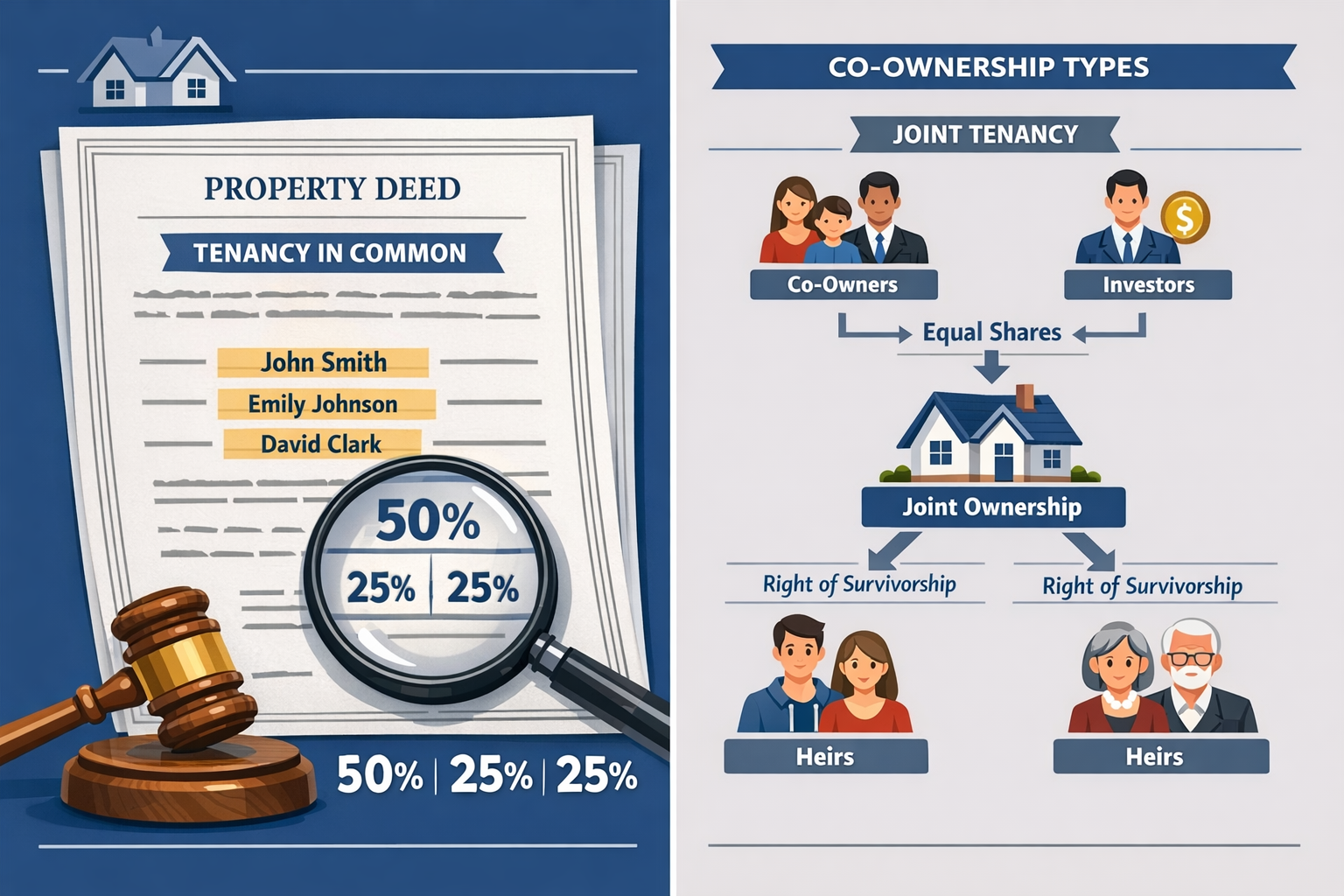
Shared ownership property refers to real estate owned by two or more individuals simultaneously. This arrangement commonly occurs through inheritance, joint purchases, or business partnerships. Each owner holds a specific interest in the property, which may be equal or unequal depending on how the title was established.
Types of Co-Ownership
Tenancy in Common represents the most flexible form of shared ownership. Each owner holds a distinct, transferable share that can be sold, gifted, or willed to heirs independently. Ownership percentages don’t need to be equal—one person might own 60% while two others each own 20%.
Joint Tenancy includes a “right of survivorship,” meaning when one owner passes away, their share automatically transfers to the surviving owners rather than to their heirs. This arrangement requires equal ownership shares and simultaneous acquisition of the property.
Tenancy by the Entirety applies exclusively to married couples in certain states, offering additional legal protections and requiring both spouses to agree to any sale or transfer.
Common Scenarios Leading to Shared Ownership
🏠 Inheritance situations create the majority of co-ownership challenges. When parents pass away without a will or leave property to multiple children, each heir becomes a co-owner. These situations often involve multiple heirs and one property, creating complex dynamics that require helpful guidance to resolve.
💰 Family investments occur when siblings, parents, or extended family members pool resources to purchase property together, whether as a vacation home, rental investment, or future residence.
📋 Divorce settlements sometimes result in continued co-ownership when couples cannot immediately sell or divide property assets.
🤝 Business partnerships frequently involve shared property ownership for commercial purposes, creating potential conflicts when partners want to exit the arrangement.
Your Legal Rights as a Co-Owner
Understanding your legal rights provides the foundation for making informed decisions about shared property. The law recognizes that co-ownership should not trap anyone in an unwanted situation indefinitely.
The Right to Sell Your Share
As a co-owner, you possess the fundamental right to sell your ownership interest in most situations. This right exists regardless of whether other owners approve or agree with your decision. However, the practical implications vary based on your ownership type and local laws.
For tenancy in common arrangements, selling your share is straightforward from a legal perspective. You can transfer your ownership percentage to any willing buyer without obtaining permission from co-owners. The new owner simply steps into your position, becoming a co-owner alongside the existing parties.
Joint tenancy situations are more complex. Selling your share typically converts the ownership structure to tenancy in common for the portion sold, while the remaining joint tenants maintain their survivorship rights among themselves.
Limitations and Considerations
While you can sell your share, several practical challenges emerge:
- Market value concerns: Buyers typically pay less for fractional ownership than for complete property control
- Co-owner complications: New owners must work with existing co-owners on property decisions
- Financing difficulties: Most traditional lenders won’t finance fractional ownership purchases
- Title complications: Existing liens, judgments, or title issues can complicate any sale
When Co-Owners Disagree
Disagreements among co-owners represent one of the most common and frustrating aspects of shared ownership. One owner might want to sell immediately for cash, while another views the property as a long-term investment or family legacy.
These conflicts don’t eliminate your rights. Even when co-owners refuse to cooperate, legal mechanisms exist to resolve the situation. The law recognizes that perpetual disagreement serves no one’s interests and provides pathways to resolution.
Sell Shared Ownership Property: No Co-Owner Agreement Needed Through Partition Actions
When co-owners cannot reach agreement, partition actions provide a court-supervised solution to divide or sell shared property. This legal process ensures that no co-owner remains trapped in an unwanted ownership situation indefinitely.
What Is a Partition Action?
A partition action is a lawsuit filed by one or more co-owners requesting that a court either physically divide the property or order its sale. This legal remedy has existed for centuries, recognizing that shared ownership should not become a permanent prison for unwilling participants.
The court examines the property, ownership interests, and practical considerations before determining the most equitable solution. Judges prioritize fairness to all parties while recognizing that sometimes selling represents the only viable option.
Types of Partition
Partition in Kind involves physically dividing the property into separate parcels, with each co-owner receiving a portion proportional to their ownership interest. This option works well for large tracts of land that can be subdivided without destroying value. For example, 100 acres owned equally by four siblings might be divided into four 25-acre parcels.
However, partition in kind rarely works for single-family homes, commercial buildings, or properties where physical division would significantly reduce value. You cannot practically divide a house into thirds without destroying its utility and worth.
Partition by Sale directs the property to be sold, with proceeds distributed according to each owner’s percentage interest. Courts increasingly favor this approach for properties that cannot be fairly divided physically. The property goes to auction or private sale, generating cash that can be distributed equitably. Learn more about partition in kind vs partition by sale to understand which option suits your situation.
The Partition Action Process
Filing a partition action lawsuit involves several distinct stages:
- Filing the complaint: An attorney prepares and files legal documents with the appropriate court, naming all co-owners as parties
- Service of process: All co-owners receive official notification of the lawsuit
- Discovery phase: Parties exchange information about the property, ownership interests, and relevant facts
- Court evaluation: The judge may appoint a referee or commissioner to inspect the property and recommend a solution
- Trial or settlement: Cases either proceed to trial for a judge’s decision or settle through negotiation
- Sale or division: The court orders implementation of its decision, either dividing the property or directing its sale
Timeline and Costs
Partition actions typically require 6 to 18 months from filing to resolution, though complex cases may take longer. The timeline depends on court schedules, case complexity, and whether co-owners contest the action.
Costs vary significantly but generally include:
- Attorney fees: $5,000 to $20,000 or more
- Court filing fees: $200 to $500
- Referee or commissioner fees: $1,000 to $5,000
- Property appraisal costs: $300 to $600
- Survey fees (if needed): $500 to $2,000
Courts typically order these costs deducted from sale proceeds or divided among co-owners based on their ownership percentages. While expensive, partition actions provide a definitive solution when other options fail.
Advantages and Disadvantages
✅ Advantages:
- Provides guaranteed resolution when co-owners cannot agree
- Court oversight ensures fairness and legal compliance
- Establishes clear market value through appraisal or auction
- Ends ongoing conflicts and property management disputes
❌ Disadvantages:
- Expensive legal fees reduce net proceeds
- Lengthy timeline delays access to funds
- Public auction may yield below-market prices
- Relationships with co-owners may suffer further damage
- Court proceedings become public record
Alternatives to Partition Actions
Before pursuing costly and time-consuming litigation, several alternatives deserve consideration. These options often provide faster resolution with less expense and stress.
Selling Your Share to Co-Owners
The most straightforward solution involves selling your ownership interest directly to the other co-owners. This approach keeps the property within the existing ownership group while allowing you to exit the situation.
Negotiation strategies include:
- Obtaining a professional appraisal to establish fair market value
- Offering a slight discount (5-10%) to incentivize purchase
- Proposing payment plans if co-owners lack immediate cash
- Suggesting they refinance the property to buy out your share
This option works best when co-owners want to retain the property and have financial means to purchase your interest. It avoids legal costs and preserves relationships while providing you with cash.
Selling to Third-Party Investors
Specialized investors and cash buyers for fractional ownership purchase partial interests in co-owned properties. These buyers understand the complexities and risks involved, offering helpful solutions for owners who need to exit quickly.
How it works:
- Investors evaluate the property and ownership structure
- They assess the likelihood of eventually acquiring full ownership or forcing a sale
- An offer is made for your ownership percentage, typically at a discount
- The sale closes quickly, often within 2-4 weeks
- The investor becomes the new co-owner
While you’ll receive less than your share’s theoretical full value, this approach provides immediate liquidity without legal battles. The discount reflects the investor’s risk and the complications of fractional ownership.
Buyout Arrangements
A structured buyout allows one or more co-owners to purchase others’ shares over time. This arrangement works particularly well when co-owners want to keep the property but lack immediate funds for a lump-sum purchase.
Components of a typical buyout agreement include:
- Professional appraisal determining each share’s value
- Payment schedule spreading the purchase over months or years
- Interest rate on the outstanding balance
- Security interest in the property protecting the seller
- Clear terms for default and remedies
These arrangements require trustworthy service from attorneys to draft enforceable agreements protecting all parties’ interests.
Mediation and Negotiation
Professional mediation brings in a neutral third party to facilitate discussions and help co-owners reach agreement. Mediators don’t make decisions but guide conversations toward mutually acceptable solutions.
Mediation offers several benefits:
- Costs significantly less than litigation
- Preserves relationships through collaborative problem-solving
- Provides creative solutions tailored to specific situations
- Maintains privacy (unlike court proceedings)
- Typically resolves within a few sessions
Many partition action cases eventually settle through mediation after parties experience the stress and expense of litigation. Starting with mediation can save time, money, and relationships.
Working With Cash Buyers and Property Solutions Companies
When traditional sale methods prove impractical, specialized companies offer alternative pathways to resolution. These cash buyers for problem properties understand complex ownership situations and provide helpful solutions.
How Cash Buyers Handle Co-Ownership Situations
Professional property solutions companies employ several strategies for shared ownership properties:
Purchasing individual shares: Some buyers acquire fractional interests, becoming co-owners themselves. They then work toward eventually purchasing remaining shares or forcing a partition sale.
Facilitating buyouts: Companies may help structure arrangements where one co-owner buys out others, providing financing or guarantees to make the transaction possible.
Buying entire properties: When possible, cash buyers purchase the complete property with all co-owners’ agreement, distributing proceeds according to ownership percentages.
Resolving title issues: Expert service includes addressing liens, judgments, or other title problems that complicate sales.
Benefits of Working With Specialized Buyers
🚀 Speed: Traditional sales require 30-60 days minimum, while cash buyers often close in 7-14 days.
💼 No repairs needed: These buyers purchase properties “as-is,” eliminating renovation costs and hassles.
📋 Simplified process: Professional buyers handle paperwork, coordinate with title companies, and manage complex details.
🤝 Experience with complications: Industry experts regularly work with inherited properties, multiple heirs, back taxes, and other challenges.
💰 Certainty: Cash offers eliminate financing contingencies that cause traditional sales to fall through.
What to Look for in a Property Solutions Company
Not all cash buyers provide equally trustworthy service. Evaluate potential buyers using these criteria:
Reputation and reviews: Research online reviews, Better Business Bureau ratings, and testimonials from previous clients.
Transparency: Reputable companies clearly explain their process, fees, and how they calculate offers.
Local knowledge: Companies familiar with your area understand local property values, regulations, and market conditions.
Professional credentials: Look for membership in real estate investor associations and proper licensing.
No-obligation offers: Legitimate buyers provide free property evaluations without pressure or commitment.
Clear communication: Responsive, friendly and caring professionals answer questions thoroughly and promptly.
Sure Path Property Solutions exemplifies these qualities, offering helpful guidance for property owners facing complicated situations. The company specializes in navigating challenges like multiple ownership, inherited property, liens, and unclear titles—exactly the issues that make traditional sales difficult.
Special Considerations for Inherited Property
Inherited property creates unique challenges beyond typical co-ownership situations. When selling inherited property, additional legal and emotional factors come into play.
Probate and Estate Settlement
Before selling inherited property, the estate typically must pass through probate—the legal process of validating a will, paying debts, and distributing assets. This process can take several months to over a year, depending on estate complexity and state laws.
Key probate considerations:
- Executor or administrator must be appointed by the court
- All heirs must be identified and notified
- Estate debts and taxes must be paid before distribution
- Court approval may be required for property sales
Some properties avoid probate through mechanisms like living trusts, transfer-on-death deeds, or joint tenancy with right of survivorship. Understanding your situation’s specific requirements prevents costly mistakes.
Dealing With Back Taxes on Inherited Property
Inherited properties often carry back taxes on inherited property that must be addressed before sale. Property taxes continue accruing even during probate, and previous owners may have fallen behind on payments.
Who pays these taxes? Generally, the estate is responsible for property taxes through the date of death, while heirs become responsible for taxes accruing afterward. However, tax liens attach to the property itself, meaning they must be satisfied at sale regardless of who technically owes them.
Resolution strategies include:
- Negotiating payment plans with tax authorities
- Requesting penalty and interest abatement
- Using sale proceeds to satisfy tax debts at closing
- Working with buyers who purchase properties with tax liens
Heir Property Challenges
“Heir property” refers to real estate passed to multiple heirs without a clear title transfer. This situation commonly occurs when property owners die without wills, leaving property to pass through intestate succession laws.
Heir property creates significant complications:
- No single heir has clear authority to sell
- Traditional lenders won’t finance purchases
- Title insurance companies may refuse coverage
- Property maintenance and tax payments become disputed
Solutions for heir property include:
- Filing quiet title actions to clarify ownership
- Having all heirs sign sale agreements simultaneously
- Working with specialized buyers who purchase heir property
- Pursuing partition actions when heirs cannot agree
Emotional Factors in Family Property Sales
Beyond legal complexities, inherited property carries emotional weight. Family homes hold memories, represent parental legacies, and symbolize family connections. These emotional factors often intensify disagreements among heirs.
Navigating family dynamics requires:
- Open, honest communication about each person’s needs and concerns
- Recognition that different heirs may have different financial situations
- Professional mediation to facilitate difficult conversations
- Focus on fair outcomes rather than winning arguments
- Understanding that selling doesn’t diminish memories or family bonds
Tax Implications of Selling Shared Ownership Property
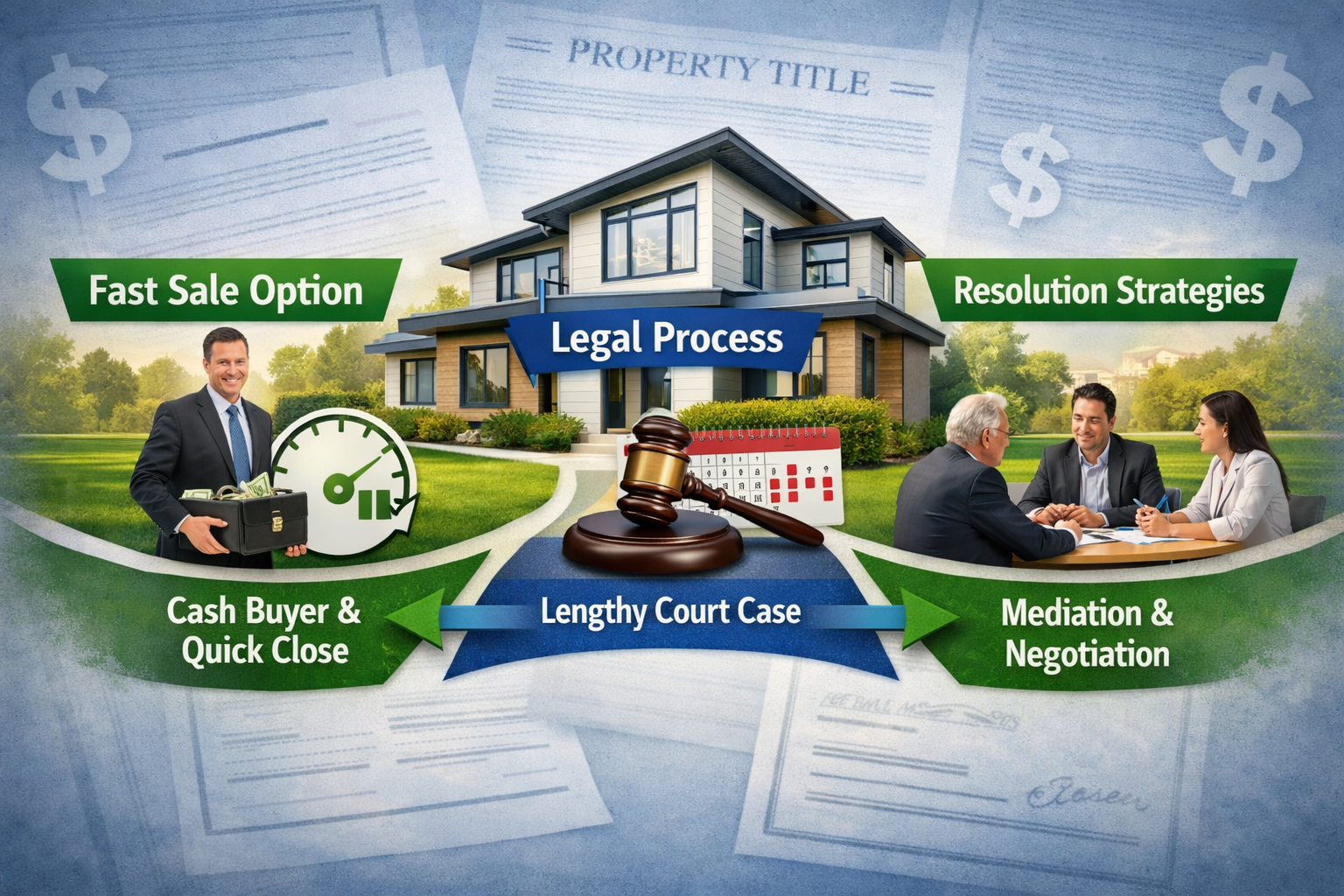
Understanding tax consequences helps you make informed decisions and avoid surprises. Tax treatment varies significantly based on how you acquired the property and your specific situation.
Capital Gains Tax Basics
When you sell property for more than your “basis” (typically what you paid plus improvements), you realize a capital gain subject to taxation. For inherited property, heirs receive a “step-up in basis” to the property’s fair market value on the date of death, often eliminating or reducing capital gains.
Example: Your mother purchased a house for $100,000 in 1990. When she passed away in 2024, the property was worth $400,000. You inherit it with three siblings, each receiving a 25% share. Your basis is $100,000 (25% of $400,000), not $25,000 (25% of the original purchase price). If you sell your share for $100,000, you owe no capital gains tax.
Selling Your Share vs. Selling the Whole Property
Tax treatment differs depending on whether you sell just your ownership interest or the entire property sells:
Selling your fractional share:
- You report only the gain or loss on your portion
- Other co-owners are not affected for that tax year
- The buyer receives a basis equal to their purchase price
Selling the entire property:
- Each co-owner reports their proportional share of the gain
- All owners must report the sale in the same tax year
- Proceeds are distributed according to ownership percentages
Tax Deductions and Considerations
Several deductions may reduce your taxable gain:
💵 Selling expenses: Commissions, attorney fees, title insurance, and closing costs reduce your taxable gain.
🏗️ Property improvements: Capital improvements you funded increase your basis, reducing gain.
📊 Depreciation recapture: If the property was rented and depreciation was claimed, some gain may be taxed as ordinary income.
🏠 Primary residence exclusion: If you lived in the property as your primary residence for at least 2 of the last 5 years, you may exclude up to $250,000 of gain ($500,000 for married couples).
Consulting Tax Professionals
Tax laws are complex and change frequently. Consulting with a qualified CPA or tax attorney before selling ensures you understand your specific situation and take advantage of available strategies. This professional guidance represents a worthwhile investment that often saves significantly more than it costs.
Steps to Sell Shared Ownership Property Without Agreement
When co-owners won’t cooperate, following a systematic approach maximizes your chances of successful resolution. These steps provide a roadmap from frustration to solution.
Step 1: Understand Your Ownership Type and Rights
Begin by obtaining a copy of the property deed from the county recorder’s office. This document reveals:
- How title is held (tenancy in common, joint tenancy, etc.)
- Each owner’s percentage interest
- Any restrictions or conditions on ownership
Understanding your legal position provides the foundation for all subsequent decisions. If the deed language is unclear, consult with a real estate attorney for interpretation.
Step 2: Attempt Communication and Negotiation
Before pursuing legal or alternative options, make a good-faith effort to communicate with co-owners:
📧 Document all communication in writing (email or certified letters) to create a record.
💬 Clearly express your intentions and reasons for wanting to sell.
🤝 Propose specific solutions like buyouts, mediation, or coordinated sales.
⏰ Set reasonable deadlines for responses and decisions.
Even if initial attempts fail, documented efforts to negotiate strengthen your position if litigation becomes necessary. Courts look favorably on parties who attempted reasonable resolution before filing lawsuits.
Step 3: Get a Professional Property Appraisal
A professional appraisal establishes the property’s fair market value, providing an objective basis for negotiations or legal proceedings. Appraisals typically cost $300-$600 and offer several benefits:
- Creates a factual foundation for buyout discussions
- Prevents unrealistic expectations about property value
- Provides evidence for partition action proceedings
- Helps evaluate offers from investors or cash buyers
Choose a licensed appraiser familiar with your property type and local market. Share the appraisal with co-owners to facilitate informed discussions.
Step 4: Explore Sale Options
With a clear understanding of value and ownership rights, evaluate your options:
Option A: Sell your share to co-owners
- Present the appraisal and propose a fair price
- Consider offering a small discount (5-10%) to facilitate agreement
- Suggest payment plans if immediate cash is unavailable
Option B: Sell to third-party investors
- Contact companies specializing in fractional ownership purchases
- Obtain multiple offers to ensure fair pricing
- Understand that offers will be discounted due to complications
Option C: Coordinate a full property sale
- Propose listing the property with all co-owners’ agreement
- Suggest a real estate agent experienced with co-owned properties
- Agree on listing price, terms, and proceeds distribution
Option D: Pursue partition action
- Consult with a real estate attorney about filing a partition lawsuit
- Understand the timeline, costs, and likely outcomes
- Use this option as a last resort when others fail
Step 5: Consult With Professionals
Navigating shared ownership sales benefits enormously from professional expertise:
🏛️ Real estate attorneys provide legal advice, draft agreements, and represent you in partition actions.
💼 Real estate agents experienced with co-owned properties understand unique marketing and negotiation challenges.
💰 Property solutions companies like Sure Path Property Solutions offer alternatives to traditional sales and litigation.
📋 Title companies identify and resolve title issues that might complicate sales.
Professional guidance transforms complex situations into manageable processes, often saving more in time and money than the services cost.
Step 6: Execute Your Chosen Solution
Once you’ve selected the best path forward, move decisively:
- Sign necessary contracts and agreements
- Meet deadlines and contingency requirements
- Maintain communication with all parties
- Address issues promptly as they arise
- Follow through to closing
Procrastination only extends the frustration and expense of co-ownership conflicts. Taking action brings resolution and allows everyone to move forward.
Common Obstacles and How to Overcome Them
Even with the best strategies, obstacles frequently arise when selling shared ownership property. Anticipating these challenges and knowing how to address them prevents delays and frustration.
Uncooperative Co-Owners
The challenge: Some co-owners simply refuse to engage, ignoring communication attempts and blocking progress.
Solutions:
- Send certified letters creating a paper trail of your efforts
- Use formal mediation to compel participation
- File a partition action that legally requires their involvement
- Sell your share to an investor who will deal with the difficult co-owner
Remember that uncooperative behavior doesn’t eliminate your rights. Legal mechanisms exist specifically to prevent one owner from holding others hostage indefinitely.
Disagreements on Property Value
The challenge: Co-owners often have unrealistic expectations about property value, either overestimating worth or suspecting others of undervaluing to gain advantage.
Solutions:
- Obtain multiple professional appraisals from independent sources
- Research recent comparable sales in the area
- Hire a real estate agent to provide a comparative market analysis
- Agree to list the property and let the market determine value
Objective, third-party valuations remove emotion from pricing discussions and provide a factual basis for negotiations.
Title Issues and Liens
The challenge: Many co-owned properties carry liens, judgments, or title defects that complicate sales.
Solutions:
- Order a title search to identify all issues
- Negotiate with lien holders for payoffs or releases
- Use sale proceeds to satisfy debts at closing
- Work with buyers who specialize in properties with liens
- Pursue quiet title actions to clear title defects
Title issues rarely prove insurmountable with proper professional guidance. Many problems that seem overwhelming have straightforward solutions once you understand the options.
Financial Barriers
The challenge: Partition actions, attorney fees, and property maintenance costs create financial burdens that some co-owners cannot afford.
Solutions:
- Seek attorneys who work on contingency or deferred payment
- Request that courts order costs paid from sale proceeds
- Work with cash buyers who purchase properties as-is, eliminating repair costs
- Explore payment plans for necessary expenses
Financial constraints shouldn’t prevent you from exercising your property rights. Multiple options exist for owners with limited resources.
Emotional Attachments and Family Dynamics
The challenge: Family properties carry emotional significance that complicates rational decision-making, and family relationships add layers of complexity to business decisions.
Solutions:
- Acknowledge emotions while separating feelings from financial realities
- Use professional mediators to facilitate difficult family conversations
- Focus discussions on fair outcomes rather than personal grievances
- Consider allowing sentimental co-owners to buy out others’ shares
- Remember that selling property doesn’t erase memories or family bonds
Emotional challenges often prove more difficult than legal or financial obstacles. Approaching these situations with empathy while maintaining clear boundaries protects both relationships and rights.
Why Choose Sure Path Property Solutions
When facing complex co-ownership situations, partnering with experienced professionals transforms overwhelming challenges into manageable solutions. Sure Path Property Solutions specializes in exactly these complicated scenarios.
Expertise in Complex Property Situations
Sure Path Property Solutions focuses specifically on properties that traditional buyers and agents avoid:
✅ Multiple owners with disagreements
✅ Inherited properties with numerous heirs
✅ Properties with back taxes or tax liens
✅ Houses and land with title problems
✅ Real estate with liens or judgments
This specialization means the company has seen virtually every variation of co-ownership challenge and developed proven strategies for resolution.
The Sure Path Advantage
Fast, fair cash offers: Receive a no-obligation offer within 24-48 hours of property evaluation, with closings possible in as little as 7-14 days.
No repairs or improvements needed: The company purchases properties in any condition, eliminating renovation costs and hassles.
Simplified process: Experienced professionals handle paperwork, coordinate with title companies, and manage complex details from start to finish.
Flexible solutions: Whether you need to sell just your share or coordinate a full property sale, Sure Path offers options tailored to your situation.
Transparent communication: Friendly and caring professionals explain every step clearly, answering questions and addressing concerns promptly.
Local expertise: Understanding local markets, regulations, and property values ensures fair, realistic offers.
How the Process Works
- Contact Sure Path: Reach out via phone or the website contact form to describe your situation.
- Property evaluation: Provide basic property information and ownership details for initial assessment.
- Receive your offer: Get a fair, no-obligation cash offer based on property value and situation complexity.
- Review and decide: Take time to consider the offer and compare it with other options—no pressure or obligations.
- Close on your timeline: If you accept, choose a closing date that works for your schedule, often within two weeks.
- Get paid: Receive cash at closing and move forward with your life, free from co-ownership complications.
Real Solutions for Real People
Sure Path Property Solutions understands that behind every complicated property situation are real people facing stress, uncertainty, and difficult decisions. The company’s mission centers on providing helpful solutions that address both the practical and emotional aspects of challenging real estate situations.
Whether you’re dealing with inherited property challenges, uncooperative co-owners, or properties with multiple complications, Sure Path offers the expert service and trustworthy guidance needed to reach resolution.
Frequently Asked Questions
Can I force the sale of a jointly owned property?
Yes, through a partition action lawsuit, you can force the sale of jointly owned property even without co-owner agreement. Courts recognize that co-owners should not be trapped indefinitely in unwanted ownership situations. The partition process typically takes 6-18 months and involves court supervision, but it provides a guaranteed path to resolution when other options fail.
How much is my share of a co-owned property worth?
Your share’s value depends on several factors: the property’s total fair market value, your ownership percentage, and the complexity of the co-ownership situation. In theory, a 50% ownership interest in a $200,000 property is worth $100,000. However, fractional interests typically sell at a 20-40% discount because buyers face complications and risks associated with co-ownership. Professional appraisal provides the most accurate valuation.
What happens if one co-owner refuses to sell?
If one co-owner refuses to sell, you have several options: sell your individual share to a third-party investor, file a partition action to force a court-ordered sale, negotiate a buyout arrangement, or pursue mediation to reach agreement. Your specific ownership type (tenancy in common vs. joint tenancy) affects which options work best for your situation.
Do I need a lawyer to sell my share of a property?
While not legally required in all situations, consulting a real estate attorney is highly recommended when selling shared ownership property. Attorneys ensure you understand your rights, help navigate complex legal issues, draft necessary agreements, and represent your interests in partition actions if needed. The cost of legal advice is typically modest compared to the value at stake and potential mistakes.
How long does it take to sell shared ownership property?
The timeline varies significantly based on your chosen method. Selling to a cash buyer can close in 7-14 days. Traditional sales with all co-owners’ agreement typically take 30-60 days. Partition actions usually require 6-18 months from filing to resolution. Negotiating buyouts with co-owners depends on their financial situation and willingness to cooperate, ranging from weeks to months.
Can I sell inherited property without probate?
In most cases, property must pass through probate before heirs can sell it. However, exceptions exist for properties held in living trusts, those with transfer-on-death deeds, or real estate owned in joint tenancy with right of survivorship. Some states also offer simplified probate procedures for small estates. Consult with an estate attorney to understand your specific situation’s requirements.
What if the property has liens or back taxes?
Properties with liens or back taxes can still be sold. Liens typically must be satisfied at closing from sale proceeds, and buyers often accept this arrangement. Alternatively, work with specialized buyers who purchase properties with existing liens and handle resolution themselves. Selling property with tax debt is more common than many people realize, and solutions exist for virtually every situation.
Conclusion: Taking Control of Your Shared Ownership Situation
Co-owning property with disagreeable partners doesn’t have to mean years of frustration and conflict. Understanding that you can sell shared ownership property: no co-owner agreement needed empowers you to take control of your situation and move forward with confidence.
Whether you choose to sell your individual share, pursue a partition action, work with cash buyers, or negotiate with co-owners, options exist for every situation. The key is understanding your rights, evaluating alternatives objectively, and taking decisive action.
Your Next Steps
Don’t let co-ownership complications continue draining your time, energy, and resources. Take these concrete steps today:
- Gather your property documents: Locate your deed, any co-ownership agreements, and recent property tax statements to understand your current situation clearly.
- Research your options: Review the strategies outlined in this guide and identify which approaches best fit your circumstances and goals.
- Consult with professionals: Reach out to real estate attorneys, property solutions companies, or other experts who can provide personalized guidance for your specific situation.
- Get a property evaluation: Contact Sure Path Property Solutions for a free, no-obligation assessment of your property and situation. Discover what your share is worth and what options make sense for your circumstances.
- Make a decision: Choose the path that best balances your financial needs, timeline, and personal circumstances, then commit to following through.
Freedom From Co-Ownership Complications
Shared ownership challenges can feel overwhelming, especially when dealing with uncooperative co-owners, inherited property complications, or financial pressures. But these situations are not hopeless. With the right information, professional support, and determination, you can resolve even the most complex co-ownership problems.
Sure Path Property Solutions stands ready to provide the helpful guidance and expert service you need to navigate these challenges successfully. The company’s specialization in complicated property situations means you’re working with industry experts who have successfully resolved hundreds of cases similar to yours.
You don’t have to remain trapped in an unwanted co-ownership situation. You have rights, options, and professionals ready to help. Take the first step today toward resolving your shared ownership challenges and reclaiming control of your financial future.
Ready to explore your options? Contact Sure Path Property Solutions now for a free, confidential consultation about your shared ownership property. Discover how quickly and easily you can resolve your situation and move forward with confidence.
Sure Path is a family-owned, curative-title cash buyer. We handle the paperwork and pay what’s owed at closing — no fees, no repairs, no pressure.
See how we help with selling a property with multiple heirs →