
How to Sell House with Title Defects: Step-by-Step Guide

Discovering title defects on a property can feel like hitting a brick wall when planning to sell. The dream of a quick, smooth transaction suddenly transforms into a complex legal maze filled with paperwork, delays, and uncertainty. But here’s the good news: selling a house with title defects is absolutely possible when you understand the process and know your options.
This comprehensive guide on How to Sell House with Title Defects: Step-by-Step Guide will walk you through every stage of the journey—from identifying common title problems to finding the right buyer and closing the deal successfully. Whether you’re dealing with liens, missing heirs, boundary disputes, or breaks in the chain of title, helpful solutions exist to move your property sale forward.
Key Takeaways
- Title defects are common and solvable: Issues like liens, judgment claims, missing signatures, and boundary disputes can be resolved through specific legal processes and expert guidance.
- Multiple selling options exist: Traditional buyers, cash buyers, and investors each offer different advantages when dealing with title problems—cash buyers often provide the fastest, simplest path.
- Professional help accelerates resolution: Working with title professionals, real estate attorneys, and experienced property buyers can save months of time and thousands in costs.
- Disclosure is legally required: Sellers must inform potential buyers about known title defects to avoid future legal complications and ensure ethical transactions.
- Acting quickly prevents complications: The sooner you address title defects, the more options you’ll have and the less the problems will compound over time.
Understanding Title Defects and Their Impact on Property Sales
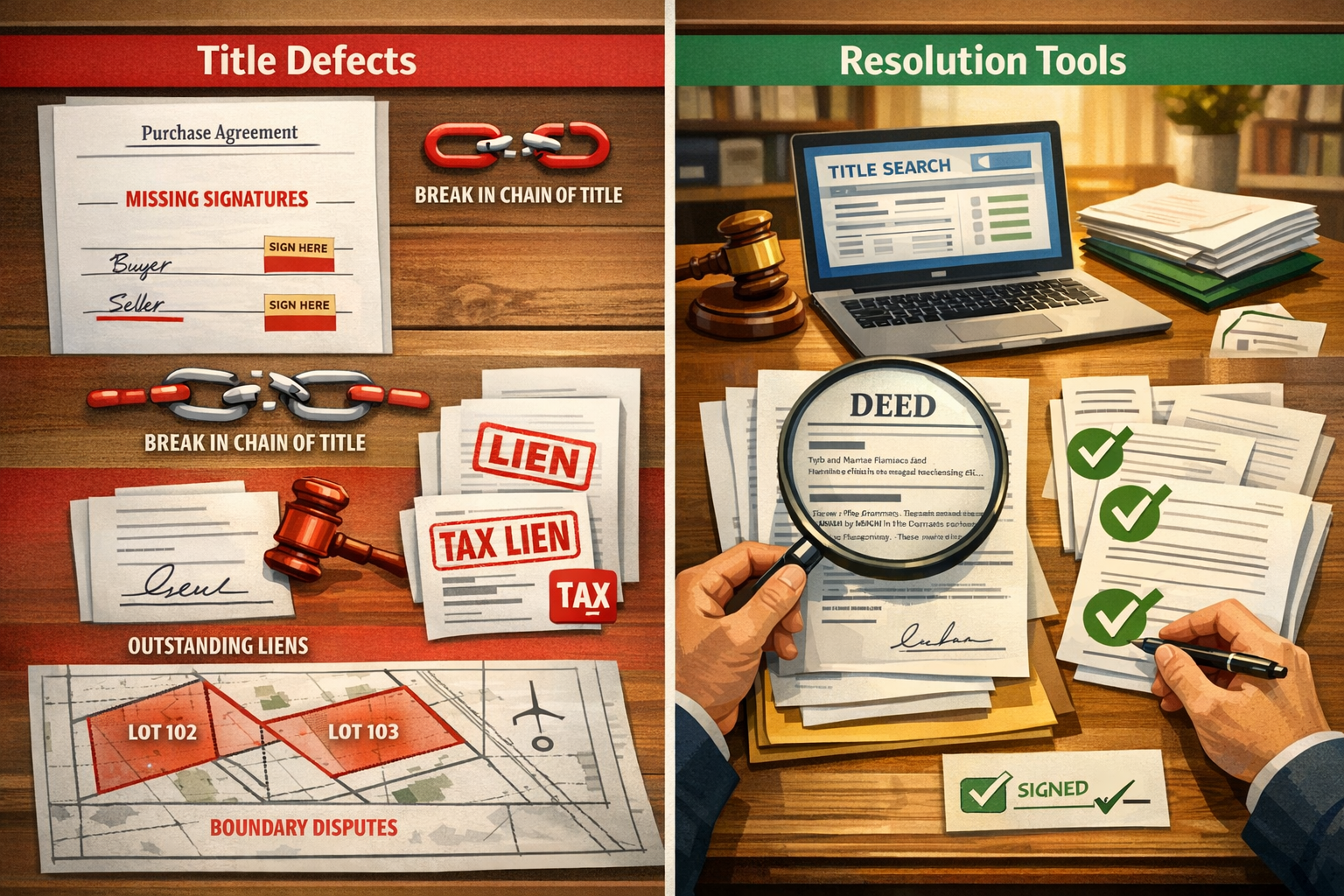
A title defect is any issue that clouds the ownership or transferability of a property. Think of a property title as a chain connecting all previous owners to the current one. When a link in that chain is broken, damaged, or missing, it creates uncertainty about who truly owns the property and whether it can be legally transferred.
What Are Title Defects?
Title defects come in many forms, but they all share one characteristic: they create questions or disputes about property ownership. These issues typically surface during a title search—the investigation process that examines public records to verify ownership history and identify any claims against the property.
Common types of title defects include:
- Outstanding liens (tax liens, mechanic’s liens, judgment liens)
- Unpaid property taxes or back taxes
- Errors in public records (clerical mistakes, filing errors)
- Missing heirs or unknown claims to the property
- Breaks in the chain of title (gaps in ownership history)
- Boundary disputes or survey discrepancies
- Forgeries or fraudulent documents in the property’s history
- Easement conflicts or undisclosed encumbrances
- Probate issues with inherited properties
How Title Defects Affect Your Ability to Sell
Title defects create significant obstacles in traditional real estate transactions. Most buyers cannot obtain mortgage financing for a property with title problems because lenders require “clear title” before approving loans. This requirement protects the lender’s investment by ensuring no one else can claim ownership or place additional liens on the property.
When a title defect appears during the sale process, several consequences typically follow:
🚫 Transaction delays: The closing process halts until the defect is resolved
💰 Reduced buyer pool: Only cash buyers or investors may consider the property
📉 Lower property value: Title problems often force price reductions
⚖️ Legal complications: Unresolved defects can lead to lawsuits or ownership disputes
😰 Buyer withdrawal: Many potential buyers simply walk away from complicated situations
Understanding abstract of title problems and common issues helps sellers recognize what they’re facing and develop appropriate strategies for resolution.
The Financial Impact of Unresolved Title Issues
Beyond delaying or preventing a sale, title defects carry real financial costs. Outstanding liens accumulate interest over time. Property tax debts grow with penalties and fees. Legal disputes require attorney involvement, adding thousands in professional fees.
The longer title defects remain unresolved, the more expensive they become to fix. This reality makes early action essential for property owners who want to minimize costs and maximize their eventual sale proceeds.
Step 1: Conduct a Comprehensive Title Search
The foundation of How to Sell House with Title Defects: Step-by-Step Guide begins with understanding exactly what problems exist. A thorough title search reveals all recorded claims, liens, and ownership issues affecting your property.
What a Title Search Reveals
A professional title search examines public records at the county recorder’s office, courthouse, and other government agencies. This investigation typically goes back 30-50 years (or more) to trace the complete ownership history and identify any clouds on the title.
A comprehensive title search uncovers:
- Current and previous property owners
- Outstanding mortgages or deeds of trust
- Tax liens (federal, state, and local)
- Judgment liens from court cases
- Mechanic’s liens from unpaid contractors
- Easements and rights-of-way
- Restrictive covenants or deed restrictions
- Pending legal actions (lis pendens)
- Probate claims or estate issues
- Survey discrepancies or boundary disputes
Who Should Perform the Title Search
While some property information is publicly accessible online, a professional title search provides the detailed examination necessary to identify hidden problems. Several professionals can conduct this search:
Title companies specialize in title searches and typically offer the most comprehensive examinations. They employ trained abstractors who understand how to interpret complex legal documents and identify potential issues.
Real estate attorneys can perform title searches as part of their legal services. They bring legal expertise that helps interpret findings and recommend solutions.
Title abstractors are professionals specifically trained to research property records and compile detailed reports about ownership history and encumbrances.
For properties with known complications—multiple heirs, long ownership gaps, or suspected liens—investing in a professional title search from a reputable company provides the most reliable results.
Understanding Your Title Report
Once the title search is complete, you’ll receive a title report (also called an abstract of title or preliminary title report). This document lists all findings in legal terminology that can seem overwhelming at first glance.
Key sections to review carefully:
- Chain of title: The chronological list of all previous owners
- Legal description: The official property boundaries and location
- Encumbrances: All liens, easements, and restrictions affecting the property
- Exceptions: Items that would not be covered by title insurance
- Requirements: Conditions that must be met before title can be transferred
Don’t hesitate to ask the title professional to explain any findings in plain language. Understanding exactly what defects exist is essential before moving to resolution strategies.
Step 2: Identify and Document All Title Defects
After receiving your title report, the next step involves creating a clear inventory of all problems that need resolution. Proper documentation makes the resolution process more efficient and helps when working with attorneys, buyers, or other professionals.
Creating Your Title Defect Inventory
Organize all identified defects into categories based on their type and severity. This organization helps prioritize which issues to address first and estimate the time and cost required for resolution.
Sample organization framework:
| Defect Type | Specific Issue | Estimated Cost to Resolve | Resolution Timeline | Priority Level |
|---|---|---|---|---|
| Tax Lien | County property taxes (3 years) | $12,500 + penalties | 30-60 days | High |
| Judgment Lien | Credit card judgment | $8,200 | 45-90 days | Medium |
| Chain Break | Missing deed from 1998 | $2,000-4,000 (legal fees) | 90-180 days | High |
| Boundary Dispute | Fence encroachment | $1,500-3,000 (survey) | 60-90 days | Low |
Gathering Supporting Documentation
For each identified defect, collect all available documentation. This preparation streamlines the resolution process and provides evidence when negotiating with creditors or presenting information to potential buyers.
Essential documents to compile:
- Complete title report and all supporting abstracts
- Property deeds and transfer documents
- Tax assessment records and payment history
- Lien documents (including filing dates and amounts)
- Court judgments or legal notices
- Probate documents (for inherited properties)
- Survey maps and boundary descriptions
- Correspondence with creditors or claimants
- Payment records for any partial resolutions
Organizing these documents in a dedicated folder—both physical and digital—ensures you can quickly access information when needed throughout the selling process.
Assessing the Severity of Each Defect
Not all title defects carry equal weight. Some can be resolved quickly with minimal cost, while others require extensive legal proceedings. Understanding the difference helps set realistic expectations for your timeline and budget.
Minor defects (typically resolved in 30-60 days):
- Small clerical errors in public records
- Satisfied liens not yet released
- Minor survey discrepancies
- Simple name variations in documents
Moderate defects (typically resolved in 60-120 days):
- Outstanding tax liens requiring payment plans
- Judgment liens from known creditors
- Missing signatures from locatable parties
- Standard probate proceedings
Major defects (may require 6+ months):
- Breaks in chain of title requiring quiet title actions
- Missing heirs or unknown claimants
- Complex boundary disputes
- Fraudulent documents in the ownership history
- Multiple overlapping claims
Understanding where your defects fall on this spectrum helps you choose the most appropriate selling strategy and set realistic timelines.
Step 3: Explore Resolution Options for Common Title Defects
Once you’ve identified and documented all title problems, the next phase involves understanding your resolution options. Different defects require different approaches, and the right strategy depends on your timeline, budget, and selling goals.
Resolving Lien-Related Title Defects
Liens represent the most common type of title defect. These legal claims against your property secure debts or obligations, and they must typically be satisfied before title can transfer to a new owner.
Tax liens arise from unpaid federal, state, or local taxes. These liens take priority over most other claims and must be addressed for any sale to proceed. Resolution options include:
- Full payment: Paying the entire debt plus penalties and interest
- Negotiated settlement: Working with tax authorities to reduce the total amount
- Payment from sale proceeds: Arranging for the lien to be paid at closing
- Installment agreement: Setting up a payment plan (though this doesn’t remove the lien)
Property owners dealing with back taxes on inherited property face additional complications, as responsibility for payment may be unclear among multiple heirs.
Judgment liens result from court cases where creditors obtained judgments against property owners. These liens can often be negotiated:
- Contact the judgment creditor directly to discuss settlement
- Offer a lump-sum payment for less than the full amount
- Provide proof of financial hardship to negotiate better terms
- Arrange for payment at closing from sale proceeds
For detailed guidance on this process, review information about how to satisfy a judgment lien.
Mechanic’s liens stem from unpaid contractors, subcontractors, or suppliers who performed work on the property. Resolution strategies include:
- Verifying the lien was properly filed within statutory deadlines
- Disputing invalid or excessive lien amounts
- Negotiating payment with the lienholder
- Bonding off the lien (posting a bond to remove it from title)
Understanding how to sell a house with a lien provides comprehensive strategies for each lien type.
Addressing Ownership and Chain of Title Issues
Problems with the ownership history require different approaches than financial liens. These defects challenge the very foundation of your ownership claim and typically require legal proceedings to resolve.
Quiet title actions are lawsuits filed to establish clear ownership when the chain of title has breaks, gaps, or competing claims. This legal process:
- Requires filing a lawsuit in the county where the property is located
- Involves notifying all potential claimants of the action
- Culminates in a court judgment declaring the rightful owner
- Typically costs $2,000-$5,000 in legal fees
- Takes 3-6 months (or longer if contested)
Learn more about the quiet title action cost and timeline to understand what this process involves.
Missing heirs create complications for inherited properties. When property passes through estates without proper probate or when heirs cannot be located, establishing clear title requires:
- Conducting heir searches through genealogical professionals
- Publishing legal notices to unknown heirs
- Obtaining court orders declaring heirship
- Completing delayed probate proceedings
Properties with missing heirs present unique challenges that often benefit from professional guidance.
Boundary disputes arise from survey discrepancies, encroachments, or unclear property lines. Resolution options include:
- Obtaining a professional survey to establish accurate boundaries
- Negotiating boundary line agreements with neighbors
- Purchasing small parcels to resolve encroachments
- Filing quiet title actions to establish legal boundaries
Correcting Errors in Public Records
Sometimes title defects result from simple clerical errors—misspelled names, incorrect legal descriptions, or improperly recorded documents. These issues are typically easier to resolve than substantive problems:
Affidavits of correction can fix minor errors like name variations or typographical mistakes. The property owner signs a sworn statement explaining the error, which is then recorded to correct the public record.
Corrective deeds (also called reformation deeds) can amend errors in previously recorded deeds. The parties to the original transaction execute a new deed correcting the mistakes.
Scrivener’s affidavits address errors made by the person who prepared legal documents. These sworn statements explain the mistake and provide the correct information.
While these corrections seem straightforward, working with a real estate attorney ensures the corrections are properly prepared and recorded to fully resolve the title defect.
Step 4: Determine Your Selling Strategy Based on Title Issues
Understanding How to Sell House with Title Defects: Step-by-Step Guide means recognizing that different selling strategies work better for different situations. Your choice depends on the severity of title defects, your timeline, and your financial goals.
Option 1: Resolve All Defects Before Listing (Traditional Sale)
The traditional approach involves clearing all title problems before putting your property on the market. This strategy offers several advantages:
✅ Access to the largest buyer pool: Properties with clear title attract both financed and cash buyers
✅ Higher sale prices: Clean title typically commands premium pricing
✅ Conventional financing available: Buyers can obtain mortgages, expanding your market
✅ Smoother closing process: Fewer complications and delays at closing
Best for properties when:
- Title defects are relatively minor and inexpensive to resolve
- You have time to complete the resolution process (3-6+ months)
- You have funds available to pay off liens or legal fees upfront
- The property’s value justifies the investment in clearing title
- You want to maximize your sale price
Challenges to consider:
- Requires upfront investment in resolution costs
- Extends your timeline before listing
- No guarantee of sale after investing in title clearing
- Ongoing property costs (taxes, insurance, maintenance) continue during resolution
Option 2: Sell “As-Is” to Cash Buyers or Investors
Many property owners choose to sell directly to cash buyers who specialize in properties with title problems. This approach offers distinct advantages:
✅ No resolution required: Buyers handle title defects after purchase
✅ Fast closing: Transactions often complete in 7-30 days
✅ No upfront costs: Buyers pay for title clearing
✅ Certainty of sale: Experienced buyers rarely back out
✅ Reduced stress: Professional buyers manage the complexity
Best for properties when:
- Title defects are severe or expensive to resolve
- You need to sell quickly (foreclosure, financial hardship, relocation)
- You lack funds to invest in title clearing
- The property requires repairs in addition to title work
- You want to avoid the uncertainty of traditional listings
Trade-offs to understand:
- Lower sale price (typically 60-80% of market value)
- Less negotiating leverage on price
- Fewer competing offers
Companies like Sure Path Property Solutions specialize in purchasing properties with complicated title issues, providing helpful solutions for owners who need quick, reliable transactions without the hassle of traditional sales.
Option 3: Hybrid Approach—Partial Resolution with Buyer Participation
Some situations allow for a middle path where sellers resolve certain defects while buyers accept others or participate in the resolution process.
Seller-financed transactions can proceed even with some title issues if both parties agree to terms that protect their interests. The seller might:
- Retain title until certain liens are paid from installment payments
- Agree to resolve specific defects within a set timeframe after closing
- Offer price reductions equivalent to resolution costs
Escrow holdbacks involve setting aside funds at closing to resolve remaining title issues. The title company holds these funds in escrow and releases them once defects are cleared.
Buyer assumption of defects works when buyers agree to purchase property subject to certain encumbrances, typically in exchange for reduced purchase price.
This hybrid approach requires:
- Sophisticated buyers willing to accept complexity
- Clear written agreements defining each party’s responsibilities
- Title company cooperation with non-standard arrangements
- Legal counsel for both parties to protect their interests
Making the Right Choice for Your Situation
Choosing the optimal strategy requires honest assessment of your priorities:
Ask yourself:
- How quickly do I need to sell?
- Do I have funds available for upfront resolution costs?
- What is my tolerance for uncertainty and complexity?
- How much equity exists in the property after resolving defects?
- Am I emotionally ready to manage a lengthy resolution process?
For many property owners dealing with title defects, working with cash buyers for problem properties provides the most practical path forward—offering certainty, speed, and freedom from the burden of complex legal proceedings.
Step 5: Work with the Right Professionals
Successfully navigating How to Sell House with Title Defects: Step-by-Step Guide requires assembling a team of experienced professionals who understand the complexities of problem properties.
Real Estate Attorneys Specializing in Title Issues
A skilled real estate attorney provides invaluable guidance throughout the title defect resolution process. These legal professionals offer expert service in several critical areas:
Title defect analysis: Attorneys review title reports and explain the legal implications of each defect in plain language, helping you understand your options and obligations.
Resolution strategy development: Based on the specific defects affecting your property, attorneys recommend the most efficient and cost-effective resolution approaches.
Legal document preparation: From corrective deeds to quiet title complaints, attorneys ensure all legal documents are properly prepared and filed.
Negotiation with creditors: Attorneys can negotiate with lienholders on your behalf, often securing better settlement terms than property owners achieve independently.
Court representation: For defects requiring quiet title actions or other litigation, attorneys represent your interests in court proceedings.
When selecting a real estate attorney, prioritize those with specific experience in title defect resolution. General practice attorneys may lack the specialized knowledge necessary for complex title issues.
Title Companies and Title Insurance Professionals
Title companies play a central role in property transactions, and their expertise becomes even more valuable when dealing with defective titles.
Title examination: Professional title examiners conduct thorough searches and identify all recorded defects affecting your property.
Title insurance underwriting: Title companies assess which defects must be resolved before they’ll issue title insurance policies—essential information for planning your resolution strategy.
Escrow services: Title companies typically handle escrow, holding funds and documents until all conditions are met for closing.
Title clearing coordination: Experienced title professionals coordinate with attorneys, creditors, and government agencies to facilitate efficient defect resolution.
Closing services: Title companies manage the closing process, ensuring all documents are properly executed and recorded.
Establishing a relationship with a title company early in the process provides helpful guidance as you navigate resolution options and prepare for sale.
Professional Property Buyers and Investors
When traditional sales aren’t practical due to title complications, professional property buyers offer an alternative path. These industry experts specialize in purchasing properties that conventional buyers avoid.
What professional buyers provide:
🏠 Quick assessments: Experienced buyers evaluate properties and make offers within 24-48 hours
💰 Cash purchases: No financing contingencies mean faster, more certain closings
📋 Title defect expertise: Professional buyers understand title issues and factor resolution into their offers
⚖️ Legal resources: Established buyers have relationships with attorneys and title professionals
🤝 Simplified process: Buyers handle paperwork, coordination, and complexity
Questions to ask potential buyers:
- How many properties with title defects have you purchased?
- What is your typical timeline from offer to closing?
- Do you charge any fees or commissions?
- Can you provide references from previous sellers?
- How do you determine your offer price?
Reputable companies like Sure Path Property Solutions bring years of experience helping property owners navigate complicated situations, offering trustworthy service and transparent processes.
Tax Professionals and Financial Advisors
Selling property with title defects often involves tax implications that require professional guidance.
Tax considerations when selling:
- Capital gains tax on property appreciation
- Tax implications of lien settlements (forgiven debt may be taxable income)
- Estate tax issues for inherited properties
- 1031 exchange possibilities for investment properties
- Deductibility of resolution costs
A qualified tax professional helps structure your sale to minimize tax liability and ensures you understand the financial implications of different resolution strategies.
Step 6: Disclose Title Defects to Potential Buyers
Transparency is both a legal requirement and an ethical obligation when selling property with title problems. Proper disclosure protects you from future liability while building trust with potential buyers.
Legal Disclosure Requirements
Most states require sellers to disclose known material defects affecting property value or desirability. Title defects clearly fall within this category, making disclosure legally mandatory in most jurisdictions.
Typical disclosure obligations include:
- All known liens, judgments, or encumbrances
- Pending legal actions affecting the property
- Boundary disputes or survey discrepancies
- Easements or restrictions on property use
- Probate issues or competing ownership claims
- Any title defects revealed by title searches
Failure to disclose known title defects can result in:
- Buyer lawsuits for fraud or misrepresentation
- Rescission of the sale (buyer can undo the transaction)
- Damages equal to repair costs plus legal fees
- Potential criminal charges in cases of intentional fraud
How to Present Title Issues to Buyers
The way you communicate title defects significantly impacts buyer response. Honest, organized disclosure builds confidence, while vague or defensive explanations raise red flags.
Best practices for disclosure:
📝 Provide written documentation: Give buyers copies of the title report and all supporting documents
🎯 Be specific and factual: Clearly explain each defect without minimizing or exaggerating
💡 Offer context: Explain how common these issues are and typical resolution processes
💰 Present solutions: Share information about resolution costs and timelines
🤝 Demonstrate cooperation: Show willingness to work toward solutions
Sample disclosure language:
“The title search revealed an outstanding judgment lien from 2018 in the amount of $8,200. We have contacted the creditor and received a settlement offer of $6,500 for full satisfaction. This lien can be paid from sale proceeds at closing, or we are willing to reduce the purchase price by an equivalent amount if the buyer prefers to handle resolution after closing.”
This approach provides complete information while demonstrating your proactive efforts to address the problem.
Disclosure in As-Is Sales to Cash Buyers
When selling to professional buyers who specialize in properties with title defects, disclosure remains important but takes a different form. These buyers expect title problems and have systems for addressing them.
Disclosure to professional buyers typically involves:
- Providing complete title reports and documentation
- Sharing any additional knowledge about the property’s history
- Answering questions honestly during the evaluation process
- Signing standard disclosure forms as required by law
Professional buyers appreciate straightforward communication and typically move forward quickly when sellers provide complete, accurate information upfront. Companies specializing in properties with liens and title issues have streamlined processes that make disclosure simple and stress-free.
Step 7: Navigate the Closing Process with Title Defects
The closing process for properties with title defects requires additional steps and coordination beyond standard transactions. Understanding what to expect helps ensure a smooth conclusion to your sale.
Pre-Closing Title Work
Before closing can occur, specific title work must be completed based on your selling strategy and the buyer’s requirements.
For traditional sales with cleared title:
- All liens must be satisfied and releases recorded
- Quiet title judgments must be final and recorded
- Corrective documents must be properly filed
- Title insurance commitment must be issued
- Final title search must confirm all defects are resolved
For as-is sales to cash buyers:
- Title report must be provided to buyer
- Seller must execute required disclosure documents
- Any agreed-upon partial resolutions must be completed
- Title company must approve the transaction structure
- Escrow instructions must address how remaining defects will be handled
Coordinating with the Title Company
The title company serves as the central coordinator for closing, ensuring all parties fulfill their obligations and all documents are properly executed.
Title company responsibilities include:
📋 Document preparation: Creating all closing documents, including deeds, settlement statements, and affidavits
💵 Escrow management: Holding buyer funds and coordinating payoffs to lienholders
🔍 Final title search: Conducting a last-minute search to ensure no new defects appeared
✍️ Closing coordination: Scheduling signing appointments and ensuring proper execution
📁 Recording: Filing all documents with the appropriate government offices
Stay in regular communication with your title company throughout the closing process. Promptly provide any requested documentation and respond quickly to questions to prevent delays.
Handling Lien Payoffs at Closing
When liens are being satisfied from sale proceeds, the title company coordinates payoffs to ensure all creditors are paid and releases are obtained.
The payoff process typically involves:
- Payoff demand letters: The title company requests current payoff amounts from all lienholders, including per-diem interest calculations
- Escrow holdbacks: Funds are set aside from sale proceeds to cover each payoff amount
- Payment disbursement: The title company sends payments to creditors immediately after closing
- Release tracking: The title company follows up to ensure lien releases are recorded
- Final confirmation: Once all releases are recorded, the title company confirms the title is clear
This process typically adds 30-60 days to the post-closing period, as creditors must process payments and file releases. However, the sale itself is complete, and you receive your proceeds (minus the holdback amounts) at closing.
Understanding Your Settlement Statement
The settlement statement (also called a closing disclosure or HUD-1) itemizes all financial aspects of your transaction. When selling a property with title defects, this document includes specific entries related to defect resolution.
Key settlement statement sections to review:
- Sale price: The agreed-upon purchase price
- Seller credits: Any price reductions for unresolved defects
- Lien payoffs: Amounts paid to satisfy liens from proceeds
- Prorations: Property tax and other prorated expenses
- Title fees: Costs for title search, insurance, and closing services
- Attorney fees: Legal fees for title work or representation
- Net proceeds: The amount you receive after all deductions
Review your settlement statement carefully before closing. Ensure all agreed-upon terms are accurately reflected and all lien payoff amounts match current demands. Don’t hesitate to ask the title company to explain any entries you don’t understand.
Post-Closing Responsibilities
Even after closing, some responsibilities may remain depending on how title defects were handled.
Potential post-closing tasks:
- Confirming all lien releases are properly recorded
- Providing additional documentation if issues arise
- Cooperating with title insurance claims if defects resurface
- Maintaining records of the transaction for tax purposes
Keep complete copies of all closing documents, title reports, and correspondence related to title defects. These records protect you if questions arise in the future and provide documentation for tax reporting.
Special Considerations for Specific Title Defect Scenarios
Different types of title defects present unique challenges that require specialized approaches. Understanding these specific scenarios helps you develop targeted strategies for your situation.
Selling Inherited Property with Title Issues
Inherited properties frequently have title complications, especially when probate wasn’t properly completed or multiple heirs have ownership interests.
Common inherited property title defects:
- Incomplete probate proceedings
- Missing or unknown heirs
- Disputes among heirs about property disposition
- Unpaid estate debts creating liens
- Outdated deeds in deceased persons’ names
When selling inherited property, additional steps may be required:
- Complete or reopen probate: Work with a probate attorney to properly transfer title through the estate
- Obtain heir agreements: Get all heirs to agree on the sale terms and sign necessary documents
- Resolve estate debts: Pay or negotiate outstanding debts that have created liens
- Update ownership records: Record new deeds transferring title from the deceased to current owners
Properties with multiple heirs and complicated ownership benefit from working with buyers who understand these complexities and can offer helpful solutions that satisfy all parties’ interests.
Properties with Multiple Liens
When multiple liens affect a single property, understanding lien priority becomes critical. Not all liens have equal status—some take precedence over others in the payment hierarchy.
Typical lien priority order:
- Property tax liens (almost always first priority)
- Special assessment liens (for improvements benefiting the property)
- Mortgage liens (in order of recording)
- IRS tax liens (federal tax liens)
- State tax liens
- Judgment liens (in order of recording)
- Mechanic’s liens (may have priority based on state law)
Understanding priority of tax liens helps you negotiate strategically with creditors. Lower-priority lienholders may accept reduced settlements because they understand they’ll receive nothing if the property goes to foreclosure.
Strategies for multiple liens:
- Negotiate with lower-priority lienholders for reduced settlements
- Prioritize paying higher-priority liens that must be satisfied
- Consider selling to cash buyers who can navigate complex lien situations
- Explore whether any liens are invalid or improperly filed
Boundary Disputes and Survey Issues
Properties with unclear boundaries or survey discrepancies require different resolution approaches than financial liens.
Common boundary-related title defects:
- Fence lines that don’t match legal descriptions
- Encroachments (structures crossing property lines)
- Gaps or overlaps in adjoining property descriptions
- Easements not reflected in surveys
- Discrepancies between different surveys
Resolution options for boundary issues:
🗺️ New survey: Obtain a current professional survey establishing accurate boundaries
🤝 Boundary line agreements: Negotiate formal agreements with neighbors defining boundaries
📋 Quit claim deeds: Exchange small parcels to resolve encroachments
⚖️ Quiet title actions: Obtain court orders establishing legal boundaries
💰 Title insurance exceptions: Accept title insurance that excludes coverage for boundary issues
Many cash buyers will purchase properties with minor boundary issues, particularly when the discrepancies don’t significantly impact property use or value.
Clouded Title from Foreclosure or Short Sale History
Properties with previous foreclosure or short sale history sometimes have clouded titles due to improper completion of those processes.
Potential defects from foreclosure history:
- Deficiency judgments from lenders
- Unreleased mortgage liens after foreclosure
- Second mortgages or HELOCs not properly extinguished
- HOA liens that survived foreclosure
- IRS liens not addressed in foreclosure
Understanding clouded title in real estate helps you recognize these issues and develop appropriate clearing strategies.
Steps to clear foreclosure-related defects:
- Research the foreclosure or short sale records to understand what occurred
- Identify which liens were supposed to be extinguished but weren’t released
- Contact lienholders to obtain proper releases
- File quiet title actions if lienholders can’t be located
- Consider title insurance to protect against unknown claims
Working with Sure Path Property Solutions: A Simplified Alternative
For property owners overwhelmed by title defects and the complex process of resolution, working with experienced professionals who specialize in problem properties offers a simplified alternative to traditional sales.
How Sure Path Property Solutions Helps Property Owners
Sure Path Property Solutions provides helpful solutions for owners facing complicated real estate situations. The company’s industry experts understand the challenges of selling properties with title defects and offer a streamlined process that removes the burden from property owners.
The Sure Path difference:
✨ No resolution required: Property owners don’t need to clear title defects before selling
⏱️ Fast closings: Transactions typically complete in 7-14 days
💰 Fair cash offers: Transparent pricing based on property value and resolution costs
🤝 Friendly and caring approach: Compassionate team members who understand difficult situations
📞 Expert guidance: Helpful guidance throughout the entire process
🎯 No fees or commissions: No hidden costs or surprise deductions
The Sure Path Process for Properties with Title Defects
Working with Sure Path Property Solutions follows a straightforward process designed to minimize stress and maximize efficiency:
Step 1: Initial contact and property evaluation
Reach out through the website or phone to provide basic property information. The team conducts a preliminary evaluation to understand the title issues and property condition.
Step 2: Title review and offer preparation
Sure Path’s experts review available title information and assess resolution requirements. Within 24-48 hours, you receive a fair cash offer based on the property’s value and the costs to clear title.
Step 3: Offer acceptance and closing coordination
If you accept the offer, Sure Path coordinates with title companies and attorneys to schedule closing at your convenience. The team handles all paperwork and complexity.
Step 4: Closing and payment
At closing, you sign the necessary documents and receive your payment. Sure Path takes ownership and assumes responsibility for resolving all title defects.
Who Benefits Most from Sure Path’s Services
While Sure Path Property Solutions helps a wide range of property owners, certain situations particularly benefit from their expert service:
🏚️ Properties with multiple title defects: When several issues compound the complexity
⏰ Time-sensitive situations: Foreclosure, financial hardship, or urgent relocation
👨👩👧👦 Inherited properties with heir disputes: Multiple owners who can’t agree on traditional sales
💸 Properties with significant back taxes: When tax debt exceeds available funds
🔧 Properties needing repairs plus title work: Combining physical and legal problems
😫 Owners overwhelmed by complexity: Anyone who wants to avoid the stress of traditional resolution
The company’s experience with properties with liens and judgments and property tax issues makes them particularly well-suited to help owners facing these common title defects.
Real Success Stories: How Sure Path Has Helped Others
Property owners across the country have found relief by working with Sure Path Property Solutions to sell properties with complicated title issues.
Case example: Multiple heir property with tax liens
Three siblings inherited their parents’ home but couldn’t agree on repairs or sale terms. The property had $18,000 in back taxes and needed $30,000 in repairs. After two years of disagreement, they contacted Sure Path, which made a fair offer that all siblings accepted. The sale closed in 10 days, providing each heir with their share and ending years of family stress.
Case example: Property with judgment liens and boundary dispute
A property owner facing financial difficulties had accumulated three judgment liens totaling $45,000 and had an ongoing boundary dispute with a neighbor. Traditional buyers walked away after discovering the issues. Sure Path evaluated the situation, made a fair offer accounting for the resolution costs, and closed in 14 days—allowing the owner to move forward with a fresh start.
These success stories demonstrate how professional buyers with expertise in title defects provide practical, helpful solutions when traditional sales aren’t viable.
Frequently Asked Questions About Selling Houses with Title Defects
Can I sell a house with a lien on it?
Yes, you can absolutely sell a house with a lien. The most common approach is paying the lien from sale proceeds at closing. The title company coordinates the payoff, ensuring the lienholder is paid and releases the lien. Alternatively, you can sell to cash buyers who purchase properties with liens and handle the resolution themselves. Learn more about selling a house with a lien.
How long does it take to clear title defects?
The timeline varies significantly based on the defect type. Simple clerical errors might be corrected in 2-4 weeks. Lien payoffs typically take 30-60 days. Quiet title actions usually require 3-6 months. Complex cases involving missing heirs or multiple legal issues can take a year or more. Working with experienced professionals accelerates the process.
Do I have to pay to fix title defects before selling?
Not necessarily. While traditional sales typically require clear title, you have alternatives. Cash buyers and investors often purchase properties with title defects and handle resolution after closing. This approach allows you to sell without investing upfront in title clearing, though it typically results in a lower sale price.
What happens if I don’t disclose known title defects?
Failing to disclose known title defects is illegal in most states and exposes you to serious consequences. Buyers can sue for fraud, seek rescission of the sale, and recover damages including legal fees. In extreme cases, intentional non-disclosure can result in criminal charges. Always disclose known defects fully and honestly.
Will title insurance cover title defects?
Title insurance protects buyers and lenders from unknown title defects that existed before the policy was issued. However, it doesn’t cover known defects disclosed in the title report. These “exceptions” are specifically listed in the policy. Title insurance also won’t cover defects created after the policy date.
Can I sell inherited property if probate wasn’t completed?
Selling inherited property without completed probate is difficult but sometimes possible. Options include reopening probate to properly transfer title, obtaining affidavits of heirship in states that allow them, or selling to buyers who specialize in probate properties and will complete the process themselves. The best approach depends on state law and the specific circumstances.
How much does it cost to resolve common title defects?
Costs vary widely based on defect type. Correcting clerical errors might cost $200-500. Satisfying small liens costs the lien amount plus any interest or penalties. Quiet title actions typically cost $2,000-5,000 in legal fees. Complex cases involving multiple defects can cost $10,000 or more. Professional evaluation helps estimate costs for your specific situation.
What’s the difference between a lien and an encumbrance?
A lien is a specific type of encumbrance—a financial claim against property securing a debt. Encumbrances include liens but also encompass non-financial restrictions like easements, deed restrictions, and covenants. All liens are encumbrances, but not all encumbrances are liens. Both can affect property value and transferability.
Conclusion: Your Path Forward with Title Defects
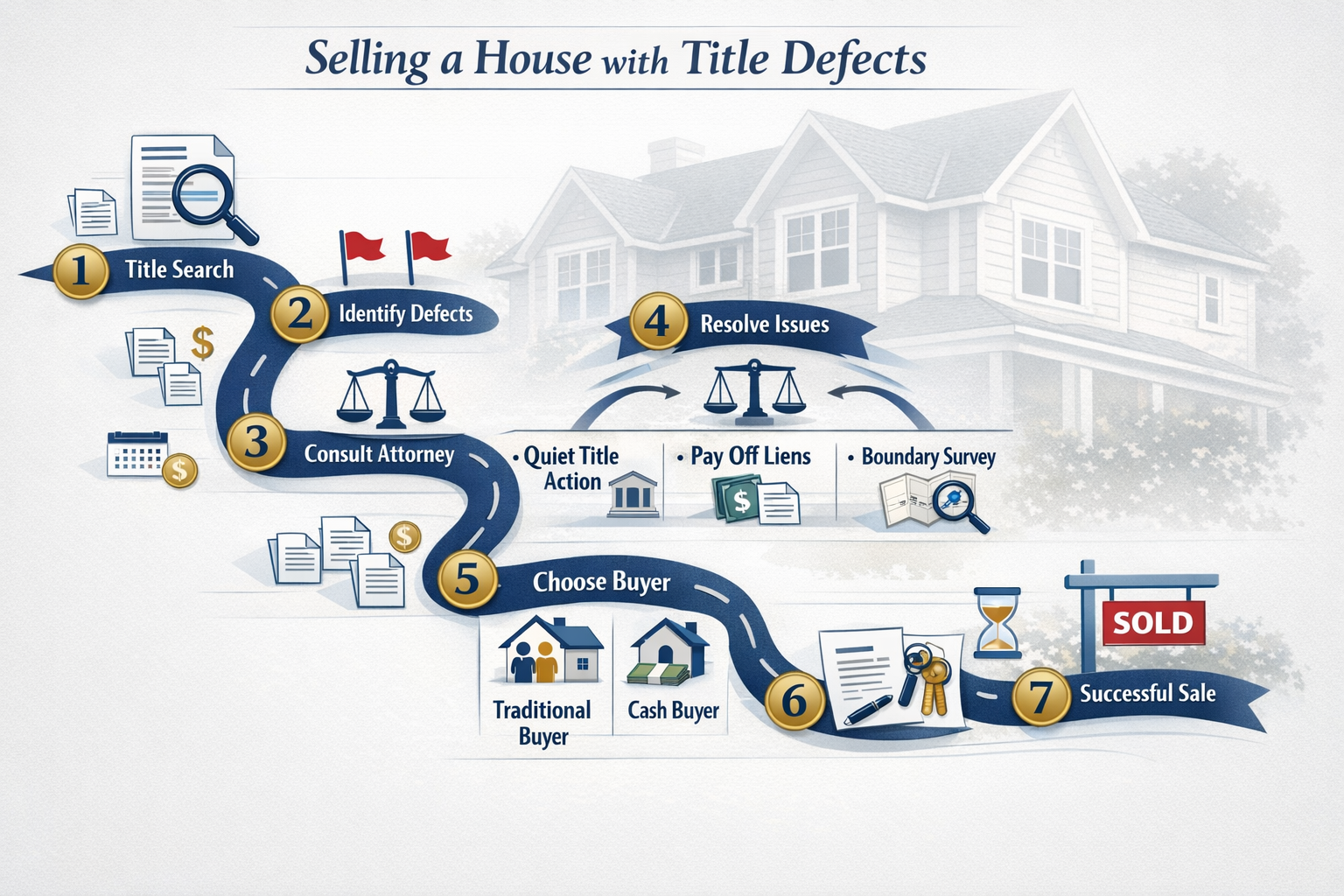
Discovering title defects on a property you want to sell can feel overwhelming, but understanding How to Sell House with Title Defects: Step-by-Step Guide empowers you to move forward with confidence. Whether you choose to resolve defects before listing, sell as-is to cash buyers, or pursue a hybrid approach, practical solutions exist for every situation.
Key Steps to Remember
📋 Conduct a thorough title search to identify all defects affecting your property
📝 Document and categorize each defect to understand resolution requirements
💡 Explore all resolution options from payoffs to quiet title actions
🎯 Choose the selling strategy that aligns with your timeline and financial goals
🤝 Work with experienced professionals who understand title defect complexities
✅ Disclose all known defects honestly and completely to potential buyers
🏁 Navigate closing carefully with proper coordination and documentation
Taking Action Today
The most important step is taking action. Title defects rarely resolve themselves and often become more complicated and expensive over time. Whether your property has a single lien or multiple complex issues, starting the process today opens the door to helpful solutions.
For property owners who want to avoid the complexity, expense, and uncertainty of traditional title defect resolution, working with professional buyers offers a practical alternative. Sure Path Property Solutions specializes in helping owners navigate complicated real estate situations with trustworthy service, expert guidance, and fair cash offers.
Your Next Steps
If you’re ready to sell a property with title defects:
- Gather your documentation: Collect any title reports, tax records, and property documents you have
- Contact professionals: Reach out to real estate attorneys, title companies, or professional buyers for evaluation
- Get multiple opinions: Consult with different professionals to understand all your options
- Make an informed decision: Choose the path that best serves your goals and circumstances
- Move forward with confidence: Take action knowing you have helpful solutions available
Remember that title defects, while challenging, don’t make your property unsellable. With the right approach, professional guidance, and realistic expectations, you can successfully sell your property and move forward to your next chapter.
The journey from discovering title defects to completing a successful sale may have twists and turns, but thousands of property owners navigate this path every year. With the information in this guide and support from industry experts who provide friendly and caring service, you have everything you need to achieve your real estate goals—even with complicated title issues.
Don’t let title defects keep you stuck. Explore your options, seek helpful guidance from professionals who understand your situation, and take the first step toward selling your property today. Whether you choose the traditional route or work with specialized buyers like Sure Path Property Solutions, a clear path forward exists for your unique situation.