
Sell Property in Probate: Process, Timeline & State Requirements
Inheriting property should feel like a blessing, not a burden. Yet when that inheritance comes wrapped in probate court proceedings, many families find themselves navigating a confusing maze of legal requirements, court deadlines, and state-specific regulations. Understanding how to sell property in probate: process, timeline & state requirements can transform what feels overwhelming into a manageable journey with a clear destination.
Whether you’ve recently lost a loved one or you’re an executor trying to settle an estate, selling probate property involves unique challenges that traditional real estate transactions don’t face. Court approval, creditor claims, multiple heirs, and state-specific laws all add layers of complexity to what might otherwise be a straightforward sale.
The good news? With the right knowledge and helpful guidance, you can successfully navigate the probate property sale process and move forward with confidence.
Key Takeaways
- Probate property sales require court approval in most states, adding 6-18 months to typical timelines depending on jurisdiction and estate complexity
- State requirements vary significantly—some states offer simplified procedures for smaller estates while others mandate full court supervision throughout the entire process
- Multiple pathways exist for selling probate property, including independent administration, supervised sales, and alternative procedures that can save time and money
- Professional guidance is essential when dealing with complications like multiple heirs, outstanding liens, or title issues that frequently accompany inherited properties
- Understanding your state’s specific requirements upfront prevents costly delays and helps executors fulfill their fiduciary duties properly
What Is Probate and Why Does It Affect Property Sales?
Probate is the legal process through which a deceased person’s estate gets settled under court supervision. The court validates the will (if one exists), appoints an executor or administrator, identifies and values assets, pays debts and taxes, and ultimately distributes remaining property to rightful heirs.
Real estate owned by the deceased typically cannot be sold without going through probate first. This protects creditors, ensures proper distribution to heirs, and provides legal oversight of the estate settlement process.
When Probate Is Required for Property Sales
Not every inherited property requires a full probate process. Several factors determine whether probate is necessary:
- How the property was titled (sole ownership, joint tenancy, tenancy in common)
- Total estate value compared to your state’s small estate threshold
- Existence of a valid will versus dying intestate (without a will)
- Outstanding debts and liens against the property
- Number of heirs and whether disputes exist
Properties held in joint tenancy with right of survivorship or in a living trust typically bypass probate entirely. However, properties owned solely by the deceased or as tenants in common generally require probate before sale.
The Executor’s Role in Selling Probate Property
The executor (also called personal representative or administrator) serves as the estate’s legal representative. This person carries significant responsibilities when selling probate property:
✅ Inventory and appraise all estate assets, including real property
✅ Maintain the property during probate to preserve its value
✅ Pay ongoing expenses like mortgages, taxes, insurance, and utilities
✅ Obtain court permission to sell (in most jurisdictions)
✅ Market the property and negotiate sale terms
✅ Distribute proceeds according to the will or state intestacy laws
Executors have a fiduciary duty to act in the estate’s best interest. This means obtaining fair market value for property and following all legal requirements throughout the sale process.
Understanding the Probate Property Sale Process
Selling property during probate follows a structured sequence of steps designed to protect all parties involved. While specific procedures vary by state, the general framework remains consistent across most jurisdictions.
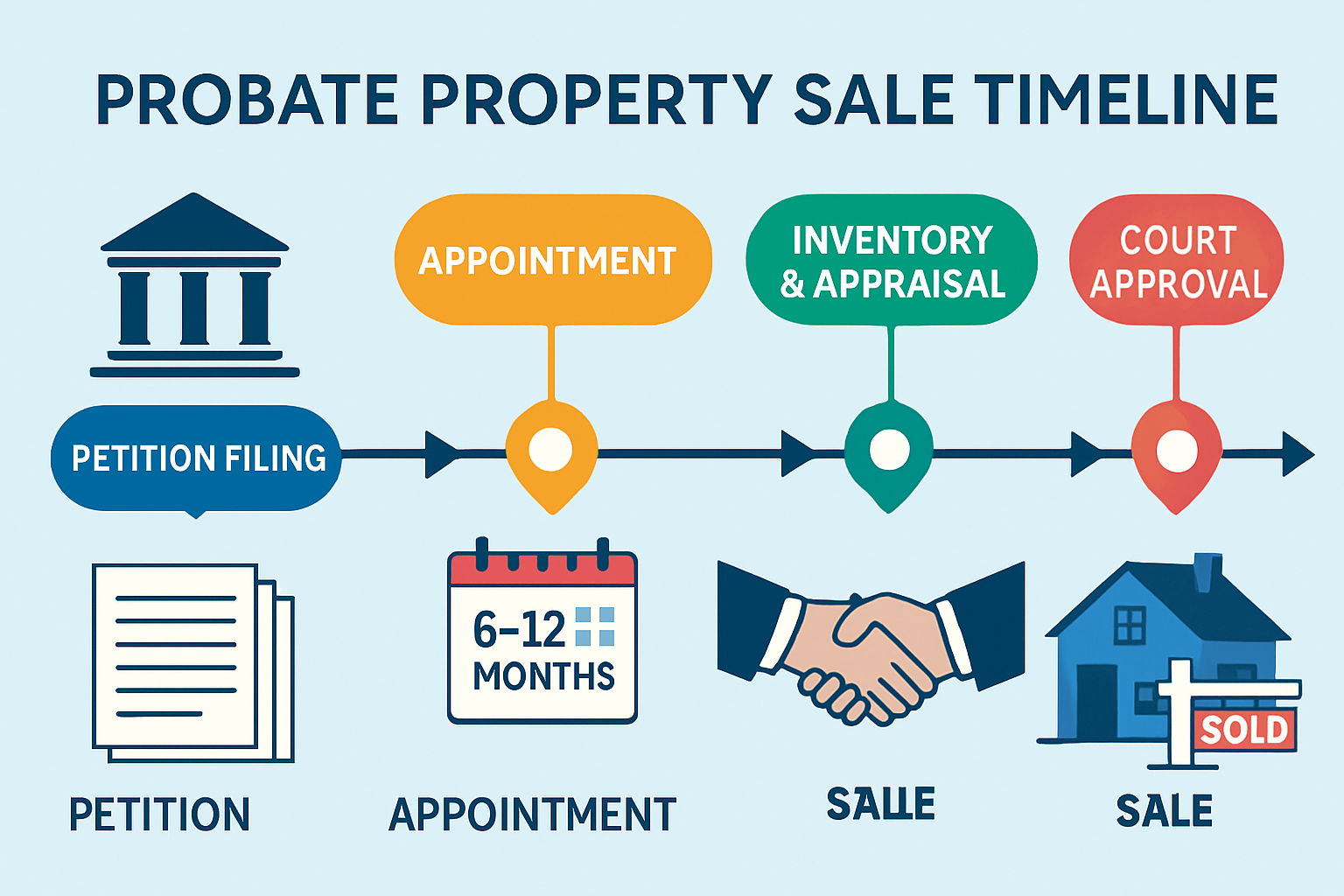
Step 1: Opening the Probate Estate
The process begins when someone files a petition with the probate court, typically in the county where the deceased resided. This petition asks the court to:
- Validate the will (if one exists)
- Appoint an executor or administrator
- Grant legal authority to manage estate assets
Timeline: Initial court hearings typically occur 2-6 weeks after filing, though this varies by jurisdiction and court schedules.
During this phase, the court issues Letters Testamentary (with a will) or Letters of Administration (without a will). These documents provide the legal authority needed to act on behalf of the estate.
Step 2: Inventory and Appraisal
Once appointed, the executor must identify, inventory, and value all estate assets. For real property, this involves:
- Professional appraisal to establish fair market value
- Title search to identify any liens, judgments, or encumbrances
- Property inspection to assess condition and needed repairs
- Documentation of all findings for court records
Many states require formal appraisals by licensed professionals. This protects heirs by ensuring property isn’t sold below market value and helps establish a baseline for estate tax purposes.
“A thorough title search during the inventory phase can reveal issues that might derail a sale later. Addressing title problems early saves time and prevents complications down the road.”
Step 3: Petition for Authority to Sell
In most states, executors must obtain specific court permission before selling real estate. This involves filing a petition that includes:
- Property description and appraised value
- Proposed sale terms and marketing plan
- Justification for the sale (paying debts, distribution to heirs, etc.)
- Notice to all interested parties (heirs, creditors, beneficiaries)
Timeline: Courts typically schedule hearings 30-60 days after filing, allowing time for interested parties to object.
Some states allow independent administration, where executors can sell property without court approval for each transaction. This significantly streamlines the process and reduces costs.
Step 4: Marketing and Accepting Offers
Once authorized to sell, the executor can list the property. Probate property sales can follow several paths:
Traditional listing works like any other real estate sale, with the property marketed through an agent and sold to the highest qualified buyer.
Probate auction may be required in some states or chosen voluntarily. Auctions can expedite sales but sometimes result in lower prices.
Direct sale to an investor or cash buyer offers speed and certainty, particularly valuable when the estate needs quick settlement or the property has condition issues.
When accepting offers, executors must consider:
- Price compared to appraisal (courts scrutinize below-market sales)
- Buyer qualifications and financing contingencies
- Closing timeline and estate needs
- Overbid procedures if required by state law
Step 5: Court Confirmation (If Required)
Many states require court confirmation of the sale before closing. This hearing allows:
- Interested parties to object to the sale terms
- Overbidding by other buyers (in some jurisdictions)
- Judicial review to ensure the sale serves the estate’s best interest
Overbid procedures can be particularly frustrating. In states like California, qualified buyers can overbid the accepted offer at the confirmation hearing, potentially requiring the executor to start over with a new buyer.
Timeline: Confirmation hearings typically occur 30-45 days after filing the sale petition.
Step 6: Closing and Distribution
After court approval (if required), the sale proceeds to closing just like a traditional transaction. However, probate sales have unique characteristics:
- Title is conveyed by executor’s deed or personal representative’s deed
- Proceeds go to the estate, not directly to heirs
- Creditor claims are paid before distribution to beneficiaries
- Court accounting documents all transactions
The executor must file a final accounting with the court showing all income, expenses, and distributions before the estate can be closed.
Timeline for Selling Property in Probate
One of the most common questions executors and heirs ask is: “How long will this take?”
Unfortunately, there’s no single answer. Probate timelines vary dramatically based on multiple factors.
Average Probate Duration by Complexity
| Estate Complexity | Typical Timeline | Key Factors |
|---|---|---|
| Simple, uncontested | 6-9 months | Single heir, no debts, cooperative parties |
| Moderate complexity | 9-18 months | Multiple heirs, some debts, standard assets |
| Complex or contested | 18-36+ months | Disputes, significant debts, business interests, litigation |
Factors That Extend Probate Timelines
Several circumstances can significantly lengthen the probate process:
🏛️ Court backlogs: Busy probate courts may schedule hearings months apart, adding delays beyond anyone’s control.
⚖️ Contested wills or disputes: Family disagreements about property distribution can add years to probate through litigation.
📋 Estate complexity: Multiple properties, business interests, or complicated assets require more time to inventory and value.
💰 Creditor claims: The creditor claim period (typically 3-6 months) must expire before final distribution, and disputed claims extend timelines further.
🏚️ Property condition: Homes needing significant repairs or cleanup before sale add months to the process.
📑 Title issues: Discovering clouded title or unknown liens requires resolution before sale, potentially adding substantial time.
👥 Multiple heirs: When jointly owned property involves multiple heirs with different goals, reaching consensus on sale terms can be challenging.
Strategies to Expedite the Process
While probate inherently takes time, executors can take steps to avoid unnecessary delays:
✅ File promptly after death—waiting months to start probate only extends the overall timeline
✅ Hire experienced professionals including probate attorneys and real estate agents familiar with estate sales
✅ Communicate proactively with all heirs to prevent misunderstandings and disputes
✅ Maintain the property to avoid condition deterioration that could complicate sales
✅ Address title issues immediately rather than discovering them during the sale process
✅ Consider cash buyers when appropriate to eliminate financing contingencies and appraisal delays
✅ Explore independent administration if your state allows it, bypassing multiple court approvals
Working with industry experts who understand probate complexities can provide helpful solutions that keep the process moving forward efficiently.
State-Specific Requirements for Probate Property Sales
Perhaps the most challenging aspect of selling property in probate is that requirements vary significantly from state to state. What’s mandatory in California may be unnecessary in Texas, and procedures that work in Florida won’t apply in New York.
Common Variations Across States
Court supervision levels range from minimal to extensive:
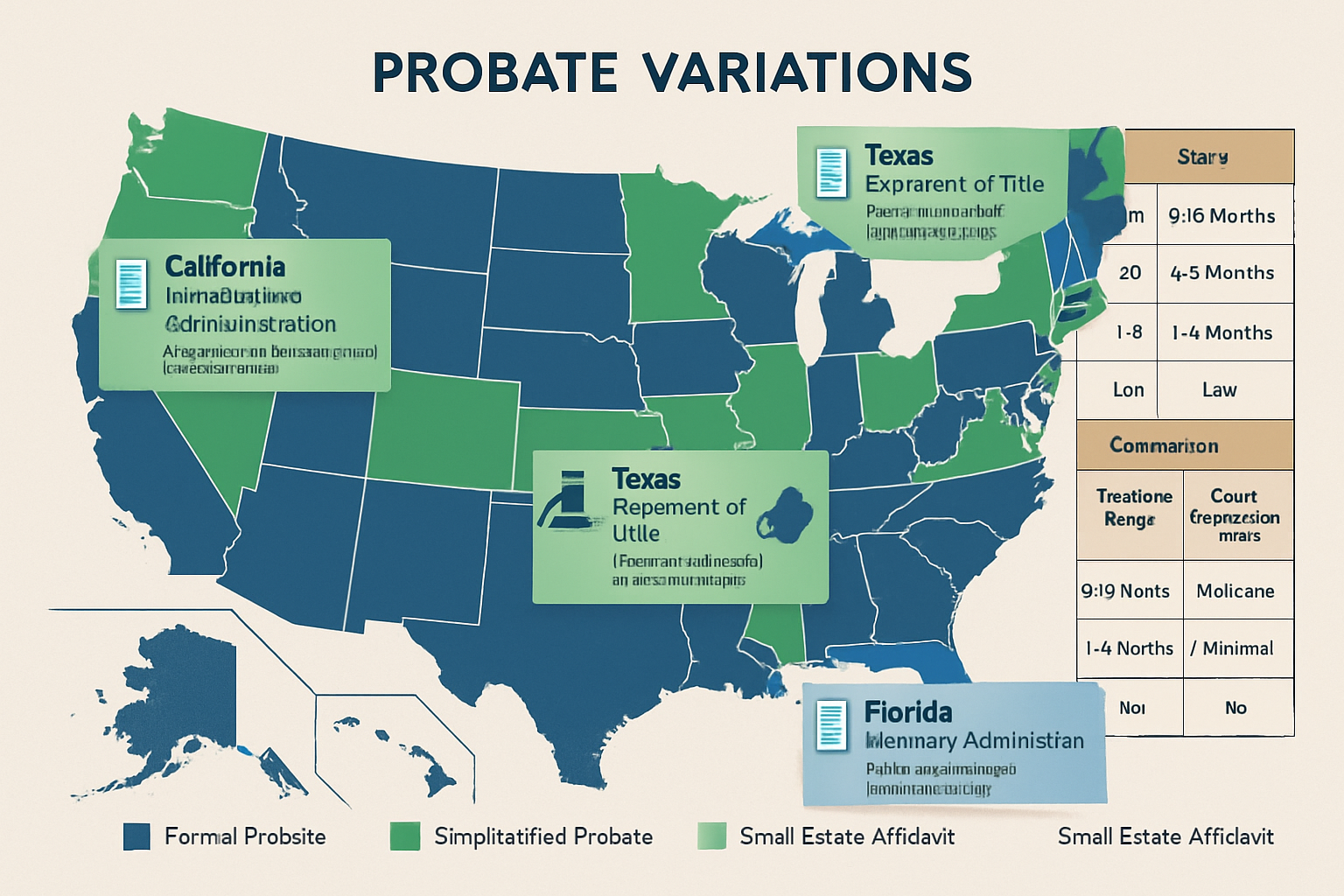
- Independent administration states (Texas, Wisconsin) allow executors to sell property without court approval for each transaction
- Supervised administration states (California, Illinois) require court confirmation of sales
- Hybrid states (Florida, Ohio) offer both options depending on circumstances
Small estate procedures provide shortcuts when estate value falls below state thresholds:
- Thresholds range from $25,000 to $275,000+ depending on state
- Simplified procedures may allow property transfer through affidavit rather than full probate
- Some states exclude real property from small estate procedures regardless of value
Notice requirements dictate who must be informed about probate proceedings:
- Publication in newspapers (required in most states)
- Direct notice to heirs and creditors
- Waiting periods before sales can proceed
Overbid rules in states like California allow others to outbid accepted offers at confirmation hearings, while most states don’t have this requirement.
Examples: How Different States Handle Probate Sales
California requires court confirmation for most probate sales. The process includes:
- Petition for authority to sell
- Notice to interested parties
- Confirmation hearing where overbidding can occur
- Minimum overbid increments (10% on first $10,000, 5% thereafter)
- Typical timeline: 4-6 months from listing to closing
Texas offers independent administration, allowing executors to sell without court approval:
- Executor has broad authority to manage estate assets
- No confirmation hearing required
- Court involvement limited to opening and closing estate
- Typical timeline: 2-4 months from listing to closing
Florida provides both formal and summary administration:
- Summary administration available for estates under $75,000 or when death occurred 2+ years ago
- Formal administration requires court supervision
- Property can often be sold without confirmation hearing
- Typical timeline: 3-5 months from listing to closing
New York requires court approval for sales but offers streamlined procedures:
- Voluntary administration for smaller estates
- Independent executors may sell without court approval if will specifically grants this power
- Otherwise, petition and hearing required
- Typical timeline: 4-7 months from listing to closing
Finding Your State’s Specific Requirements
To understand your state’s probate property sale requirements:
- Consult a local probate attorney who practices in your jurisdiction—this is the most reliable approach
- Review your state’s probate code (usually available online through state legislature websites)
- Contact the probate court clerk where the estate is filed for procedural guidance
- Research state-specific resources from bar associations and legal aid organizations
Don’t rely on general information or procedures from other states. The wrong approach can result in invalid sales, personal liability for executors, and expensive legal complications.
Common Challenges When Selling Probate Property
Even with perfect understanding of the process, executors frequently encounter obstacles that complicate probate property sales. Recognizing these challenges early allows for proactive solutions.
Multiple Heirs with Different Goals
Perhaps the most common complication involves multiple beneficiaries who disagree about whether to sell, when to sell, or for how much.
The challenge: One heir may want to keep the family home for sentimental reasons while others need their inheritance immediately. Some may want to maximize sale price through traditional listing while others prefer quick cash sales.
Helpful solutions:
- Open communication early in the process to understand each heir’s needs and concerns
- Professional mediation when disagreements arise, preventing costly litigation
- Buyout arrangements allowing one heir to purchase others’ interests
- Partition actions as a last resort when heirs cannot agree (though this adds significant time and expense)
Understanding options for inherited property helps heirs make informed decisions together.
Outstanding Liens and Judgments
Deceased owners often leave behind properties with liens that must be addressed before or during sale.
Common types include:
- Mortgage liens that must be paid at closing
- Tax liens from unpaid property or income taxes
- Judgment liens from lawsuits or unpaid debts
- Mechanic’s liens from unpaid contractor work
- HOA liens from unpaid association fees
The challenge: Some liens take priority over estate distributions, meaning they must be paid even if it reduces heirs’ inheritance. Others may be negotiable or dischargeable.
Helpful solutions:
- Title search immediately to identify all liens early
- Negotiation with lien holders for reduced payoffs
- Estate funds to clear liens before sale when possible
- Closing proceeds to satisfy liens at sale if estate lacks other funds
- Expert service from professionals experienced in selling property with liens
Property in Poor Condition
Inherited properties often suffer from deferred maintenance, especially if the deceased was elderly or ill before death. Some properties may be filled with personal belongings requiring extensive cleanup.
The challenge: Traditional buyers expect move-in ready homes. Properties needing significant work may not qualify for conventional financing, limiting the buyer pool and reducing offers.
Helpful solutions:
- Estate funds for essential repairs if available and cost-effective
- As-is sales to investors or cash buyers who specialize in renovation projects
- Price adjustments reflecting condition and needed repairs
- Professional estate cleanout services to remove personal property
- Disclosure of all known issues to avoid post-sale liability
Title Complications
Probate properties frequently have title issues that complicate sales:
- Missing heirs who cannot be located for consent
- Unclear ownership from incomplete prior transfers
- Boundary disputes with neighbors
- Easements or restrictions limiting property use
- Errors in public records requiring correction
The challenge: Title companies won’t insure sales until these issues are resolved, potentially derailing transactions.
Helpful solutions:
- Quiet title actions to resolve ownership disputes legally
- Probate proceedings themselves often clear some title issues
- Title insurance covering known defects (when available)
- Professional guidance from attorneys and title companies experienced with title issues
Creditor Claims Against the Estate
Creditors have limited time to file claims against estates (typically 3-6 months from notice). Valid claims must be paid before distributing assets to heirs.
The challenge: Property sale proceeds may be needed to pay creditor claims, and sales cannot close until the claims period expires or claims are resolved.
Helpful solutions:
- Early creditor notice to start the claims period immediately
- Claim evaluation to determine validity and negotiate settlements
- Reserve funds from sale proceeds to cover anticipated claims
- Court guidance on disputed or questionable claims
Market Timing and Property Carrying Costs
Properties in probate incur ongoing expenses while sitting unsold:
- Mortgage payments (if applicable)
- Property taxes
- Insurance
- Utilities
- Maintenance and repairs
- HOA fees
The challenge: These costs reduce estate value monthly, but rushing to sell may result in below-market prices.
Helpful solutions:
- Cost-benefit analysis comparing carrying costs to potential price improvements from waiting
- Seasonal timing when appropriate for the market
- Property rental during probate if allowed by court (generates income but adds complexity)
- Quick sale options when carrying costs exceed the benefit of waiting for top dollar
Alternatives to Traditional Probate Property Sales
While most people assume probate property must be sold through traditional real estate listings, several alternatives exist that may better serve certain situations.
Selling to Cash Buyers and Investors
Cash buyers and real estate investors offer distinct advantages for probate property sales:
✅ Speed: Transactions often close in 2-4 weeks versus 2-4 months for traditional sales
✅ Certainty: No financing contingencies that might fall through
✅ As-is purchases: No repairs or improvements needed
✅ Simplified process: Fewer inspections, appraisals, and contingencies
✅ Reduced carrying costs: Faster closing means fewer months of expenses
Considerations: Cash offers typically come in below retail market value, reflecting the convenience and certainty they provide. Executors must weigh whether the price reduction is offset by benefits like speed, reduced carrying costs, and transaction certainty.
For estates with properties in poor condition, multiple heirs needing quick distribution, or executors wanting to minimize involvement, cash sales often provide the best overall outcome even if the gross price is lower.
Selling Before Probate Closes
In some situations, property can be sold before probate formally closes:
Early sale with court approval allows proceeds to be held in estate accounts until final distribution. This works when:
- Estate needs liquidity to pay debts or taxes
- Property has high carrying costs
- Market conditions favor immediate sale
Muniment of title (available in Texas and some other states) allows property transfer based on the will without full probate administration when no debts exist.
Transfer on death deeds (where available) bypass probate entirely by automatically transferring property to named beneficiaries at death.
Keeping the Property vs. Selling
Not every inherited property must be sold. Heirs have options:
Distribute property to heirs who can then decide individually whether to keep or sell their interests
Rent the property to generate income for beneficiaries (though this adds management responsibilities)
One heir buys out others allowing family property to stay with someone who values it while providing liquidity to other heirs
The decision should consider:
- Tax implications of keeping versus selling
- Ongoing costs and management responsibilities
- Market conditions and property appreciation potential
- Heir relationships and ability to co-own property
- Estate liquidity needs for debts and taxes
Tax Implications of Selling Probate Property
Selling inherited property triggers several tax considerations that executors and heirs should understand.
Capital Gains Tax and Step-Up in Basis
The most important tax benefit for inherited property is the step-up in basis. When someone inherits property, the cost basis is “stepped up” to the fair market value on the date of death (or alternate valuation date).
Example:
- Original purchase price: $100,000
- Value at death: $300,000
- Sale price: $310,000
- Taxable gain: Only $10,000 (not $210,000)
This step-up in basis often eliminates or dramatically reduces capital gains tax on inherited property sales.
Timeline matters: Property sold shortly after death usually has minimal gains. Property held for years after inheritance may have substantial gains from the stepped-up basis.
Estate Tax Considerations
Federal estate tax only applies to estates exceeding $13.61 million (2025). Most estates fall well below this threshold and owe no federal estate tax.
However, some states impose estate or inheritance taxes at much lower thresholds:
- Estate taxes (paid by the estate) in states like Massachusetts ($2 million threshold)
- Inheritance taxes (paid by heirs) in states like Pennsylvania and New Jersey
Property sales may be necessary to generate liquidity for estate tax payments when applicable.
Income Tax on Estate Income
Estates are separate tax entities. Any income earned by estate property between death and distribution is taxable to the estate:
- Rental income from inherited property
- Interest and dividends from estate accounts
- Capital gains from property sales (using stepped-up basis)
Executors must file estate income tax returns (Form 1041) when estate income exceeds $600 annually.
Property Tax Considerations
Property taxes continue during probate. Executors must ensure timely payment to avoid:
- Tax liens that take priority over other debts
- Penalties and interest that reduce estate value
- Tax sales in extreme cases of non-payment
Some jurisdictions offer property tax relief for estates or inherited properties. Check local regulations for potential savings.
Professional Tax Guidance
Tax rules for inherited property are complex and vary by situation. Executors should:
✅ Consult tax professionals familiar with estate and inheritance taxation
✅ Document property values carefully at date of death for basis determination
✅ Consider timing of sales for optimal tax treatment
✅ Understand state-specific rules that may differ from federal treatment
✅ Coordinate with estate attorneys to ensure tax efficiency
Working with Professionals During Probate Sales
Successfully navigating probate property sales almost always requires a team of professionals with specialized expertise.
Probate Attorneys
A qualified probate attorney is essential for:
- Opening the estate and obtaining executor appointment
- Navigating court procedures specific to your jurisdiction
- Preparing required petitions for authority to sell
- Resolving disputes among heirs or with creditors
- Ensuring compliance with all legal requirements
- Protecting executors from personal liability
Cost: Probate attorneys typically charge hourly ($200-$500+) or a percentage of estate value (3-5% in some states). While this seems expensive, the cost of mistakes made without legal guidance is usually far higher.
Real Estate Agents Experienced in Probate
Not all real estate agents understand probate sales. Look for agents who:
- Have specific probate sale experience and training
- Understand court approval processes and timelines
- Can market properties in various conditions
- Have investor and cash buyer networks
- Communicate effectively with attorneys and courts
- Show patience with longer timelines and court procedures
Benefits: Experienced agents price properties appropriately, navigate unique probate requirements, and help executors fulfill fiduciary duties while maximizing property value.
Appraisers and Inspectors
Professional appraisals serve multiple purposes in probate:
- Establish date-of-death value for tax basis
- Support sale prices when court approval is required
- Document estate value for tax returns and court filings
- Protect executors from claims of undervaluing assets
Property inspections identify issues that affect value and help executors make informed decisions about repairs and pricing.
Title Companies and Escrow Officers
Title professionals experienced with probate sales understand:
- Executor’s deed requirements and proper documentation
- Probate court order review and compliance
- Lien resolution from estate assets
- Distribution procedures for sale proceeds
Choose title companies familiar with probate rather than assuming any company can handle these specialized transactions.
Tax Professionals
CPAs or enrolled agents with estate tax experience help with:
- Estate income tax returns (Form 1041)
- Final personal income tax returns for deceased
- Estate tax returns if required (Form 706)
- Tax planning for heirs receiving distributions
- Basis documentation for inherited property
Property Solutions Specialists
When probate properties have complications like liens, tax issues, or title problems, specialists who focus on complex property situations provide invaluable assistance.
Companies like Sure Path Property Solutions offer expert service for executors dealing with:
- Multiple heirs with conflicting goals
- Properties with back taxes or liens
- Title issues requiring resolution
- Properties in poor condition
- Time-sensitive estate settlements
This friendly and caring approach helps executors navigate complicated situations with trustworthy service and helpful guidance.
Executor Responsibilities and Fiduciary Duties
Serving as executor carries significant legal responsibilities. Understanding these duties helps executors avoid personal liability and fulfill their role properly.
Core Fiduciary Duties
Duty of loyalty: Act in the estate’s best interest, not personal interest. Executors cannot:
- Buy estate property for themselves (without court approval and full disclosure)
- Favor some heirs over others
- Use estate assets for personal benefit
- Have conflicts of interest in transactions
Duty of care: Manage estate assets prudently as a reasonable person would:
- Maintain property to preserve value
- Obtain fair market value in sales
- Invest estate funds conservatively
- Keep accurate records of all transactions
- Make informed decisions with professional guidance
Duty of impartiality: Treat all beneficiaries fairly according to the will or intestacy laws. This doesn’t always mean equally—the will may specify different distributions—but requires fairness in administration.
Duty to account: Provide detailed accounting of all estate income, expenses, and distributions. Most states require formal accounting filed with the court before estate closure.
Common Executor Mistakes to Avoid
❌ Selling property too quickly below market value without proper marketing
❌ Delaying unnecessarily and incurring excessive carrying costs
❌ Failing to maintain property leading to deterioration and reduced value
❌ Not obtaining proper court approval when required
❌ Poor communication with heirs creating disputes and litigation
❌ Mixing estate and personal funds in accounts
❌ Making distributions before paying all debts and taxes
❌ Inadequate documentation of decisions and transactions
Executor Liability and Protection
Executors can be held personally liable for:
- Losses from negligence or poor decision-making
- Unpaid taxes if distributions are made before tax obligations are satisfied
- Creditor claims if assets are distributed without proper notice and waiting periods
- Breach of fiduciary duty through self-dealing or favoritism
Protection strategies:
✅ Obtain court approval for major decisions when possible
✅ Document everything including communications, decisions, and rationale
✅ Hire qualified professionals and follow their guidance
✅ Communicate regularly with heirs to prevent misunderstandings
✅ Purchase executor’s bond if required (insurance protecting against executor errors)
✅ Seek court instruction when uncertain about proper procedures
When to Decline or Resign as Executor
Being named executor is an honor, but it’s also a burden. Consider declining or resigning if:
- You lack time for the significant responsibilities involved
- You have conflicts of interest with beneficiaries
- The estate is complex beyond your capabilities
- Family dynamics make impartial administration impossible
- You live far from the property requiring management
Courts can appoint successor executors when the named person declines or resigns. There’s no shame in recognizing when professional administration better serves the estate.
Frequently Asked Questions About Selling Probate Property
Can you sell a house in probate without all heirs’ consent?
It depends on your state and the executor’s authority. In most states, the executor has legal authority to sell estate property once appointed by the court, even if some heirs object. However:
- The will may require heir consent for property sales
- Some states require notice to heirs and opportunity to object
- Court approval processes allow heirs to voice concerns
- Executors must act in the estate’s best interest, not heir preferences
Practically speaking, sales proceed more smoothly with heir agreement. Executors should communicate openly and address concerns when possible, but ultimately must fulfill their fiduciary duty to the estate even if some heirs disagree.
How long do you have to sell a house after someone dies?
There’s no universal deadline. Probate timelines vary by state, typically ranging from 6 months to 2 years for estate settlement. However:
- Executors should sell within a reasonable timeframe to minimize carrying costs
- Courts may question unnecessary delays that reduce estate value
- Creditor claim periods (usually 3-6 months) must expire before final distribution
- Market conditions and property circumstances affect optimal timing
The key is balancing the need for fair market value against carrying costs and estate settlement goals. Executors should document their reasoning for sale timing to support their fiduciary duty.
Can probate property be sold as-is?
Yes, probate property can absolutely be sold as-is. This is often the best approach when:
- The estate lacks funds for repairs
- Property needs extensive work exceeding cost-effective improvements
- Quick sale is prioritized over maximum price
- Multiple heirs want expedited distribution
As-is sales typically attract investors and cash buyers rather than traditional owner-occupant buyers. While sale prices may be lower, the overall benefit to the estate often exceeds the cost of repairs and extended marketing time.
What happens if the property sells for less than the appraisal?
Courts scrutinize below-appraisal sales to ensure executors aren’t undervaluing estate assets. However, legitimate reasons exist for lower sale prices:
- Market conditions changed since appraisal
- Property condition deteriorated
- Appraisal was inaccurate or optimistic
- Quick sale was necessary for estate reasons
Executors should:
✅ Document marketing efforts and all offers received
✅ Obtain updated appraisal if significant time has passed
✅ Explain circumstances in court filings
✅ Show the sale serves the estate’s best interest
With proper documentation and justification, courts typically approve below-appraisal sales when executors acted reasonably and in good faith.
Do you pay capital gains tax on inherited property?
Usually very little or none thanks to the step-up in basis. Inherited property receives a new cost basis equal to fair market value at the date of death. Capital gains tax applies only to appreciation after inheritance.
Example:
- Value at death (new basis): $400,000
- Sale price six months later: $405,000
- Taxable gain: $5,000
If property is sold shortly after death, gains are typically minimal. Property held for years after inheritance may have substantial gains from the stepped-up basis, but these are still far less than gains calculated from the original owner’s purchase price.
Can you live in a house during probate?
Sometimes, but it’s complicated. Whether someone can live in probate property depends on:
- Relationship to deceased: Surviving spouses often have homestead rights allowing continued occupancy
- Will provisions: The will may grant specific people right to occupy property
- Executor permission: Executors may allow heirs to occupy property during probate
- Rent payments: Occupants may need to pay fair market rent to the estate
- State laws: Some states have specific rules about probate property occupancy
Executors must ensure occupancy doesn’t reduce property value or complicate eventual sale. Formal agreements documenting terms protect both the estate and occupants.
Moving Forward: Next Steps for Executors and Heirs
Selling property in probate involves complexity, but understanding the process, timeline, and state requirements transforms uncertainty into manageable steps. Whether you’re an executor navigating fiduciary responsibilities or an heir hoping to settle an estate efficiently, knowledge empowers better decisions.
Immediate Action Steps
If you’re facing a probate property sale, take these steps now:
1. Consult a probate attorney in your jurisdiction to understand specific state requirements and your legal obligations.
2. Secure and maintain the property to prevent deterioration, theft, or liability issues.
3. Order a title search to identify any liens, judgments, or title issues requiring resolution.
4. Obtain a professional appraisal to establish property value for tax and court purposes.
5. Communicate with all heirs about the process, timeline, and goals for the property.
6. Research your options for selling—traditional listing, cash sale, auction—based on property condition and estate needs.
7. Assemble your professional team including attorney, real estate agent, tax advisor, and any specialists needed for complications.
When to Seek Specialized Help
Some probate property situations benefit from specialized assistance beyond traditional professionals:
- Multiple heirs with disagreements about selling or terms
- Properties with significant liens or judgment issues
- Back taxes creating tax lien complications
- Title problems requiring resolution before sale
- Properties in poor condition that won’t qualify for traditional financing
- Time-sensitive situations requiring quick estate settlement
Companies specializing in complex property situations offer helpful solutions when standard approaches won’t work. Sure Path Property Solutions provides expert service for executors and heirs dealing with complicated probate property sales, offering trustworthy service and helpful guidance through challenging situations.
The Path Forward
Selling property in probate doesn’t have to be overwhelming. Yes, the process involves more steps than traditional real estate sales. Yes, timelines are longer and requirements more complex. But with proper guidance, clear understanding, and the right professional team, executors can successfully navigate probate property sales while fulfilling their fiduciary duties and serving heirs’ best interests.
The journey from inheritance to sale may feel daunting at first, but each step forward brings clarity and progress. Whether your path involves traditional listing, cash sale, or specialized solutions for complex situations, resources exist to help you move forward with confidence.
Remember: you don’t have to navigate this alone. Professional guidance from attorneys, real estate specialists, and industry experts who understand probate complexities can transform what feels impossible into achievable goals with clear, practical solutions.
Take the first step today. Reach out to qualified professionals, gather information about your specific situation, and begin the journey toward successful estate settlement. The property that once seemed like an overwhelming burden can become a properly managed asset that honors your loved one’s legacy while providing for their heirs’ future.
Conclusion
Understanding how to sell property in probate: process, timeline & state requirements empowers executors and heirs to navigate estate settlement with confidence rather than confusion. While probate property sales involve more complexity than traditional transactions, the core elements remain consistent: proper legal procedures, court oversight when required, professional guidance, and fiduciary responsibility to the estate.
The timeline for selling probate property typically ranges from 6-18 months, though this varies significantly based on state requirements, estate complexity, and property circumstances. States differ dramatically in their procedures—from independent administration allowing quick sales to supervised probate requiring court approval at each step. Knowing your state’s specific requirements prevents costly mistakes and unnecessary delays.
Common challenges like multiple heirs, outstanding liens, property condition issues, and title complications can complicate probate sales, but each has practical solutions when addressed proactively with professional help. The right team of attorneys, real estate professionals, and specialists transforms obstacles into manageable steps.
For executors and heirs facing complicated situations—properties with liens, multiple owners, title issues, or difficult condition—specialized assistance provides the helpful guidance needed to move forward. Whether you choose traditional listing, cash sale, or alternative approaches, the key is making informed decisions that serve the estate’s best interest while honoring your loved one’s legacy.
The probate property sale journey may feel overwhelming at first, but with knowledge, professional support, and practical solutions, you can successfully navigate the process and achieve positive outcomes for all involved.