
Selling House During Probate Process: State-by-State Guide
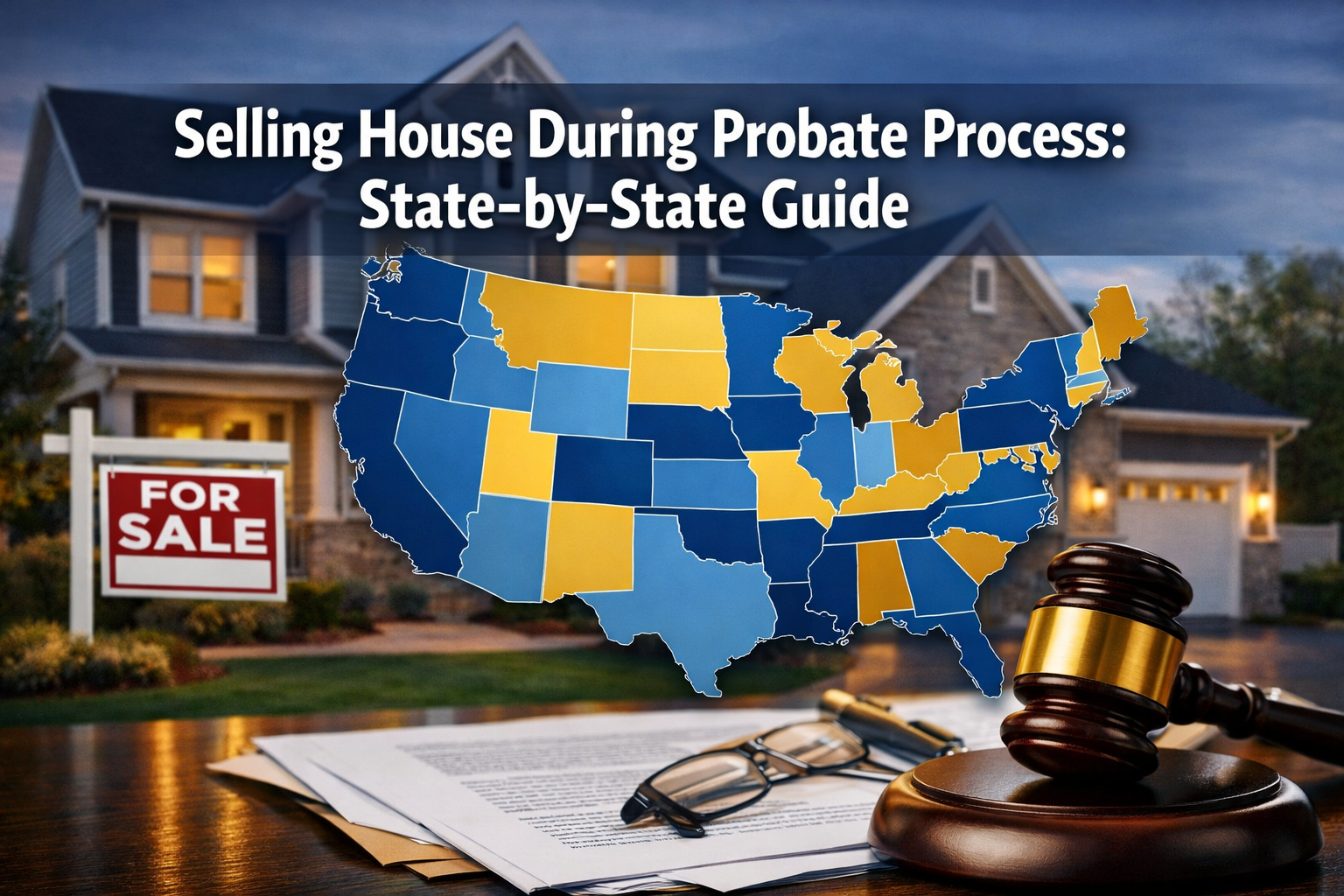
When a loved one passes away, dealing with their property can feel overwhelming—especially when you’re navigating the legal maze of probate court. Selling a house during probate isn’t like a typical real estate transaction. Each state has different rules, timelines, and requirements that can turn what should be a straightforward sale into a months-long journey through court filings, creditor notifications, and legal approvals.
Understanding your Selling House During Probate Process: State-by-State Guide becomes essential when you’re responsible for settling an estate. Whether you’re an executor in California facing a six-month timeline or a personal representative in Texas working with independent administration, knowing your state’s specific requirements can save you time, money, and considerable stress.
The good news? With the right guidance and expert service, you can navigate these complex situations successfully. This comprehensive guide breaks down the probate sale process across all 50 states, providing helpful solutions for every scenario you might encounter.
Key Takeaways
- Probate timelines vary dramatically by state, ranging from 4-6 months in streamlined states to 18-24 months in formal probate states
- Court approval requirements differ significantly—some states require court confirmation of sales while others allow independent administration
- Small estate procedures can bypass formal probate in many states, with thresholds ranging from $25,000 to $184,500
- Professional guidance from industry experts can help navigate complex title issues, multiple heirs, and creditor claims during probate sales
- Alternative sale options like cash buyers can expedite the process and eliminate repair requirements for estate properties
Understanding the Probate Process and Property Sales
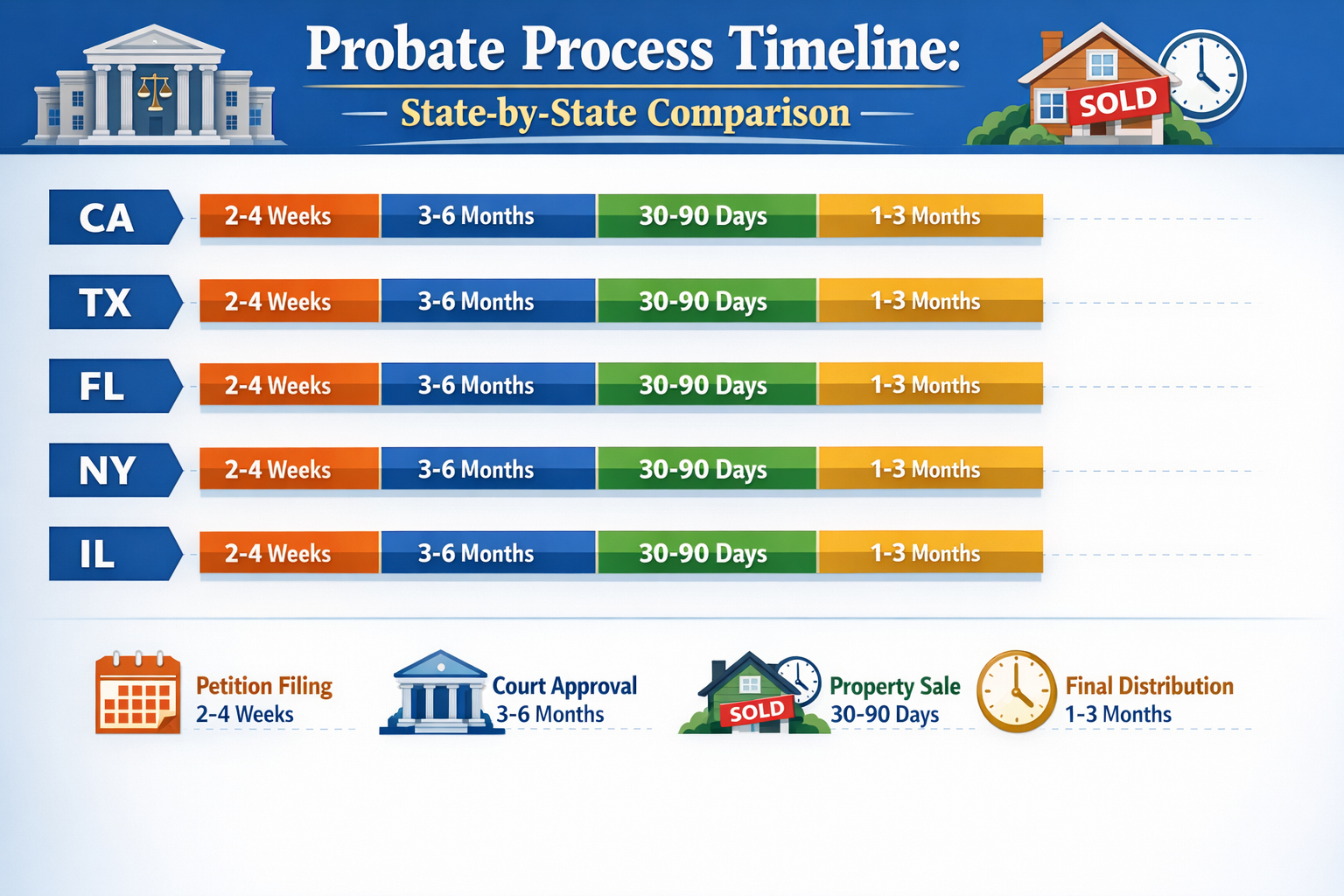
The probate process serves as the legal framework for transferring a deceased person’s assets to their rightful heirs. When real estate is involved, this process becomes more complex because property represents a significant asset that often requires court oversight.
What Is Probate and Why Does It Matter for Real Estate?
Probate is the court-supervised procedure for authenticating a will, appointing an executor or personal representative, paying debts and taxes, and distributing remaining assets to beneficiaries. When someone dies owning real property in their name alone, that property typically must go through probate before it can be sold or transferred.
Think of probate as a checkpoint system. The court ensures that:
- All creditors receive proper notification
- Outstanding debts and taxes get paid
- The property transfers to the rightful owners
- The executor follows legal requirements
For real estate specifically, probate matters because you cannot legally sell property that’s still titled in a deceased person’s name. The probate court must authorize the transfer of title to either the heirs or a buyer.
Types of Probate: Formal, Informal, and Small Estate Procedures
Not all probate processes are created equal. States offer different pathways depending on the estate’s value and complexity:
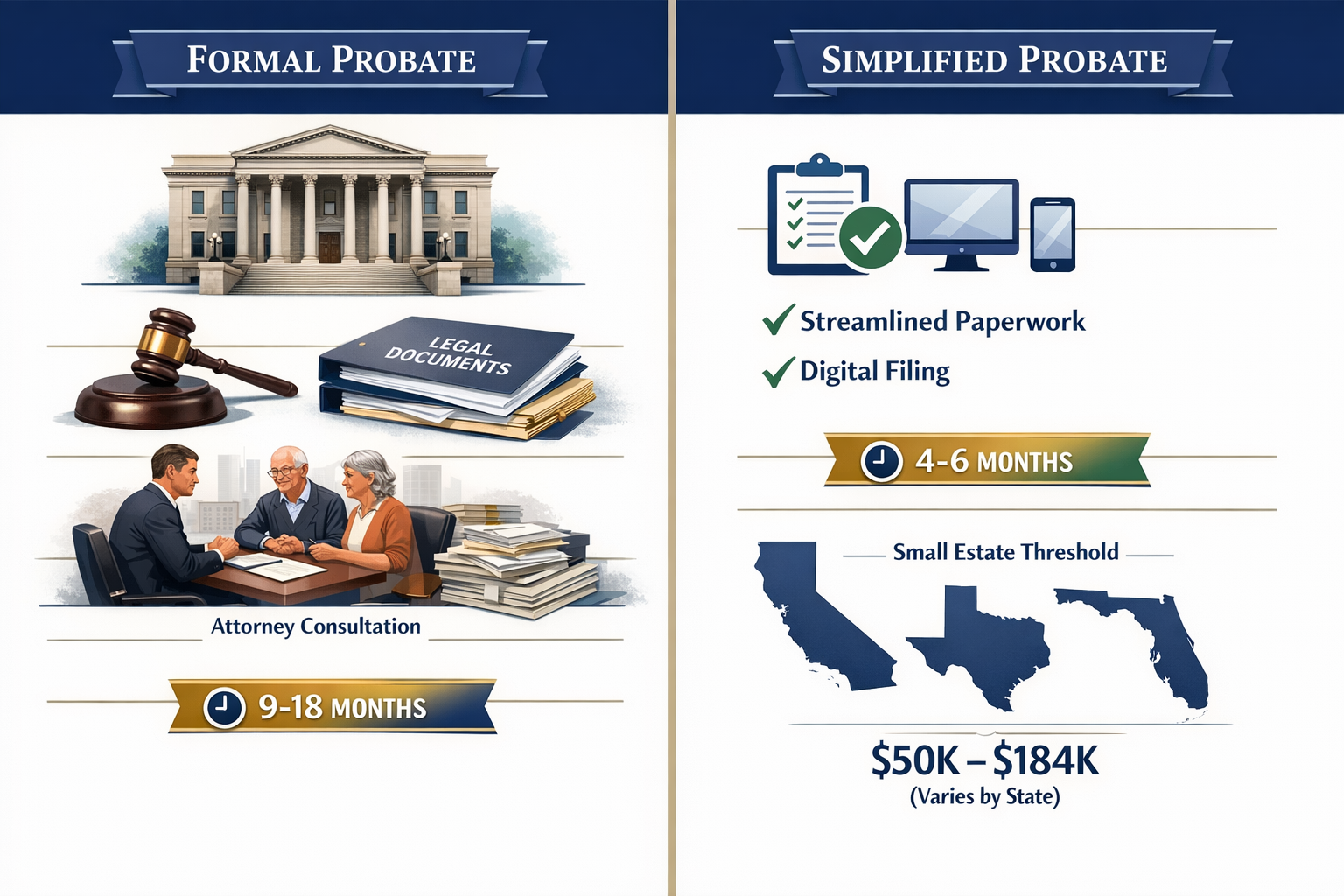
Formal Probate involves full court supervision with hearings, creditor notification periods, and judicial oversight of all transactions. This process typically takes 9-18 months and applies to larger estates or contested situations.
Informal Probate (also called unsupervised administration) allows the executor to handle most tasks without court approval for each action. The court still oversees the process but with less direct involvement. Timeline: 6-12 months.
Small Estate Procedures provide streamlined processes for estates below certain value thresholds. These can include:
- Affidavit procedures (no court involvement)
- Summary administration (simplified court process)
- Muniment of title (Texas-specific, will-based transfer)
The threshold for small estate procedures varies dramatically:
- California: $184,500
- Texas: $75,000
- Florida: $75,000
- New York: $50,000
- Illinois: $100,000
The Executor’s Role in Property Sales
The executor (also called personal representative or administrator) serves as the estate’s legal representative. Their responsibilities regarding property sales include:
📋 Key Duties:
- Securing and maintaining the property
- Obtaining property appraisals
- Paying property taxes, insurance, and maintenance costs
- Marketing the property for sale
- Negotiating offers
- Obtaining court approval (when required)
- Distributing sale proceeds according to law
Executors have a fiduciary duty to act in the estate’s best interest. This means getting fair market value for the property and managing it responsibly until sale.
“An executor who fails to maintain property insurance or lets the property fall into disrepair can be held personally liable for the decreased value.” – Estate Planning Attorneys Association
When selling property in probate, executors often work with real estate professionals who understand the unique challenges of estate sales, including coordinating with attorneys, title companies, and courts.
The Standard Probate Sale Process: Step-by-Step
While specific requirements vary by state, most probate property sales follow a similar general framework. Understanding these steps helps you anticipate what’s ahead.
Step 1: Opening the Estate and Appointing the Personal Representative
The probate process begins when someone files a petition with the probate court in the county where the deceased person lived. This petition requests:
- Validation of the will (if one exists)
- Appointment of an executor or administrator
- Issuance of “letters testamentary” or “letters of administration”
Timeline: 2-8 weeks depending on the state and whether anyone contests the will.
The court issues official documents giving the personal representative legal authority to act on behalf of the estate. Without these letters, you cannot legally sell the property.
Step 2: Inventorying and Appraising the Property
Once appointed, the executor must create a complete inventory of estate assets, including real property. For houses and land, this involves:
✅ Required Actions:
- Hiring a licensed appraiser or real estate professional
- Obtaining a fair market value assessment
- Filing the inventory with the court (deadline varies: 30-90 days)
- Notifying all interested parties of the property value
Some states require formal appraisals, while others accept broker price opinions (BPOs) or comparative market analyses (CMAs). The appraisal establishes the baseline value for the estate and helps determine if offers are reasonable.
Step 3: Obtaining Court Permission to Sell
This step varies significantly by state and type of probate administration:
States Requiring Court Approval:
- California (unless will grants independent administration)
- Illinois
- New York
- Many others for formal probate
States Allowing Independent Sales:
- Texas (with independent administration)
- Florida (with full authority)
- Many states with informal probate
When court approval is required, the executor files a petition to sell real property, including:
- Property description and appraised value
- Proposed sale terms
- Reason for the sale
- Notice to all heirs and beneficiaries
The court schedules a hearing, typically 4-6 weeks after filing. Interested parties can object during this period.
Step 4: Marketing and Accepting Offers
Once authorized to sell, the executor can list the property. Probate sales have unique characteristics:
Traditional Listing Approach:
- Hire a real estate agent experienced with probate sales
- List on MLS and marketing platforms
- Hold showings and open houses
- Review and negotiate offers
Direct Sale Options:
- Work with cash buyers who specialize in estate properties
- Skip repairs and sell as-is
- Faster closing timelines (often 7-14 days)
- Helpful solutions for properties with title issues or multiple heirs
Many executors choose selling estate property quickly through cash buyers to avoid the carrying costs of maintaining a property for months during a traditional sale.
Step 5: Court Confirmation Hearing (If Required)
In states requiring court confirmation, accepting an offer doesn’t finalize the sale. The process continues with:
Confirmation Hearing Steps:
- File the accepted offer with the court
- Publish notice of the proposed sale (newspaper requirement in some states)
- Attend the confirmation hearing
- Allow overbidding (in some states, others can bid at least 5-10% more)
- Obtain court order confirming the sale
Overbidding rules vary by state. California, for example, allows courtroom bidding where others can outbid the original offer by specific increments. This can be frustrating for both sellers and initial buyers.
Step 6: Closing the Sale and Distributing Proceeds
After court approval (or without it in independent administration states), the sale proceeds to closing:
🏠 Closing Process:
- Title company conducts title search
- Buyer secures financing (if applicable)
- Final walkthrough occurs
- Closing documents are signed
- Funds are transferred to estate account
The executor cannot immediately distribute proceeds to heirs. The money must:
- Pay estate debts and taxes
- Cover administration expenses
- Satisfy any liens or judgments
- Wait through the creditor claim period
- Finally distribute to beneficiaries per the will or state law
For properties with complications like back taxes or liens, working with industry experts who understand these issues provides helpful guidance through the resolution process.
Selling House During Probate Process: State-by-State Requirements
Probate laws vary dramatically across the United States. What works in Texas won’t work in California. Understanding your specific state’s requirements is crucial for a smooth sale process.
High-Level State Categories: What Makes States Different
States can be grouped into categories based on their probate approaches:
📊 Streamlined Probate States (4-8 months average):
- Texas (with independent administration)
- Colorado
- Wisconsin
- Arizona
⚖️ Moderate Oversight States (6-12 months average):
- Florida
- Illinois
- Ohio
- Pennsylvania
🏛️ Formal Probate States (12-24 months average):
- California (without independent administration)
- New York
- Massachusetts
- New Jersey
Key Differentiating Factors:
- Court supervision level
- Creditor claim periods (3-12 months)
- Court approval requirements for sales
- Small estate thresholds
- Attorney requirements
California Probate Real Estate Sales
California has one of the most complex probate systems, but it offers options for simplification.
Standard Timeline: 12-18 months
Small Estate Threshold: $184,500
Attorney Required: Yes, for formal probate
California-Specific Requirements:
The Independent Administration of Estates Act (IAEA) allows executors to sell property without court confirmation if the will grants this authority. This can save 2-4 months.
Without IAEA authority, California requires:
- Court petition to sell real property
- Publication in local newspaper (3 consecutive weeks)
- Confirmation hearing
- Potential overbidding (minimum 5% increase plus $500)
Overbidding Process: At the confirmation hearing, anyone can submit a higher bid. The minimum overbid starts at 10% of the first $10,000 plus 5% of the remaining amount. This creates uncertainty for both sellers and buyers.
Helpful Solutions: Many California executors work with cash buyers who can close quickly once court approval is obtained, minimizing the risk of deals falling apart during the extended timeline.
Texas Probate Property Sales
Texas offers one of the most executor-friendly probate systems in the nation.
Standard Timeline: 6-9 months (with independent administration)
Small Estate Threshold: $75,000
Attorney Required: Yes, initially
Texas-Specific Advantages:
Independent Administration is the default in Texas when the will names an executor. This allows the executor to:
- Sell property without court approval
- Avoid ongoing court supervision
- Complete the process much faster
- Reduce legal costs significantly
Muniment of Title: For estates with no debts (except secured by real estate), Texas offers this streamlined process that proves the will’s validity without full probate administration.
Community Property Considerations: Texas is a community property state, which affects how property ownership is determined and transferred.
For Texas property owners dealing with complex situations, selling houses fast in Texas through experienced buyers provides trustworthy service throughout the probate process.
Florida Probate Real Estate Requirements
Florida offers both formal and summary administration, depending on estate size and circumstances.
Standard Timeline: 8-12 months (formal), 4-6 months (summary)
Small Estate Threshold: $75,000
Attorney Required: Yes
Florida-Specific Processes:
Summary Administration is available when:
- Estate value is less than $75,000, OR
- The deceased has been dead for more than 2 years
Formal Administration requires:
- Personal representative appointment
- Creditor notification (3-month claim period)
- Inventory filing within 60 days
- Court approval for property sales (unless will grants authority)
Homestead Property: Florida’s homestead laws create special protections and restrictions. Homestead property may pass outside probate to surviving spouses or minor children, but restrictions apply to sales.
Florida executors often benefit from working with local cash buyers who understand Florida’s unique probate laws, especially when dealing with homestead issues or title complications.
New York Probate Sale Process
New York has a reputation for lengthy, formal probate proceedings.
Standard Timeline: 12-18 months
Small Estate Threshold: $50,000 (for simplified process)
Attorney Required: Strongly recommended
New York-Specific Requirements:
Surrogate’s Court handles all probate matters. Each of New York’s 62 counties has its own Surrogate’s Court with slightly different procedures.
Property Sale Process:
- Executor must petition for authority to sell
- Court issues citation to interested parties
- Hearing scheduled (typically 4-6 weeks out)
- Court order required before listing
- Sale proceeds held in estate account
SCPA 2307: This statute governs real property sales and requires specific language in petitions and orders.
Creditor Period: New York requires a 7-month creditor claim period, which extends the overall timeline.
Illinois Probate Property Requirements
Illinois offers both supervised and independent administration options.
Standard Timeline: 8-14 months
Small Estate Threshold: $100,000
Attorney Required: Yes
Illinois-Specific Processes:
Independent Administration allows executors to act without court approval for most actions, including property sales, if:
- The will authorizes it, OR
- All beneficiaries consent
Supervised Administration requires:
- Court approval for property sales
- Regular status reports
- Court approval for final distribution
Claims Period: Illinois requires a 6-month claims period, during which creditors can file claims against the estate.
Publication Requirement: Notice to creditors must be published in a local newspaper for three consecutive weeks.
Other Notable State Variations
Arizona: Offers informal probate with minimal court supervision. Timeline: 6-9 months. Small estate affidavit available for estates under $100,000.
Georgia: Allows year’s support for family members, which can affect property sales. Timeline: 6-12 months. Simplified procedures for estates under $10,000.
Michigan: Requires court approval for property sales in supervised estates. Timeline: 8-12 months. Small estate threshold: $25,000.
Ohio: Offers Release from Administration for small estates under $100,000. Standard timeline: 6-12 months.
Pennsylvania: Requires Register of Wills approval. Timeline: 8-12 months. Small estate threshold: $50,000.
Washington: No estate tax for most estates. Allows community property agreements. Timeline: 6-10 months.
Virginia: Offers small estate procedures for estates under $50,000. Standard timeline: 6-12 months.
Common Challenges When Selling a House During Probate
Even with a clear understanding of your state’s requirements, probate property sales present unique obstacles that can delay or complicate the process.
Multiple Heirs and Disagreements
When a property passes to multiple heirs, unanimous agreement on the sale becomes necessary in most situations. Common conflicts include:
❌ Typical Disagreements:
- One heir wants to keep the property while others want to sell
- Disputes over listing price
- Disagreement about repairs and improvements
- Conflicts about which real estate agent to hire
- Arguments over offer acceptance
Legal Solutions:
Partition Action: When heirs cannot agree, any co-owner can file a partition lawsuit forcing the sale. The court orders the property sold and divides proceeds among owners according to their ownership percentages.
Buyout Agreements: One heir can buy out the others’ interests, though this requires appraisal and financing.
Mediation: Many courts require mediation before allowing partition actions, which can lead to friendly and caring resolution of disputes.
For families dealing with inherited property with multiple owners, professional guidance from industry experts can facilitate agreements and expedite sales.
Property in Poor Condition or Needing Repairs
Estate properties often sit vacant for months, leading to deterioration. Executors face difficult decisions:
Repair Dilemmas:
- Should the estate invest in repairs to maximize sale price?
- Who pays for maintenance and utilities during probate?
- What happens if the estate lacks funds for repairs?
Traditional Sale Challenges:
- Conventional buyers often require repairs before closing
- FHA and VA loans have strict property condition requirements
- Lengthy repair timelines extend the already-long probate process
- Carrying costs accumulate (taxes, insurance, utilities)
As-Is Sale Solutions:
Many executors choose to sell estate houses without repairs through cash buyers who:
- Purchase properties in any condition
- Eliminate repair requirements
- Close quickly (often 7-14 days after court approval)
- Handle code violations and deferred maintenance
- Provide certainty in uncertain situations
This approach provides helpful solutions when the estate lacks funds or the executor wants to minimize time and complexity.
Outstanding Liens, Judgments, and Tax Issues
Properties often come with financial encumbrances that must be resolved before or during the sale:
Common Title Issues:
🔴 Property Tax Liens: Unpaid property taxes create liens that survive the owner’s death. These must be paid from estate funds or sale proceeds.
🔴 Mortgage Debt: The mortgage doesn’t disappear when the owner dies. The estate must continue payments or face foreclosure.
🔴 Judgment Liens: Court judgments against the deceased create liens on real property.
🔴 Mechanic’s Liens: Unpaid contractor bills can result in liens.
🔴 IRS Tax Liens: Federal tax debt creates liens on all property.
Resolution Strategies:
Most liens can be paid from sale proceeds at closing. The title company coordinates payoffs and ensures clean title transfer to the buyer.
For properties with tax liens or judgment liens, working with buyers who specialize in these situations provides expert service and streamlined resolution.
Priority of Liens: Understanding lien hierarchy helps determine which debts get paid first from limited sale proceeds.
Title Issues and Clouded Ownership
Probate properties sometimes have title defects that complicate sales:
Common Title Problems:
- Missing signatures on previous deeds
- Undisclosed heirs claiming ownership
- Errors in legal descriptions
- Unrecorded documents
- Breaks in the chain of title
Resolution Options:
Quiet Title Action: A lawsuit that asks the court to declare ownership and eliminate competing claims. Timeline: 6-12 months. Cost: $3,000-$10,000+.
Title Insurance Solutions: Enhanced title insurance policies can sometimes insure over certain defects.
Quitclaim Deeds: Getting signatures from all potential claimants can clear title issues.
Properties with clouded title or title defects can still be sold to specialized buyers who handle title resolution as part of the purchase process.
Time Constraints and Carrying Costs
Every month a property remains unsold during probate creates additional expenses:
Monthly Carrying Costs:
- Property taxes
- Homeowners insurance
- Utilities (water, electric, gas)
- HOA fees
- Lawn maintenance and property upkeep
- Security monitoring
Financial Impact Example:
For a $300,000 property, monthly carrying costs might include:
- Property taxes: $400
- Insurance: $150
- Utilities: $200
- Maintenance: $150
- Total: $900/month or $10,800/year
Over an 18-month probate process, that’s nearly $16,000 in carrying costs—money that could go to beneficiaries instead.
Time Pressure Scenarios:
- Estate lacks liquid assets to pay carrying costs
- Beneficiaries need distributions quickly
- Property is deteriorating
- Market conditions are declining
For executors facing time constraints, selling probate houses fast through cash buyers eliminates months of carrying costs and provides quick resolution.
Alternative Sale Options for Probate Properties
Traditional real estate listings aren’t the only path forward. Executors have several options, each with distinct advantages and disadvantages.
Traditional MLS Listing vs. Direct Cash Sale
Traditional MLS Listing:
✅ Advantages:
- Potentially higher sale price
- Maximum market exposure
- Competitive bidding possible
- Familiar process for most people
❌ Disadvantages:
- Longer timeline (60-90 days average, plus probate delays)
- Repair requirements from conventional buyers
- Financing contingencies (deals can fall through)
- Carrying costs during marketing period
- Commission fees (typically 5-6%)
Direct Cash Sale:
✅ Advantages:
- Fast closing (7-14 days after court approval)
- No repairs needed
- No financing contingencies
- Reduced carrying costs
- Certainty of closing
- Helpful guidance through probate process
❌ Disadvantages:
- Potentially lower gross price (but often higher net proceeds after costs)
- Less market exposure
- Requires finding reputable buyer
Net Proceeds Comparison:
Consider a property worth $250,000 needing $30,000 in repairs:
Traditional Sale:
- Sale price: $250,000
- Agent commission (6%): -$15,000
- Repairs: -$30,000
- Carrying costs (6 months): -$5,400
- Net proceeds: $199,600
Cash Sale As-Is:
- Sale price: $215,000
- Commission: $0
- Repairs: $0
- Carrying costs (1 month): -$900
- Net proceeds: $214,100
In this scenario, the cash sale actually nets more money despite the lower gross price.
Working with Investors and Cash Buyers
Not all cash buyers are created equal. When selecting a buyer for a probate property, look for:
🏆 Qualities of Reputable Cash Buyers:
- Experience with probate transactions
- Knowledge of state-specific requirements
- Ability to work with attorneys and title companies
- Transparent pricing and process
- References from previous estate sales
- Willingness to wait for court approval
- Understanding of title issues and lien resolution
Red Flags to Avoid:
- Pressure tactics or rushed decisions
- Unwillingness to provide proof of funds
- Lack of local knowledge
- No verifiable track record
- Unclear fee structures
Companies like Sure Path Property Solutions specialize in helping executors navigate complicated situations, offering expert service and friendly and caring support throughout the probate process.
Selling to Heirs or Family Members
Sometimes the best buyer is already in the family. Heir purchases involve one or more heirs buying out the others’ interests.
Process:
- Obtain professional appraisal
- Calculate each heir’s share
- Buyer heir secures financing
- Purchase agreement drafted
- Court approval obtained (if required)
- Closing and distribution to selling heirs
Advantages:
- Keeps property in the family
- Avoids marketing and showing property
- May reduce family conflicts
- Potentially faster process
Challenges:
- Financing can be difficult (estate sales have special requirements)
- Family dynamics can complicate negotiations
- Court scrutiny to ensure fair pricing
- Potential gift tax implications
Fair Market Value Requirement: Courts typically require sales to heirs at fair market value to protect all beneficiaries’ interests.
Short Sales and Foreclosure Situations
When estate properties have mortgages exceeding the property value, or when foreclosure looms, special options exist:
Short Sale During Probate:
A short sale occurs when the lender agrees to accept less than the full mortgage balance. This requires:
- Lender approval (lengthy process)
- Hardship documentation
- Court approval of the sale
- Coordination between executor, lender, and buyer
Timeline: 4-9 months (in addition to probate timeline)
Foreclosure Prevention:
If the deceased was in pre-foreclosure or foreclosure, the estate can:
- Continue making payments to stop foreclosure
- Sell quickly to pay off the mortgage
- Negotiate with the lender for a loan modification
- Allow foreclosure if the property has no equity
Understanding foreclosure timelines by state helps executors make informed decisions about whether to fight foreclosure or let it proceed.
Deed in Lieu: The estate might negotiate a deed in lieu of foreclosure, transferring the property to the lender and avoiding foreclosure.
Legal and Tax Considerations for Probate Property Sales
Selling during probate involves complex legal and tax issues that executors must understand to fulfill their fiduciary duties properly.
Capital Gains Tax and Step-Up in Basis
One significant benefit of inheriting property is the step-up in basis rule.
How It Works:
When someone inherits property, the tax basis “steps up” to the fair market value on the date of death (or alternate valuation date). This eliminates capital gains tax on appreciation that occurred during the deceased’s lifetime.
Example:
- Original purchase price (1990): $100,000
- Value at death (2026): $400,000
- Sale price (2026): $405,000
- Stepped-up basis: $400,000
- Taxable gain: $5,000 (not $305,000)
Tax Implications:
If the property sells for close to the date-of-death value, there’s typically little or no capital gains tax. If the property appreciates during probate, only the gain since the date of death is taxable.
Holding Period: Inherited property is automatically considered long-term for capital gains purposes, regardless of how long the estate or heirs hold it.
Estate Tax Implications
Federal Estate Tax applies only to estates exceeding $13.61 million (2024, adjusted annually). Most estates don’t owe federal estate tax.
State Estate Taxes exist in some states with much lower thresholds:
- Massachusetts: $2 million
- Oregon: $1 million
- Illinois: $4 million
- New York: $6.94 million
- Others: Connecticut, Hawaii, Maine, Maryland, Minnesota, Rhode Island, Vermont, Washington, District of Columbia
If the estate owes estate tax, it must be paid before distributing assets to heirs. Property sales often provide the liquidity needed to pay these taxes.
Executor Liability and Fiduciary Duties
Executors have significant legal responsibilities and can face personal liability for mistakes:
Fiduciary Duties:
- Duty of Loyalty: Act in the estate’s best interest, not personal interest
- Duty of Care: Manage estate assets prudently
- Duty of Impartiality: Treat all beneficiaries fairly
- Duty to Account: Keep detailed records and provide accountings
Common Liability Scenarios:
- Selling property below fair market value
- Self-dealing (buying the property themselves without disclosure)
- Failing to maintain property insurance
- Allowing property to deteriorate
- Distributing assets before paying creditors
- Missing tax filing deadlines
Protection Strategies:
- Obtain court approval for major decisions
- Get professional appraisals
- Document all decisions and communications
- Work with experienced attorneys and real estate professionals
- Purchase executor’s bond insurance
- Maintain detailed financial records
Working with Probate Attorneys and Real Estate Professionals
Most probate sales benefit from professional guidance:
Probate Attorney Role:
- Filing court petitions
- Navigating state-specific procedures
- Advising on executor duties
- Representing the estate in disputes
- Ensuring compliance with deadlines
- Preparing final accountings
Cost: $3,000-$15,000+ depending on estate complexity and state
Real Estate Professional Role:
- Pricing the property appropriately
- Marketing to qualified buyers
- Negotiating offers
- Coordinating with title companies
- Understanding probate sale requirements
- Managing transaction timeline
Specialized Buyers’ Role:
Companies specializing in probate properties offer:
- Knowledge of state-specific probate processes
- Ability to purchase properties with title issues
- Flexibility with timing around court approval
- As-is purchase eliminating repair negotiations
- Coordination with attorneys and courts
This trustworthy service approach provides helpful solutions for executors facing complex situations.
Tips for Expediting the Probate Sale Process
While probate timelines are largely dictated by state law, executors can take steps to minimize delays and complications.
Preparing the Property for Sale
Even if selling as-is, basic preparation helps:
Essential Tasks:
✅ Secure the property (change locks, install security system)
✅ Maintain utilities for showings and inspections
✅ Remove personal belongings (coordinate with family)
✅ Basic cleaning and decluttering
✅ Lawn maintenance and exterior upkeep
✅ Address safety hazards
✅ Document property condition with photos
Optional Improvements:
- Fresh paint in neutral colors
- Minor repairs (leaky faucets, broken fixtures)
- Professional cleaning
- Staging (for higher-end properties)
Cost-Benefit Analysis: Consider whether improvements will increase sale price enough to justify the cost and time. For many probate properties, selling as-is makes more financial sense.
Getting Accurate Property Valuations
Proper pricing is crucial for quick sales and fulfilling fiduciary duties:
Valuation Methods:
Professional Appraisal ($400-$600): Most accurate, often required by court, provides defensible value for estate purposes.
Broker Price Opinion ($100-$300): Real estate agent’s opinion based on comparable sales, useful for listing decisions.
Comparative Market Analysis (Free from agents): Analysis of similar recently sold properties, helpful for pricing strategy.
Automated Valuation Models (Free online): Websites like Zillow provide estimates, but these can be significantly inaccurate.
Best Practice: Obtain both a formal appraisal (for court purposes) and a BPO/CMA from a local agent familiar with probate sales.
Pricing Strategy: In probate sales, pricing at or slightly below market value often generates multiple offers quickly, reducing carrying costs and uncertainty.
Communicating with All Interested Parties
Clear, consistent communication prevents disputes and delays:
Communication Best Practices:
📧 Regular Updates: Send monthly updates to all beneficiaries about probate progress, property status, and timeline.
📧 Major Decision Notifications: Inform all parties before making significant decisions (listing price, offer acceptance, repair choices).
📧 Documentation: Keep written records of all communications and decisions.
📧 Transparency: Share appraisals, offers, and financial information openly.
📧 Professional Tone: Maintain respectful, businesslike communication even with difficult family members.
Managing Disagreements: When conflicts arise, consider:
- Family meetings (in-person or virtual)
- Mediation with neutral third party
- Attorney-facilitated discussions
- Clear explanation of legal requirements and executor duties
Understanding Your State’s Specific Timelines
Research your state’s requirements early to set realistic expectations:
Key Timeline Questions:
- What’s the creditor claim period in your state?
- Does your state require court approval for sales?
- What’s the typical time from petition to hearing?
- Are there publication requirements?
- What’s the average total probate duration?
Planning Backwards: If you know the total timeline, you can schedule tasks appropriately:
- Month 1-2: Open estate, get appointed
- Month 2-3: Inventory and appraise property
- Month 3-4: File petition to sell (if required)
- Month 4-5: List or market property
- Month 5-6: Accept offer, obtain court approval
- Month 6-7: Close sale
- Months 7-12: Pay debts, wait through claim period
- Month 12+: Final distribution
Expedited Options: Ask your attorney about:
- Small estate procedures
- Independent administration
- Informal probate
- Affidavit processes
These alternatives can reduce timelines by 50% or more in eligible cases.
Frequently Asked Questions About Selling Houses During Probate
Can You Sell a House During Probate Without Court Approval?
It depends on your state and type of probate administration.
Yes, in these situations:
- States with independent administration (Texas, Colorado, Arizona)
- When the will specifically grants the executor authority to sell without court approval
- Informal probate in some states
- Small estate procedures in certain states
No, court approval required when:
- Formal probate in most states
- The will doesn’t grant independent authority
- State law requires court confirmation
- Disputes exist among beneficiaries
Best Practice: Even when not legally required, some executors seek court approval for major sales to protect themselves from later challenges by beneficiaries.
How Long Does It Take to Sell a House in Probate?
Timeline breakdown:
Minimum (streamlined states, independent administration):
- 4-6 months total
- 1-2 months: Estate opening and appointment
- 1-2 months: Property preparation and marketing
- 1-2 months: Sale and closing
Average (most states, standard probate):
- 8-14 months total
- 2-3 months: Estate opening and appointment
- 1-2 months: Court approval to sell
- 2-3 months: Marketing and sale
- 3-6 months: Creditor period and final distribution
Maximum (complex estates, contested matters):
- 18-24+ months
- Multiple court hearings
- Litigation delays
- Title issues requiring resolution
Acceleration Factors:
- Working with cash buyers (eliminates financing delays)
- Selling as-is (eliminates repair negotiations)
- Independent administration
- Cooperative beneficiaries
- Experienced probate attorney
What Happens If the Property Has a Mortgage?
The mortgage doesn’t disappear when the owner dies. Several scenarios can occur:
Scenario 1: Estate Continues Payments
The executor uses estate funds to make monthly mortgage payments until the property sells. Sale proceeds pay off the remaining balance at closing.
Scenario 2: Heir Assumes the Mortgage
Under the Garn-St. Germain Act, certain family members can assume the mortgage without triggering the due-on-sale clause:
- Spouse inheriting the property
- Children inheriting from parents
- Other relatives inheriting and occupying the property
Scenario 3: Refinancing
An heir who wants to keep the property can refinance in their own name, paying off the original mortgage.
Scenario 4: Short Sale
If the mortgage exceeds the property value, the executor can negotiate a short sale with the lender’s approval.
Scenario 5: Foreclosure
If the estate cannot make payments and the property has no equity, allowing foreclosure might be the practical choice.
Important: Most mortgages have a due-on-sale clause, but federal law provides exceptions for inherited property. The lender cannot accelerate the loan simply because the borrower died.
Can Beneficiaries Force a Sale?
Generally, yes, but it depends on the circumstances:
When beneficiaries can force a sale:
- Multiple beneficiaries inherit as tenants in common
- One or more beneficiaries want to sell while others want to keep the property
- Through a partition action lawsuit
Partition Action Process:
- Beneficiary files lawsuit requesting partition
- Court determines ownership interests
- Court orders either:
- Partition in kind: Physical division of property (rare for houses)
- Partition by sale: Court-ordered sale with proceeds divided
Timeline: 6-12 months
Cost: $5,000-$15,000+ in legal fees
When beneficiaries cannot force immediate sale:
- During the probate process, the executor controls decisions (subject to court approval)
- If the will creates a trust with specific distribution instructions
- When one beneficiary has exclusive rights under the will
Preventing partition actions: Beneficiaries can avoid litigation through:
- Buyout agreements (one heir buys others’ shares)
- Negotiated sales (all agree to sell)
- Mediation to resolve disputes
For situations where siblings won’t agree on selling inherited property, understanding legal options helps move the process forward.
Do You Pay Taxes on a Probate Property Sale?
Multiple tax considerations apply:
Capital Gains Tax:
- Usually minimal due to step-up in basis
- Only appreciation after date of death is taxable
- Inherited property automatically qualifies for long-term capital gains rates
- Current long-term capital gains rates: 0%, 15%, or 20% depending on income
Estate Tax:
- Federal: Only estates exceeding $13.61 million (2024)
- State: Varies by state, with thresholds from $1-6.94 million
- Paid by the estate before distribution to heirs
Income Tax:
- The estate (not individual heirs) pays income tax on income earned during probate
- Rental income, interest, dividends are taxable to the estate
- Estate gets its own tax ID number (EIN)
- Estate files Form 1041
Property Tax:
- Continues to accrue during probate
- Executor must pay from estate funds
- Delinquent property taxes create liens on the property
Transfer Tax:
- Some localities charge transfer tax on property sales
- Typically 0.5-2% of sale price
- Usually paid at closing from sale proceeds
Tax Reporting:
- Executor files final income tax return for deceased (Form 1040)
- Estate files annual returns during probate (Form 1041)
- Beneficiaries report their share of estate income (Schedule K-1)
Professional Advice: Complex tax situations benefit from consultation with a CPA or tax attorney familiar with estate taxation.
Conclusion: Navigating Your Probate Property Sale Successfully
Selling a house during probate doesn’t have to be overwhelming. While the process involves more steps than a traditional sale, understanding your state’s specific requirements and working with experienced professionals makes the journey manageable.
Remember these key principles:
🏠 Every state is different – The Selling House During Probate Process: State-by-State Guide varies dramatically. What works in Texas won’t work in California. Research your specific state’s requirements or work with local industry experts who know the process.
🏠 Time is money – Every month a property sits in probate costs money in taxes, insurance, and maintenance. Expediting the sale through cash buyers or streamlined processes often nets more money for beneficiaries despite potentially lower gross sale prices.
🏠 You don’t have to do it alone – Probate sales involve legal, financial, and real estate complexities. Working with probate attorneys, real estate professionals, and specialized buyers provides helpful guidance through each step.
🏠 As-is sales are often the best solution – For properties needing repairs, with title issues, or in complicated situations, selling as-is to experienced buyers eliminates obstacles and accelerates the timeline.
🏠 Communication prevents conflicts – Keeping all beneficiaries informed, documenting decisions, and maintaining transparency reduces disputes and legal challenges.
Your Next Steps
If you’re facing the challenge of selling a house during probate, take these actions today:
1. Consult a Probate Attorney – Schedule a consultation with an attorney experienced in your state’s probate laws. They’ll guide you through the legal requirements and help you avoid costly mistakes.
2. Get the Property Appraised – Obtain a professional appraisal to establish fair market value. This protects you as executor and provides a baseline for pricing decisions.
3. Assess Your Options – Consider whether a traditional listing or direct sale better serves the estate’s interests. Factor in the property’s condition, timeline pressures, and carrying costs.
4. Explore Cash Sale Opportunities – If you need to sell a deceased parent’s house quickly, resolve tax liens, or handle properties with multiple heirs, reach out to companies that specialize in these situations.
5. Create a Timeline – Map out the expected probate duration in your state and plan backwards to set realistic expectations with beneficiaries.
6. Communicate with Beneficiaries – Hold a family meeting or send a detailed letter explaining the process, timeline, and your plan for the property.
How Sure Path Property Solutions Can Help
At Sure Path Property Solutions, we understand that selling a house during probate involves more than just real estate—it’s about resolving complex situations during an already difficult time. Our team provides:
✅ Expert knowledge of probate processes across multiple states
✅ Cash offers that eliminate financing contingencies and delays
✅ As-is purchases so you don’t have to invest in repairs
✅ Lien resolution services for properties with tax liens, judgments, or title issues
✅ Flexible timelines that work around court approval requirements
✅ Compassionate service that treats your family’s situation with respect and care
✅ Coordination with attorneys, title companies, and courts to streamline the process
We’ve helped hundreds of executors and families navigate complicated real estate situations, providing helpful solutions when traditional sales aren’t practical.
Ready to explore your options? Contact Sure Path Property Solutions today for a no-obligation consultation. We’ll review your specific situation, explain your options, and provide a fair cash offer if a direct sale makes sense for your circumstances.
The probate process may be complex, but with the right guidance and expert service, you can successfully sell the property and distribute proceeds to beneficiaries—providing closure and moving forward.