
Abstract of Title Problems: Common Issues & How to Resolve
Imagine standing at the closing table, ready to sell your property or finalize your purchase, only to discover that hidden issues in the property’s history have brought everything to a grinding halt. For thousands of property owners in 2026, Abstract of Title Problems: Common Issues & How to Resolve isn’t just a technical real estate term—it’s a real obstacle standing between them and their goals. Whether you’ve inherited property from a loved one, discovered liens you didn’t know existed, or encountered gaps in the ownership chain, understanding these problems and their solutions is essential for moving forward.
An abstract of title is essentially the property’s biography—a comprehensive summary of every recorded transaction, ownership transfer, lien, and legal action affecting the property throughout its entire history. When problems emerge in this document, they can delay or completely derail real estate transactions, leaving property owners frustrated and uncertain about their next steps.
The good news? Most abstract of title problems can be resolved with the right guidance and approach. At Sure Path Property Solutions, we’ve helped countless property owners navigate these complex situations, coordinating with counties, title professionals, and legal experts to find clear, practical solutions.
Key Takeaways
- Abstract of title problems are issues in a property’s ownership history that can prevent sales, refinancing, or transfers until resolved
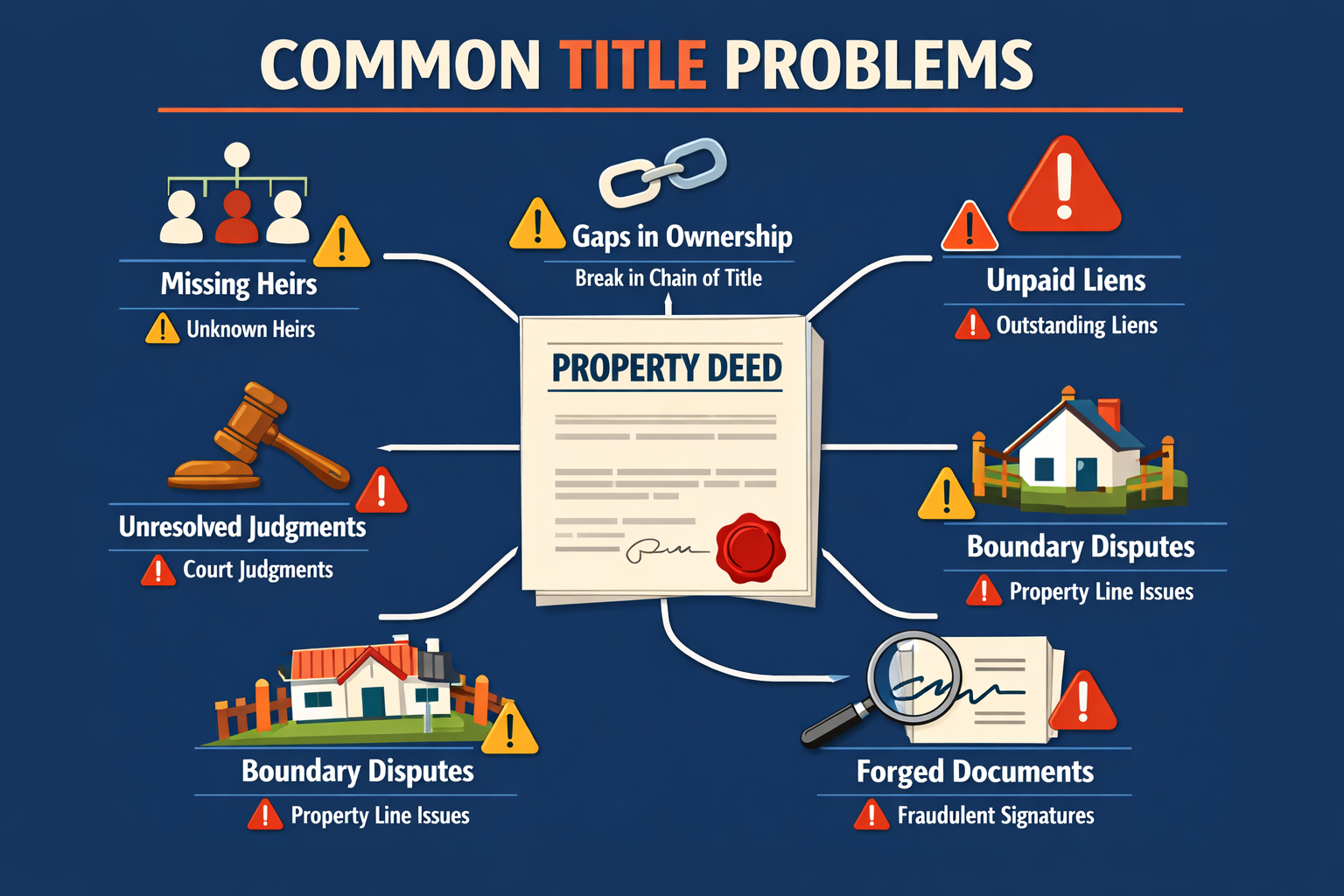
- Common problems include missing heirs, breaks in the chain of title, unpaid liens, unresolved judgments, boundary disputes, and clerical errors
- Resolution typically requires professional title research, legal documentation, lien satisfaction, or court action depending on the specific issue
- Timeline for resolution varies from days for simple clerical fixes to months for complex legal proceedings like quiet title actions
- Professional guidance from title companies, real estate attorneys, and experienced property solutions experts can save time, money, and frustration
What Is an Abstract of Title?
An abstract of title serves as the complete historical record of a property. Think of it as a detailed timeline that traces every significant event in the property’s legal life, from the original land grant or first recorded owner all the way to the present day.
Components of an Abstract of Title
A comprehensive abstract typically includes:
- Ownership transfers – Every deed, sale, gift, or inheritance that changed ownership
- Liens and encumbrances – Mortgages, tax liens, mechanic’s liens, and judgment liens
- Easements and restrictions – Rights others have to use the property or limitations on its use
- Legal proceedings – Lawsuits, foreclosures, probate cases, or bankruptcy filings
- Tax information – Property tax payment history and any delinquencies
- Survey information – Boundary descriptions and any disputes
Why the Abstract Matters
The abstract of title is crucial because it reveals who has legitimate ownership rights and what obligations or claims exist against the property. Before any real estate transaction can close, buyers, lenders, and title insurance companies need assurance that the seller has clear, marketable title to convey.
When problems appear in the abstract, they create what’s known as a “clouded title“—a situation where ownership isn’t completely clear or transferable.
Common Abstract of Title Problems
Understanding the most frequent issues that arise in property abstracts helps property owners recognize problems early and take appropriate action. Here are the issues our industry experts encounter most often:
🔗 Breaks in the Chain of Title
A break in the chain of title occurs when there’s a gap in the documented ownership history. This might happen when:
- A deed was never properly recorded
- An heir’s name doesn’t match exactly between documents
- A previous owner’s death wasn’t properly documented
- A divorce settlement transferred ownership but wasn’t recorded
- Corporate name changes weren’t reflected in property records
Example: Sarah inherited her grandmother’s house, but the abstract shows ownership passing from her great-grandfather directly to her mother, skipping her grandmother entirely. The missing deed from great-grandfather to grandmother creates a break in the chain.
👥 Missing or Unknown Heirs
When property passes through inheritance, especially over multiple generations, tracking down all legal heirs can become challenging. Problems arise when:
- Previous owners died without wills (intestate)
- Heirs moved away and lost contact with the family
- Birth, marriage, or death records are incomplete
- Adoptions or name changes complicate identification
- Multiple generations have passed without proper title transfers
This issue is particularly common with inherited property where several family members may have ownership interests they don’t even know about.
💰 Unpaid Liens and Judgments
Liens represent debts secured by the property and must typically be satisfied before title can transfer. Common types include:
| Lien Type | Description | Priority |
|---|---|---|
| Tax Liens | Unpaid federal, state, or local taxes | Highest priority |
| Mortgage Liens | Outstanding home loans | Based on recording date |
| Mechanic’s Liens | Unpaid contractor or supplier bills | Can supersede mortgages |
| Judgment Liens | Court-ordered debt attachments | Based on recording date |
| HOA Liens | Unpaid homeowners association fees | Varies by state |
If you’re dealing with liens, our comprehensive guide on how to sell a house with a lien provides detailed strategies for resolution.
⚖️ Unresolved Legal Proceedings
Active or improperly closed legal cases can cloud title:
- Foreclosure actions that weren’t completed or properly dismissed
- Bankruptcy cases where property disposition wasn’t finalized
- Divorce proceedings with unclear property division
- Probate cases still pending or improperly closed
- Lawsuits involving property disputes or claims
📏 Boundary and Survey Disputes
Property boundary issues create uncertainty about what exactly is being transferred:
- Conflicting survey descriptions in different deeds
- Encroachments where structures cross property lines
- Adverse possession claims by neighbors
- Easement disputes regarding access rights
- Discrepancies between legal descriptions and physical markers
✍️ Errors and Omissions
Simple mistakes in public records can create significant problems:
- Clerical errors – Misspelled names, wrong property descriptions, incorrect dates
- Filing mistakes – Documents recorded in wrong counties or under wrong parcel numbers
- Fraudulent documents – Forged signatures or fraudulent transfers
- Improper acknowledgments – Deeds lacking proper notarization or witnesses
🏛️ Governmental Actions
Government entities can create title complications through:
- Eminent domain proceedings
- Unpaid property taxes leading to tax liens or tax sales
- Code violations with attached fines
- Environmental liens for cleanup obligations
- Special assessments for infrastructure improvements
How Abstract of Title Problems Impact Property Owners
The consequences of title problems extend beyond mere inconvenience. Understanding these impacts helps property owners appreciate the urgency of resolution.
🚫 Inability to Sell or Transfer Property
The most immediate impact is that you cannot complete a traditional sale until title issues are resolved. Buyers and their lenders require clear, marketable title before closing. This creates particular challenges for property owners who:
- Need to sell quickly due to financial hardship
- Want to divide inherited property among multiple heirs
- Face foreclosure deadlines
- Have time-sensitive relocation needs
💸 Financial Consequences
Title problems can create significant financial burdens:
- Accumulating interest and penalties on unpaid liens
- Legal fees for resolution efforts
- Lost sale opportunities when buyers walk away
- Continuing property expenses (taxes, insurance, maintenance) while the property remains unsellable
- Declining property values in deteriorating markets
For those dealing with property tax issues, delays in resolution can compound the financial pressure.
😰 Stress and Uncertainty
Beyond dollars and cents, title problems create emotional strain:
- Anxiety about unresolved legal issues
- Family conflicts over inherited property
- Frustration with bureaucratic processes
- Uncertainty about rights and obligations
- Feeling overwhelmed by complex legal terminology
📉 Limited Refinancing Options
Even if you’re not planning to sell, title problems can prevent you from:
- Refinancing to lower interest rates
- Taking out home equity loans
- Qualifying for reverse mortgages
- Obtaining necessary property improvements financing
Abstract of Title Problems: Common Issues & How to Resolve Them
Resolving title problems requires a systematic approach tailored to the specific issue. Here’s how to address the most common problems with helpful solutions and expert service.
Step 1: Obtain a Complete Title Search
Before you can fix title problems, you need to understand exactly what you’re dealing with. A professional title search conducted by a title company or real estate attorney will:
- Review all recorded documents affecting the property
- Identify gaps, errors, or problematic entries
- Create a comprehensive chain of title
- Highlight specific issues requiring resolution
- Provide a preliminary title report
Cost: Title searches typically range from $200-$500 depending on property complexity and location.
Timeline: Most title searches are completed within 5-10 business days.
Step 2: Categorize and Prioritize Issues
Once you have the title report, work with your title professional to categorize problems:
Quick Fixes (Days to Weeks):
- Clerical errors requiring corrective affidavits
- Paid liens needing formal release documents
- Name discrepancies resolved with supporting documentation
Moderate Complexity (Weeks to Months):
- Negotiating lien payoffs or settlements
- Obtaining releases from known parties
- Recording missing documents from cooperative parties
Complex Resolutions (Months to Year+):
- Quiet title actions for unknown heirs or adverse claims
- Boundary disputes requiring surveys and negotiations
- Fraudulent conveyance challenges
Resolving Specific Title Problems
🔧 Fixing Breaks in the Chain of Title
Solution Approach:
- Identify the missing link – Determine exactly where the gap occurs
- Locate missing documents – Check with family members, attorneys, or old title companies
- Create corrective documents – Prepare quitclaim deeds or affidavits from appropriate parties
- Record properly – Ensure all corrective documents are filed in the correct county
When cooperation isn’t possible: A quiet title action may be necessary to legally establish ownership through court proceedings.
👨👩👧👦 Addressing Missing or Unknown Heirs
Solution Approach:
- Conduct heir research – Hire genealogists or heir search firms if necessary
- Publish legal notices – Required in most jurisdictions to notify unknown heirs
- Obtain releases – Get quitclaim deeds from identified heirs
- Consider probate – May need to open or reopen estate proceedings
- Pursue quiet title – For truly unknown or unlocatable heirs
Helpful guidance: When dealing with multiple heirs on one property, clear communication and fair treatment of all parties leads to smoother resolution.
💵 Satisfying Liens and Judgments
Solution Approach:
For Known, Legitimate Liens:
- Verify the amount – Get current payoff statements including interest and fees
- Negotiate if possible – Some lienholders will accept reduced settlements
- Pay or arrange payment – Direct payment or through escrow at closing
- Obtain releases – Ensure lien releases are properly recorded
For Questionable or Expired Liens:
- Check statute of limitations – Some liens expire after specific periods
- Verify validity – Confirm the lien was properly filed and maintained
- Challenge if appropriate – File motions to release invalid liens
- Obtain title insurance coverage – Sometimes insurers will cover old, questionable liens
Our detailed guide on satisfying judgment liens provides step-by-step instructions for this process.
📐 Resolving Boundary Disputes
Solution Approach:
- Obtain professional survey – Hire licensed surveyor to establish actual boundaries
- Review all relevant documents – Compare survey with deed descriptions and prior surveys
- Negotiate with neighbors – Many boundary issues resolve through friendly discussion
- Record boundary agreements – Formalize resolutions in recorded documents
- Pursue legal action if necessary – Quiet title or partition actions for serious disputes
✏️ Correcting Errors and Omissions
Solution Approach:
For Simple Clerical Errors:
- Scrivener’s affidavit – Sworn statement correcting obvious mistakes
- Corrective deed – New deed with proper information
- Court order – For errors requiring judicial correction
For Fraudulent Documents:
- Report to authorities – File police reports for suspected fraud
- Quiet title action – Court proceeding to remove fraudulent claims
- Title insurance claim – If you have owner’s title insurance
🏛️ Addressing Government Liens and Actions
Solution Approach:
For Tax Liens:
- Verify amounts owed – Contact taxing authorities directly
- Explore payment plans – Many jurisdictions offer installment agreements
- Request penalty abatement – Sometimes penalties can be reduced or waived
- Pay and obtain releases – Ensure releases are properly recorded
Learn more about selling houses with tax liens for comprehensive strategies.
For Code Violations:
- Determine compliance requirements – Understand what must be corrected
- Make necessary repairs – Bring property into compliance
- Obtain clearance – Get official documentation that violations are resolved
- Negotiate fines – Request reductions for good-faith compliance efforts
Legal Remedies for Abstract of Title Problems
When cooperative solutions aren’t possible, legal proceedings may be necessary. Understanding these options helps property owners make informed decisions.
Quiet Title Actions
A quiet title action is a lawsuit filed to establish clear ownership and “quiet” competing claims. This remedy is appropriate when:
- Unknown heirs may exist
- Old liens of questionable validity appear in the chain
- Adverse possession claims need resolution
- Gaps in the chain of title can’t be filled cooperatively
Process:
- File complaint in appropriate court
- Conduct title search and identify all potential claimants
- Serve known parties and publish notice for unknown parties
- Present evidence of ownership rights
- Obtain court judgment establishing clear title
Timeline: 4-12 months typically, depending on jurisdiction and complexity
Cost: $2,000-$5,000+ in attorney fees, plus court costs and publication fees
Partition Actions
When multiple owners can’t agree on property disposition, partition actions force a solution through:
- Partition in kind – Physical division of the property
- Partition by sale – Court-ordered sale with proceeds divided among owners
This remedy is common when siblings won’t agree on selling inherited property.
Declaratory Judgment Actions
These lawsuits ask the court to declare the rights and obligations of parties regarding property, useful for:
- Interpreting ambiguous deed language
- Determining easement rights
- Clarifying ownership percentages
- Resolving conflicting claims
Lis Pendens
When filing property-related litigation, recording a lis pendens (notice of pending action) provides public notice that the property is subject to legal proceedings, protecting your claim during the lawsuit.
Working with Title Professionals
Successfully resolving abstract of title problems typically requires a team of professionals providing expert service and trustworthy guidance.
Title Companies
Title companies provide essential services:
- Title searches and examinations – Identifying all issues affecting the property
- Title insurance – Protecting against undiscovered defects
- Escrow services – Holding funds and documents until closing conditions are met
- Title clearance assistance – Coordinating resolution of identified problems
When to engage: At the beginning of any sale process or when you suspect title issues
Real Estate Attorneys
Attorneys specializing in real estate provide:
- Legal interpretation of complex title issues
- Preparation of corrective documents
- Representation in quiet title and other legal proceedings
- Negotiation with lienholders and other claimants
- Court appearances and litigation
When to engage: For complex issues, legal proceedings, or when significant money is at stake
Surveyors
Licensed surveyors provide:
- Accurate boundary determinations
- Resolution of conflicting property descriptions
- Identification of encroachments
- Documentation for boundary agreements
When to engage: Whenever boundary questions arise or surveys conflict
Genealogists and Heir Search Firms
These specialists help:
- Locate missing heirs
- Establish family relationships
- Provide documentation for probate proceedings
- Research historical ownership
When to engage: When heirs are unknown or unlocatable
Property Solutions Companies
Companies like Sure Path Property Solutions offer comprehensive assistance by:
- Coordinating with all necessary professionals
- Providing helpful solutions for complex situations
- Working directly with counties and title companies
- Offering alternative sale options when traditional sales aren’t feasible
- Guiding property owners through each step with friendly and caring support
When to engage: When you need comprehensive assistance navigating complicated situations involving liens, judgments, multiple heirs, or unclear title
Preventing Abstract of Title Problems
While some title issues are unavoidable, property owners can take proactive steps to minimize future problems.
✅ Proper Estate Planning
Create comprehensive estate documents:
- Updated wills specifying property disposition
- Living trusts to avoid probate
- Transfer-on-death deeds where available
- Clear beneficiary designations
Ensure proper execution:
- Proper witnessing and notarization
- Recording when required
- Regular updates as circumstances change
Learn more about selling trust property for guidance on trust-based ownership.
✅ Maintain Accurate Records
Keep organized files containing:
- Original deeds and title documents
- Mortgage satisfaction documents
- Property tax payment records
- Survey and appraisal documents
- Home improvement receipts (for mechanic’s lien protection)
- Insurance policies
Create digital backups of all important documents to prevent loss.
✅ Address Issues Promptly
Don’t delay when problems arise:
- Pay property taxes on time
- Resolve contractor disputes before they become liens
- Handle divorce property transfers immediately
- Probate estates promptly after death
- Record all ownership changes
Early intervention prevents small problems from becoming major obstacles.
✅ Purchase Owner’s Title Insurance
While lender’s title insurance protects the mortgage company, owner’s title insurance protects you against:
- Undiscovered liens and encumbrances
- Forged documents
- Errors in public records
- Unknown heirs appearing later
- Survey errors
One-time premium at purchase provides protection for as long as you own the property.
Learn about title insurance claims to understand how this protection works.
✅ Conduct Title Searches Before Purchase
Due diligence before buying includes:
- Comprehensive title examination
- Review of all exceptions and exclusions
- Investigation of any concerns before closing
- Requiring sellers to clear title defects
Never waive title contingencies without understanding the risks.
Alternative Solutions When Traditional Sales Aren’t Possible
Sometimes resolving title problems before a traditional sale isn’t practical due to time constraints, financial limitations, or complexity. In these situations, alternative approaches may provide helpful solutions.
Selling to Cash Buyers or Investors
Some buyers specialize in purchasing properties with title issues:
Advantages:
- ✅ Faster closing timelines
- ✅ Buyer may handle title resolution
- ✅ Fewer contingencies
- ✅ No financing complications
Considerations:
- ⚠️ Lower purchase prices to account for resolution costs and risk
- ⚠️ Need to verify buyer’s legitimacy and capability
- ⚠️ Understanding what title issues the buyer will accept
At Sure Path Property Solutions, we help property owners evaluate whether this approach makes sense for their specific situation, providing transparent information about all options.
Seller Financing
In some cases, seller financing arrangements can work around certain title issues:
- Buyer makes payments directly to seller
- Title transfers after specific conditions are met
- Allows time for gradual title problem resolution
Important: Requires careful legal documentation and isn’t appropriate for all situations.
Negotiated Settlements
When multiple parties have claims or interests:
- Buyouts – One party purchases others’ interests
- Agreements – Parties agree to specific property disposition
- Compromises – Creative solutions addressing everyone’s concerns
Our guide on tenants in common buyouts explains this process in detail.
Real-World Examples: Abstract of Title Problems Resolved
Understanding how others have successfully navigated these challenges provides both hope and practical insights.
📖 Case Study 1: The Inherited Property with Missing Heirs
Situation: Maria inherited her uncle’s property, but the title search revealed that her uncle had inherited it from his father without proper probate. Additionally, her uncle had two siblings who had passed away, potentially leaving heirs with ownership interests.
Challenges:
- No probate had been conducted for grandfather’s estate
- Two potential branches of unknown heirs
- Property taxes were becoming delinquent
- Maria needed to sell to avoid foreclosure
Resolution:
- Hired heir search firm to locate all potential heirs
- Found and contacted five cousins who had potential interests
- Negotiated quitclaim deeds from all identified heirs for nominal payments
- Filed quiet title action to address any unknown heirs
- Published required legal notices
- Obtained court judgment establishing clear title
Timeline: 8 months from initial title search to clear title
Outcome: Maria successfully sold the property and divided proceeds with the heirs who had released their interests, creating a fair resolution for everyone involved.
📖 Case Study 2: The Property with Multiple Liens
Situation: Robert wanted to sell his home but discovered it had three liens he didn’t know about: a 15-year-old contractor’s lien for $12,000, a judgment lien from a credit card lawsuit for $8,500, and a tax lien for $3,200.
Challenges:
- Total liens exceeded $23,000
- Some liens were old and potentially invalid
- Robert had limited funds for payoff
- Buyer was ready to purchase but needed clear title
Resolution:
- Researched the contractor’s lien and found it had expired under state law
- Filed motion to release the expired lien
- Negotiated settlement with judgment creditor for $4,000
- Paid tax lien in full with accumulated interest
- Obtained recorded releases for all satisfied liens
Timeline: 6 weeks from discovery to resolution
Outcome: Robert cleared all liens for approximately $7,200 instead of $23,000, allowing the sale to proceed successfully.
📖 Case Study 3: The Boundary Dispute
Situation: The Johnsons were selling their property when the buyer’s survey revealed their garage encroached 18 inches onto the neighbor’s property. The neighbor was claiming ownership of the encroached area through adverse possession.
Challenges:
- Garage had been there for 30+ years
- Neighbor initially refused to cooperate
- Buyer threatened to walk away
- Moving the garage was cost-prohibitive
Resolution:
- Hired real estate attorney to negotiate with neighbor
- Obtained new survey clearly documenting the encroachment
- Negotiated boundary line adjustment with neighbor
- Compensated neighbor $2,500 for the small strip of land
- Recorded new legal descriptions and boundary agreement
Timeline: 5 weeks from discovery to recorded agreement
Outcome: Sale proceeded successfully, and the boundary issue was permanently resolved for future owners.
Costs Associated with Resolving Title Problems

Understanding potential costs helps property owners budget appropriately and make informed decisions.
Professional Service Fees
| Service | Typical Cost Range | When Needed |
|---|---|---|
| Title Search | $200 – $500 | Always, as first step |
| Real Estate Attorney | $200 – $400/hour | Complex issues, legal proceedings |
| Surveyor | $400 – $1,500 | Boundary disputes, conflicting descriptions |
| Genealogist/Heir Search | $1,000 – $5,000+ | Unknown or missing heirs |
| Title Insurance | $500 – $2,000+ | Purchase or refinance |
| Document Preparation | $100 – $500 | Corrective deeds, affidavits |
Legal Proceeding Costs
| Proceeding | Typical Cost Range | Timeline |
|---|---|---|
| Quiet Title Action | $2,000 – $5,000+ | 4-12 months |
| Partition Action | $3,000 – $10,000+ | 6-18 months |
| Probate Proceedings | $2,000 – $8,000+ | 6-24 months |
| Boundary Litigation | $5,000 – $20,000+ | 12-36 months |
Lien Satisfaction Costs
Costs vary dramatically based on:
- Lien amounts – From hundreds to hundreds of thousands
- Negotiation success – Settlements often 40-70% of claimed amounts
- Interest and penalties – Can double original amounts over time
- Attorney fees – For contested or complex liens
Cost-Benefit Analysis
When evaluating resolution strategies, consider:
Total Resolution Cost vs. Property Value:
- Is resolution economically feasible?
- Will the cleared property value justify the investment?
Time Value:
- Continuing property expenses during resolution
- Opportunity costs of delayed sale
- Market condition changes during resolution period
Alternative Approaches:
- Selling “as-is” to investors at discount vs. resolving and selling traditionally
- Accepting lower offers that account for buyer’s resolution costs
- Walking away if costs exceed property value
Timeline Expectations for Title Problem Resolution
Setting realistic expectations about timelines helps reduce frustration and enables better planning.
Quick Resolutions (1-4 Weeks)
Issues typically resolved quickly:
- ✅ Simple clerical errors with corrective affidavits
- ✅ Paid liens needing release documents from cooperative creditors
- ✅ Name discrepancies with supporting documentation
- ✅ Missing documents available from cooperative parties
Requirements for speed:
- All parties are cooperative and responsive
- Documentation is readily available
- No court proceedings required
- County recording offices process promptly
Moderate Timelines (1-3 Months)
Issues in this category:
- 🔄 Lien negotiations and settlements
- 🔄 Probate proceedings in uncontested estates
- 🔄 Boundary agreements with willing neighbors
- 🔄 Heir identification with known family members
Factors affecting timeline:
- Negotiation complexity
- County and court processing times
- Number of parties involved
- Document gathering requirements
Extended Timelines (3-12+ Months)
Complex issues requiring more time:
- ⏳ Quiet title actions with unknown heirs
- ⏳ Contested probate proceedings
- ⏳ Partition actions among disagreeing co-owners
- ⏳ Boundary litigation
- ⏳ Extensive heir searches
Variables impacting duration:
- Court calendars and backlogs
- Discovery and investigation requirements
- Number of hearings needed
- Appeal possibilities
- Complexity of legal issues
Strategies to Minimize Delays
Proactive approaches:
- Start immediately – Don’t delay once problems are identified
- Stay organized – Respond promptly to all requests for information
- Communicate clearly – Maintain open lines with all professionals
- Be flexible – Consider reasonable compromises to avoid litigation
- Allocate resources – Budget appropriately for professional assistance
When to Seek Professional Help
Knowing when to engage professionals versus handling issues independently saves both time and money.
🚨 Seek Professional Help Immediately When:
- Legal proceedings are involved – Lawsuits, foreclosures, or court orders
- Multiple parties disagree – Co-owners, heirs, or claimants in conflict
- Significant money is at stake – Property values or lien amounts exceed $50,000
- Fraud is suspected – Forged documents or fraudulent transfers
- Deadlines are approaching – Foreclosure sales, tax sales, or contract deadlines
- You feel overwhelmed – Complexity exceeds your understanding or capacity
🤔 Consider Professional Assistance When:
- Title problems involve more than simple clerical errors
- Multiple liens need negotiation
- Heir identification is challenging
- Boundary questions arise
- You’re unfamiliar with real estate procedures
- Time is limited and you need efficient resolution
✋ You Might Handle Independently When:
- Issues are simple clerical errors with clear solutions
- You have time to research and understand the process
- All parties are cooperative
- Stakes are relatively low
- You’re comfortable with legal documents and procedures
Remember: Even when handling matters independently, having an attorney review documents before signing provides valuable protection.
For comprehensive support navigating complicated situations, contact Sure Path Property Solutions for a friendly consultation about your specific circumstances.
Abstract of Title Problems: Common Issues & How to Resolve – State-Specific Considerations
Title laws, procedures, and timelines vary significantly by state. Understanding your state’s specific requirements ensures appropriate resolution strategies.
Recording Requirements
States differ in:
- Recording offices – County recorder, register of deeds, or clerk of court
- Recording fees – Ranging from $10 to $200+ per document
- Documentary stamps – Transfer taxes varying from 0% to 2%+ of sale price
- Indexing systems – How documents are organized and searched
Statute of Limitations
Each state sets different time limits for:
- Lien enforcement – When liens become unenforceable
- Adverse possession – How long before squatters gain ownership rights
- Fraud claims – Time limits for challenging fraudulent transfers
- Quiet title actions – Deadlines for bringing ownership claims
Probate Procedures
States vary in:
- Small estate affidavits – Simplified procedures for estates below certain values
- Probate timelines – From 6 months to 2+ years
- Heir determination – Requirements for establishing heirship
- Real property transfers – Procedures for transferring property from estates
Community Property vs. Common Law States
Community property states (Arizona, California, Idaho, Louisiana, Nevada, New Mexico, Texas, Washington, Wisconsin):
- Spouses automatically own equal interests in property acquired during marriage
- Both spouses must typically sign conveyances
- Special rules for inheritance
Common law states:
- Property belongs to the spouse whose name is on title
- Different rules for marital property rights
Homestead Protections
States provide varying levels of protection for primary residences:
- Exemption amounts – From $5,000 to unlimited
- Lien priorities – Which liens can attach to homesteads
- Spousal rights – Requirements for spouse signatures on conveyances
Recommendation: Always consult with local real estate professionals familiar with your state’s specific requirements and procedures.
Technology and Title Searches in 2026
The title industry has evolved significantly, with technology streamlining many processes while creating new considerations.
Digital Records and Blockchain
Many counties now offer:
- Online document access – Viewing recorded documents from anywhere
- Electronic recording – Submitting documents digitally
- Blockchain experiments – Some jurisdictions testing blockchain for title records
- Automated searches – AI-assisted title examination
Benefits:
- ✅ Faster access to records
- ✅ Reduced costs for document retrieval
- ✅ More comprehensive searches
- ✅ Better fraud detection
Limitations:
- ⚠️ Not all historical records are digitized
- ⚠️ Technology can’t replace professional judgment
- ⚠️ System variations between jurisdictions
- ⚠️ Cybersecurity concerns
Remote Online Notarization (RON)
RON has become widely accepted, allowing:
- Virtual notarization of documents
- Faster execution of corrective deeds
- Easier coordination with out-of-state parties
- Reduced travel and scheduling challenges
Title Insurance Evolution
Modern title insurance includes:
- Enhanced coverage options
- Cyber fraud protection
- Digital closing processes
- Instant title reports in some markets
Emotional and Family Considerations
Beyond the legal and financial aspects, title problems often involve emotional challenges, particularly with inherited property.
Family Dynamics
When dealing with inherited property, emotions can complicate resolution:
Common challenges:
- 😢 Grief over lost loved ones
- 😠 Sibling rivalries and old conflicts
- 😰 Anxiety about financial implications
- 😕 Confusion about legal processes
- 🤝 Differing opinions on property disposition
Helpful approaches:
- Open communication – Discuss concerns honestly and respectfully
- Professional mediation – Neutral third parties can facilitate agreements
- Fair treatment – Ensure all parties feel heard and respected
- Written agreements – Document decisions to prevent misunderstandings
- Focus on solutions – Emphasize moving forward rather than assigning blame
Managing Stress
Title problems create stress through:
- Uncertainty about outcomes
- Financial pressure
- Time demands
- Complex terminology and processes
- Fear of making mistakes
Stress management strategies:
- Educate yourself – Understanding reduces anxiety
- Seek support – Professional guidance provides reassurance
- Break it down – Focus on one step at a time
- Set realistic expectations – Understand that resolution takes time
- Practice self-care – Maintain health and well-being during the process
Remember: You don’t have to navigate these challenges alone. Trustworthy service providers like Sure Path Property Solutions offer friendly and caring support throughout the entire process.
Frequently Asked Questions About Abstract of Title Problems
How long does it take to clear title problems?
Answer: Timeline varies dramatically based on the specific issue:
- Simple clerical errors: 1-4 weeks
- Lien negotiations: 1-3 months
- Quiet title actions: 4-12 months
- Complex litigation: 12+ months
The key is starting promptly and working with experienced professionals who can navigate the process efficiently.
Can I sell my property with title problems?
Answer: Yes, but with limitations. You have several options:
- Resolve problems first – Clear title, then sell traditionally for maximum value
- Sell “as-is” to investors – Accept lower price; buyer handles resolution
- Disclose to buyers – Some buyers will proceed if price reflects the issues
- Seller financing – Structure deals that work around certain problems
The best approach depends on your timeline, financial situation, and the specific problems involved.
How much does it cost to fix title problems?
Answer: Costs range from under $500 for simple corrections to $10,000+ for complex legal proceedings. Typical expenses include:
- Professional fees: $500-$5,000
- Lien payoffs: Variable, often negotiable
- Legal proceedings: $2,000-$10,000+
- Surveys and research: $500-$3,000
Many title issues can be resolved for $1,000-$3,000 with proper guidance.
What if I can’t afford to fix title problems?
Answer: Several options exist for property owners with limited resources:
- Negotiate with creditors – Many accept reduced settlements
- Payment plans – Spread costs over time
- Sell to investors – Transfer resolution responsibility to buyer
- Legal aid – Some organizations provide free or low-cost assistance
- Contingency arrangements – Some attorneys work on contingency for certain cases
Don’t let cost concerns prevent you from exploring options—many situations have affordable solutions.
Will title insurance cover these problems?
Answer: It depends on when you purchased the insurance and what the policy covers:
Owner’s title insurance typically covers:
- ✅ Defects existing before you purchased (if not disclosed)
- ✅ Forged documents
- ✅ Errors in public records
- ✅ Unknown heirs appearing later
Usually NOT covered:
- ❌ Problems created after you purchased
- ❌ Issues disclosed in the policy exceptions
- ❌ Problems you created
- ❌ Governmental actions after purchase
Review your policy and contact your title insurance company if you believe you have a covered claim.
Can I do a title search myself?
Answer: While you can access public records, professional title searches are recommended because:
- Expertise matters – Professionals know what to look for
- Comprehensive searches – They check multiple record sources
- Legal interpretation – Understanding the significance of findings requires training
- Insurance implications – Professional searches support title insurance
- Error detection – Trained examiners catch issues laypeople miss
For significant transactions, the $200-$500 cost of a professional search is worthwhile insurance against overlooked problems.
Taking Action: Your Next Steps
If you’re facing abstract of title problems, taking decisive action leads to resolution. Here’s your roadmap forward:
Immediate Actions (This Week)
- Gather your documents 📄
- Locate your deed and any title documents
- Collect tax records and payment history
- Find any correspondence about liens or claims
- Organize estate documents if property was inherited
- Order a title search 🔍
- Contact a title company or real estate attorney
- Request a comprehensive title examination
- Ask for a written report of all findings
- Clarify any terminology you don’t understand
- Assess your situation 📊
- Review the title report carefully
- List all identified problems
- Understand the severity of each issue
- Determine your goals and timeline
Short-Term Actions (This Month)
- Consult with professionals 👥
- Meet with a real estate attorney for legal issues
- Discuss options with title company representatives
- Consider property solutions companies for comprehensive assistance
- Get cost estimates for various resolution approaches
- Develop a resolution plan 📋
- Prioritize issues by urgency and complexity
- Create a timeline for addressing each problem
- Budget for necessary expenses
- Identify which issues you can handle vs. which require professional help
- Begin resolution efforts 🚀
- Start with simplest, quickest fixes first
- Initiate communications with lienholders
- Begin heir searches if needed
- File necessary legal proceedings
Ongoing Actions
- Monitor progress 📈
- Track resolution of each issue
- Follow up regularly with professionals
- Document all communications and agreements
- Adjust your plan as circumstances change
- Prepare for next steps 🏁
- Once title is cleared, move forward with your goals
- If selling, engage with qualified real estate professionals
- If keeping the property, ensure proper recording of all corrective documents
- Maintain organized records for future reference
Conclusion
Abstract of Title Problems: Common Issues & How to Resolve represents one of the most challenging aspects of property ownership, but these obstacles are rarely insurmountable. Whether you’re dealing with missing heirs, unpaid liens, breaks in the chain of title, or any other title defect, understanding the problem is the first step toward resolution.
The key takeaways for successfully navigating title problems include:
🔑 Act promptly – Title issues don’t improve with time and often worsen as interest accumulates and complications multiply.
🔑 Seek expert guidance – Professional assistance from title companies, real estate attorneys, and property solutions specialists provides invaluable expertise and saves time and money in the long run.
🔑 Understand your options – From traditional resolution and legal proceedings to alternative solutions like selling to investors, multiple paths exist for most situations.
🔑 Stay organized and persistent – Resolution requires patience, documentation, and consistent follow-through, but the effort yields clear, marketable title.
🔑 Consider the big picture – Evaluate resolution costs against property value, your timeline, and your ultimate goals to make informed decisions.
For property owners facing complicated situations involving back taxes, liens, judgments, inheritance issues, or unclear title, remember that helpful solutions exist. The industry experts at Sure Path Property Solutions specialize in guiding property owners through exactly these challenges, providing friendly and caring support while coordinating with counties, title professionals, and other stakeholders to achieve practical outcomes.
Don’t let title problems prevent you from achieving your property goals. Whether you need to sell quickly, resolve family disputes, address financial pressures, or simply gain peace of mind about your ownership rights, taking that first step toward resolution opens the door to moving forward.
The path may seem unclear now, but with the right helpful guidance and trustworthy service, you can navigate even the most complex title issues and emerge with clear, marketable property ready for whatever comes next.
Ready to resolve your title problems? Contact our team today for a no-obligation consultation about your specific situation. We’ll review your circumstances, explain your options, and help you determine the best path forward—with no pressure and no confusing jargon, just straightforward, helpful solutions from people who genuinely care about helping you succeed.